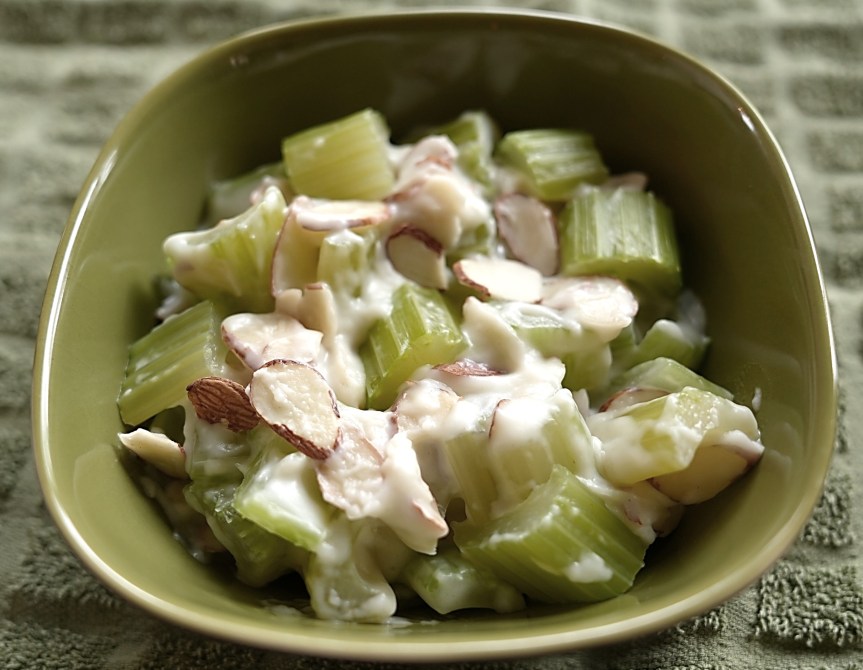
A hundred years ago, cooked celery was a commonly served vegetable. Today, not so much. But, when I saw I hundred year old recipe for Creamed Celery with Almonds, I decided to give it a try. The subtle sweetness of the celery was lovely, and sliced almonds added a bit of crunch. I feel certain that I’ll make this recipe again. Making this side dish reminded me how much I enjoy this tasty and nutritious vegetable.
Here’s the recipe updated for modern cooks:
Source: The Home Makers’ Cooking School Cook Book
I used half milk and half celery stock when I made this recipe. This made the sauce lighter and more flavorful.
1 cup celery stock (Reserve 1 cup of the liquid that the celery was boiled in.)
1/3 cup almonds, sliced
Put the sliced celery in a saucepan; barely cover with water. Bring to a boil using high heat, then reduce heat and simmer until the celery is tender (about 10 minutes). Remove from heat and drain, reserving 1 cup of the liquid.
In the meantime, melt butter in another saucepan, then stir in the flour, salt, and pepper. Gradually, add the milk and celery stock while stirring constantly. Continue stirring until the white sauce begins to thicken. Stir in the cooked celery and the almonds.
I love browsing through hundred-year-old cookbooks and selecting recipes to make for this blog. Generally I choose recipes that I think I will enjoy. But, old cookbooks also contain some recipes that seem very unusual and that I don’t think that I will like. I tend to ignore those recipes, but occasionally I’m intrigued enough to give one a try – while not having very high expectations. The recipe that I’m sharing this week is one of those times.
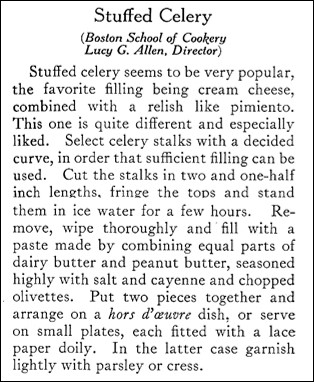
I made Stuffed Celery. The recipe called for “fringing” celery pieces with a knife, putting in ice water for several hours, and then stuffing and putting two pieces together and standing on a plate. What seemed really unusual was that the stuffing contained butter, peanut butter, salt, cayenne (red) pepper, and chopped olives. I couldn’t even begin to imagine what this mixture might taste like, but definitely had my doubts that I’d like it.
The verdict: The Stuffed Celery looked very dramatic, though some of the pieces didn’t want to stay together or stand for very long. The stuffing mixture actually tasted okay (not incredible, but it was not terrible). It was definitely a case where something tasted better than it sounds.
Here’s the original recipe:
Source: American Cookery (October, 1924)
I’m not sure what olivettes are, but I interpreted it to mean olives. When I made this recipe I used stuffed green olives that I finely chopped.
2 tablespoons stuffed green olives, finely chopped
Select the large curved stalks of celery in the bunch, wash, and then cut into 2 1/2 inch pieces. (Save small stalks and pieces for use in other recipes.) Fringe the top of the celery by making vertical cuts close together in the top half of each piece of celery. Stand the fringed celery in ice water for 2-4 hours.
In the meantime put the butter, peanut butter, salt, and cayenne pepper in a small bowl; stir until thoroughly mixed. Add chopped olives and stir until evenly distributed.
After 2-4 hours remove celery pieces from the ice water and wipe dry. Fill the bottom portion of each piece of celery with the peanut butter mixture. Put two pieces together, and wipe with a paper towel to remove any excess peanut butter mixture, then stand on a plate. The bottom edges of the celery may be trimmed if needed to make them level so they will stand better.
I can remember eating gelatin salads that contained vegetables when I was a child, so was intrigued when I came across a hundred-year-old recipe for Combination Cabbage Salad. The salad actually is a gelatin salad that contains shredded cabbage, chopped celery, and chipped pimento. It is made using unflavored gelatin. The recipe only called for 1/2 cup of sugar, while calling for 1 cup vinegar and the juice of a lemon. The result was a salad that was very tart and tangy.
The recipe suggests serving the salad with whipped cream that has a little salad dressing stirred into it. I used Ceasar dressing. This added to the overall tartness of the salad.
This salad is very old-fashioned–and definitely very different from modern sweet, fruit-flavored, gelatin salads, but I enjoyed it. The salad was refreshingly tart on a hot summer day – though if I made it again I think that I’d skip the whipped cream topping. The whipped cream and salad dressing mixture amplified the sourness of this dish, and overwhelmed the other ingredients.
Here’s the original recipe:
Source: Larkin Housewives’ Cook Book (1923)
I skipped the suggestion to mold this gelatin salad in teacups, and went right to the suggestion to put it in a pan – though I actually used a square, flat baking dish.
This recipe required lots of interpretation on my part. I have no idea how much one-half package of Larkin Gelatin would be, so I added up all the liquids and estimated that this recipe calls for approximately 5 2/3 cups of liquid. My rule of thumb is to use one packet of unflavored gelatin for each 2 cups of liquid, so I used 3 packets. That worked well.
I don’t know how much 1/4 can of pimientos would be. I used 2 tablespoons of chopped pimento.
I put a little salad dressing in the whipped cream. I’m curious about what type of dressing the recipe author used. I used Ceasar dressing because I had it on hand – though that’s probably not very authentic when making a hundred-year-old recipe. If I made this recipe again, I skip the salad dressing (and probably would also skip the whipped cream).
Here’s the recipe updated for modern cooks:
Combination Cabbage Salad (Cabbage and Celery Gelatin)
2 teaspoons salad dressing (if desired) – I used Ceasar salad dressing, though think that a sweeter dressing might be better.)
Put 1/2 cup cold water in a bowl. Sprinkle the gelatin on top of the water, and let soak for 5 minutes.
Put 4 cups water, the sugar, and salt in a saucepan. Bring to a boil. Add the gelatin that has been soaked in water. Bring back to a boil while stirring constantly until the gelatin is dissolved. Remove from heat and stir in the vinegar and lemon juice. If needed, strain. Cool slightly, then stir in the cabbage, celery, and pimento. Mold or pour into a dish or bowl. (Use a fairly flat dish, if you plan to cut the gelatin into squares to serve. A 9″ X 9″ baking dish would work well.) Refrigerate until firm.
If desired, serve with whipped cream. Whip the cream until peaks form, then stir the salad dressing into the whipped cream. Put a dollop of the whipped cream on top of each serving.
It was more popular to serve celery as a stand-alone vegetable a hundred years ago than it is now. One way of serving it back then was to bread the celery, and then fry it.
When I made this recipe, I struggled to get the bread crumbs to stay on the celery – and the breading was very uneven – though it tasted fine.
Here’s the original recipe:
Source: General Welfare Guild Cook Book(Beaver Valley General Hospital, New Brighton, Pennsylvania, 1923)
I used paper towels instead of cheese cloth to dry the celery.
Wash celery and cut into 4-pieces; dry with paper towels. Sprinkle the celery pieces with salt, then dip in beaten eff, and then roll in the bread crumbs.
Heat 1-inch of fat in large skillet. Put the breaded celery in the heated fat, and fry until the breading is brown and the celery tender; remove from skillet and drain on paper towels.
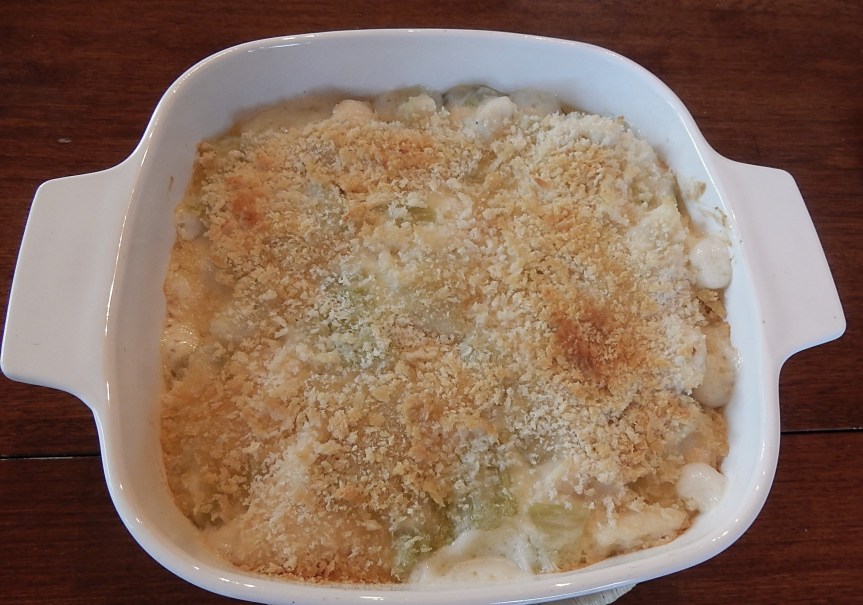
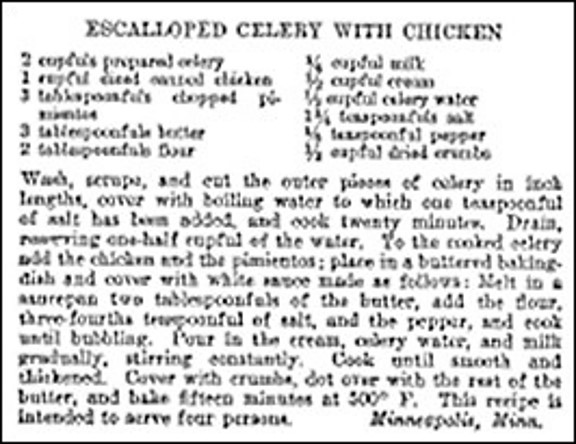
I don’t see many recipes for casseroles when browsing through hundred-year-old cookbooks. There are a few casserole recipes in 1922 cookbooks, but they didn’t become really popular until the mid-20th century. In any case, I was intrigued by a casserole recipe that I found in a hundred-year-old cookbook for Escalloped Celery with Chicken, and decided to give it a try.
Though I made this recipe from scratch, the Escalloped Celery with Chicken brought back vague memories of creamed chicken and celery dishes I ate as a child that were made using cream of celery soup. In any case, I enjoyed this dish. It was tasty and made a nice casserole.
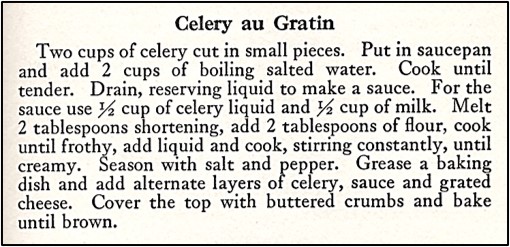
Here’s the original recipe:
Source: Good Housekeeping’s Book of Recipes and Household Discoveries (1922)
I used a little less salt than was called for in the original recipe. It called for boiling the celery in water with 1 teaspoon salt, plus an additional 3/4 teaspoon salt in the sauce. I decided that an additional 1/2 teaspoon would be plenty – and the recipe tasted fine. I also thought that 500° F. seemed very high – so I baked at 425° F. until the bread crumbs were lightly browned and it was hot and bubbly (about 15 minutes). The recipe says it serves four. In my opinion, if this is served as the main dish, that it is a little skimpy for four, so I listed it as 3-4.
1/2 cup celery water (reserved when celery is drained after cooking)
1/8 teaspoon pepper
1/2 cup fine dry plain bread crumbs
Put diced celery in a saucepan. cover with water and add 1 teaspoon salt. Bring to a boil using high heat, then reduce heat and simmer until the celery is tender (about 10-15 minutes). Drain and reserve 1/2 cup of the celery water.
In the meantime, preheat oven to 425° F. In a skillet, using medium heat, melt 2 tablespoons butter; then stir in the flour. Gradually, add the milk, cream, and celery water while stirring constantly. Continue stirring until the white sauce thickens. Stir in 1/2 teaspoon salt and the pepper. Add the cooked celery and diced chicken. and stir to combine. Put in a 1-quart baking dish. Sprinkle with the bread crumbs and using 1 tablespoon of butter, dot with small pieces of butter. Put in oven and bake until hot and bubbly, and the bread crumbs are lightly browned.
Preheat oven to 375° F. Put celery pieces, water and 1/2 teaspoon salt in a saucepan. Bring to a boil using high heat, then reduce heat and simmer until the celery is tender (about 10 minutes). Then remove from heat, and drain, reserving 1/2 cup of the liquid to use in the sauce. Set aside.
Melt 2 tablespoons butter in another saucepan, then stir in flour and dashes of salt and pepper. Gradually, add the milk and reserved celery liquid while stirring constantly; Continue heating and stirring using medium heat until the sauce thickens.
Put half the cooked celery in a 3-cup casserole dish; add 1/2 of the sauce, then top with 1/2 of the grated cheese. Repeat in same order. Set aside.
Melt 1 tablespoons butter in a small saucepan. Add the breadcrumbs and stir. Continue stirring until the breadcrumbs are crispy and light brown.
Sprinkle the buttered breadcrumbs on top of the layered celery. Put in oven and bake for approximately 20 minutes or until hot and bubbly.
I always enjoy Waldorf Salad, so was intrigued by recipe for Apple and Celery Salad in a hundred-year-old cookbook. It seemed very similar to Waldorf Salad – but with fewer ingredients (just apples and celery). I wondered, would I miss the nuts and raisins in the typical Waldorf Salad?
The verdict- Apple and Celery Salad was nice, but I prefer Waldorf Salad with the added crunchiness and sweetness of the nuts and raisins.
Here’s the original recipe:
Source: The New Cookery (1921) by Lenna Frances Cooper
I went with the mayonnaise option when I made this recipe, and I did not garnish with lettuce. (Exactly how do you garnish with lettuce?) I also did not peel the apples. To be totally honest, I somehow failed to notice that the apples were supposed to be peeled until I started writing this post. When I made this recipe, I was in a hurry and just glanced at the recipe, and thought that this would be an easy recipe because it was Waldorf Salad minus half the ingredients. I should have read it more carefully. The salad would be different (and less colorful) if the apples had been peeled.
And I also failed to notice that I was supposed to marinate the apple pieces in lemon juice – but we ate the salad soon after I made it, so the apples didn’t discolor. (I think that coating them with mayonnaise also slows discoloration).
I used just enough mayonnaise to coat the celery and apple pieces (about 1/2 – 2/3 cup). I previously made the Golden Salad Dressing recipe that is listed in this recipe when I made another recipe from this cookbook: Pineapple and Strawberry Salad with Golden Dressing. Golden Salad Dressing recipe can be found in that post.
I’m now realizing that I barely made the original recipe for Apple and Celery Salad – and am fascinated that I somehow failed to do so many things quite right with such a simple recipe. I guess it’s a lesson learned about carefully reading directions even for the easiest recipes. That said, the recipe turned out well, so the updated recipe for modern cooks is based on how I made it..