Old-Fashioned Orange Bread and Muffins (Orange Marmalade Bread/Muffins)

It’s fun to bring treats to meetings and gatherings with friends. I enjoy making new “old” recipes, and attendees are captive audiences for testing the foods I make. One day last week I needed to make snacks for a coffee group in the morning, and for the November meeting of the garden club in the evening. I found a hundred-year-old recipe for Orange Bread that sounded very flexible. The recipe said that the bread could be baked in a round pan (and implicitly it suggested that the bread could also be baked in the typical rectangular pans), and that the bread mixture could be put in muffin pans. It called for using orange marmalade to provide the sweetness and the orange flavor.

I made this recipe three times. Once to see how Orange Bread turned out (it was excellent); and, two more times to get enough bread and muffins for the coffee group and garden club meeting. Since the recipe said it could be made in a variety of ways, I made a round loaf, small rectangular loaves, regular-sized muffins, and small muffins.Orange Bread on plate
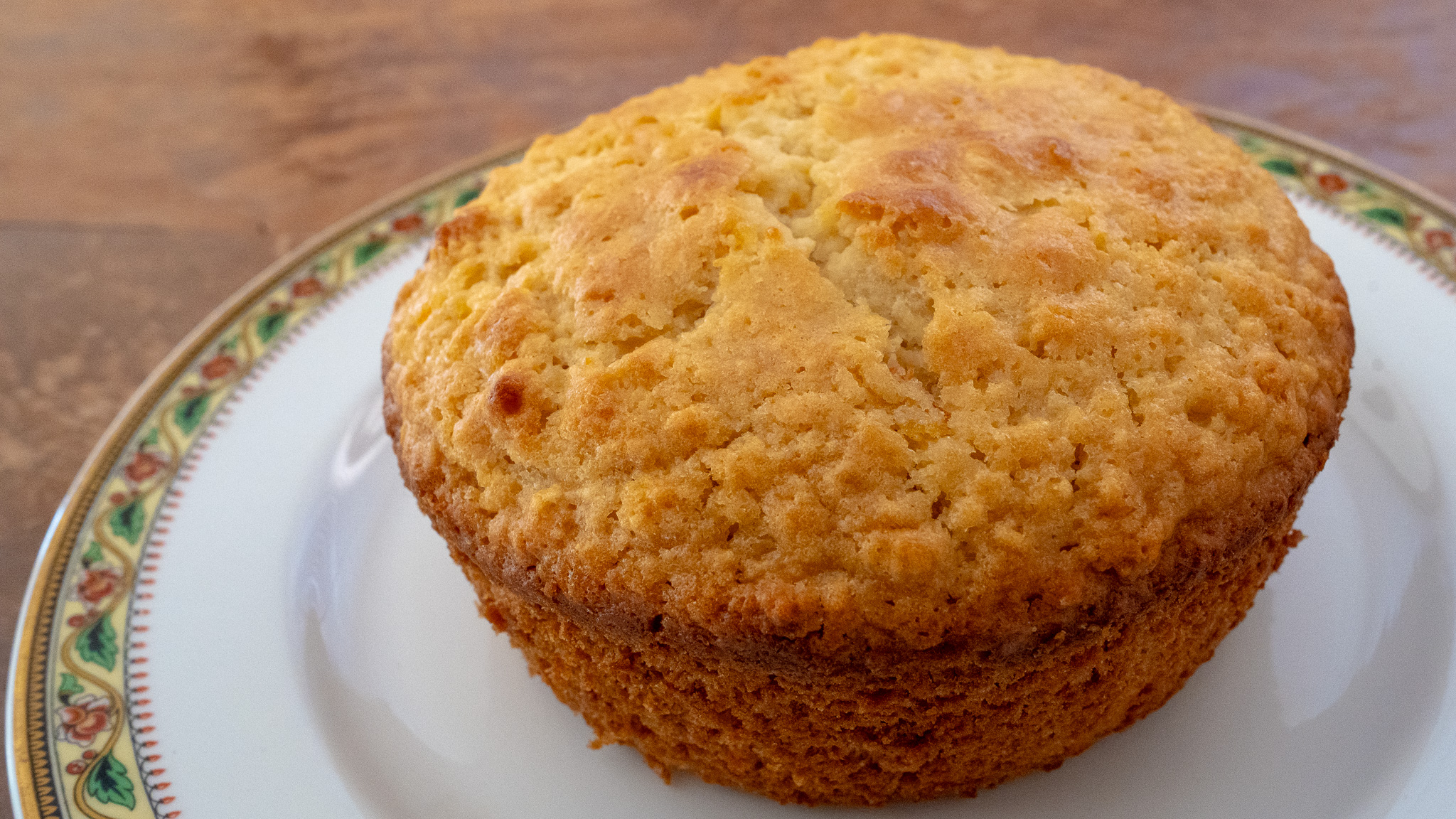
The Orange Bread and Muffins were easy to make. The muffins had a slightly denser texture than the bread. They all had a lovely, sunny citrus flavor. The bread (or in one case, muffins) went quickly at the events, and I received lots of compliments.

My husband and I are having some other friends over to the house for coffee next week. I may make the Orange Bread or Muffins again for them (or I may flip through my hundred-year-old cookbooks a little more and find a different recipe to try for them).

Here’s the original recipe:
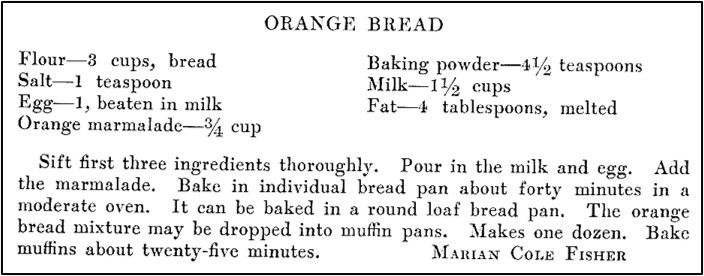
Recipe for Orange Bread/Muffins
Source: Diamond Jubilee Recipes compiled by The Sisters of St. Joseph, St. Paul, MN

I used butter for the fat in this recipe. The recipe calls for 4 tablespoons of melted fat. That is the equivalent of 1/4 cup, so I updated the recipe to say 1/4 cup since it is easier to measure.

The bread and muffins are tasty when they are made following the original recipe directions, but are a little less sweet than many modern quick breads. When I updated the recipe, I included an option of adding 1/4 cup sugar. With added sugar, the degree of sweetness is similar to many modern quick bread recipes.

Here’s the recipe updated for modern cooks:

Orange Bread/Muffins (Orange Marmalade Bread/Muffins

  • Difficulty: moderate
  • Print

This recipe makes 1 large loaf, 3 small loaves, approximately 12 regular muffins, or approximately 36 mini-muffins.

3 cups bread flour

4 1/2 teaspoons baking powder

1 teaspoon salt

1 egg

1 1/2 cups milk

1/4 cup sugar (optional)

1/4 cup melted butter

3/4 cup orange marmalade

Step 1. Preheat oven to 350° F.

Step 2. Sift the flour, baking powder, and salt into a mixing bowl.

Step 3. In another bowl, beat the egg and stir in the milk.

Step 4. Slowly add the milk and egg mixture to the flour mixture. Add about a quarter of the liquid at a time, and stir between each addition of liquid.

Step 5. If desired, stir in the sugar. Then stir in the melted butter, and finally stir in the orange marmalade.

Step 6. Put into prepared bread pans or muffin tins. Bake a large bread loaf for approximately 40 minutes, small loaves for approximately 30 minutes, and muffins for 15 – 20 minutes, or until lightly browned and a wooden pick comes out clean.
http://www.ahundredyearsago.com

Old-Fashioned Mock Nut Bread (Grape Nuts Bread)

A 1925 recipe supplement in a Sioux Falls, South Dakota newspaper contained a recipe for Mock Nut Bread. Intrigued, I decided to give it a try. The “mock nuts” were Grape Nut cereal nuggets.

Grape Nuts is fiber rich, has a crunchy texture, and contains whole wheat and malted barley flour. It has been around for more than 125 years. Originally developed as a health food, Grape Nuts has a long-fascinating history. In 1933, Grape Nuts sponsored Admiral Byrd’s expedition to Antarctica. During World War II, the rations of some troops included Grape Nuts. And, the first individuals to reach the summit of Mount Everest, Sir Edmund Hillary and Sherpa Tenzing Norgay, brought Grape Nuts with them when they climbed the mountain.

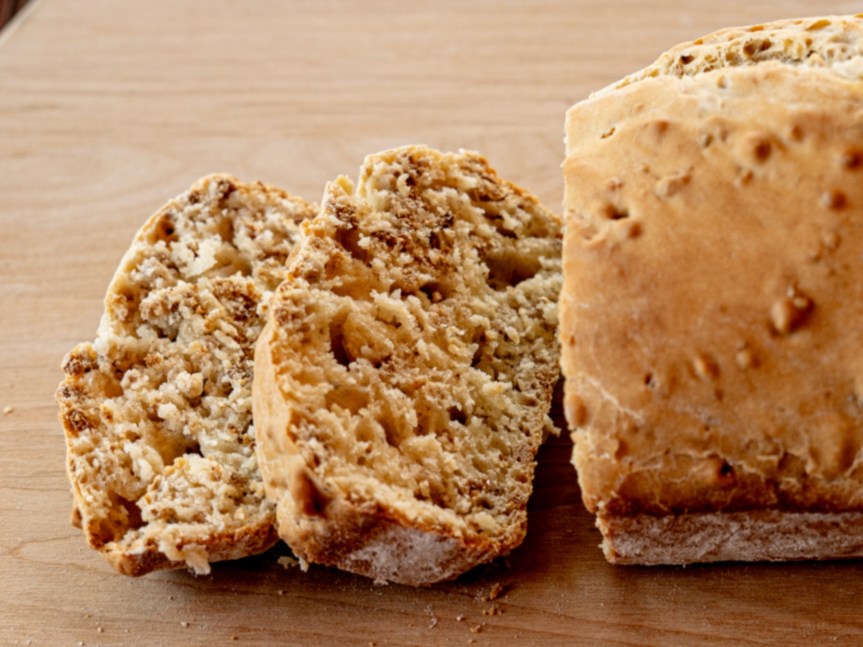
This recipe made a lovely, hearty quick bread. I especially enjoyed eating warm Mock Nut Bread when topped with some of the Pear Honey I recently made.

I liked Mock Nut Bread, but was disappointed that it did not have a nut bread texture or taste. The Grape Nut nuggets soften during baking, and the bread is not crunchy. I also was a little disappointed that the bread was not especially attractive. The Grape Nut nuggets make the top of the bread loaves look lumpy, but maybe that is part of its rustic appeal.

Here’s the original recipe:

Recipe for Mock Nut Bread
Source – Home Economics and Cook Book: The Daily Argus-Leader (Sioux Falls, South Dakota), Supplement – March 13, 1925

The recipe says to mold into loaves. This recipe did not make a dough thick enough to mold; instead it makes a thick batter that can be poured into the pans.

The original recipe called for adding the flour and baking powder prior to adding the Grape Nuts. I reversed the order when I updated the recipe. It is difficult to fully incorporate the flour and baking powder into the batter after the Grape Nut cereal has been added.

The recipe also says to bake the bread in two “small” bread pans. This does not refer to the small personal-sized bread pans that are available today, but rather to what I call “regular-sized” bread pans (8 1/2 ” X 4 1/2″ X 2 1/2 inches).

Here’s the recipe updated for modern cooks:

Mock Nut Bread (Grape Nuts Bread)

  • Servings: 10 - 12
  • Difficulty: easy
  • Print

Slice of Mock Nut Bread

1 egg

2 tablespoons brown sugar

1 teaspoon salt

2 cups milk

4 teaspoons baking powder

4 cups flour

1 cup Grape Nuts cereal

Preheat oven to 350° F.  Put the egg, brown sugar, salt, and milk in a mixing bowl; beat until combined. Add baking powder and flour; beat until thoroughly mixed. (The batter will be very thick.) Add the Grape Nuts; stir until they are evenly distributed throughout the batter. Pour into 2 prepared regular (not large) bread pans (8 1/2″ X 4 1/2″ X  2 1/2″). Bake for 40 minutes or until a wooden pick inserted in the center comes out clean. Partially cool, then remove from pans.

http://www.ahundredyearsago.com

Old-Fashioned Oatmeal Sticks

oatmeal sticks

When I was recently browsing through the recipes in a hundred-year-old cookbook I saw a recipe for Oatmeal Sticks and was intrigued. Breadsticks are a nice addition to a meal, and I thought that Oatmeal Sticks might be a nice change of pace. When I read the recipe, I was surprised that flour was the main ingredient and that the recipe called for a relatively small amount of oatmeal, but decided to proceed anyway and give it a try. Many breadstick recipes call for yeast, while this recipe was in a cookbook published by the Rumford Baking Powder Company so it called for the use of baking powder.

The Oatmeal Sticks were very rustic and had an artisan look. They were tasty but denser than the typical breadstick and had the texture of a quick bread. I could not tell that the baked Oatmeal Sticks actually contained oatmeal, though it may have contributed to the texture.

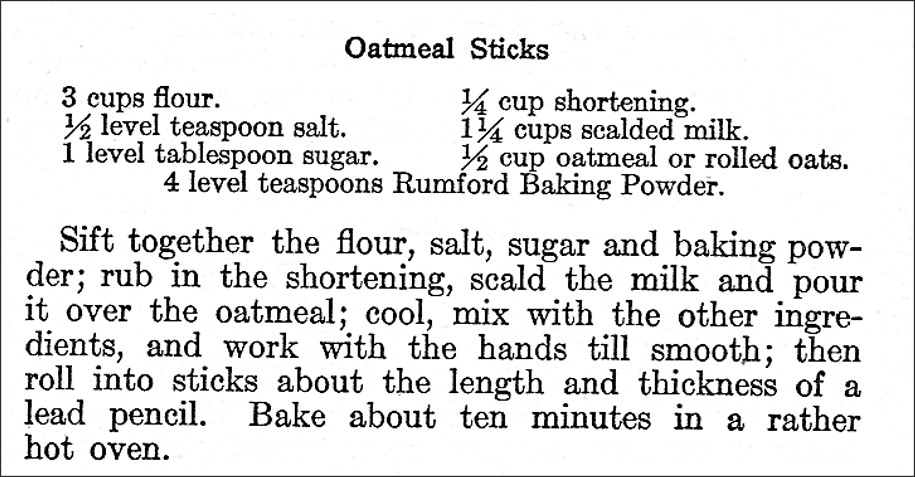
Here’s the original recipe:

Recipe for Oatmeal Sticks
Source: Rumford Complete Cook Book (1925)

It took me substantive time to shape the Oatmeal Sticks, and even though I tried to do it very carefully, they were not as smooth as the typical bread stick (which I will again attribute to the use of baking powder rather than yeast).

Here’s the recipe updated for modern cooks:

Oatmeal Sticks

  • Servings: approximately 18 sticks
  • Difficulty: moderate
  • Print

1 1/4 cups milk

1/2 cup oatmeal (I used quick 1-minute oatmeal.)

3 cups flour

1/2 teaspoon salt

1 tablespoon sugar

4 teaspoons baking powder

1/4 cup shortening

Preheat oven to 425◦ F.  Using medium heat, bring milk to a boil, then stir in the oatmeal and turn off heat.

In the meantime, in a mixing bowl combine the flour, salt, sugar, and baking powder, then cut in the shortening. Add the cooked oatmeal and mix until all the ingredients are combined, then put on a prepared surface and knead for a few minutes until the mixture is smooth. Roll into sticks about the length and diameter of a pencil. Place on baking sheets (space about 1 1/2 inches apart). Cover dough that has not yet been made into sticks as well as the sticks that have been shaped while working to prevent them from drying out. Put in oven and bake until lightly browned (about 10 minutes).

http://www.ahundredyearsago.com

Old-Fashioned Date and Nut Bread

Date and Nut Bread

Summer is coming to an end, and students are back in school.  I did a post several weeks ago for the back-to-school season on suggestions in a hundred-year-old year old cookbook for packed lunches.  Date and nut sandwiches were one suggestion. A reader commented, “Date/nut bread with creamy cream cheese… um.”

I’d never had Date and Nut Bread, so the next thing I knew, I was searching through my hundred-year-old cookbooks to see if I could find any recipes for Date and Nut Bread. Happily, I found a recipe, and made it yesterday.

The Date and Nut Bread was moist, and chock full of dates and pecans. Now that I’ve eaten Date and Nut Bread, I can state with confidence that I agree with the reader, “Date/nut bread with creamy cream cheese… um.” It would be lovely in a packed lunch.

Date and Nut Bread

Here’s the original recipe:

Recipe for Date and Nut Bread
Source: Cook Book of the Susquehanna Valley Country Club, Sunbury, PA (1924)

I interpreted “hot wheat breakfast cereal” as cream of wheat. I was surprised that it was listed as an ingredient in the recipe, but it worked fine.

When, I made the recipe, I substituted a packet of dry yeast for the yeast cake.

Here’s the recipe updated for modern cooks:

Date and Nut Bread

  • Servings: 2 loaves
  • Difficulty: moderate
  • Print

2 cups of hot cream of wheat cereal (prepare the cereal following package direction)

1/2 cup brown sugar

1 teaspoon salt

1 1/2 cups dates, chopped

1 1/2 cups pecans, chopped

2 tablespoons butter

1 packet active dry yeast

1/2 cup lukewarm milk (105 – 115° F.)

approximately 5 cups bread flour

In a large bowl mix together the hot cream of wheat cereal, brown sugar, salt, dates, and pecans. Allow to partially cool for a few minutes.

In a small bowl, dissolve the yeast in the lukewarm milk. When the cereal mixture is lukewarm (105-115° F.), add the dissolved yeast and stir to combine. Add half of the flour and stir to combine, then gradually add the remaining flour until the dough reaches a consistency where it can be handled. Turn onto a floured surface and knead until the dough is smooth and elastic (about 10 minutes). Put in a large greased bowl, cover and place in a warm spot that is free from drafts until doubled in size (about 1 1/2 hours).

Punch dough down, then divide dough into two equal parts and shape into loaves. Place in two greased loaf pans, and cover. Let rise until doubled in size (about 1 hour).

Bake loaves in 375° F. oven for 35 -45 minutes or until lightly browned.

http://www.ahundredyearsago.com

Old-Fashioned Raisin Bread

Raisin Bread

When browsing through hundred-year-old cookbooks, I often skip the yeast bread section while thinking that breadmaking is too much work and too time consuming. But I recently had a little spare time – and thought that it might be relaxing to make bread – so I looked at the old bread recipes. The one that piqued my interest was a recipe for Raisin Bread. It had been year since I’d eaten Raisin Bread – and suddenly I was very hungry for it. (I know that I can buy it at the store, but I never do.)

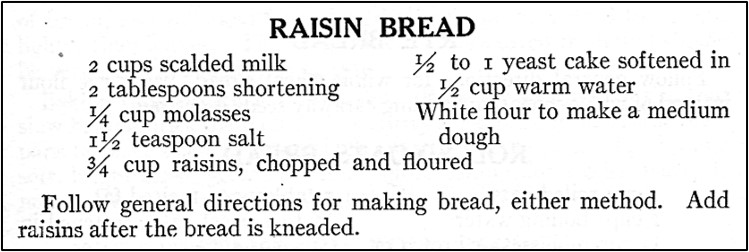
Here’s the original recipe:

Recipe for Raisin Bread
Source: The New Butterick Cook Book, 1924

Sounds easy peasy. Right?

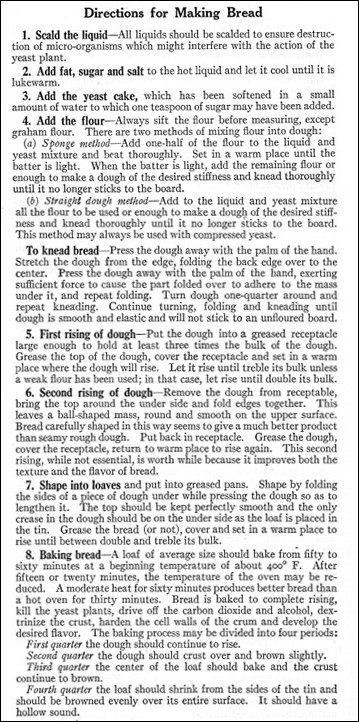
Next I found the general directions for making bread, as well as the directions for making white bread, and realized it was a little more complicated than I originally thought. Here are the general directions in the 1924 cookbook for making bread:

directions for making bread
Source: The New Butterick Cookbook (1924)

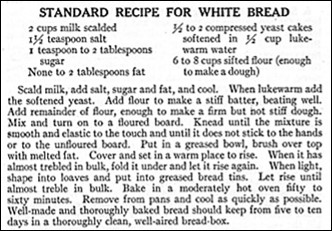
And, here is the “standard recipe for making white bread” that was in that cookbook:

Recipe for white bread
Source: The New Butterick Cook Book, 1924

After reading all of these directions, I realized that this bread recipe is different from most other bread recipes that I’ve made. It called for allowing the bread to rise three times (rather than two times like I typically do), and instead of kneading the bread the second time, the directions called for folding the dough under. Also, the recipe indicated that the dough should be allowed to “almost treble” for the first and third times the dough was allowed to rise, while the second time, the dough should be allowed to rise until it was “light.”

My head was starting to spin, so I did several online searches, and discovered that bread dough can be allowed to rise three times (though there is a risk of the bread collapsing during baking if it is allowed to rise too much) – but that stretching and folding bread dough instead of kneading it the second time is gentler on the dough, so it reduces the risk of the bread collapsing. The online searches also indicated that folding the bread dough and allowing it to rise three times had the potential to improve the texture.

Since yeast cakes a hundred years ago, aren’t the same as modern dried yeast, I did another online search and determined that a yeast cake was about the same as a packet of dry active yeast. I used a packet of yeast when making this recipe.

As indicated in the old directions, I started baking the bread in a 400° F. oven. After 15 minutes, I reduced the heat to 350° F. After baking an additional 25 minutes (for a total of 40 minutes), the bread was nicely brown and sounded hollow when I tapped it, so I removed it from the oven. (I didn’t bake if for the 50 to 60 minutes called for in the old directions.)

Onward–

The verdict: This recipe was worth the effort. The Raisin Bread turned out great. It was tasty and had a lovely texture. It should be noted that most modern Raisin Breads contain cinnamon, but that this recipe didn’t call for any – so it tastes a little different than modern Raisin Breads. That said, this Raisin Bread is lovely warm, spread with butter, and sprinkled with cinnamon.

Here’s the recipe updated for modern cooks:

Raisin Bread

  • Servings: 2 loaves
  • Difficulty: moderate
  • Print

2 cups milk

2 tablespoons shortening

1/4 cup molasses

1 1/2 teaspoon salt

1 packet dry active yeast

1/2 cup warm water

6 to 8 cups flour

3/4 cup raisins

Scald the milk by heating to just below boiling (about 180 – 185° F.). Remove from heat and add shortening, molasses, and salt. Allow to cool until lukewarm.

In the meantime, chop the raisins (I cut each raisin into 3 – 4 pieces.). Then dredge the raisin pieces with approximately 1-2 tablespoons flour and gently stir to coat the pieces with flour. Set aside.

In the meantime, dissolve the yeast in the warm water. Combine the dissolved yeast, and lukewarm scalded milk mixture in a large bowl. Add half the flour; beat until smooth beat. Then add additional flour until the dough reaches a consistency where it can be handled. Turn onto a floured surface and knead until the dough is smooth and elastic (about 10 minutes). Flatten the dough and sprinkle about one-fourth of the chopped raisins on top; then fold over and knead a little more to incorporate the raisins. Repeat until all the raisins are embedded in the dough. Put in a large greased bowl,  and grease the top of the dough. Cover and place in a warm spot that is free from drafts until it has almost tripled in size (about 1 1/2 hours).

Fold the dough by pulling each side of dough to stretch it, and then fold underneath the other dough. Cover and allow to rise until light (about 30 minutes).  Divide dough into two equal parts and shape into loaves. Place in two greased loaf pans, and cover. Let rise until tripled in size (about 1 hour).

Bake loaves in 400° F. oven for 15 minutes, then reduce heat to 350° F and continue baking until lightly browned (about an additional 25 minutes for a total of about 40 minutes).

http://www.ahundredyearsago.com

Old-Fashioned Luncheon Caraway Bread

Luncheon Caraway Bread

I recently came across a hundred-year-old recipe for Luncheon Caraway Bread, and decided to give it a try. It is a white quick bread with caraway seeds. This tasty, easy-to-make bread was flavorful and slightly sweet.

Here’s the original recipe:

Recipe for Luncheon Caraway Bread
Source: The Boston Cooking School Cook Book (1923)

Here’s the recipe updated for modern cooks:

Luncheon Caraway Bread

  • Servings: 6-8
  • Difficulty: moderate
  • Print

1/4 cup butter, softened

3/4 cup sugar

1 egg

3/4 cup milk

3 teaspoons baking powder

1/4 teaspoon salt

3/4 teaspoon vanilla

1 2/3 cups flour

3 teaspoons caraway seeds

Preheat oven to 400° F.  Put butter in a mixing bowl, cream with the sugar. Add the egg and milk; stir. Stir in the baking powder, salt, and vanilla. Add flour and stir until mixed. Add caraway seeds, and stir. Put into prepared bread pan or 8″ X 8″ pan. Put in the oven and bake for 35 -45 minutes or until lightly browned. Serve warm.

http://www.ahundredyears.com

Old-fashioned Bacon Muffins

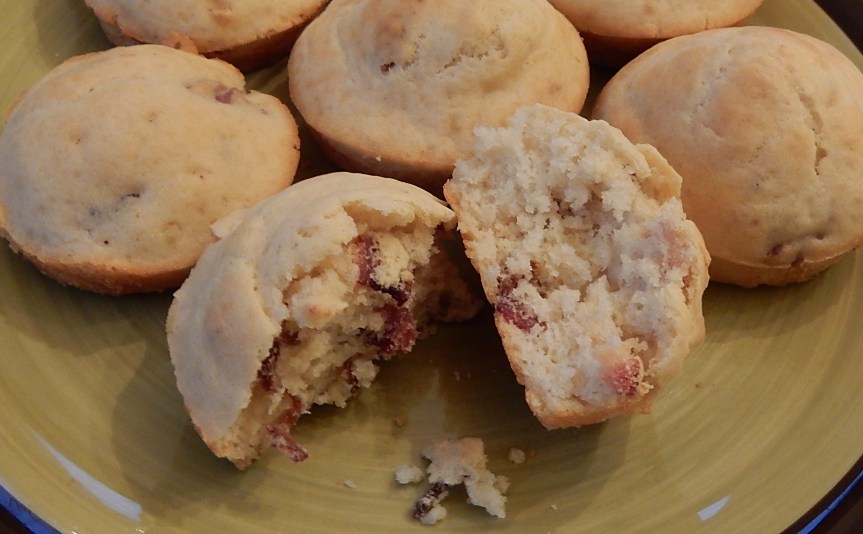
Bacon Muffins on plate

When browsing through hundred-year-old cookbooks I sometimes come across recipes that are different modern recipes, yet sound intriguing. This was one of those times. I found an old recipe for Bacon Muffins which sounded a bit unusual – yet similar enough to some modern foods (think bacon and egg muffins minus the eggs) that I decided to give it a try.

The recipe turned out well. The muffins are a nice way to add variety to a breakfast or brunch menu.

Here’s the original recipe:

Recipe for Bacon Muffins
Source: Good Housekeeping’s Book of Menus, Recipes, and Household Discoveries (1922)

The bacon that I used was salty, so I didn’t add any additional salt when I made this recipe.

Here is the recipe updated for modern cooks:

Bacon Muffins

  • Servings: approximately 15-20 muffins
  • Difficulty: moderate
  • Print

1/4 pound bacon

1 tablespoon sugar

1 egg, beaten

1/12 cups milk

2 1/2 cups bread flour

5 teaspoons baking powder

Preheat oven to 400° F. Chop bacon into small pieces; put into a small skillet and fly until crisp. Drain the bacon fat; reserving 2 tablespoons of the fat (as well as the bacon pieces).

Put the sugar and 2 tablespoons bacon fat in a mixing bowl and stir to combine, then add the egg and milk and stir until mixed. Stir together the flour and the baking powder, then add to the mixture in the mixing bowl; stir to combine. Then fold in the bacon pieces. Pour into greased muffin pans. Fill each muffin cup about 2/3 full. Put in oven and bake about 25 minutes or until lightly browned. Best when served warm.

http://www.ahundredyearsago.com