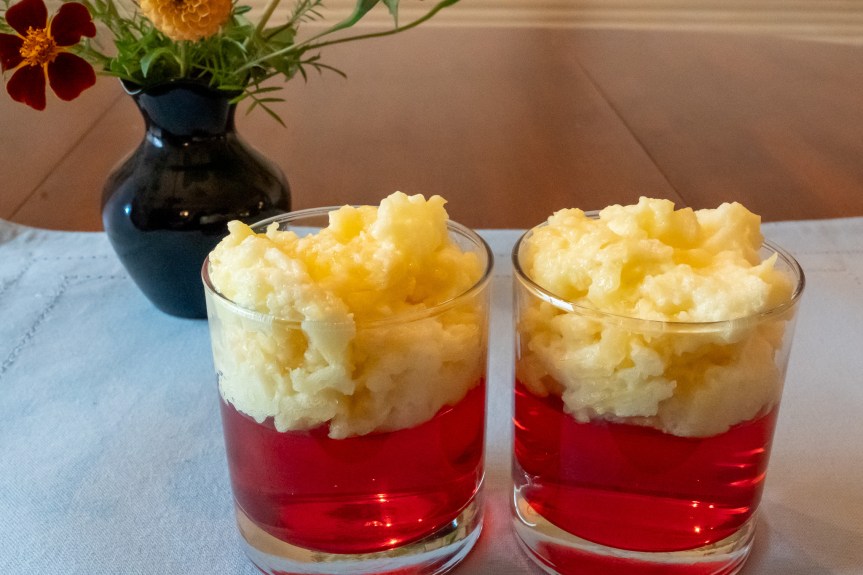
Old-Fashioned Apple Snow Gelatin

Both today and a hundred years ago, some tasty recipes are embedded in advertisements. Food companies hoped to sell more of the advertised ingredient, and they carefully tested recipes before including them in an advertisement. I recently saw a Jell-O advertisement in a 1925 magazine that included a recipe for Apple Snow Jell-O (Gelatin), and decided to give it a try.

Apple Snow Gelatin contains strawberry gelatin topped with whipped lemon gelatin that is embedded with very small pieces of grated apple. It is refreshing with prominent notes of citrus in the foamy “snow” topping, but had almost no apple flavor (which was unexpected since the recipe title refers to “apple snow”). The grated apple pieces do create a slightly chewy texture. The recipe is fun and easy to make.

Here’s the original recipe:Apple Snow Gelatin

Recipe for Apple Snow Jello
Source: Jell-O advertisement in American Cookery (March 1925)

The recipe does not call for putting any lemon juice on the grated apples to avoid discoloration, but I was concerned about potential discoloration, so I used a little lemon juice. I stirred the lemon juice and sugar into the grated apples, then let them sit for a few minutes while I whipped the lemon gelatin. I then drained the grated apple mixture before adding to the whipped gelatin.

Here’s the recipe updated for modern cooks:

Apple Snow Gelatin

  • Servings: 4 - 6
  • Difficulty: easy
  • Print

1 3-ounce box of strawberry gelatin

1/2 3-ounce box of lemon gelatin (Use other half of the box to make another recipe or plain lemon gelatin.)

2 cups boiling water + 1 cup boiling water

1 medium apple

4 tablespoons sugar

1 teaspoon lemon juice

Step 1. Put strawberry gelatin into a bowl, then add 2 cups boiling water. Stir until the gelatin is dissolved. Let cool slightly then fill small dessert serving glasses 3/4 full with the liquid. (The number of glasses needed will vary depending upon their size. Refrigerate at least 3 hours or until the gelatin is set.

Step 2. In the meantime, put lemon gelatin int0 a bowl, then add 2 cups boiling water. Stir until the gelatin is dissolved. Pour into a mixing bowl. Refrigerate until the gelatin is just beginning to thicken (about 1 – 1 1/2 hours).

Step 3. Wait until the gelatin is cool and just barely beginning to thicken, then peel and core the apple. Grate the apple. (I used a box grater.) Put the grated apple, sugar, and lemon juice in a small bowl, and stir to mix the ingredients. Set aside.

Step 4. Beat the lemon gelatin that is beginning to thicken with electric beaters until the gelatin is very foamy.

Step 5. Drain the grated apple mixture using a strainer. Gently press the grated apples to remove any additional liquid. Then gradually add the grated apples to the whipped lemon gelatin. The grated apples have a tendency to clump, so just put a small amount into the whipped gelatin at a time, and stir before adding more. If there are still clumps of grated apple in the gelatin, beat the gelatin for just a couple seconds to evenly disperse. (If there is a need to beat to disperse clumps of grated apple, take care not to beat more than a few seconds or the grated apples will be pulverized and lose their texture.) Refrigerate the whipped gelatin with grated apples until set (at least an additional 2 hours).

Step 6. To serve: Scoop some of the whipped lemon gelatin mixture on top of the strawberry gelatin.
http://www.ahundredyearsago.com

Old-Fashioned Apple Griddle Cakes

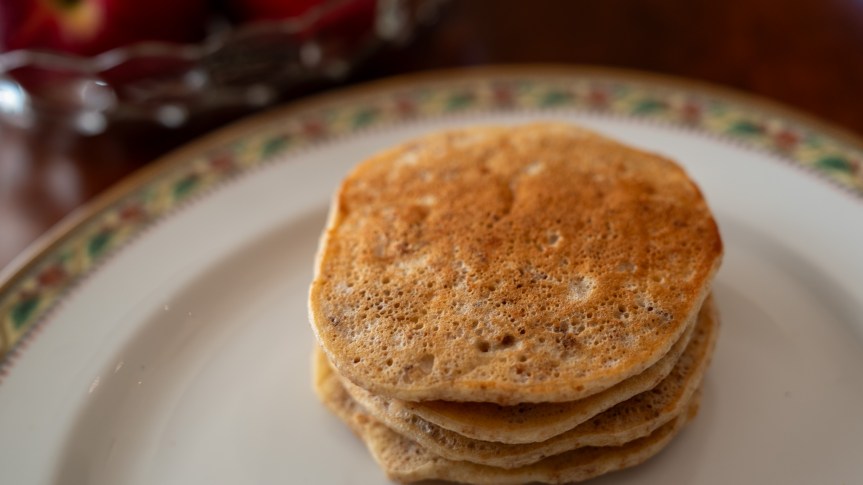
Fall is in the air. The trees are turning color, and the nights are getting nippier – and it’s apple season. Apples are so versatile. Biting into a fresh juicy apple is a treat, and they can be used to make tasty salads, side dishes, and desserts. When browsing through a hundred-year-old magazine I came across a recipe for Apple Griddle Cakes and decided to give it a try.

My sense is that griddle cakes and pancakes are interchangeable terms. There may be regional variation regarding which is used.

The Apple Griddle Cakes were delectable. They were light and almost airy with sweet and chewy bits of apple. I started to write that the griddle cakes were light and fluffy, but then I realized that many recipes state that the recipe makes “light and fluffy” griddle cakes. This recipe is different from most because it calls for separating the eggs, beating the egg whites, and then folding them into the griddle cake batter. Most modern recipes just call for adding the entire egg with all the other ingredients.

Most apple recipes today call for cinnamon; however, the old recipe did not call for using any. This allowed the natural sweet and tangy flavor of the apples to be more prominent in the griddle cakes.

Another difference between this recipe and other griddle cake recipes is that it calls for small pieces of torn bread (bread crumbs) that have been soaked in milk. A hundred years ago, cooks didn’t want to waste food, and this recipe was a way to use stale bread (or bread crusts).

Here is the original recipe:

apple griddles cakes on plate
Source: Ladies Home Journal (November, 1925)
recipe for Apple Griddle Cakes
Source: Ladies Home Journal (November, 1925)

This recipe was included in an advertisement for Crisco. (Yes, Crisco has been around for more than a hundred years, though the ingredients have been tweaked several times over the years.). When I updated the recipe, I used melted butter instead of the Crisco.

A hundred years ago, this recipe probably was a good way to use stale bread that was very dry and firm, so the bread crumbs may have needed to soak overnight to soften. However, I decided to use some whole wheat bread that I recently purchased. I just tore up several slices of the bread and soaked it in the milk. It did not take more than a few minutes for the bread to become mushy. I did not heat the milk. After the bread softened, I just used electric beaters to turn it into a paste.

One large apple made approximately one cup of chopped apples.

Here’s the recipe updated for modern cooks:

Apple Griddle Cakes

  • Servings: 4 - 5
  • Difficulty: moderate
  • Print
apple griddle cakes on plate

2 cups bread, torn into small pieces

2 cups milk

2 eggs, separated

1 tablespoon butter, melted

1 tablespoon sugar

1/2 teaspoon salt

2 teaspoons baking powder

1 cup flour

1 cup chopped apples (1 large apple)

Put the bread crumbs into a bowl and pour the milk over them. Let the bread soak until it is soft and mushy. This will only take a few minutes in many cases; it may take up to several hours if the bread is extremely stale and dry.)

In the meantime, put the egg whites in a bowl and beat until stiff peaks form. Set aside.

Once the bread crumbs have softened, beat the bread and milk mixture with electric beaters to make a paste. Add the egg yolks, butter,  sugar, salt, and flour; beat until thoroughly mixed. Gently fold in the beaten egg whites; then, using a fork, stir in the chopped apples.

Heat a lightly greased griddle or skillet to a medium temperature, then pour or scoop the batter onto the hot surface to make individual pancakes.  Cook until the top surface is hot and bubbly, and then flip and cook other side.

http://www.ahundredyearsago.com

Old-fashioned Apple Pudding

Apple Pudding

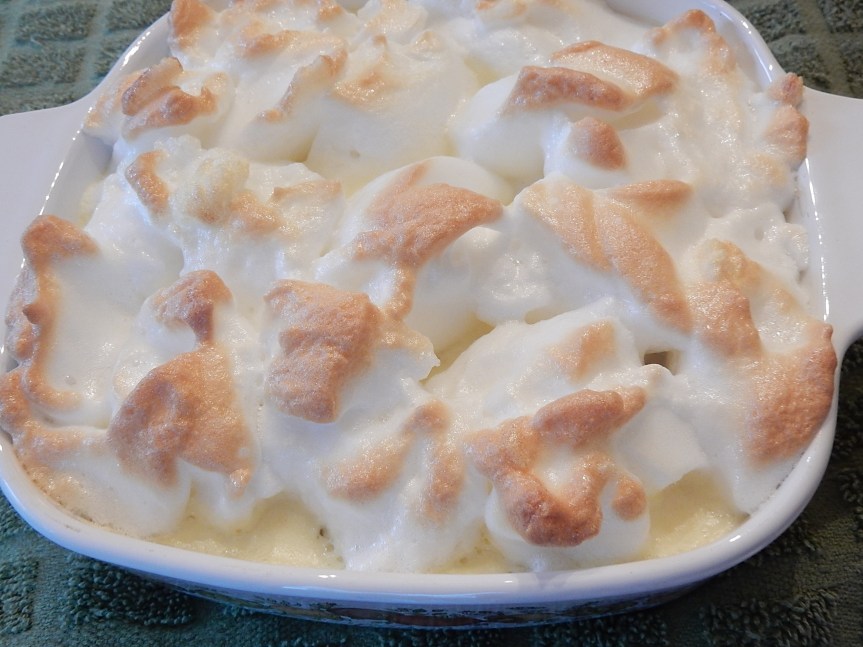
Fall is in the air, and it’s apple season. I found a recipe for Apple Custard in a hundred-year-old cookbook, and decided to give it a try. The Apple Pudding is made by putting stewed apples in a casserole dish, adding a lovely custard, and then topping with meringue.

This recipe is different from most modern recipes for apple desserts because it uses no cinnamon or other spices, and it calls for very little sugar (only 4 tablespoons). The result is a tasty, yet delicate dessert.

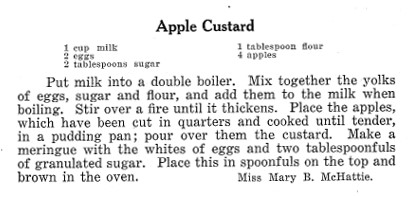
Here’s the original recipe:

Apple Pudding Recipe
Source: General Welfare Guild Cook Book (Beaver Valley General Hospital, New Brighton, Pennsylvania, 1923)

Apples vary a lot  in size. Apples often were smaller a hundred years ago then they are today, so I interpreted the 4 apples called for in the recipe as approximately 2 cups of peeled, cored, and quartered apples.

Here’s the recipe updated for modern cooks:

Apple Pudding

  • Servings: 3 - 5
  • Difficulty: moderate
  • Print

Apple Pudding

4 apples (approximately 2 cups, peeled and quartered apples)

water

1 cup milk

2 eggs, separated

2 tablespoons sugar + 2 tablespoons sugar

1 tablespoon flour

Peel apples, remove cores, and cut into quarters. Place them in a saucepan and add a little water to prevent scorching until the apples begin to soften.  Bring to a boil using medium heat and then reduce heat. Continue to simmer gently until the apples are soft (approximately 10-15 minutes). Remove from heat and set aside.

Put egg yolks, 2 tablespoons sugar, and flour in a small bowl. Stir to combine then set aside.

In the meantime, put the milk in another saucepan. Bring to a boil using medium heat, while stirring frequently.

Place a small amount (approximately 1 – 2 tablespoons) of hot milk into the bowl containing the egg, sugar and flour mixture; then add the mixture to the hot milk. Stir quickly. (The egg is first combined with a little of the hot mixture to prevent it from turning into scrambled eggs when introduced into the milk.) Continue heating using medium heat, while stirring constantly, until the mixture thickens into a custard. Remove from heat.

Preheat oven to 400° F. Put the cooked apples in a casserole dish. (I used a 1-quart dish, which was quite full; an 8-inch square pan would also work.) Pour the custard over the apples.

Place egg whites in a bowl, and beat the egg whites until they form stiff peaks. Gradually add 2 tablespoons sugar while continuing to beat. Then spoon on top of the custard and swirl. Put in oven for 10 minutes or until the meringue is lightly browned.

http://www.ahundredyearsago.com

Old-fashioned Cranberry Applesauce

Cranberry Applesauce in bowl

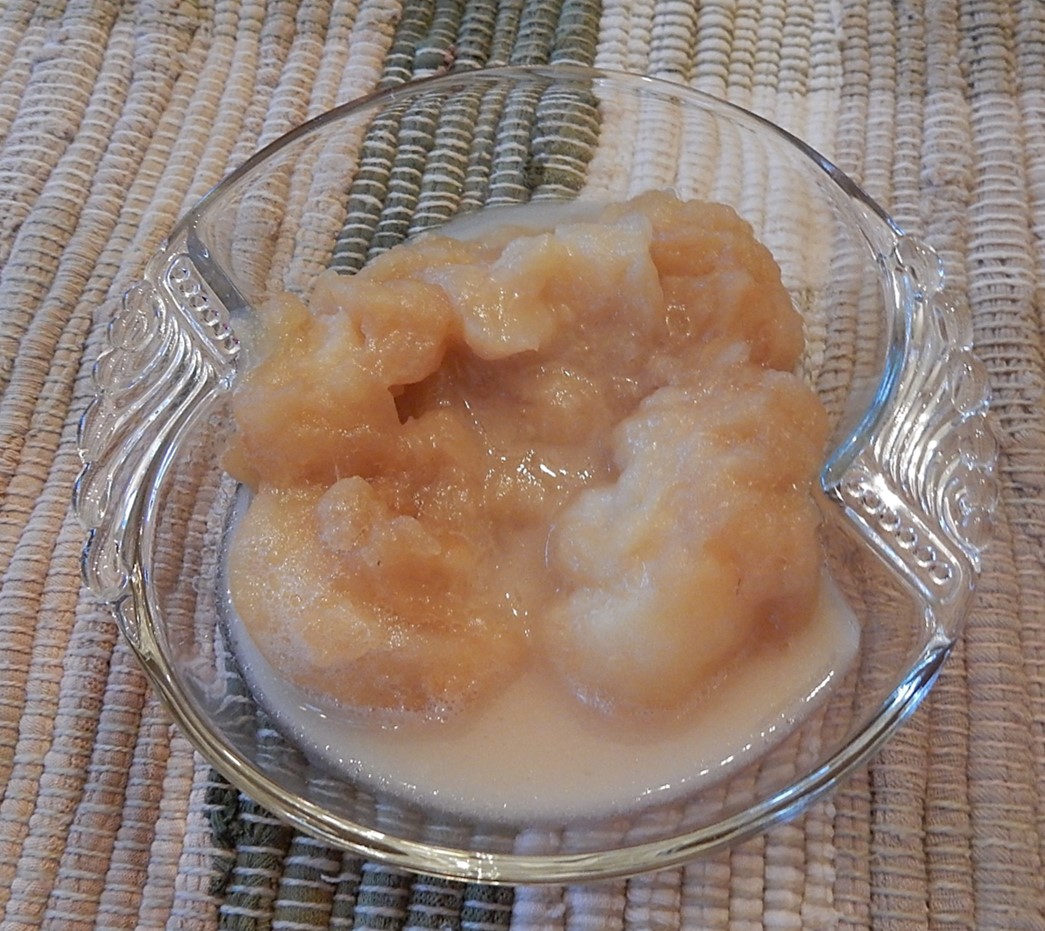
Fresh cranberries are only available for a short time each year, and each Fall I look forward their arrival on the produce aisle. I was pleased to see them this week. I then looked through my hundred-year-old cookbooks and found a simple but very tasty recipe for Cranberry Applesauce. The recipe turned out well. The Cranberry Applesauce wasn’t as tart as Cranberry Sauce, but it wasn’t as sweet as Applesauce. In other words, it was just right.

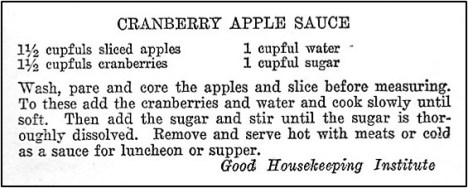
Here’s the original recipe:

Recipe for Cranberry Applesauce
Source: Good Housekeeping’s Book of Menus, Recipes, and Household Discoveries (1922)

Even though the old recipe spelled “applesauce” as two words, I think that it is usually spelled as one word today, so that’s the way I spelled it. Apparently, it was at least sometimes spelled as two words a hundred years ago.

‘Here’s the recipe updated for modern cooks:

Cranberry Applesauce

  • Servings: 6-8
  • Difficulty: easy
  • Print

1 1/2 cups apples, sliced (peel and core before slicing) (use Gala, Honeycrisp, or other apple that makes a good sauce)

1 1/2 cups cranberries

1 cup water

1 cup sugar

Put all ingredients in a large saucepan, then using medium heat bring to a boil. Reduce heat and continue cooking until the apples are soft are tender and the cranberries have burst. Periodically stir. Remove from heat. May be served hot or cold.

http://www.ahundredyearsago.com

Old-fashioned Lemon Apple Pie

Slice of Lemon Apple PieI love apple pies, but sometimes I get bored by the typical cinnamon-flavored pie, so when I saw a recipe for Lemon Apple Pie in a hundred-year-old cookbook, I decided to give it a try.
The pie was delightful – and nothing like any apple pie I’ve ever had before. Chopped apples are smothered in a tart lemony sauce.

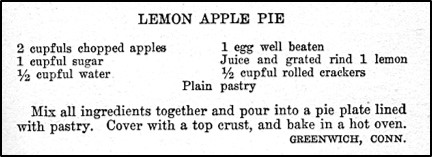
Here’s the original recipe:

Recipe for Lemon Apple Pie
Source: Good Housekeeping’s Book of Recipes and Household Discoveries (1920)

Here’s the recipe updated for modern cooks:

Lemon Apple Pie

  • Servings: 6 - 8
  • Difficulty: moderate
  • Print

2 cups chopped apples

1 cup sugar

1/2 cup water

1 egg beaten

juice and grated rind of 1 lemon

1/2 cup saltine crackers (about 12 crackers), rolled fine (I put the crackers in a plastic bag and crushed with a rolling pin.)

milk, sugar

pastry for a 2-crust, 9-inch pie

Heat oven to 425° F.  Put the sugar, water, egg, lemon juice, and lemon rind in a bowl; stir to combine. Add the crushed saltine crackers and chopped apples, stir. Turn into pastry-lined pie pan. Cover with top crust and flute edges. Brush crust with a small amount of milk; sprinkle with sugar.  Bake in oven for 10 minutes; then reduce heat to 350° F. Bake an additional 20 to 30 minutes or until crust is lightly browned and juice just begins to bubble.

http://www.ahundredyearsago.com

Old-fashioned Butterscotch Apples

dessert bowl with butterscotch apples

Fall is in the air! Evenings are a bit nippy, and the trees are starting to turn color. And, it’s the season for apples, so browsed through old magazines and books for an apple recipe. And, I think I found a winner.

I found a delightful hundred-year-old recipe for Butterscotch Apples. Stewed apples are served in a creamy brown sugar sauce.

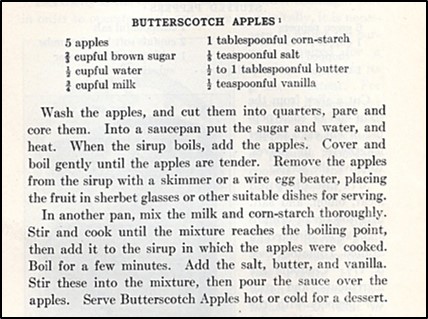
Here is the original recipe:

recipe for butterscotch apples
Source: School and Home Cooking (1920) by Carlotta C. Greer

Here’s the recipe updated for modern cooks:

Butterscotch Apples

  • Servings: 2 - 3
  • Difficulty: moderate
  • Print

5 large apples

2/3 cup brown sugar

1/2 cup water

3/4 cup milk

1 tablespoon cornstarch

1/8 teaspoon salt

1/2 to 1 tablespoon butter (I used 1 tablespoon.)

1/2 teaspoon vanilla

Peel, core, and quarter the apples.

In the meantime, put the brown sugar and water in a large saucepan. Using medium heat, bring to  boil while stirring occasionally. Add the quartered apples. Cover and bring back to a boil. Reduce heat and boil gently until the apples are tender (5-10 minutes) while stirring occasionally. (The apples can boil over, so watch carefully and reduce heat further if boiling too vigorously.) Remove the apples from the syrup using a slotted spoon; set both the apples and the syrup aside.

Put the cornstarch in another saucepan. Gradually stir in milk, and stir until smooth. Using medium heat, bring to a boil while stirring constantly. Add the syrup that the apples were cooked in.  Bring back to a boil, and cook for an additional 2 minutes. Remove from heat, and stir in the salt, butter, and vanilla.

To serve: May be served hot or cold. (I served it hot.) Put in the cooked apples in serving dishes, and spoon sauce over them.

http://www.ahundredyearsago.com

Old-fashioned Carrot and Apple Salad

Carrot and Apple Salad on Plate

Summer is the perfect time for salads to take center stage, so I was intrigued by a hundred-year-old recipe for Carrot and Apple Salad. The recipes called for arranging apple slices that are spread with mayonnaise on lettuce, and then sprinkling with grated carrot. The recipe also called for putting additional mayonnaise in the middle plate. Based on the recipe description, I couldn’t quite picture what the salad would look or taste like, so I decided to give it a try.

The Carrot and Apple Salad was fun to make. I enjoyed arranging the apple slices on the lettuce – then garnishing with grated carrot. This is a recipe that a child might enjoy helping make.

The salad was bright and sunny. And, it met the taste test with a delightful combination of textures. There was just the right balance due to the crispness of the apples, the crunchiness of the lettuce, the sweetness of the carrots, and the hint of a dressing. (My husband and I didn’t add any of the additional mayonnaise that was in the center of the plate when we ate the salad).

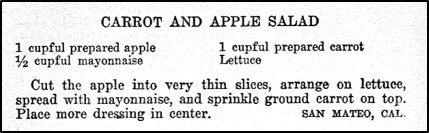
Here is the original recipe:

Recipe for Carrot and Apple Salad
Source: Good Housekeeping’s Book of Recipes and Household Discoveries (1920)

When I made this recipe,  1 cup of apple slices were not quite enough to make an attractive arrangement on the plate so I used additional slices. Similarly, 1 cup of grated carrot seemed like too much, so I only used about 1/2 cup.

And, here is the recipe updated for modern cooks:

Carrot and Apple Salad

  • Servings: 2 -3
  • Difficulty: easy
  • Print

lettuce

1 – 1/2 cups thinly sliced peeled apples (I put the apple slices in a mixture of 1 cup water + 1 tablespoon lemon juice for 5 minutes to prevent browning; then drained and dried using paper towels.)

mayonnaise

1/2 cup grated carrot

Arrange lettuce pieces on plate. Lightly spread mayonnaise on the top of each slice; then arrange the slices attractively on the lettuce. Sprinkle with the grated carrot. If desired, put additional mayonnaise in a small bowl in the center of the plate.

http://www.ahundredyearsago.com