19-year-old Helena Muffly wrote exactly 100 years ago today:
Wednesday, August 5, 1914: Ditto
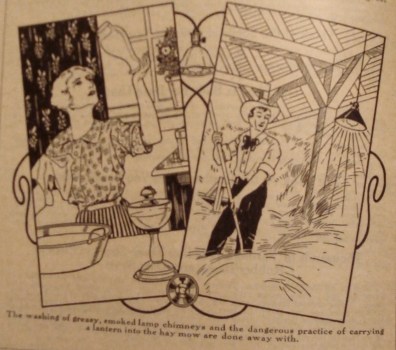
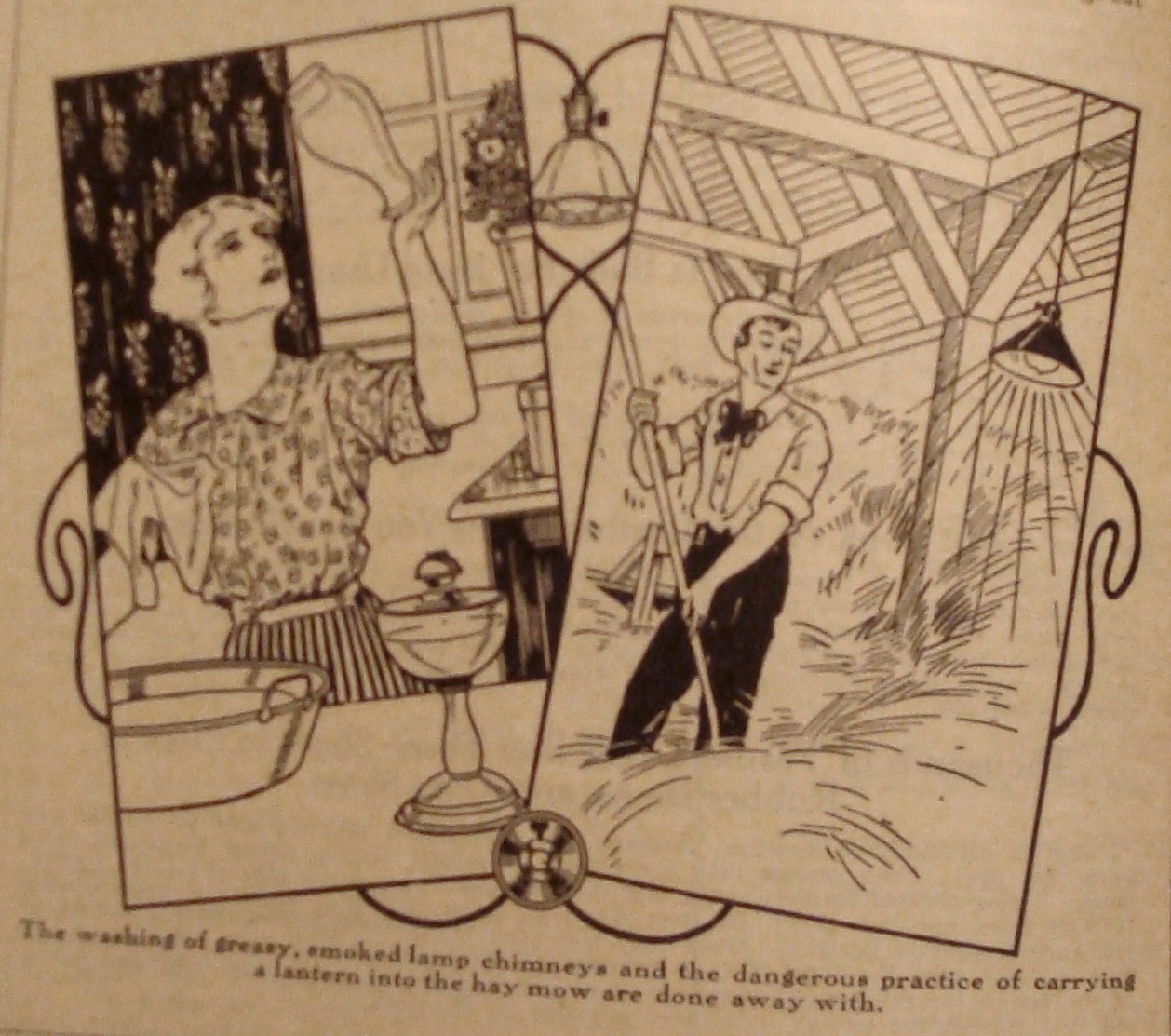
Caption: The washing of the greasy, smoked lamp chimneys and the dangerous practice of carrying a lantern into the hay mow are done away with. Source: Kimball’s Dairy Farmer Magazine (October, 1914)
Her middle-aged granddaughter’s comments 100 years later:
The previous day Grandma wrote that she, “Forgot what I did today.”
Since nothing was happening in Grandma’s life that merited mention in her diary, and since I’m still fascinated with how technology was changing a hundred years ago, I’m going to go off on another tangent.
In 1914 electricity was widely available in larger towns—though it had not yet come to McEwensville. However, some farmers were beginning to install generators and batteries that could be used to produce electricity.
I don’t really understand how the systems worked, but here’s what an article in the October, 1914 issue of Kimball’s Dairy Farmer Magazine said:
The Farm Electricity Plant
For the operation of the little plant, less skill is required than to run the simplest automobile. It contains a gasoline engine of 1 1/2 horsepower, an electric generator or dynamo, a storage battery of 16 small cells, which can be placed on a shelf 8 inches wide by 5 feet long and a simple switchboard. The generating part weights but 160 pounds.
The cost of lamps and wiring will be about $3 per lamp, more or less, depending on the conditions and grade of materials employed. An estimate of materials and wiring may be obtained from a local electrician or contractor. Or the farmer may buy the materials and do the wiring himself at odd times. This is a simple matter with the aid of a good book on wiring.