16-year-old Helena Muffly wrote exactly 100 years ago today:
Sunday, March 17, 1912: Today is St. Patrick’s Day. I had some green on this morning. It was so nice out today. Just like spring. I was going away this afternoon, but didn’t go after all.
Her middle-aged granddaughter’s comments 100 years later:
Sometimes I’m surprised how similar some things are across the years.
The weather was beautiful a hundred years ago–just like it is today.
Grandma wore green a hundred years ago– just like I’m wearing green today.
16-year-old Helena Muffly wrote exactly 100 years ago today:
Friday, March 15, 1912: It was out of the ordinary walking to school this morning. It rained so last night that my morning, water was plainly visible everywhere. It was about the same height tonight. I thought this morning I might not get to school after all.
Recent photo of Warrior Run Creek.
Her middle-aged granddaughter’s comments 100 years later:
Grandma needed to cross Warrior Run Creek to get to school.
It sounds like the creek had flooded and was out of its banks. However, the water apparently had not covered the road and the bridge so Grandma could get to school.
Though not visible, the creek is in the valley in the center of this photo. Probably the field next to the railroad tracks and low lands were flooded a hundred years ago today.
16-year-old Helena Muffly wrote exactly 100 years ago today:
Monday, March 11, 1912: I heave a sigh of relief when I think examinations are past for this month. I have my doubts about what I will get in geometry.
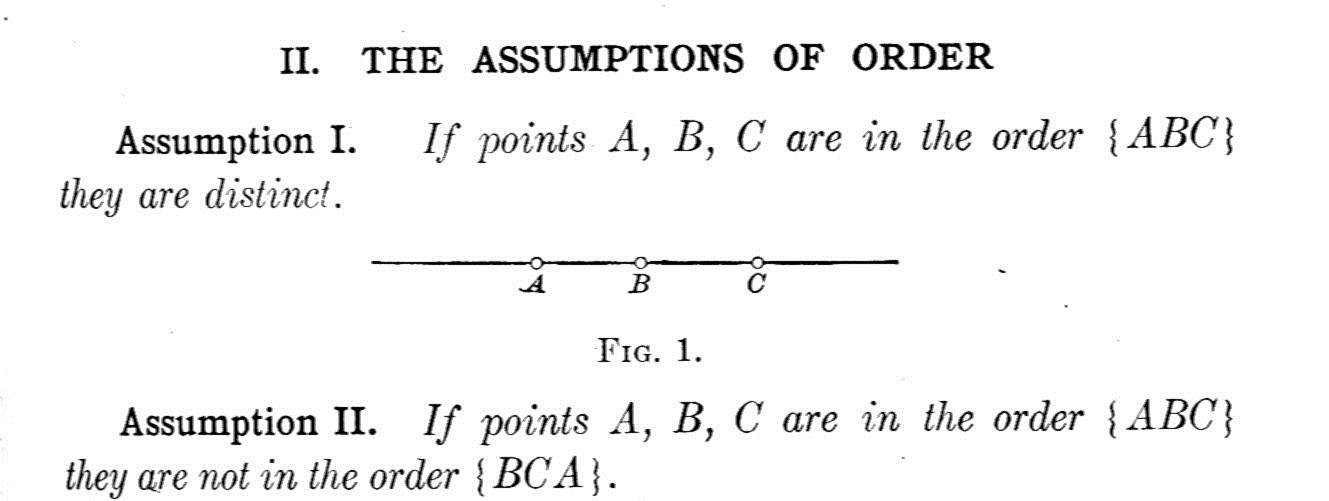
II. THE ASSUMPTIONS OF ORDER
Assumption I. If point A, B, C are in the order {ABD} they are distinct.
Assumption II. If points A, B, C are in the order {ABC} they are not in order {BCA}.
Modern Mathematics (1911), Edited by J.W.A. Young
Her middle-aged granddaughter’s comments 100 years later:
I suppose that Grandma had to do some proofs in geometry. Do students do proofs any more in high school? I get a head-ache just thinking about them.
Here’s the definition of a point in a hundred –year-old mathematics book. It was the first term defined in the book. (I assume that Grandma’s examination was on something more complicated—but I enjoyed reading this definition.)
In geometry a great many technical terms are defined, and each is defined in terms of others. Hence at the beginning of a book on geometry at least one term must be undefined; otherwise the book would have no beginning. We have to leave the undefined term point.
This implies that the reader is free to carry in his mind any image of a point which he can reconcile with what is said about it. We may try to import a notion of our image of a point by saying it has no length, breadth, or thickness, or by like phrases, but these are no part of our book on geometry; they have nothing to do with the logical steps by which the theorems are derived.
16-year-old Helena Muffly wrote exactly 100 years ago today:
Friday, March 8, 1912: I think I came out fairly in General History today. I remembered all of my speech, but as my custom is I never get enough pauses and proper way of speaking in the thing. This time it was too fast. Are going to have them again next Friday. They ought to be pretty well digested by that time.
Mollie was shorn of her horns today. Poor thing, I hope she won’t kick the bucket. But I don’t think she will.
Photo source: The Farm Dairy (1908) by H. B. Gurler
Her middle-aged granddaughter’s comments 100 years later:
Mollie was Grandma’s cow. Based on previous diary entries it seems as if each of the Muffly girls owned one the family’s cows.
Mollie had her first calf the previous August, so probably was about 2 1/2 years old when this diary entry was written.
I’m surprised that Mollie’s horns were removed when she was so old. I think that typically horns would either be removed when the cow was younger than this—or the cow would never be dehorned. My gut feeling is that Mollie was acting aggressively toward other cows with her horns—and that as a result ended up being dehorned.
The horns would have been cut off with a tool designed for that purpose. Mollie probably bled quite a bit afterwards—and there would have been the risk of infection.
Dehorning would have been very painful for a few days—though I doubt that there was much chance that the dehorning might actually cause a cow to die (kick the bucket).
The Tennessee Extension Service has a publication that explains how cattle are dehorned. See page 6 for a description of how older cattle are de-horned. I don’t think that the process has changed much in the last hundred years.
16-year-old Helena Muffly wrote exactly 100 years ago today:
Saturday, March 2, 1912: Well I really think I worked pretty good today. I put things in order and washed up and a lot more that comes under Saturday duties .Ruth was up to Turbotville attending Teachers’ Institute so you see I had to be busy. Tweet is here this evening.
Recent photo of Turbotville Community Hall. The building was once a high school and the Teachers' Institute probably was held here.
Her middle-aged granddaughter’s comments 100 years later:
Grandma’s 20-year-old sister Ruth was a teacher at one of the one-room schoolhouses near McEwensville. Ruth had graduated the previous spring from high school and immediately got a teaching position.
A hundred years ago teachers weren’t required to attend college, though they had to pass tests in various content areas. The Saturday teachers’ institute would have provided training and professional development. And, it would have been a wonderful opportunity for the teachers in scattered isolated schools to gather, compare notes, and provide support for one another.
Tweet refers to Helen Wesner. She was a friend of Grandma and Ruth.
16-year-old Helena Muffly wrote exactly 100 years ago today:
Friday, March 1, 1912:
March
This month signifies that the winter is passing.
And soon will be the Springtime
With all its bright scenes and soul stirring dreams,
And memories so long and so dear.
After a whole week of trying to get a theme in readiness, I finished the thing at noon. It came under General History. Cleopatra was what I had to write about. I got it so as to suit my satisfaction. But of course there were some mistakes.
Late 19th century painting of Cleopatra by Jean-Leon Gerome--Maybe this is what Grandma pictured Cleopatra looking like. (Source: Wikipedia)
Her middle-aged granddaughter’s comments 100 years later:
How did Grandma end up writing about Cleopatra? Did she choose the topic? (If so, why?) . . . or did her teacher assign it? (If so, why did he assign it to her instead of to another student?)
The way I picture Cleopatra is strongly affected by the 1960s movie with Elizabeth Taylor and Richard Burton.—and I can’t quite envision how people thought about her a hundred years ago.
Was Cleopatra’s beauty, charm and ability to control men generally seen in a positive or a negative light back then? The suffragettes were very active a hundred years ago. Do they see Cleopatra as a role model or as a failure of the past to allow women appropriate roles?