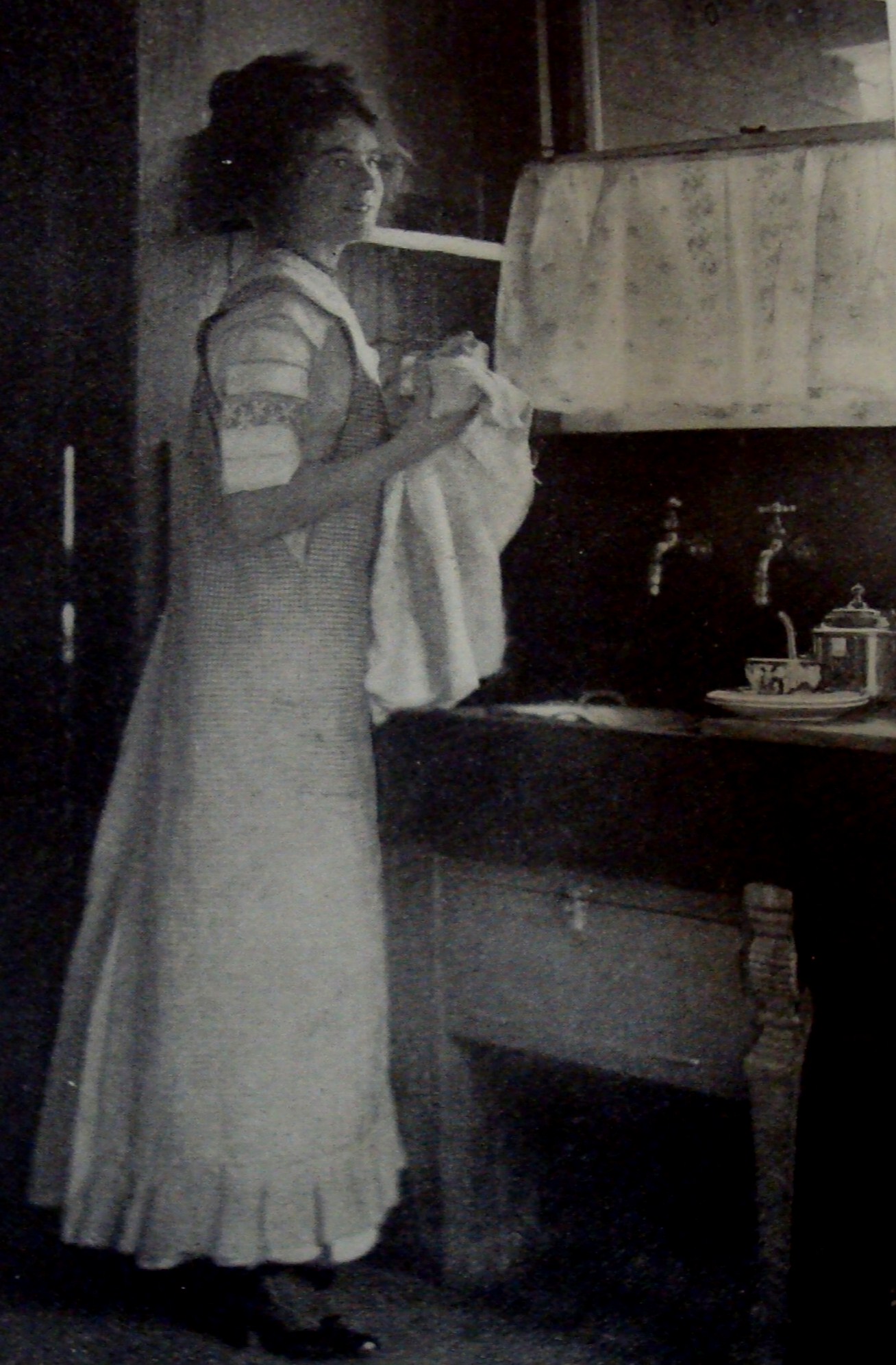
I assume that wasn’t the hat she was refurbishing—but maybe a hat could become an “old hat” in only three months.
A hundred years ago 5 & 10 cent stores sold ribbon, artificial flowers, feathers from ostriches and other less exotic birds, and other types of millinery supplies so that people could easily change the look of their hats.
Does anyone refurbish old hats anymore? . . . or old clothes (or anything else) for that matter?
I just move things to the back of my walk-in closet or give them away when they go out of style.
17-year-old Helena Muffly wrote exactly 100 years ago today:
Saturday, July 13, 1912: My calling was out in the field today. I was glad when it was over and I was at leisure to do something.
Recent photo of the stream that flows through the farm Grandma grew up on.
Her middle-aged granddaughter’s comments 100 years later:
Sounds like Grandma had to again watch cows or do some other type of field work. Thank goodness she apparently had time to do something fun—at least I hope it was fun; she only wrote that it was “something.”
I love to swim on hot summer days. I don’t think that Grandma ever learned how to swim, but she may have taken her shoes off and waded in the creek. The water would have felt good in the days before electric fans and air conditioners.
A book published in 1911 called Outdoor Sports by Claude Miller discussed the importance of confidence when swimming:
. . . The lack of confidence is disastrous. I have known girls who could swim perfectly well in the shallow but could not keep up at all in water out of their depth. And yet they have not been touching the bottom in the shallow water, but they could if they wished.
Learning to swim in water that is over your head is really better, though it is more “scary” at first. If you do learn in that way you can there-after look upon the deepest water with confident scorn.
17-year-old Helena Muffly wrote exactly 100 years ago today:
Thursday, July 4, 1912: Such a magic sound it has to some, but to me it is about the same as other days. We got a glorious rain this afternoon. I can’t help but rejoice over the very thought of it. It’s cooler now for one thing.
I bet that people a hundred years ago would never have expected that “ancient” traditions like fireworks would still exist in 2012.
Her middle-aged granddaughter’s comments 100 years later:
Poor Grandma–It sounds like an incredibly boring 4th. Some places were livelier.
About 125 miles northeast of McEwenville, New York City was holding a modern 4th of July celebration.
Here are some excerpts from the July 4, 1912 issue of the New York Times:
CITY TO CELEBRATE ITS SANEST FOURTH
Music, Parading, Speeches, and Electric Light to Banish Firecracker Riot
Over the Old Fort Block House at 5:30 o’clock this morning the new forty-eight-starred flag of this country will be raised and its raising will be the start of this city’s celebration of Independence Day. This celebration will be the 136th anniversary of the signing of the Declaration of Independence in Philadelphia.
It will represent weeks of effort put forth by the Mayor’s Committee and by countless societies and organizations, all joined in a determined campaign to free the marking of this day from the ancient rites of fire and powder and its ancient toll of death and wounds.
Instead of the steady popping of firecrackers and deafening crash of the cannon cracker, there will be parading, music, dancing, and speechmaking.
The prediction last evening, as the final touches were put on the innumerable arrangements, pointed to the safest and sanest Fourth in a city where the Nation’s big day has been growing safer and saner every passing years.
For safety Acting Chief Guerin of the Fire Prevention Bureau reported that for the last week he and his men had been on the lookout for fireworks stored away for sale. Confiscation is the rule and some $3,000 worth of explosives have been so put out of harm’s way.
The weather man, after scanning the heavens and weighing the evidence with unusual care last evening announced his gloomy fear that this city and the surrounding country would experience thunderstorms this afternoon or evening.
Quite as much as any other part of the celebration, the elaborate illumination depends on the holding off of the rain. If all goes well many parts of the city will be radiant with fantastic light, for nearly a hundred thousand Japanese lanterns have been strung to the trees in the parks and these were supplied with current last evening to try them out. As the dim trees in each park, loaded with festoons and strung ropes of these lanterns would spring into radiance with the turning of the switch, a shrill chorus of delightful approval would go from hundreds of children. The current is the gift of the New York Edison Company for the celebration and besides this, it has given the lanterns.
City Hall and its square is to be more brilliantly lighted than any, 6,000 electric light bulbs being devoted to this purpose.
17-year-old Helena Muffly wrote exactly 100 years ago today:
Wednesday, June 25, 1912:Nothing extraordinary done.
Her middle-aged granddaughter’s comments 100 years later:
I think that Grandma was in a rut when she wrote this entry.
Here’s some advice hundred –year –old advice about how to get out of a rut:
Dare to be different; dare to take a decisive step to carry out your plans and ideas yourself. Fight your own battle, make a new road if necessary.
Ask no favor of anyone and you will succeed a thousand times better than one who sticks in the old beaten path, and who is always beseeching someone’s influence and patronage.
Aren’t you tired of the rut, tired of walking in file as convicts walk together in stripes? Cultivate enough individuality to refuse to be sewed up in the universal patchwork. The onward sweep of progress in this age has prepared the way for nonconformists. Why not get into line?
As in a game of cards, so in the game of life. We must play what is dealt to us, and the glory consists not so much in winning as in playing a poor hand well. Do not ask for a new deal, but play the cards given you.
You were not born to solve the problems of the universe, but to find out what you have to do and then do it with all your might, because it should be your duty, your enjoyment, or the very necessity of your being.
How many of us exhaust ourselves and wear out our friends by chafing against the chains of the unalterable, by complaining of the cards that are dealt to us in the game of life.
Play the game the best you know how to play it, give your life, your energy, your enthusiasm to the game.
17-year-old Helena Muffly wrote exactly 100 years ago today:
Saturday, June 1, 1912:
Passing, the spring time is passing away,
May summer appear all-a-bloom,
But the brightest and fairest of the season,
Is the bright and fair month of sweet June.
Carrie was over to see me this afternoon. I am engaged in trying to solve a puzzle. I have one ninth of it to get yet and it’s a stickler.
Recent photo of Muffly farm.
Her middle-aged granddaughter’s comments 100 years later:
What was the puzzle like that Grandma so challenging? I found several hundred-year-old puzzles called Brain Bothers in 1912 issues of Farm Journal. I’ll give you the answers tomorrow.
Brain Bothers
1. Transform a MULE to a PONY in four changes, one letter at a time, without transposing.
(January, 1912)
2. What number is divisible by 2,3,4,5, and 6, with a remainder of 1 in each instance, but is divisible by 7 without a remainder?
(March, 1912)
3. Substitute a letter in the name of an American president, and make something good to eat. Do the same with an American poet with the same result.
(May, 1912)
Poem, Etc.
Grandma included a poem in the diary on the first day of each month. Carrie refers to her friend Carrie Stout.
17-year-old Helena Muffly wrote exactly 100 years ago today:
Sunday, May 13, 1912: Ma got my dress on the go at last and I’ll keep at her until she gets it made.
Source: Ladies Home Journal (June, 1912)
Her middle-aged granddaughter’s comments 100 years later:
Hmm . . This entry obviously is referring to the second dress that was mentioned in previous entries. (It’s not the Indian linen one that a seamstress finished).
Was the plan always for Grandma’s mother to make this second dress or had Grandma originally expected to make it herself?
Did some sewing this afternoon. I have so many things to fix over and a dress I want to get made, but it is slow about getting there.
When I look at pictures of dresses from a hundred years ago they look like they would be complex to make. Maybe Grandma and her mother reached consensus that her mother could more skillfully do the sewing task.

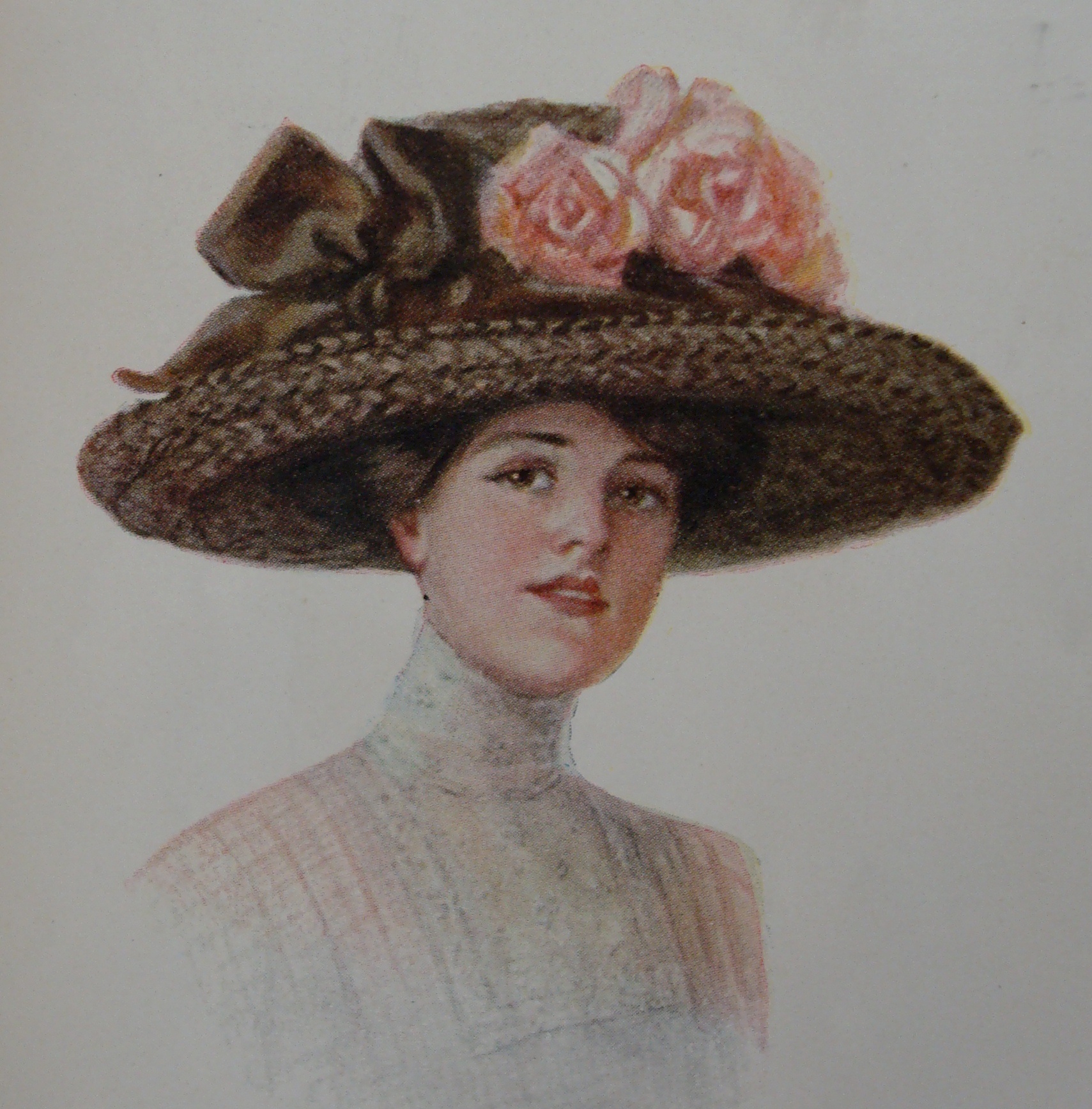
 A hundred years ago 5 & 10 cent stores sold ribbon, artificial flowers, feathers from ostriches and other less exotic birds, and other types of millinery supplies so that people could easily change the look of their hats.