Fixing Clothes to Make Them More Stylish

16-year-old Helena Muffly wrote exactly 100 years ago today: 

Saturday, January 27, 1912: Saturday is a busy day if so you choose to make it. I was busy all day. Sewed nearly all afternoon. I didn’t make anything, but fixed some of my clothes the way I wanted them. And I’m not going to study any this evening—lessons or no lessons.
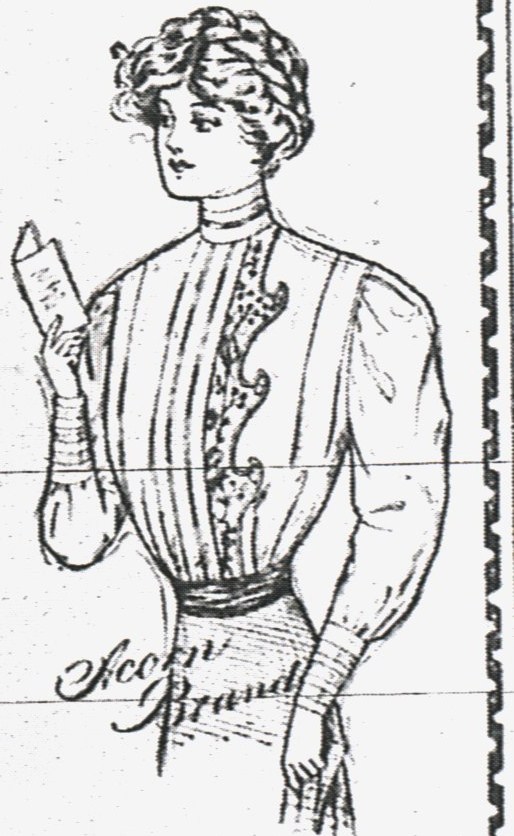
Waist (Source: Milton Evening Standard, Feb. 4, 1911)

Her middle-aged granddaughter’s comments 100 years later:

Today clothes have become almost throwaway items.  Styles seem to change ever more rapidly. The legs on my pants from last year are too wide; the skirts too long.

A hundred years ago people remodeled their clothes when styles changed. According to The Dressmaker (1911) by the Butterick Publishing Company:

In making over a waist it is sometimes necessary to use quite a little new material; but when chemisettes, yokes, and half-sleeves are in fashion it is an easy matter to supplement the old material with net, lace, chiffon, etc.

Sleeves and skirts frequently need to be recut. If piecing is necessary, see to it that the seams fall in places where they will not show or where they can be covered with trimming.

Remodeling a skirt is an easy matter if the new pattern is narrower than the old skirt. In that case it is only a question of recutting; but if the pattern calls for more material than you have in the skirt itself you will have to do some piecing.  Braided bands covering the skirt seams are an excellent way of increasing the width of a skirt.

Or you can raise the skirt at the waistline, refit it, and add to it at the bottom by a band or a fold. Or it may be pieced at the bottom and the line of piecing covered by wide braid, bias bands, etc.

Had a Little Fun–and Did a Little Studying

16-year-old Helena Muffly wrote exactly 100 years ago today: 

Friday, January 26, 1912:  Ruth and I went up to Oakes’ this evening. Wanted to stay at home and work my Algebra problems. Worked two after I came home. Ruth helped me with one. Must manage to the rest some other time.

Grandma and Ruth would have walked down this road to get to Oakes.

Her middle-aged granddaughter’s comments 100 years later:

Grandma went to visit neighbors with her sister Ruth on a Friday night–though she also did  two algebra problems.

Hmm–has Grandma turned a new page?

In the diary entry that I posted yesterday Grandma wrote that she’d gotten a lecture from her teacher about cheating on tests. She said that she was going to:

. . . bid adieu to all ways of crookedness and get the things in my head instead of having them on paper.


Do Students Cheat More Now?

16-year-old Helena Muffly wrote exactly 100 years ago today: 

Thursday, January 25, 1912:  Gave my ear to a free-for-all lecture this afternoon. It was delivered by Mr. Teacher, the chief part of which was about cheating on examinations. I’ve been so worked up at this, although Conscience tells me not to.  Anyway I believe it is time to stop, and do better in the future. So now, I will try to bid adieu to all ways of crookedness and get the things in my head instead of having them on paper.

Recent photo of the building that once housed the McEwensville school.

Her middle-aged granddaughter’s comments 100 years later:

My grandmother cheating on tests!! . . . .Grandma, what were you thinking?

Sometimes it’s hard to interpret what Grandma wrote without judging her.  Grandma was 16 and about 40 years younger than me when she wrote this diary entry. I’m looking at this entry through the lens of a mother and I can’t completely wrap my head around why a teen would decide to cheat.

I want to think that the world was a simpler place a hundred years ago—and that students were less likely to cheat back then. But I’m not sure. This is the second time Grandma’s mentioned cheating in the diary.

On February 7, 1911 Grandma wrote:

Some of the boys at school found the teacher’s Latin questions in examination, and we all expect to make a good mark. I do at least, but I might be fooled as some cheats are.

And, the next day, her diary entry said:

Had some of our exams today. Came out all right in Latin. Our arithmetic wasn’t so easy though.

Comparison: 1912 and 2012 Algebra Textbooks

16-year-old Helena Muffly wrote exactly 100 years ago today: 

Tuesday, January 23, 1912:  Sleigh rides are a thing of the past now. There is no danger of freezing yourself now. I’m at a standstill in Algebra.

Her middle-aged granddaughter’s comments 100 years later:

Maybe Grandma was struggling in algebra because the textbook was confusing.

To get a sense of how algebra textbooks have changed over the past 100 years. I compared the promotional materials for an algebra textbook published in 2012 with the information in the preface of an algebra textbook published in 1912.

The Books

2012 Book

Beginning & Intermediate Algebra, (4th Edition) by John Tobey, Jr., Jeffrey Slater,  Jamie Blair, and Jennifer Crawford (Pearson)

1912 book

Durrell’s School Algebra by Fletcher Durrell (Charles E. Merrill Company)

Comparison

Of course the book published in 2012 is brightly colored with lots of pictures and figures (and there are numerous supplemental online resources). The 1912 book is black and white with only a few pictures.

The 1912 book looks denser than then new one. However, the chapter titles are similar. For example both books had a chapter called Factoring.

Purpose

2012:  “. . . builds essential skills one at a time by breaking the mathematics down into manageable pieces. This practical “building block” organization makes it easy for students to understand each topic and gain confidence as they move through each section.”

1912:  “The main object in writing this School Algebra has been to simplify principles and give them interest, by showing more plainly, if possible, than has been done heretofore, the practical or common-sense reason for each step or process.”

Problems

2012:  “Student Practice problems are paired with every example in the text . . .”

1912: “A large number of problems. . . .”

Review and Reinforce

2012:  “Students will find many opportunities to check and reinforce their understanding of concepts throughout the text . . .”

1912: “Numerous and thorough reviews of the portion of the Algebra already studied are also called for.”

Ruth’s Birthday

16-year-old Helena Muffly wrote exactly 100 years ago today: 

Friday, January 19, 1912: You walk through slush instead of snow for the present. I pulled Ruthie’s ears. I tell her she is getting to be an old maid but really don’t mean it.

I was rather mad this afternoon. We had some Algebra problems that I didn’t know how on earth to do them. But I guess I can do them now if I try hard enough.

Ruth Muffly*

Her middle-aged granddaughter’s comments 100 years later:

A hundred years ago today was Grandma’s sister Ruth’s 20th birthday. People used  to pull the birthday person’s ear lobes one time for each year, so Grandma would have pulled Ruth’s ears 20 times.

In 1911, on Ruth’s birthday, Grandma woke Ruth by pulling her ears. She made have done the same thing in 1912.

*1913 photo of Ruth. Photo used with permission. Source: The History of the McEwensville Schools: 1800-1958 by Thomas Kramm.

A Novel, New Way to Save Recipes–Recipe Boxes and Cards

16-year-old Helena Muffly wrote exactly 100 years ago today: 

Thursday, January 18, 1912: To write something when you have nothing to write is an impossible task.

Her middle-aged granddaughter’s comments 100 years later:

Since Grandma didn’t write much a hundred years ago today, I’m going to go off on a tangent.

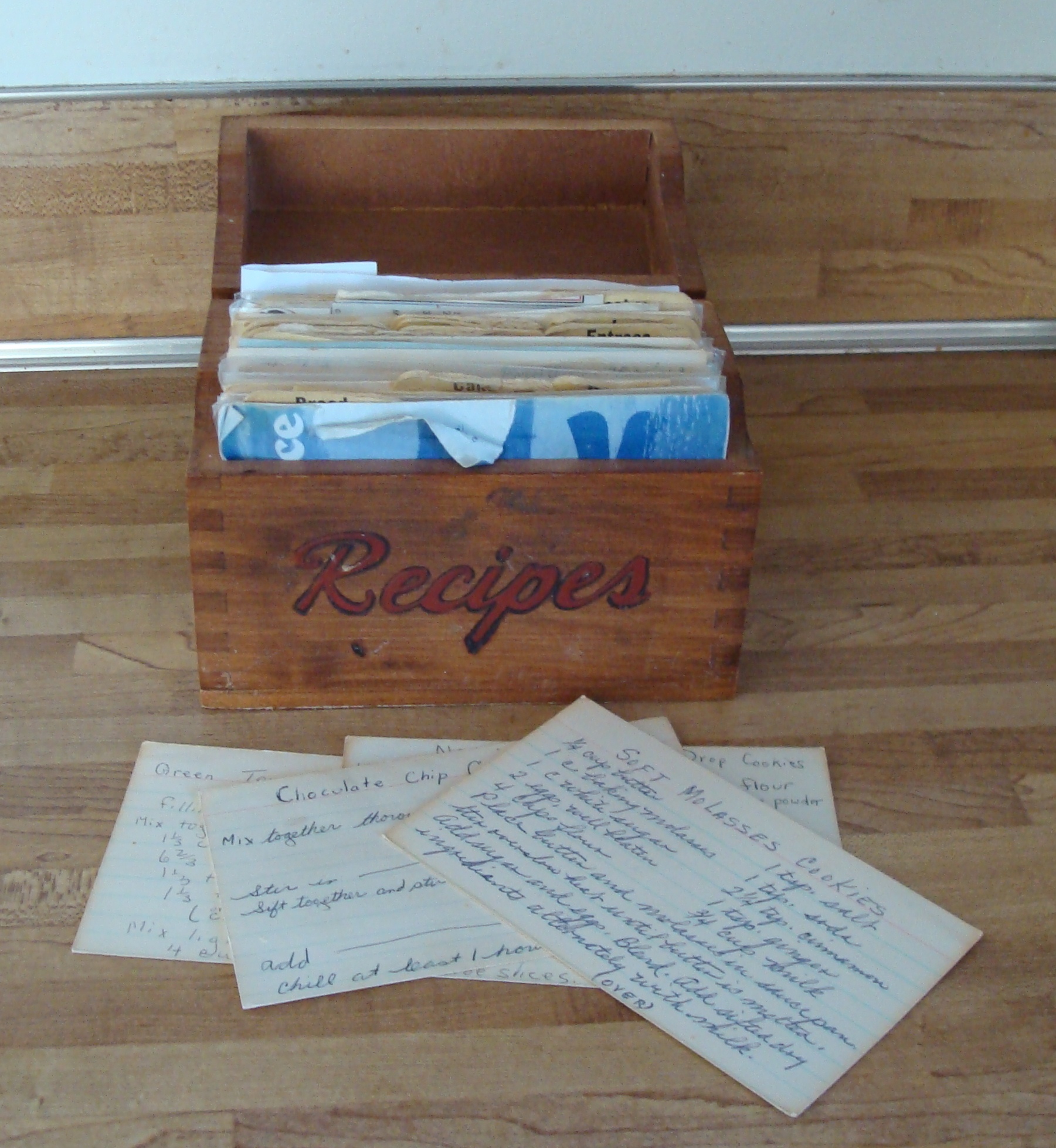
When I began working on this blog I knew that cars, airplanes, and telephones were all relatively new technology in 1912–I was amazed to discover that recipe boxes and cards were also a new idea.

I got my recipe box when I got married many years ago--and many of the recipes in it are old family recipes that were copied at that time. Who would have guessed that I was compiling the recipes in the modern way?

Here are some excerpts from an article called “A Housekeeper’s Filing Cook Book A Novel Way to Save Recipes and Household Hints in a Systemic and Convenient Form,” that was in the March 1912 issue of National Food Magazine:

Every year housekeeping becomes more of a science. Shiftless methods and poor tools give place to system and efficient utensils, so that housekeeping is taking the rightful place by the side of other well-managed businesses.

One of the greatest aids to system in business offices is the filing drawer, or cabinet. A clever housewife has adapted the filing idea to her own needs and developed a filing cook book which she and several others have been using successfully for some time past.

Cards measuring 5×8 were bought at a stationer’s and fitted into a pasteboard drawer such as can be bought to fit the cards. The drawer holds over two hundred cards. Any size card may be used but the above has been found the most convenient.

The cards are grouped under sub-heads is alphabetical order, as Bread, Cake, Desserts, Meats, Pastry, Oysters, Salads, Specials, Vegetables, etc.

On these cards are written or typed, under their proper sub-head, choice recipes from friends, the favorite dishes of the hostess or more particularly, recipes taken from culinary magazines such as the National Food Magazine.

The “old way,” to save a recipe was to paste it anywhere on any page in an old note-book which became covered with flour and mayonnaise whenever used. Or the recipe was just “tucked away” among the leaves of the real cook book—and never found.

Here instead of writing down your friend’s recipe for her best sponge cake or pasting some of the fine recipes you have read in the National Food Magazine into a messy book, in a disorderly fashion—you write the recipe on a card, or paste the clipping on a card and slip it into its proper place . . .

Rural Free Delivery

16-year-old Helena Muffly wrote exactly 100 years ago today: 

Wednesday, January 17, 1912: Had to walk to school this morning, as Daddy was busy elsewhere. We didn’t get any mail today because the mail carrier was almost too lazy I guess to get through the drifts. How you do miss the mail then. Ahem.

1996 stamp commemorating the 100th anniversary of rural free delivery of the mail

Her middle-aged granddaughter’s comments 100 years later:

Today’s diary entry brings back warm fuzzy memories of the days when getting mail was one of the highlights of the day.

A hundred years ago the mailman probably used a horse and buggy to deliver the mail.

The mailman would not have delivered packages. A hundred years ago merchants opposed the establishment of parcel post because they believed that it would take business away from the local stores—but farmers and others strongly advocated for parcel post and it would be established a year later in 1913.