16-year-old Helena Muffly wrote exactly 100 years ago today:
Tuesday, February 6, 1912: Am trying to get ready for monthly exams. They come tomorrow and the day after. I have sad hopes and misgivings for one study especially.
Source: Durrell’s School Algebra (1912)
Her middle-aged granddaughter’s comments 100 years later:
I’ve recently posted many of Grandma’s diary recent entries which indicated that she was working very hard on her algebra.
And, I’ve provided a lot of background information about algebra a hundred years ago. When I got ready to write this post, I wondered what else I might write about algebra.
To get inspiration, I flipped through a 1912 algebra textbook —and I happened to notice that one of the problems in the book was about the average height of males and females.—and it included a data table with heights for selected ages between 3 and 21.
This reminded me that I’ve heard that on average people are taller now than they were a hundred years ago—and the next thing I knew I was headed off on a tangent.
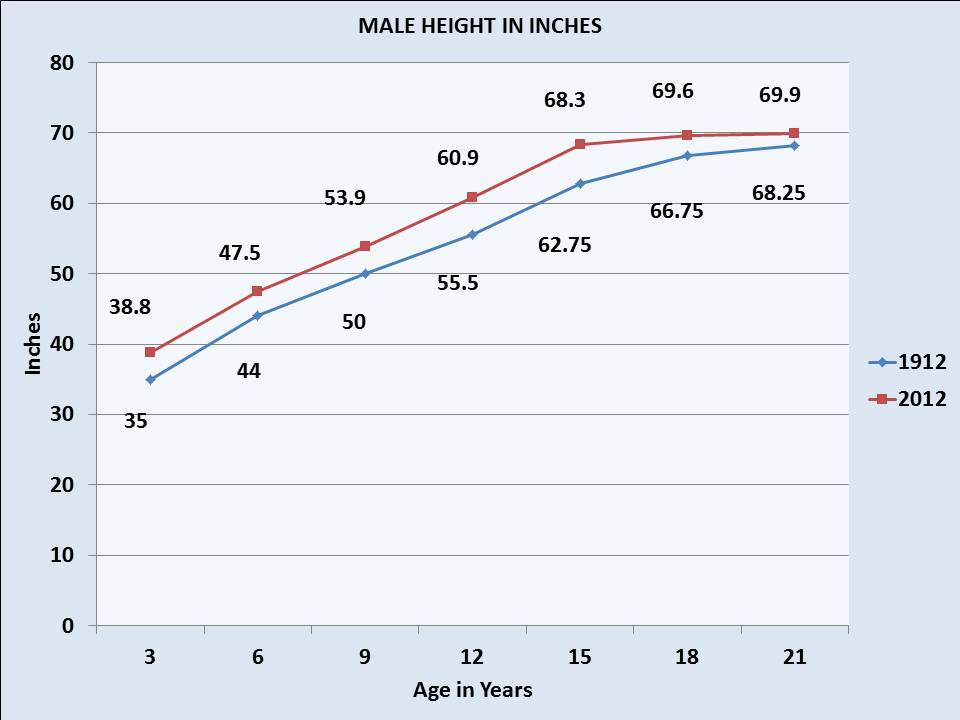
Average Height by Age and Gender, 1912 and 2012
Click on graph to enlarge.Click on graph to enlarge.
I found recent Centers for Disease Control data on average heights in the US. Since 2012 data are not yet available, I assumed that it is the same as it was in recent years. I also assumed that the data in the algebra book was correct for 1912.
On average, three-year-old children are much taller now than they were 100 years ago. Three-year-old boys are almost 4 inches taller; girls about 3 and 1/2 inches.
By age, 21, males now are, on average, more than 1 1/2 inches taller than they were a hundred years ago. In 1912 the average 21-year-old male was 68.25 inches (5 feet 8.25 inches) tall. Now the average male in the US is 69.9 inches (5 feet 9.9 inches) tall.
Females are about 1/2 inch taller now than they were a hundred years ago. In 1912 the average 21-year-old female was 63 .75 inches (5 feet, 3.75 inches) tall. Now the average 21-year-old female in the US is 64.3 inches (5 feet 4.3 inches) tall.
16-year-old Helena Muffly wrote exactly 100 years ago today:
Monday, February 5, 1912: Back to my lessons again, I resolve to study until twelve, but it is more likely to be ten or a little later.
Her middle-aged granddaughter’s comments 100 years later:
Yesterday, I wrote about how the church that Grandma attended closed a few years after she wrote these diary entries. Since the diary entry that I’m posting today is self-explanatory, I’m going to continue telling you about country churches in 1912.
A hundred years ago there were many more small churches in rural hamlets than there are now. The Country Life Movement, which sought to revitalize rural life in an era when many youth were leaving rural areas for the cities, was at its peak in 1912. The media, many government officials, policymakers, and academics saw the churches as having a key role in this rural revitalization.
However, many of these churches were very small and struggling—and needed to revitalize themselves if they were to play a larger role in rural revitalization.
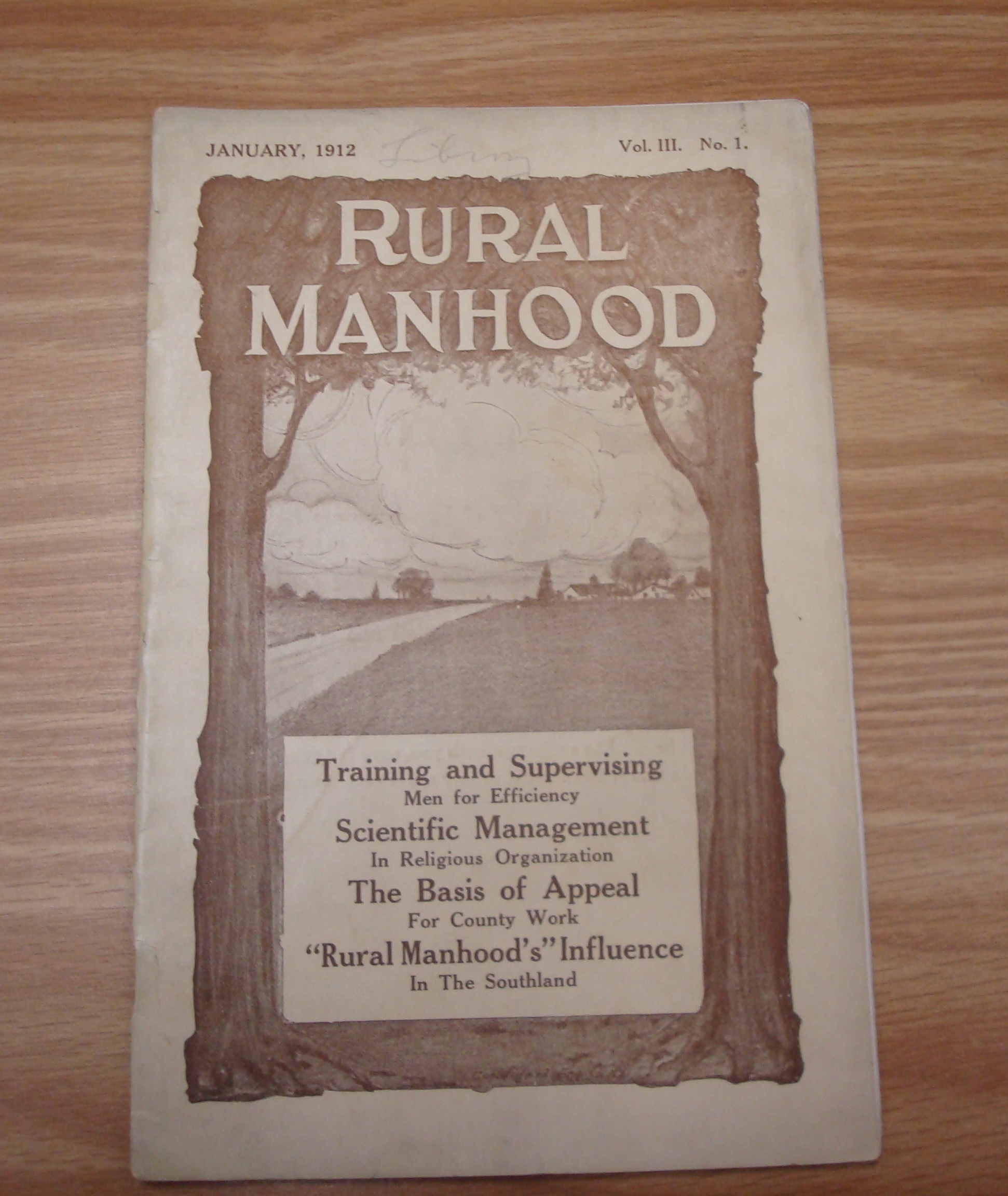
An article on country churches in a 1912 issue of a magazine published by the YMCA called Rural Manhood listed some “elements of weaknesses” and suggested principles that would lead to country church improvement.
Elements of Weakness
1. The chief element in the problem is the inevitable isolation in the open country and the depletion in thousands of villages; not merely in the loss in numbers, but in the improvement of the life of many of those who remain.
2. The element of Economic weakness: Impoverished soil, poor agricultural conditions and bad farming, which are found all too frequently.
3. Element of Business weakness. We seldom find any business system in the country church. As a rule, they have no financial policy, no plan for the future.
4. The element of Wasteful Competition, Altogether too many rival churches, due to the excessive individualism and lack of social co-operation, or the depletion of a once populous village, or the early blinders of too zealous denominational strategy. Wasteful sectarianism is a sin in the city, but it is a crime in the country.
5. Element of Moral Ineffectiveness: Many country churches have lost the respect of their communities and their local support, because of their lack of vital religion, of deeds of spiritual power for character making, because they do not prove their genuine brotherliness in an unselfish service of the community.
6. The element of Narrow Vision of service: The country church is often slow in responding to the progressive spirit of the times, and has little idea of the modern social vision. Few country churches as yet are seeing their great opportunity to serve broadly all the interests and needs of the whole community.
7. Lastly, the weakness is Leadership. The country ministry is in general an untrained ministry.
Principles
1. We must study the country church, or any other church, not as a machine, but as an organism, and we should remember that a body becomes as it functions. It develops by doing, or it dies from atrophy.
2. The pathway to success is adjustment to the environment. This necessitates a scientific, inductive method of careful study of environment and social contacts.
3. We must follow the natural method of redemption through resident forces, including of course among all personal forces, the might of the immanent God.
4. We must adopt modern business principles in the work of the church; Conservation of resources, combination of forces, elimination of waste and friction, for maximum efficiency.
5. As churches we must accept Jesus’ law of self-sacrifice for the sake of the Kingdom. We must subordinate selfish personal preferences to community needs.
The Country Church (Rural Manhood, January 1912)
Since Grandma’s church, the McEwensville Baptist Church, was disbanded around 1920 it must not have been able to move beyond some of its weaknesses.
16-year-old Helena Muffly wrote exactly 100 years ago today:
Sunday, February 4, 1912: Didn’t want to miss Sunday School this morning, but all the same I did. It was too snowy to walk, and that was my only way of locomotion, so I staid at home. It was so stale this afternoon.
The old McEwensville Baptist Church probably was located somewhere on the lot that contains this yard and house.
Her middle-aged granddaughter’s comments 100 years later:
Wow, the weather must have been really bad. I believe this is the first (or possibly the second) time that Grandma’s missed Sunday School since she began the diary 14 months ago.
It amazes even more that a teen like Grandma was so dedicated to attending Sunday School when I think that the church she attended was on its last legs. Grandma never mentioned the church by name. There were three churches in McEwensville a hundred years ago, but I believe that she attended the McEwensville Baptist Church—which closed a few years after she wrote the diary.
I recently found an article in an old magazine published by the YMCA called Rural Manhood that identified the four stages of Country Church evolution.
Stages of Country Church Evolution
1. The period of pioneer struggle and weakness, through which practically all churches have had to pass.
2. The period of growth and prosperity, sharing the growth of the community; or lacking this growth, a period of marking time under the burden of a building debt.
3. The third stage, in which I presume a majority of country churches are now found, is the period of struggle against rural depletion, and for many of them it is a noble struggle.
4. The ultimate stage of this evolution is the survival of the fittest, an inevitable and a desirable result of the struggle.
The Country Church (Rural Manhood, January 1912)
Using this taxonomy the McEwensville Baptist Church failed to successfully navigate Stage 3. I’m amazed how a hundred years ago Darwinian “survival of the fittest” language provided a lens through which to examine churches.
16-year-old Helena Muffly wrote exactly 100 years ago today:
Saturday, February 3, 1912: Today proved to be a dull Saturday to me anyway. Ruth went skating this evening. It’s the first time this winter.
Source: Youths' Companion (November 16, 1911)
Skate forward, backward; start, stop, dodge. With “U.S. Hockey Player” Skates you have the jump on the other fellows.
They’re the fastest, lightest and strongest made. And they’re the only kind with chrome-nickel steel runner which can not dull.
U.S. Skates
are tempered steel, absolutely guaranteed to stand the hardest strain. The nickel-plating won’t chip or peel. They look more expensive than they are.
Send for FREE CATALOGUE
Illustrating Hockey, Club, Rink, Racing, and Ladies’ models. Showing pictures.
F. LOWENTRAUT MFG, Co.
54 Brenner St., Newark, N.J.
Her middle-aged granddaughter’s comments 100 years later:
Since this was the first time that Grandma’s sister Ruth went skating, the weather must not have been as conducive for skating in 1912 as it had been the previous winter. In 1911 Grandma’s diary entries mentioned that friends came over to her family’s farm several times to go skating. For example, on January 17, 1911 she wrote:
Miss Stout was over this evening, wanted me to go skating or else sliding with her down on the creek with the rest of the gang. I choose to stay at home, and there I remained, and here I am at the present time.
Warrior Run Creek flows along the edge of the farm. I’m surprised that the creek froze enough to skate on. Maybe they flooded nearby land to create a homemade skating rink.
16-year-old Helena Muffly wrote exactly 100 years ago today:
Friday, February 2, 1912: I wonder if I am really mean or what is the matter with me. On seeing my chance to grab a boy’s necktie, I availed myself of the opportunity. The result was I was dispatched of my hair ribbon and this evening my cap. I was to give up the tie and then I could have my cap. I got mine first, and then gave back the tie.
Her middle-aged granddaughter’s comments 100 years later:
It’s amazing that guys wore neckties to school a hundred years ago. Styles sure have changed.
Sounds like Grandma was having fun. According to yesterday’s diary entry she was not going to go to the box social that was being held that evening. It sounds like she figured out another way to get a boy’s attention.
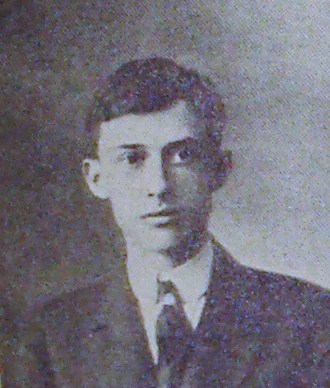
Raymond Swartz (1915 picture)
I wish that Grandma had mentioned the boy’s name in this entry. My grandfather (Raymond Swartz) and Grandma both graduated from McEwensville High School in 1913. The school was small—only 6 students graduated in the class of 1913—but so far I’ve found no mention of Raymond in the diary.
Might this entry refer to Raymond? Somehow I think not—
Raymond was 3 1/2 years younger than Grandma—so when this entry was written he would have been 13 years-old and she would have been 16 (almost 17). He apparently skipped several grades and was a really young high school student.
They did not marry until Grandma was in her mid-twenties.
16-year-old Helena Muffly wrote exactly 100 years ago today:
Thursday, February 1, 1912:
This is the only month that e’er can change
The only month that adds another day.
Though life is short and time is fleeting,
Should we not strive to glorify the way.
I had some small hopes to attend a box social tomorrow evening, but they have all fallen through this evening. Rachel and Al were down this evening. Ruth was busy making candy for her box. Her first attempt was a failure. She had the misfortune to burn it like fury. Of course it was worthless, anyway it appeased my curiosity and see how it tasted, I was so dumb as to stick my fingers in it, when it was the next thing to being red-hot. The result proved very disastrous. I am now the owner of a big blister on my finger.
Photo source: Wikipedia
Her middle-aged granddaughter’s comments 100 years later:
Wow, they really had box socials a hundred years ago in rural Pennsylvania. When I think of box socials, I always think of the play Oklahoma where the climactic scene takes place at one.
Grandma’s sister Ruth would have filled her box with food for two. At the box social the men would then bid on the boxes in hopes of getting to share the meal with the woman who made it.
This entry raises lots of questions–Why did Grandma decide not to go? Was Ruth really popular? . .. . Will her box be bid way up by several men competing to get it?
Poor Grandma—first she wasn’t going to the box social; then she burned her finger.
Rachel and Al (Alvin) Oakes lived on a farm near the Muffly’s. Rachel was a friend of Grandma and Ruth. Al was her brother.
The first diary entry each month begins with a poem. For more about the poems click here.
16-year-old Helena Muffly wrote exactly 100 years ago today:
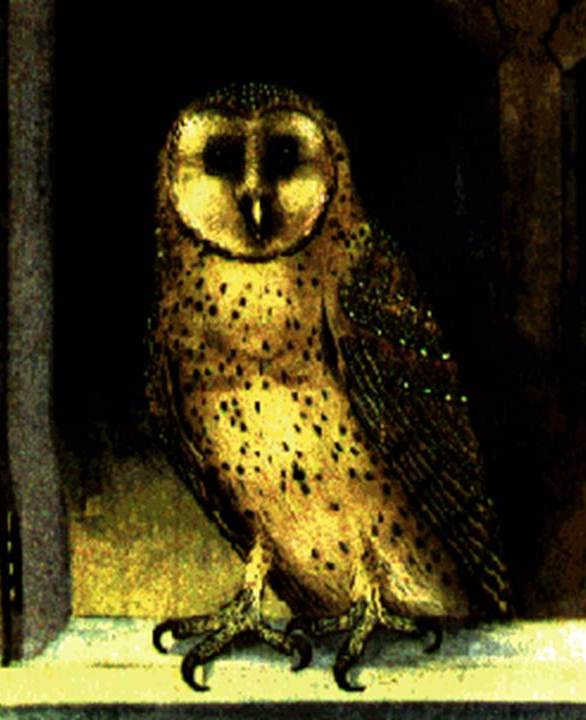
Tuesday, January 30, 1912: Ran a splinter in my hand at noon and didn’t get it out until this evening. It went in almost straight. Jimmie pulled it out for me, although I didn’t think he could. Saw an owl this evening. Would like to have laid my hands on him and seen the result.
Source: Wikimedia Commons
Her middle-aged granddaughter’s comments 100 years later:
I’m amazed that Grandma’s six-year-old brother Jimmie was able to pull the splinter out.
My sense is that the population of many wild animals and birds has decreased over the years—though I’m really not sure. This diary entry makes it sound as if it was unusual to see an owl a hundred years ago.
By the early 1900’s many people realized that it was important to protect wildlife.
According to The Old Tackle Box, the first non-resident hunting licenses in Pennsylvania were issued in 1901—though resident licenses were not issued until 1913.
However, bounties were still offered for some animals.
A 1908 book called The Compendium of Everyday Wants described the Pennsylvania Game Laws:
Hunting is prohibited on Sunday, and any one convicted of this offense is liable to a penalty consisting of a fine and imprisonment.
It is illegal to kill any song bird. It is unlawful to place on sale any song birds caught, except those generally sold, such as parrots, canary and other similar birds. Birds taken for scientific purposes are not included in this restriction, when the person capturing or killing them holds a certificate. These certificates are good for one year, under the law of Pennsylvania.
It is unlawful to kill deer, fawn, etc., for the purpose of selling them, in Pennsylvania.
For the benefit of agriculture and the protection of game, the legislatures in many States have passed laws whereby a certain amount of money is paid for killing wildcats, foxes, minks and any such dangerous animals. A bounty, that is a sum of money, is paid by the counties of the States for each one destroyed. In Pennsylvania, $2 is given for every wildcat, $1 for every red or grey fox, and 50 cents for every mink.