“I might Be fooled as some cheats are”

15-year-old Helena wrote a hundred years ago today:

Tuesday, February 7, 1911. Some of the boys at school found the teacher’s Latin questions in examination, and we all expect to make a good mark. I do at least, but I might be fooled as some cheats are.

Her middle-aged granddaughter’s comments 100 years later:

Hmm—Today’s news media makes cheating sound like a new phenomena . . .

Odd, Unusual, and Strange Math Problems

15-year-old Helena wrote a hundred years ago today:

Tuesday, January 31, 1911.  If anything of real importance happened today I would write it down, but as nothing has it will not be here to read. This is the last day of the first month. What do you think of it? Vice versa.

Her middle-aged granddaughter’s comments 100 years later:

No mention of arithmetic problems in today’s diary entry. Maybe it went better today than yesterday.

I’m still fascinated by the problems in the 1911 high school arithmetic textbook that I found. The book contains some really strange problems–including some that deal with topics that probably would be considered unacceptable today.  

1. If 44 cannons, firing 30 rounds an hour for 3 hours a day consume 300 barrels of powder in 5 days, how long will 400 barrels last 66 cannons, firing 40 rounds an hour for 5 hours a day?

2. Bought by avoirdupois weight, 20 pounds of opium at 40 cents an ounce, and sold the same by Troy weight at 50 cents an ounce; did I gain or lose, and how much?

3. A wine merchant imported 1000 dekaliters of wine, at a cost of 75 cents a liter, delivered. At what price per gallon must he sell the same to clear $2000 on the shipment?

4. A certain number of men, twice as many women, and three times as many boys, earn $123.80 in 5 days; each man earned $1.20, each woman 66 1/3 cents, and each boy 53 1/3 cents per day. How many were there of each?

Kimball’s Commercial Arithmetic: Prepared for Use in Normal, Commercial and High Schools and the Higher Grades of the Common School (1911)

Remember that a hundred years ago patent medicines containing opium were legal, child labor laws were just being enacted, and it was way before woman had equal rights.

If you want to do the opium problem here are a couple of definitions:

Avoidupois weight (The usual system used in the U.S.):  16 ounces = 1 pound

Troy weight:  12 ounces = 1 pound

Arithmetic Problems in 1911 High School Text Book

15-year-old Helena wrote a hundred years ago today:

Monday, January 30, 1911. My! How the wind did blow today, smashed some panes in the school house windows with a deafening crash and alarmed us all, fortunately we escaped uninjured. Boo hoo I haven’t got all my arithmetic problems for tomorrow. Boo hoo. I’m getting stupid.

Her middle-aged granddaughter’s comments 100 years later:

It was either a damn strong wind–or the windows weren’t very strong. I wonder if the panes blew out when the class was working on the dreaded arithmetic.  To get a sense of what the problems were like I found a high school arithmetic book that was published in 1911. Here are the written exercises in the chapter titled The Equation:

1. To four times a certain number I add 16, and obtain as a result 188. What is the number?

2. A man having $100 spent a part of it; he afterwards received five times as much as he had spent, and then his money was double what it was at first. How much did he spend?

3. A farmer had two flocks of sheep, each containing the same number. He sold 21 sheep from one flock and 70 from the other, and then found that he had left in one flock twice as many as in the other. How many had he in each?

4. Divide 100 into two such parts that a fourth of one part diminished by a third of the other part may be equal to 11.

5. Find the area of a square field whose diagonal is 50 rods.

Kimball’s Commercial Arithmetic: Prepared for Use in Normal, Commercial and High Schools and the Higher Grades of the Common School (1911)

Directions for Making an Old-Fashioned Scarf

15-year-old Helena wrote a hundred years ago today:

Saturday, January 28, 1911. I puttered around, and did some work today. Although Ruth says, “I don’t do anything,” but as for earning my salt, I guess I earn as much as she does.

Her middle-aged granddaughter’s comments 100 years later:

I wonder what Grandma was doing while she was puttering around. . . .Maybe she made a scarf.

Scarves—then like now—were a stylish fad. The January 15, 1911 issue of Ladies Home Journal  had directions in an article titled How You Can Make the New Scarfs:

In the center of the page above is shown one of the satin scarfs which are worn with tailored suits on days too mild for heavy fur. The right side is of black satin and the underside of white. It usually measures about eighteen inches in width, and two yards to two yards and a half in length. In narrow silk just this quantity would be required. The ends are drawn in and finished with silk tassels formed of stuffed oval shapes of satin, hung from cords.

For evening nothing could be more charming than the scarf shown on the center figure on the right. It is made of dotted gauze in a delicate mauve, lined with pale pink chiffon, the ends finished with hemstitching and caught with a narrow band of mink fur. It may be made of different materials in this way. Two-tone chiffon would be lovely—a cornflower blue, for instance, lined with pale pink with a band of white swansdown or marabou confining the fullness across the lower part of the front about twelve inches from the hem.

Ladies Home Journal  (January 15, 1911)

It’s amazing how styles—and terminology—change (or don’t change) over time. In case you care, the definitions of swansdown and marabou are below:

Swansdown—(1) the soft downy feathers of the swan often used as trimming on article of dress; (2) a heavy cotton flannel that has a thick nap on the face and is made with sateen weave.

Marabou—(1) a soft fluffy material prepared from turkey feathers or the coverts of marabous and used especially for trimming women’s hats or clothes. (2)  a large dark gray African stork.

Merriam-Webster Online Dictionary

Direct Election of Senators and Other Boring (or Not So Boring) Topics

15-year-old Helena wrote a hundred years ago today:

Wednesday, January 25, 1911. Oh what did I do today? About the same things as I do on other days. I’m sure it wasn’t so very much. Just the same old routine with no breaks.

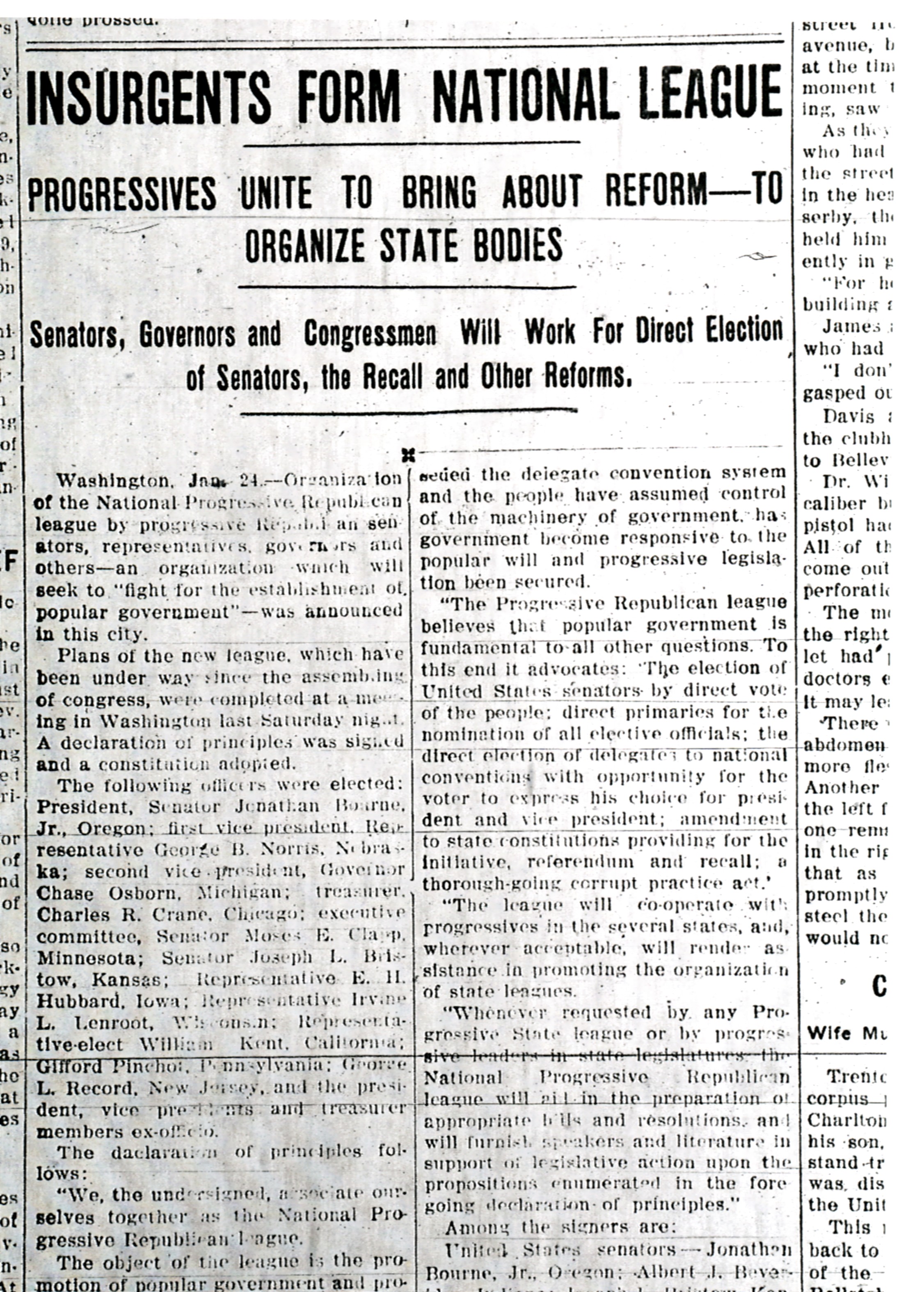
Local Front Page News  a 100 Years Ago:

INSURGENTS FORM NATIONAL LEAGUE

PROGRESSIVES UNITE TO BRING ABOUT REFORM–TO ORGANIZE STATE BODIES

Senators, Governors and Congressmen Will Work For Direct Election of Senators, the Recall and Other Reforms

Milton Evening Standard, January 24, 1911


Her middle-aged granddaughter’s comments 100 years later:

My gut feeling is that if my 15-year-old grandmother read this headline that she yawned, and moved on to the next article. Hey, she was already yawning from boredom—why would articles about complex national issues pique the interest of a rural teen? But maybe, just maybe,  her teacher at McEwensville High School pulled topics of national importance into his lessons–and she might have had a basic understanding of the issue.

A hundred years ago US senators were not elected by popular vote. Instead they were elected by state legislators. In 1911 muckrakers argued that the system led to corruption and that industrialists and robber barons had undue influence in selecting senators.  (The 17th Amendment, which was adopted in 1913, instituted the direct election of senators.)  

Many social issues and governance issues were bubbling in the public conscience in 1911. Two other amendments were also adopted during the 1910s–the 16th in 1913 (it gave the federal government the right to collect income taxes) and the 19th in 1919 (prohibition). And, in 1920 the 20th amendment gave women the right to vote. I can picture high school students debating the pros and cons of prohibition and women’s suffrage.  Did Grandma take a stand on either issue?

Old Ice Cream Freezer Advertisement

15-year-old Helena wrote a hundred years ago today:

Sunday, January 22, 1911. Went to Sunday school and church this morning. Made ice cream. That is my sister made it and I assisted. I got the ice. Besse and Curt came out this evening. Just when Ruth and I were having a little spat all to ourselves.

Advertisement in the July 1910 issue of National Food Magazine.

 Her middle-aged grand-daughter’s comments 100 years later:

Grandma’s oldest sister Besse was married to Curt Hester, a butcher in Watsontown. My father can remember Curt and Besse working in the butcher shop

Today we think of ice cream as a warm weather food—but I guess in the days before refrigeration that maybe it was a cold weather food. It would have been easier to get the ice needed to make ice cream during the winter months.

I wonder what Grandma and her sister Ruth had a ‘spat’ was about.  Maybe Grandma wanted to make the ice cream rather than assist .

Where did Grandma get the ice?  Warrior Run Creek flows near the house, so maybe she gathered frozen chunks that were near the creek bank. .  . or maybe there was ice on the cattle watering troughs . . . or maybe had they set pans and buckets filled with water out to freeze the previous day . . .

A Birthday Tradition

15-year-old Helena Muffly wrote exactly 100 years ago today:

Thursday, January 19, 1911: Pulled Miss Muffly’s ears first thing this morning, whether she liked it or not. Bout all I can do to fish up enough things to knock down. My life has reached an uneventful state or period with all its calm ripples. I almost forgot, I got a new pair of rubbers today which I needed very bad.

Her middle-aged granddaughter’s comments 100 years later: 

I’m guessing that Miss Muffly refers to Grandma’s sister Ruth. And, that January 19 was Ruth’s birthday. According to the 1900 Ruth was born in January 1892, so this must have been her 19th birthday. Grandma probably woke Ruth by pulling her ears.

When I was a child my parents told me that in the old days people used to pull the birthday person’s ear lobes one time for each year, but that I shouldn’t pull ears since it might damage the person’s hearing (which, of course, gave me the idea that it might be fun to pull ears—but that is another story).