More Odd, Unusual, and Strange Math Problems

16-year-old Helena Muffly wrote exactly 100 years ago today: 

Monday, October 16, 1911: Nothing new at school or at home. Read several stories after I had worked some problems. Still have some for tomorrow though.

Her middle-aged granddaughter’s comments 100 years later:

I wonder what type of problems Grandma was working on.  I enjoy looking at hundred-year-old math books. The problems are so different from the ones in today’s books.

I’ve previously shared some problems with you.  Here are some more odd, unusual, and strange problems from 1911:

1. If 44 cannons, firing 30 rounds an hour for 3 hours a day, consume 300 barrels of powder in 5 days, how long will 400 barrels last 66 cannons, firing 40 rounds an hour for 5 hours a day?

2. A ditch 80 yards long, 10 ft. deep, and 9 ft. wide was dug by 20 men in 12 1/2 days of 10 hours each; and a ditch 76 yards long and 12 ft. wide was dug by 30 men in 7 1/2 days of 9 1/2 hours each. How deep was the latter ditch?

3. A speculator bought 10 village lots, and gave a 4-months’ note in payment. This note was immediately discounted in the bank at 8%, and the bank discount was $192. What was the average price of the lots?

4. A druggist bought 6 pounds of quinine at $11 per pound, avoirdupois weight, and sold it in 2-grain capsules at 10 cents per dozen. What was his profit?

Kimball’s Commercial Arithmetic: Prepared for Use in Normal, Commercial and High Schools and the Higher Grades of the Common School (1911)

A hundred years ago prescriptions weren’t required and druggists made their own medicines, men actually dug ditches by hand, and labor laws about how many hours a day a person could work had not yet been enacted.

If you want to do the quinine problem–and, for some reason never had a math class that taught you the conversion factors for apothecaries and avoirdupois weights 🙂 – here is the information you need:

Apothecaries Weight

20 grains = 1 scruple

3 scruples = 1 dram

8 drams = 1 ounce

12 ounces = 1 pound

Avoirdupois Weight

16 ounces = 1 pound

In case you missed the previous posts that contained math problems, here are the links:

Odd, Unusual, and Strange Math Problems
1911 Algebra Problems: The Lusitania and Molasses

Old Math Problems

How Many Verses Did She Memorize This Week?

16-year-old Helena Muffly wrote exactly 100 years ago today: 

Sunday, October 15, 1911: Went to Sunday School this morning. My verses that I am learning for that Bible has decreased some, but I’m still at it.

Her middle-aged granddaughter’s comments 100 years later:

Grandma was trying to memorize Bible verses to get a free Bible. On September 17 she wrote:

. . .One reason for my regular attendance is that if you learn a number of verses from the Bible (over 700 it is) you will in the course of time receive a Bible.. .

And on September 24 she wrote:

 . . . Only learned seven verses for today. Usually have twenty-seven . . .

I wonder how many she memorized this week. I can’t even imagine trying to memorize 27 verses a week. No wonder the number of verses  has decreased over time.

U.S. Crop Yields and Production, 1911 and 2011

16-year-old Helena Muffly wrote exactly 100 years ago today: 

Saturday, October 15, 1911: Was so busy all day. Had to help Daddy pick corn and husked pop corn between loads. Both of these jobs aren’t finished yet either.

Her middle-aged granddaughter’s comments 100 years later:

Whew, it sounds like a lot of work. There weren’t combines (or even mechanical corn pickers) a hundred years ago. Horses would have been used and much of the labor would have been by hand.

This entry made me curious about how crop production and yields have changed over the last 100 years.

Crop Production

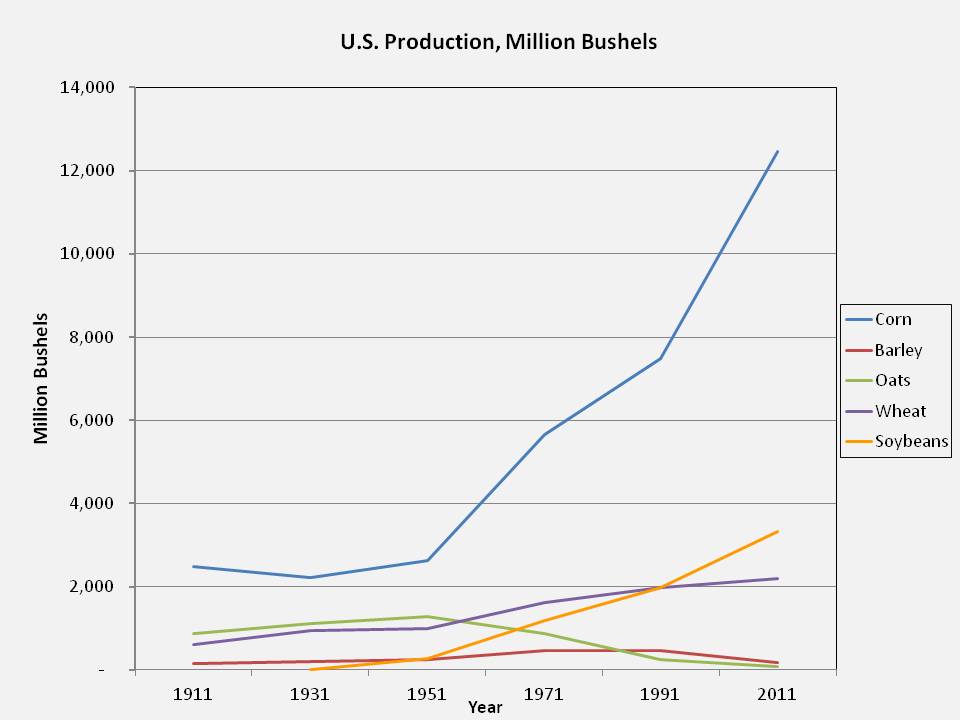
Corn production has mushroomed. In 1911, approximately 2,475 million bushels of corn were produced in the US. In 2011, about 12,447 million bushels were produced.

So few soybeans were produced in 1911 that the U.S. Department of Agriculture did not even track it.  In 1931, 17 million bushels of soybeans were produced in the U.S. –and by 2011 approximately 3,329 million bushels were produced.

Barley and oats production decreased substantially between 1911 and 2011—probably due at least in part to the reduced number of horses that needed to be fed in the US. Wheat production increased a little over the years.

Crop Yields

Crop yields increased significantly for all the major cops between 1911 and 2011.

Corn yields increased the most. For example, in 1911, about 24 bushels per acre were produced. This increased to approximately 148 bushels per acre in 2011. Yields increased substantially between the 1930’s and 1950’s due to the widespread shift from open pollinated corn to hybrid corn. The increased use of commercial fertilizers and pesticides in the later part of the last century also increased yields.  In recent years the use of genetically modified seed has led to major yield  increases.

Another factor that has increased the average yield per acre over the past 100 years, is that some of the less productive land in the US has been taken out of production.

Data Source: US Department of Agriculture. For some crops 2011 data are not yet available. If not available, 2010 data were used to construct the figures.

Visited Friends, But Didn’t Stay Long

16-year-old Helena Muffly wrote exactly 100 years ago today: 

Friday, October 13, 1911: Ruth and I went up to Oakes’ this evening and arrived home in  no time.

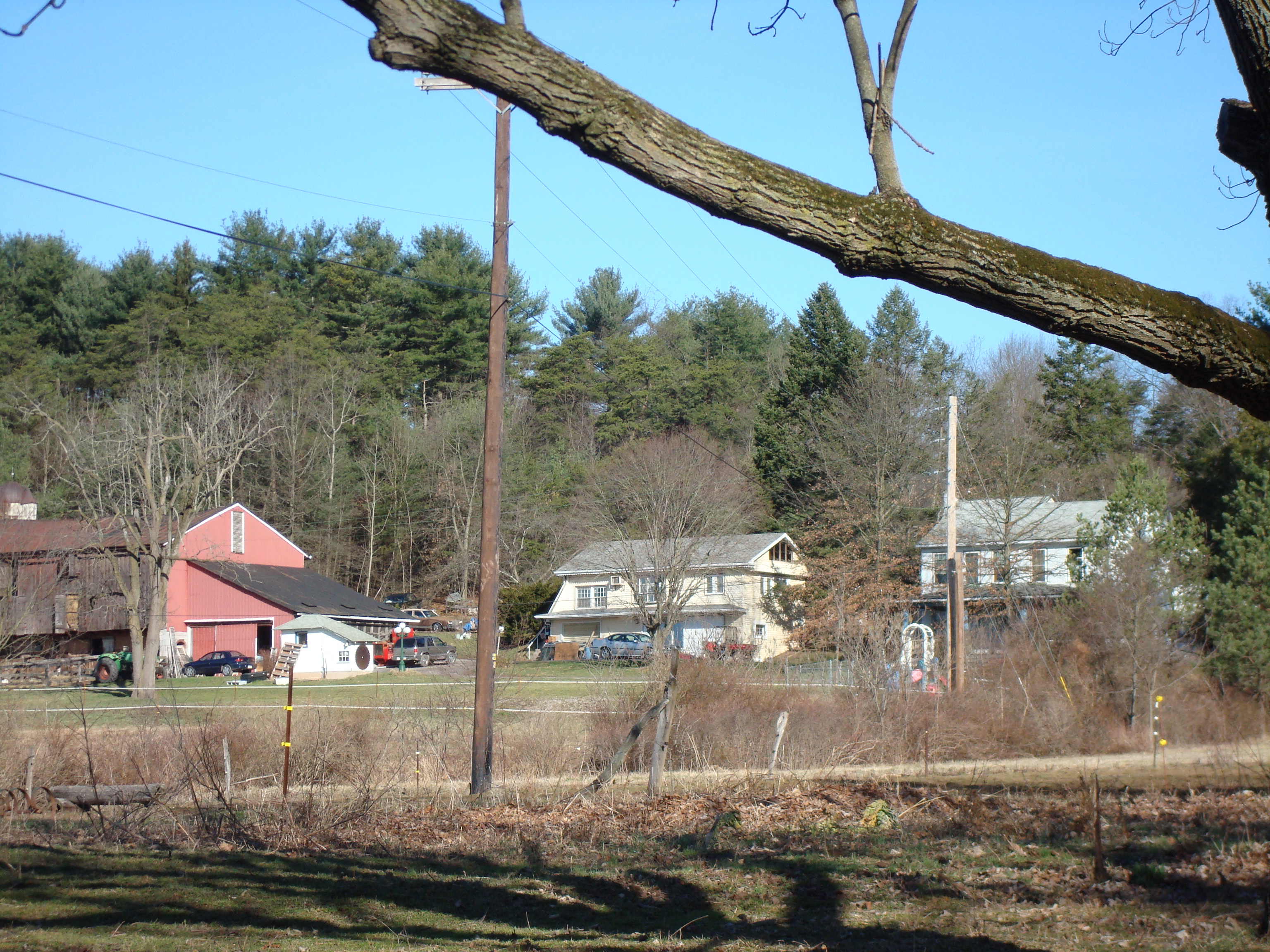
Recent photo of the farm where Rachel and Jim Oakes lived.

Her middle-aged granddaughter’s comments 100 years later:

It was a Friday night. I wonder why Grandma and her sister Ruth didn’t stay long.

The Oakes lived on a farm near the Muffly’s. Several of the Oakes children were close in age to  Grandma and  Ruth. Rachel Oakes was a friend and also the primary school teacher at McEwensville.

Several times during the spring and early summer Grandma mentioned in the diary that Ruth was dating Jim Oakes—though he hasn’t been mentioned recently so perhaps that relationship ended sometime prior to this date.

1911 Sports Trivia: Cy Young Retired

16-year-old Helena Muffly wrote exactly 100 years ago today: 

Thursday, October 12, 1911: Nothing much at all.

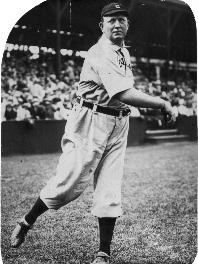
Cy Young (Photo source: Wikipedia)

Her middle-aged granddaughter’s comments 100 years later:

Since Grandma didn’t write much today, I’ll tell you a bit of sports history.

Cy Young played his last game in October, 1911 at the age of 44. He is generally considered one of the all-time top pitchers, and had 511 wins over a 22-year career.

Young played the last two months of his career as a Boston Rustler. His last game was a 3-13 loss to Brooklyn. He’d previously played for four other professional teams including the St. Louis Browns and Cleveland Naps.

After his last game Young retired to his farm in Ohio where he lived until he died in 1955.

Beliefs a Hundred Years Ago About High Quality Education for Young Children

16-year-old Helena Muffly wrote exactly 100 years ago today: 

Wednesday, October 11, 1911: Don’t know what to write. Got my report today. Was better than what I expected.

Her middle-aged granddaughter’s comments 100 years later:

Yeah! Even though it’s silly to be happy about an event that occurred a hundred years ago, I’m glad that Grandma did well on her exams.

Two days ago I quoted from a 1911 book about the purpose of education.  Since Grandma didn’t write much today I’ll tell you about an interesting section in the book about the role of education for younger children (pre-school and primary grades).

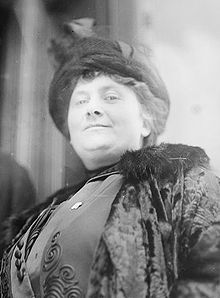
In 1911 there was a lot of interest in kindergartens. Many believed that young children needed an enriching environment and that children should develop at a pace they set for themselves. There was a huge amount of interest in the ideas of Madame Maria Montessori. She believed that children spontaneously educated themselves based upon their experiences and environment.

Madame Maria Montessori (Source: Wikipedia)

Today much of the policy discussion for young children revolves around whether there should be universal pre-schooling and how to standardize educational experiences for children in grades k-2. The focus is on teaching children reading skills.  This is very different from what people believed about early education a hundred years ago:

There is good reason, however for believing that early childhood freedom is more important to good mental development than to good physical development. The mind of the child may be more injured by “thorough” mental training of any particular kind, than the body by any special form of physical training. . .

Children not only develop the power to perceive remember, imagine, reason, etc. without any special assistance, but they acquire knowledge without special teaching.

  The Making of the Individual (1911) by E.A. Kirkpatrick

Finished Exams (for the Time Being)

16-year-old Helena Muffly wrote exactly 100 years ago today: 

Tuesday, October 10, 1911: Wound up with our examinations today. Don’t think I made a good mark in algebra. I have such a sore thumb! Mighty.

Grandma may have used a wood pencil to take written exams. Wood pencils with erasers have been around since the late 1800s. (Photo source: Wikimedia Commons)

Her middle-aged granddaughter’s comments 100 years later:

The previous day’s entry also indicated that Grandma was taking exams. And, diary entries the preceding winter and spring mentioned exams on consecutive days.

These entries imply that students at McEwensville High School took periodic exams in all subject areas on successive days. The school only had one teacher—so it seems as if the multiple exams spread over two days were by design.

Whew, I’m glad that I wasn’t a student a hundred years ago. I remember when I was a high school student how much I hated it when several teachers gave tests close together. (I did learn how to successfully take multiple exams one after the other for college finals—but never liked it.)