15-year-old Helena Muffly wrote exactly 100 years ago today:
Sunday, March 5, 1911: I went to Sunday school this morning. Carrie Stout and I walked to Turbotville this afternoon going up the rail road. We were rather weak in our feet by the time we got home. Ruth and I went to church this evening.
Her middle-aged granddaughter’s comments 100 years later:
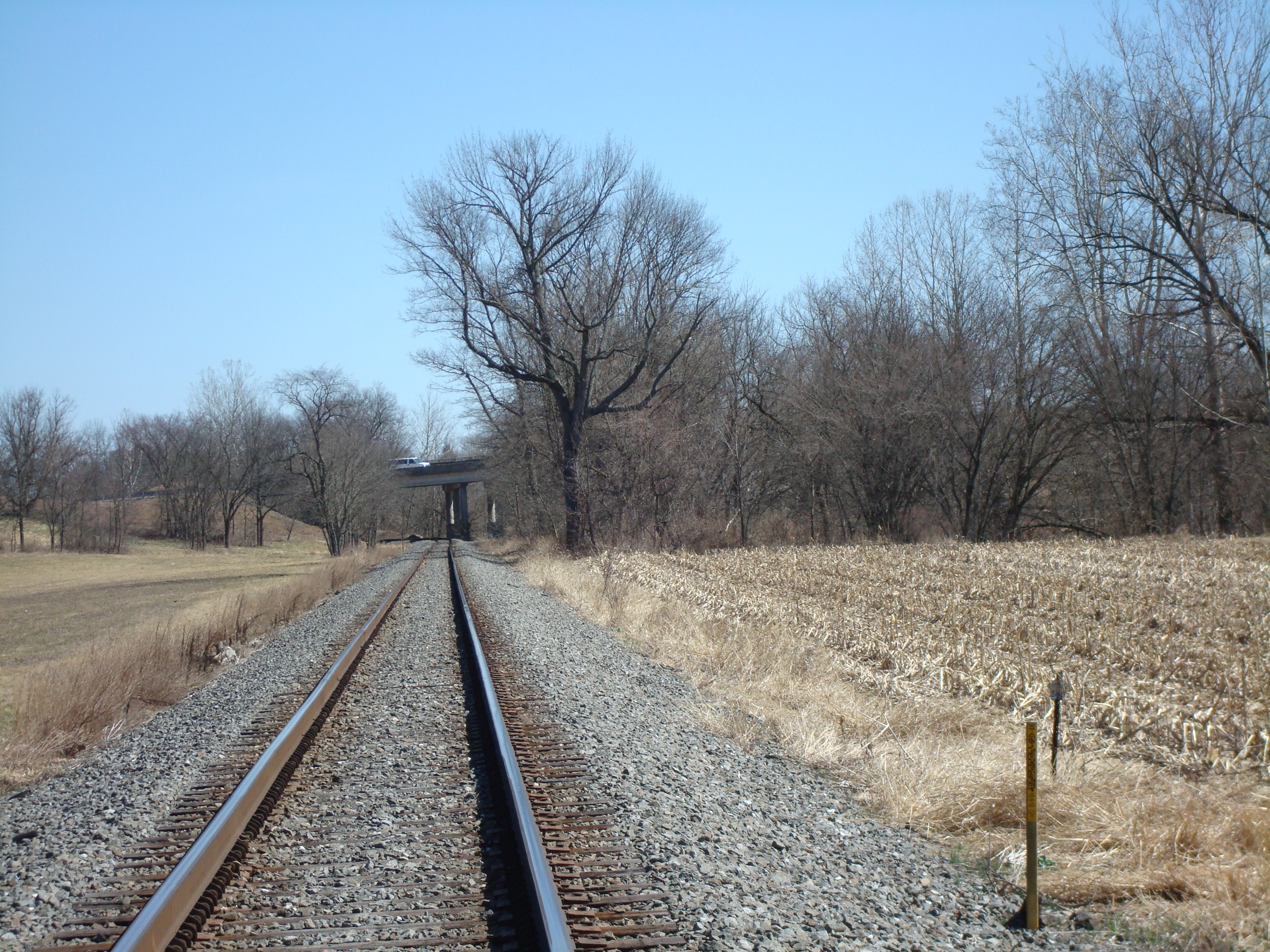
Whew, this was a hike. It’s about 5 miles each way via road and it may be a little further on the railroad tracks. In 1911 the roads weren’t paved yet, and Helena and Carrie were probably trying to avoid the mud by walking on the railroad.
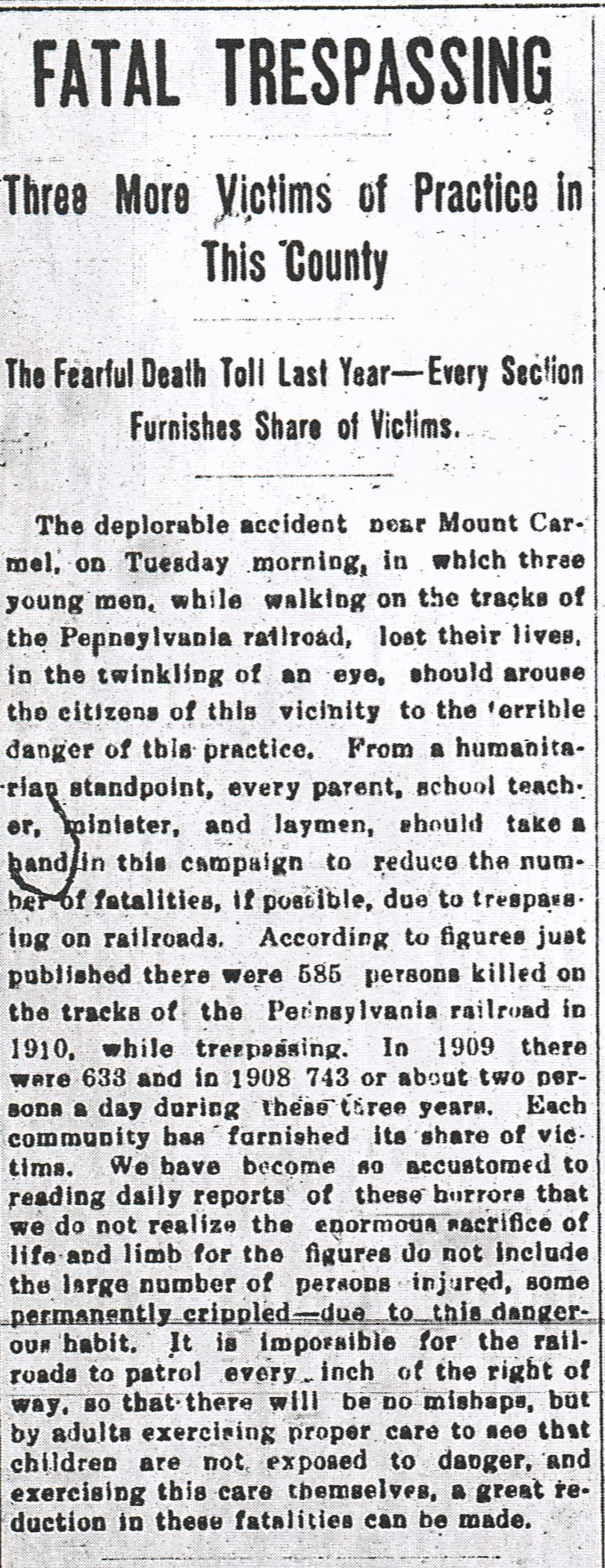
Apparently lots of people walked train tracks in those days even though it officially was considered trespassing and could be dangerous. Below are excerpts from an article in the local paper, the Milton Evening Standard, that was written less than two months before Grandma and Carrie walked the rails.
Article in Milton Evening Standards, January 19, 1911
FATAL TRESPASSING
Three More Victims of Practice in the County
The Fearful Death Toll Last Year—Every Section Furnishes Share of Victims
The deplorable accident near Mount Carmel on Tuesday morning, in which three young men while walking on the tracks of the Pennsylvania railroad lost their lives in the twinkling of an en eye, should arouse the citizens of this vicinity to the terrible danger of this practice. . .
According to figures just published there were 585 persons killed on the tracks of the Pennsylvania railroad in 1910, while trespassing. In 1909 there were 633 and in 1908 743 or about two persons a day during these three years. Each community has furnished its share of victims. . .
We have become so accustomed to reading daily reports of theses horrors that we do not realize the enormous sacrifice of life and limb for the figures do not include the large number of persons injured, some permanently crippled—due to this dangerous habit. . .
It is impossible for the railroads to patrol every inch of the rights of way, so that there will be no mishaps, but by adults exercising proper care to see that children are not exposed to dangers, and exercising this care themselves, a great reduction to these fatalities can be made.
15-year-old Helena Muffly wrote exactly 100 years ago today:
Saturday, March 4, 1911: Things certainly were stale today. Mother was so out of humor this morning and we poor kids received some scathy scoldings. We usually do nearly every Saturday, or I do at least. I have a mania for teasing Jimmie, and when I do I get some growling. If you see any mistakes in this entry, don’t let on you see them.
Her middle-aged granddaughter’s comments 100 years later:
At least Grandma’s mother didn’t chase her with a stir stick like she did the previous Saturday. Jimmie is Grandma’s 6-year-old brother. Siblings always tease each other but, with more than a 9-year age difference, it’s a little surprising that Grandma and her brother apparently routinely annoy each other so much that their mother feels a need to get involved.
—————
It sounds like Grandma believes that someone else is reading her diary. Was it her sister Ruth? . . . her mother?
15-year-old Helena Muffly wrote exactly 100 years ago today:
Friday, March 3, 1911: I was invited to a dance tonight, but didn’t go because I didn’t have any one to go with. Ruthie went to Helen Wesner’s party. I would have liked to have gone too, but I wasn’t invited. I guess I am not out yet. I’ll have to sleep alone tonight for it isn’t very likely that Ruthie will get home before daylight. She’ll be lazy tomorrow.
15-year-old Helena Muffly wrote exactly 100 years ago today:
Thursday, March 2, 1911: Dear me, what shall I write? Mrs. Hester was out this afternoon. I intended to work thirty-one algebra problems this evening or rather tonight but instead of that I only worked one. Perhaps I may get the remaining thirty tomorrow, but it is only perhaps.
Her middle-aged granddaughter’s comments 100 years later:
Sometimes I have a vague idea about what I might say about a diary entry—and then I discover something interesting that sends my post in a totally different direction. Today is one of those days—
I found a high school algebra textbook published in 1911 at the library and idly flipped through the pages while pondering—Should I include some example problems from the chapter on Simple Equations . . . or from the chapter on Quadratic Equations? And then I saw the problem on the Lusitania:
4. One ton of coal will make 8.7 tons of steam. If the Lusitania requires 1200 tons of coal a day for this purpose, how many tons of steam are required for an hour?
First Year Algebra (1911, page 157) by William J. Milne
Lusitania
Wait—Isn’t the Lusitania famous because it was sunk during World War I by the Germans in 1915? Why was the Lusitania in a textbook published in 1911?
And, as I sought answers, this post headed in a totally different direction.
The Lusitania was a British ship that made its first trans-Atlantic trip in 1907—and it periodically held the world record as the fastest ship to make the crossing. For example, in October 1907, it held the record for an eastbound trip with a time of 4 days, 19 hours, and 53 minutes. The average speed was 24 knots/hr. (27.6 miles/hr.).
(Cruise ships today don’t cross the Atlantic as quickly as they did a hundred years ago. It now takes at least 6-7 days to make the crossing. I guess that if someone wants to cross quickly they just fly.)
In the early 1900s there were several very fast ships that held the record at one time or another. They informally competed with one each other and the newspapers regularly reported on when the ships entered the New York harbor –or the harbors in England on eastward trips– since there was the potential with every trans-Atlantic voyage that the world record would be broken.
A hundred years ago the general public across the US knew about the Lusitania and were following its story even before it was sunk by a German torpedo. (And, the Lusitania was apparently considered a good topic for an algebra problem since it was a timely, high-interest topic that might motivate students ).
Algebra problems provide lots of hints about what was common knowledge a hundred years ago. For example, would you ever find a problem about molasses pumps and tubing in a text today? Well, it provided the context for the word problem that followed the Lusitania problem in the 1911 textbook:
5. A grocer paid $8.50 for a molasses pump and 5 feet of tubing. He paid 12 times as much for the pump as for each foot of tubing. How much did the pump cost? the tubing?
First Year Algebra (1911, page 157) by William J. Milne
15-year-old Helena Muffly wrote exactly 100 years ago today:
Wednesday, March 1, 1911:
Blustering March, month of spring,
We bid you welcome here.
You bring the sunshine and the flowers.
Hurrah for the third month of the year.
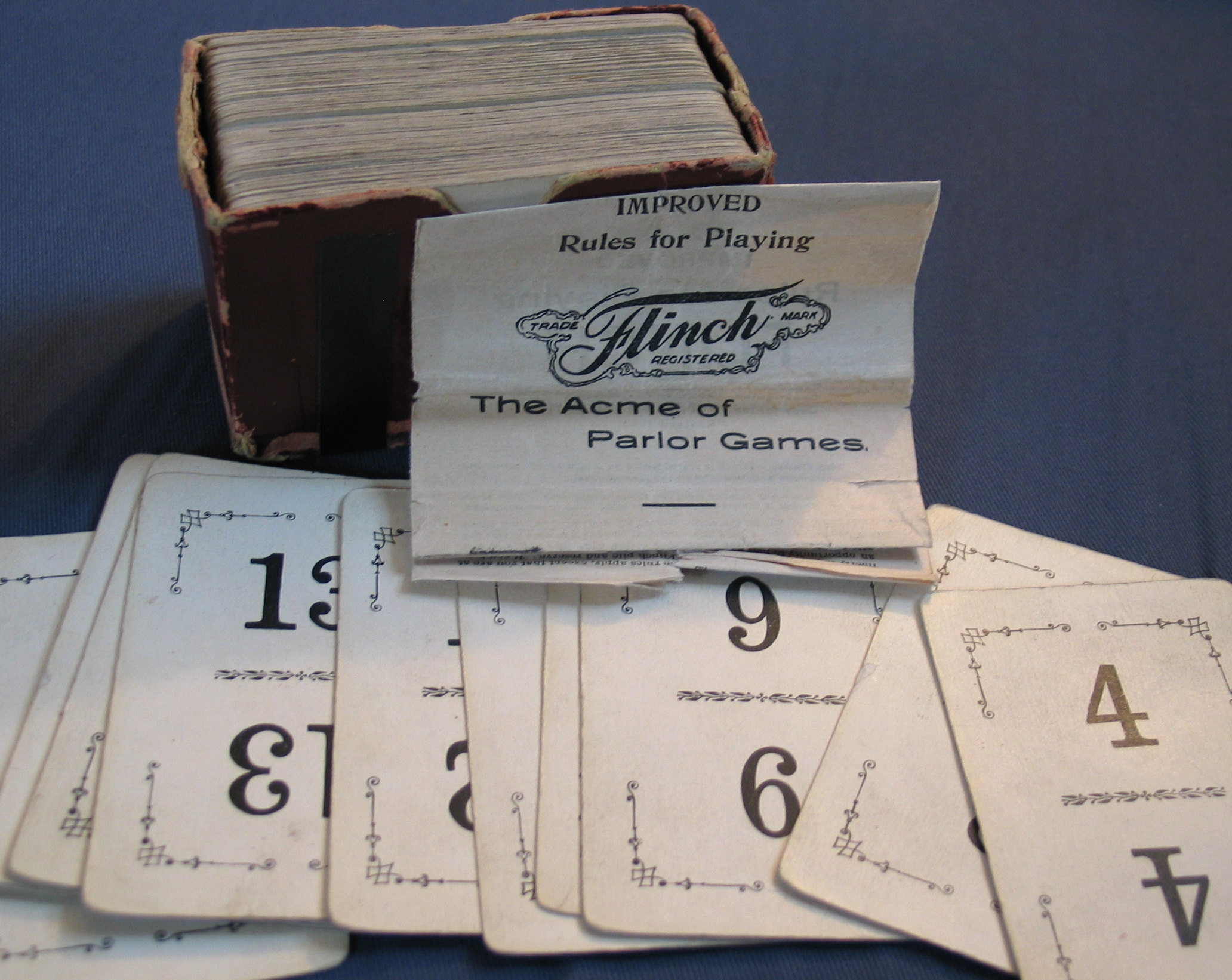
I was invited to dine out this evening and accepted the invitation. It was up at Gauger’s. My beauteous or rather vain sister was up also. It was, as I supposed in honor of the senior class. I had quite a pleasant evening. I played Flinch part of the time. My partner and I winning two games.
Her middle-aged granddaughter’s comments 100 years later:
A hundred years ago Flinch as a popular card game. According to Amazon’s website the game is still available– though I’m not familiar with it.
Flinch is played with a deck of 150 cards. The cards go from 1 to 15. It is kind of a cross between double solitaire and “go fish.” It can be played with partners—though partners are not necessary.
Each player receives a stack of face down cards. The first player turns over a card. If it is a “1” it is put in the center of the table. Otherwise the player puts it face up on the table in front of him- or herself.
Once the first person is finished the next player turns over a card. If the card is one higher than the top card in the center of the table, it can be placed there–or if the card is one above or below a card in front of another player it can be placed on top of that card. If the card doesn’t go anywhere, it is placed face up on the table. Play continues until a player goes out.
If a player fails to notice that a card can be put on a previously placed card, the other players yell, “flinch.”
—————-
Grandma’s sister Ruth and Bill Gauger were both senior’s at McEwensville High School They will marry several years later.
15-year-old Helena Muffly wrote exactly 100 years ago today:
Tuesday, February 28, 1911: I really cannot think of one thing that happened today of marked importance concerning my little world. One of the boys stopped school today.
Her middle-aged granddaughter’s comments 100 years later:
It’s amazing how much high school graduation rates have changed over the last one hundred years. In 1911 only about 20% of youth attended high school—and fewer than 10% graduated. Whereas, in 2010, about 90% of all students in Pennsylvania graduated from high school; and, the graduation rate for the Warrior Run School District (the district that now includes McEwensville) was 91%.
I wonder what the boy did after he dropped out of McEwensville High School. Even as a high school drop-out he had a higher educational level than most people in 1911.
Today the nation is focused on enacting policies that will ensure that all students graduate from high school “college and career ready”. Are schools better or worse now than a hundred years ago?
In Grandma’s day many people went on to lead successful lives with an 8th grade education. In my father’s day, a high school diploma was generally the minimal requirement for a good job. When I entered the job market, a bachelor’s degree was often a needed qualification. And, today it seems like many positions require at least a M.S.
15-year-old Helena Muffly wrote exactly 100 years ago today:
Monday, February 27, 1911: The roads were so muddy that I went up the railroad to school and came home that way. Besse was out this afternoon. Wish I had all of my lessons out for tomorrow especially my latin.
Her middle-aged granddaughter’s comments 100 years later:
It’s hard to picture how bad the mud must have been in the era before paved roads. Railroad tracks for the Susquehanna, Bloomsburg, and Berwick Railroad (S.B. & B. R.R.) crossed the Muffly farm.The route went from Watsontown to McEwensville and Turbotville and then continued east to Washingtonville, Bloomsburg, and Berwick.
My father says that Grandma always called the railroad the Sweet Bye and Bye.
According to an essay by the Columbia County Historical and Genealogical Society the Susquehanna, Bloomsburg and Berwick Railroad (S.B. & B.R.R.) was often called the ‘Sweet Bye and Bye’ because traffic was intermittent, and trains traveled at a slow speed and stopped at every hamlet and feed mill along the route. Sweet Bye and Bye is also the name of an old-time hymn.
There were flag stops at two feed mills between Watsontown and McEwensville (a distance of only 4 or 5 miles). One was at a hamlet called Pioneer–it’s just a group of 4 or 5 houses today–and the other was at Truckenmiller’s Mill which was located next to the Muffly farm.
The railroad was also sometimes called the Weak and Weary railroad. It was a financial failure because there were no major industries along the route.
The S.B. & B.R.R. no longer exists, but the track is still used by trains transporting coal to the Pennsylvania Power and Light (PP & L) power plant at Strawberry Ridge near Washingtonville.