Sweet Sixteen

16-year-old Helena Muffly wrote exactly 100 years ago today: 

 Tuesday, March 21, 1911:  It hardly seems possible, that I am really sixteen years old. Perhaps it was because I didn’t get my ears pulled. Mother gave me a dollar this morning as a birthday present. Dear mother, many thanks to you. A beautiful sun shone on my birthday as if to brighten my future pathway through life.

I hereby truthfully resolve to be a better and more useful girl in the future than I have been in the past, and may this birthday resolution never be broken, I sign myself, Helena Muffly, Mar. 21, 1911

 Her middle-aged granddaughter’s comments 100 years later:

 Grandma always considered March 21 to be a very special day. It was special for three reasons. In addition to being her birthday, it was the traditional first day of spring as well as her wedding anniversary. Her husband Raymond Swartz wrote in a short family history many years later:

On March 21, 1921, Helen Muffly and I were married at her home in Watsontown. We started farming on the home farm where we farmed for thirty years.

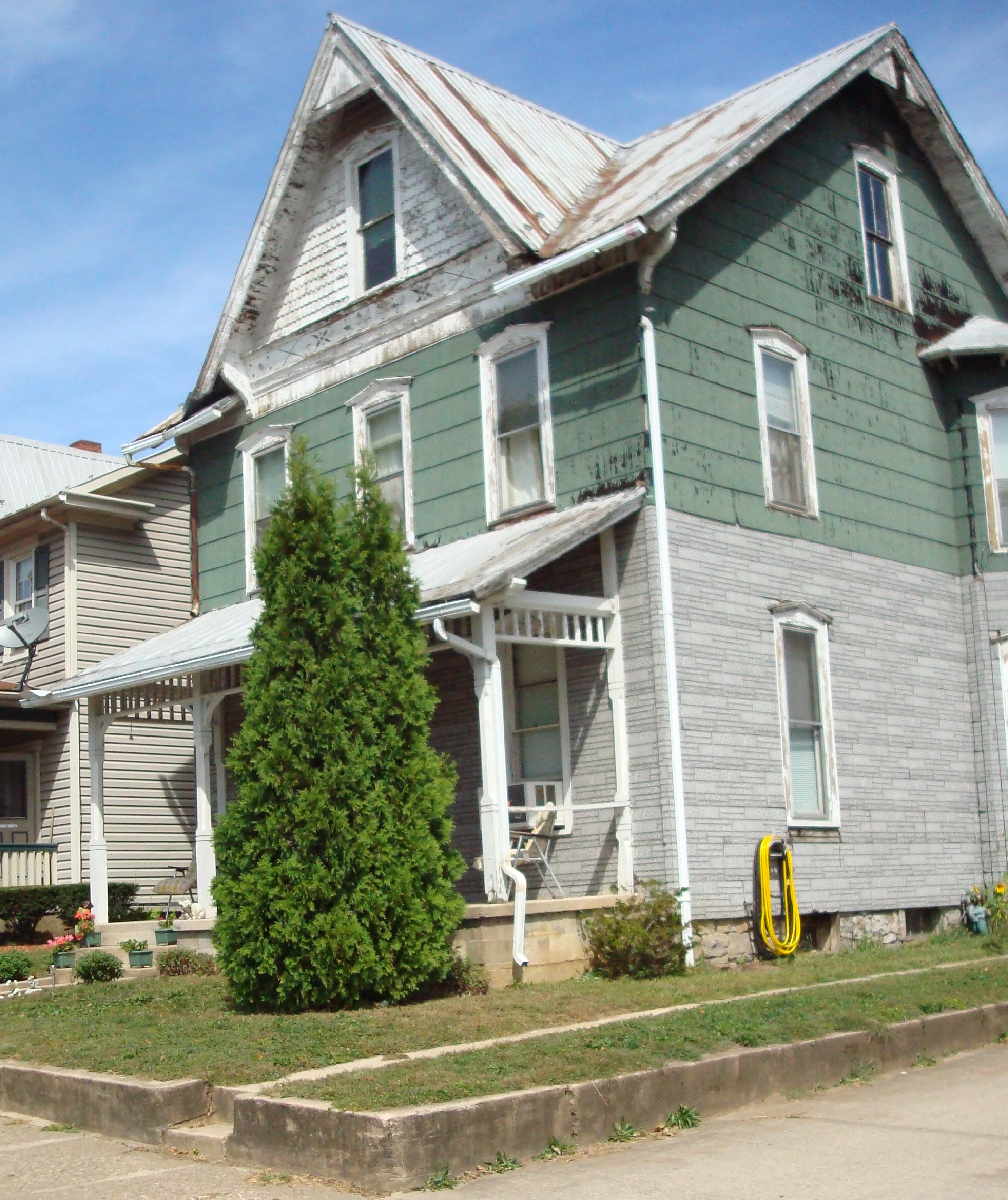
Recent photo of the house in Watsontown that the Muffly family lived in when Helen and Raymond married.

They got married at her family’s home on Pennsylvania Avenue in Watsontown. The Muffly family moved to Watsontown because her father had ‘retired’ from farming in the intervening years between the diary entry and the wedding.

Grandma apparently was going by the name Helen (instead of Helena) by the time she married. When my grandparents married, she was 26 and he was 22.

“Dainty” Apron Directions

15-year-old Helena Muffly wrote exactly 100 years ago today: 

Monday, March 20, 1911: Windy day, also snowy this morning. This was the last snow of winter unless we get some more before midnight. Today was Mollie’s birthday. I forgot to pull her ears. Carrie Stout was over this evening. She brought me a birthday present. It was a dainty white apron. Mother said, “It was only a patch.” Well I’ll have to say good-by to fifteen years and pass on to the next. Wonder if I will get any more presents.

Spring of the year, brightest of seasons.

Flinging grim winter into the past.

Leading us on to a happy vacation.

Making us joyous, while life can last.

First day of spring for thee I have waited.

Impatiently, eagerly, day after day

Longing, yet dreading the approach of my birthday.

Sorry, yet glad, when it passes away. 
Her middle-aged granddaughter’s comments 100 years later:

Grandma’s sixteenth birthday will be the next day (March 21). Mollie was Grandma’s cow, and it is mentioned several places in the diary. Grandma’s parents must have given her Mollie as a calf (probably as a birthday present a couple years before this diary entry). Each year in the diary Grandma mentions when Mollie had a calf. If the calf was a male, Grandma was allowed to sell it and keep the money.

—————

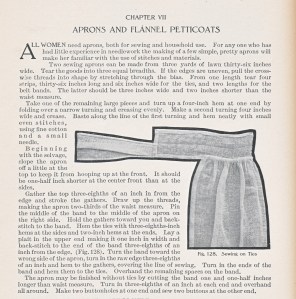
I wonder if Grandma’s friend Carrie made the apron for her. Grandma’s mother must have been a practical person who prefered large bib aprons that provided lots of protection from spills–but if you’d like to make a dainty apron I found the directions in a 1911 book:

Two sewing aprons can be made from three yards of lawn thirty-six inches wide. Tear the goods into three equal breadths. If the edges are uneven, pull the cross-wise threads into shape by stretching through the bias. From one length tear four strips, thirty-six inches long and six inches wide for the ties, and two lengths for the belt bands. The latter should be three inches wide and two inches shorter than the waist measure.

Take one of the remaining large pieces and turn up a four-inch hem at one end by folding over a narrow turning and creasing evenly. Make a second turning four inches wide and crease. Baste along the line of the first turning and hem neatly with small even stitches, using fine cotton and a small needle.

Beginning with the selvage, slope the apron off a little at the top to keep it from hooping up at the front. It should be one-half inch shorter at the center front than at the sides.

Gather the top three-eights of an inch in from the edge and stroke the gathers. Draw up the threads, making the apron two-thirds of the waist measure. Pin the middle of the band to the middle of the apron on the right side. Hold the gathers toward you and back-stitch to the band. Hem the ties with three-eight-inch hems at the sides and two-inch hems at the ends. Lay a plait in the upper end making it one inch in width and back-stitch to the end of the band three-eights of an inch from the edge. Turn the band toward the wrong side of the apron, turn in the raw edge three-eights of an inch and hem to the gathers, covering the line of sewing. Turn in the ends of the band and hem them to the ties. Overhand the remaining spaces on the band.

The Dressmaker (The Butterick Publishing Company, 1911)

The directions call for lawn cloth.  Lawn is a light, fine, high-thread count linen or cotton cloth.

Self-Flattery

15-year-old Helena Muffly wrote exactly 100 years ago today: 

Sunday, March 19, 1911:  I went to Sunday school and church this morning. I saw such a pretty baby today with a head fairly covered with thick auburn hair. It struck me that I looked something like that baby when I was about her age. I had so much hair then with a bit of waviness in it, and dimples in my smiling cheeks, but this is enough flattery for one night. I must scratch gravel off  and to bed, and to my sweet beautiful dreams, so vivid and real.

The Facts of Life

15-year-old Helena Muffly wrote exactly 100 years ago today: 

Saturday, March 18, 1911:  I got up with a funny feeling this morning, not just exactly sleepy, but rather achy like I was to wash up the oil cloths today but I didn’t do it. Momma said something about she wouldn’t let us go to parties if we couldn’t do any work afterwards. Of course it was all rot.

Her middle-aged granddaughter’s comments 100 years later: 

Grandma was feeling achy and referred to oil clothes. I think that she has pre-menstrual cramps. In the old days pieces of sheep hides (oil clothes) were sometimes used to make homemade, reusable sanitary pads.

Mothers talked with their daughter’s about menstruation and the facts of life then as now. An article in the February 15, 1911 issue of Ladies Home  Journal gave mothers suggestions for talking with their daughters about the facts of life:

Many mothers are asking me, “Please tell me what to tell my daughter, who is approaching her teens.”

As in telling the “story of life” the main purpose has been that of awakening reverence for fatherhood and motherhood, so now it is reverence for self that must be taught.

The mother may say:

“Dear little Daughter, I’ve already told you what it is to be a mother, haven’t I? How mothers live for their babies and care for them; and you have begun to realize what a wonderful thing it is to be a mother. I want you to come and sit with my now while I tell you more about it.

——–

First your figure will begin to change. Little by little you will lose the angularities of childhood and your body will begin to take on gentle curves. In time you will outgrow your boisterous ways and become graceful in all your acts, expressing that gentleness of spirit which a true mother must have. Your will begin to care more about your appearance because you will want your children to love and admire you in every way.

And there will be still other changes. The little room must be prepared for its great work; so each month, special nourishment will go to that part of your body. In order that this work may not be interfered with it will be necessary for you to take special care of yourself at this time.

—————-

 It will, of course, be necessary for the mother to give her daughter detailed instruction as to her own physical care, but there should be nothing in this teaching to give the child a shrinking from what is before her. This is not a disease, as some have characterized it. It is one of the natural, physiological functions of the body.”

St. Patrick’s Day

15-year-old Helena Muffly wrote exactly 100 years ago today: 

Friday, March 17, 1911:  Today is St. Patrick’s day. The day to be green and feel green. Ruth and I went to Blanche Bryson’s party. We went with Rachel and Alvin Oakes, going out a lane, that I had never been in before, and because of this, I was goosey enough to tumble down. I had a lot of fun at the party and I suppose everyone else did too. We took our departure about half past one o’clock a.m.

Current Events: March 16, 1911

15-year-old Helena Muffly wrote exactly 100 years ago today: 

Thursday, March 16, 1911: It has been so biting cold today. We all crowded around the stove at school this morning, and about all I did was to shiver for I couldn’t study. Well I am shivering now, this room is rather cold. I must hurry off to bed. 

Her middle-aged granddaughter’s comments 100 years later: 

I’ve seen several lists of events that occurred during 1911. Two things of note happened exactly 100 years ago today:

(1) Nazi war criminal Josef Mengele was born in Bavaria (Germany) on March 16, 1911. He was the physician responsible for many deaths at the Auschwitz-Birkenau prison camp during World War II, and is sometimes called the “Angel of Death”. World War II seems like it happened very, very long ago. It’s kind of amazing that an infamous figure in that war was just an infant a 100 years ago. Mengele would have only been in his early 30s during the war—I don’t think that I ever thought about his age before, but I had pictured him being older.

Las Vegas a Hundred Years Later

(2) The city of Las Vegas was incorporated on March 16, 1911. It is the largest city founded during the 20th century in the U.S. It’s hard to imagine how parts of the west were still the “wild west” a hundred years ago–though I guess in a different way, today Las Vegas still is the wild west.

Neither of these events would have been news outside of their local community in 1911. Only subsequent events many years later made them become history timeline material.

Report Card–Grades Wonderful!

15-year-old Helena Muffly wrote exactly 100 years ago today: 

Wednesday, March 15, 1911:  It snowed last night, and the trees were covered thick with snow. My, but it was an exquisite night, but it soon vanished, for by noon the trees were as bare as ever. We got our reports cards today. Some of my marks were something wonderful. As a whole I seem to be a wonderful girl and something out of the ordinary.