A Visitor

16-year-old Helena Muffly wrote exactly 100 years ago today:

Tuesday, March 28, 1911: W.J. Dentler was up at our school awhile this morning. We hustled at our lessons but fortunately he left before we had any classes. He also came down to see Ruth and bid her good-bye I suppose.

I got an invitation to the commencement today, and now I’ll be in for getting another present. Alas my pocketbook.

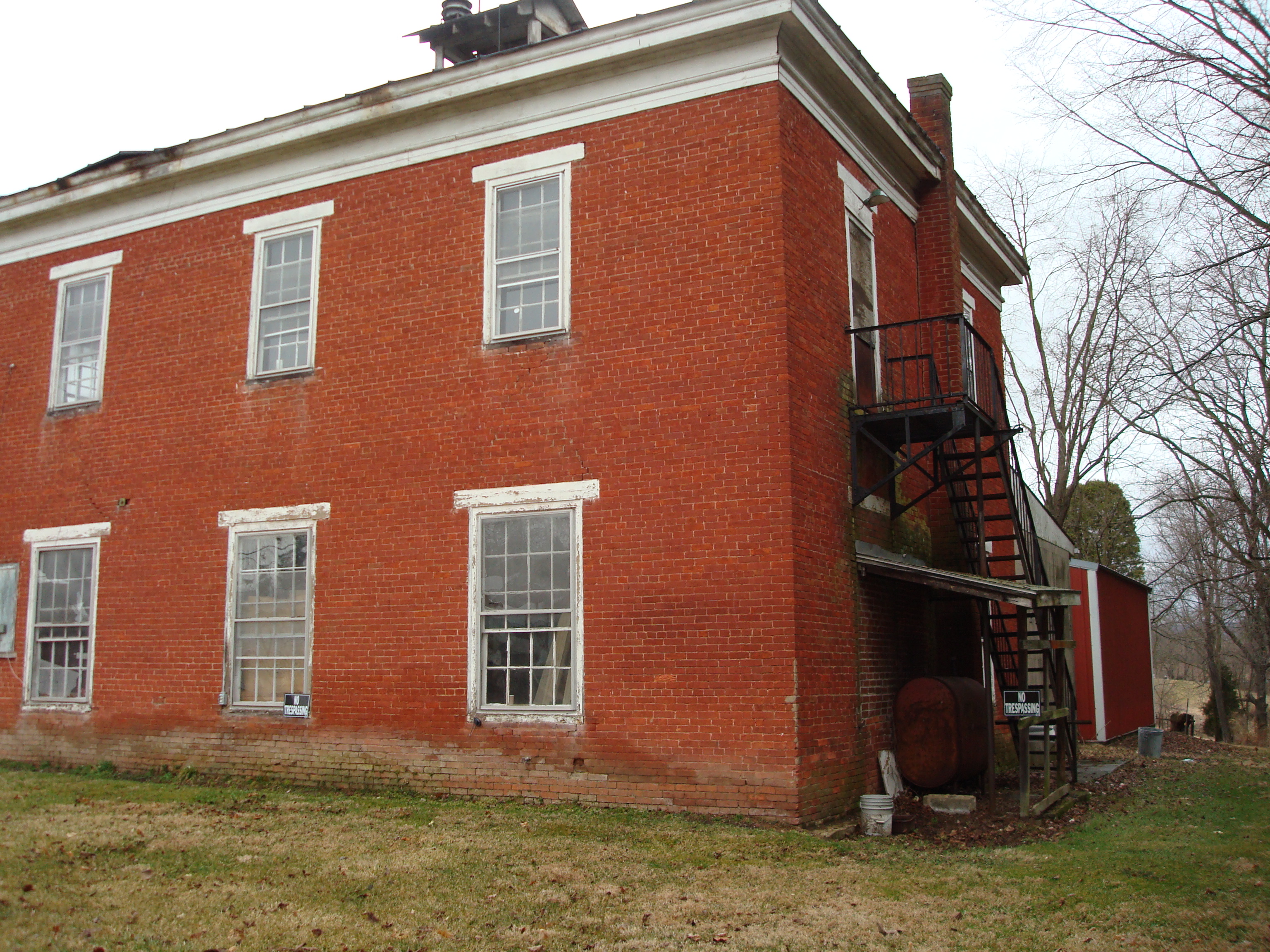
Recent photo of abandoned building that once housed McEwensville High School.

Her middle-aged granddaughter’s comments 100 years later:

Entries like this one are very frustrating. They raise many questions—none of which I’ve found any answers to.

W.J. Dentler is mentioned nowhere else in the diary and I have no idea who he is. Since W.J visited McEwensville High School, my first thought was that he was  a school official (country superintendent, school board member), but then Grandma discusses him coming to the Muffly farm to say good-bye to her sister Ruth.

Was W.J. a former or potential beau of Ruth’s? Where was he going?  Maybe he was someone who graduated from the high school a year or two prior to the diary entry—and came back as an alumni to visit.

Two days previously Grandma’s diary entry mentioned Ruth “chasing”  another guy—James Oakes. It seems like there may have been some sort of mismatch between the guys that Ruth thought were cute and the guys who thought she was cute. (Ah—I’m glad that I’m past all of intrigues of the teen-aged years.)

Spring Rain

16-year-old Helena Muffly wrote exactly 100 years ago today: 

Monday, March 27, 1911:  I got caught in a rainstorm while coming home from school this evening, but I soon got out of it. Bessie was out this afternoon to freshen Rastus up with some news.

Entertaining a Caller

15-year-old Helena Muffly wrote exactly 100 years ago today: 

 Sunday, March 26, 1911:  Went to Sunday school and church this afternoon. Mother is busy reading a novel, and I’m making this entry in her room, because I can’t have the light. Ruthie has the honorable James B. Oakes down in the sitting room, but she had to go after him or he wouldn’t have been here. Papa is down there also, so nothing will happen. Tee hee, poor me.

Her middle-aged granddaughter’s comments 100 years later: 

Grandma’s father apparently believed that it is appropriate to stay in the living room when a beau was visiting one of his daughters—though parents in 1911 did not always chaperone. The May 15, 1911 issue of the Ladies Home Journal had a question and answer on this topic.  

Unchaperoned While Entertaining a Caller

When a young man calls upon my daughter in the evening is it necessary for me to remain in the room during his call? I have been in this country only a short time.

French Mother

In this country young girls are allowed far more liberty than in France. The fact that your daughter is trusted to act as she should makes her worthy of the trust in the majority of cases. I should suggest that you receive your daughter’s guest with her, and, after remaining for a few minutes, leave the young people to enjoy each other’s society. If this is not convenient go into the room during the call and leave again after exchanging a few words with the young man. The idea to be conveyed is that a young’ girl’s parents take an interest in all that concerns her. A mother, therefore, is expected to wish to become acquainted with all those in whose society her daughter is thrown.

Hair Rats and the Triangle Shirtwaist Factory Fire

16-year-old Helena Muffly wrote exactly 100 years ago today: 

 Tuesday, March 25, 1911:  I did a wee bit of work this morning. This afternoon I manufactured a rat, it’s quite harmless though, and of course I tried its effect, but it didn’t agree with my fastidious sister. I’m not sure whether I’ll wear it very much now or not.

Her middle-aged granddaughter’s comments 100 years later:

Today Grandma is focused on her own small world. How can she make her hair look better? . . .and would a hair “rat” be the solution to her problems?  Yet a horrific event was taking place less than 200 miles away in New York City–the Triangle Shirtwaist Factory Fire.

(Please forgive me if this post just doesn’t work. Somehow things as trivial as a hair rat and as consequential as the fire don’t seem like they should be mixed together–but the diary entry seemed like it needed an explanation and the fire is just too important to ignore. )

Triangle Shirtwaist Factory Fire

A hundred years ago today 146 people, mostly young women, died when the building they worked in caught fire. The factory was on the ninth floor and some doors may have been locked to keep the women from stealing or sneaking out to take breaks.

The nation (including central Pennsylvania) was horrified by this disaster. A hundred years ago the small towns that dotted the Pennsylvania landscape were filled with factories that–like the Triangle Factory–sometimes had poor working conditions. An outcome of the fire was a mass outcry for better working conditions. This led to more support for unions and  the passage of industrial safety laws that improved working conditions for all.

If you are interested in learning more about the fire and its outcomes, the Kheel Center at Cornell University has a really nice remembrance site with lots of photos and survivor interviews.

Triangle Shirt Factory Fire--March 25, 1911 (photographer unknown)

—–

Hair Rats

A ‘rat’ was used to make it look like a person had more hair than she really had. A rat (which was made out of one’s own hair) was tucked under  hair when it was pinned up to make it look puffier.

Grandma would have collected her own hair by gathering shed hair that had accumulated in her brush.  When she had enough hair she would have rolled it into an oblong and then placed it into a small piece of hair netting. A few stitches would have then held it all together.

Grandma must have been trying to create a stylish hairdo—I wonder if she ever actually used the rat since her sister apparently made fun of how she looked.

The Play Was Interesting . . . Or Not

16-year-old Helena Muffly wrote exactly 100 years ago today: 

Friday, March 24, 1911:  Ruth and I went to a play tonight or rather I went with her. Carrie Stout went along with us. It was up at the Town Hall, given by the senior class of Turbotville. I thought it was very interesting, but Rufus didn’t agree or didn’t seem to agree. I suppose by that she wanted it distinctly understood that her queenly presence had attended many better plays than that insignificant one.

Young People and Marriage

16-year-old Helena Muffly wrote exactly 100 years ago today: 

Thursday, March 23, 1911:  Ruth and I received an invitation to the wedding. But oh dear me it is two wks. off. It took a streak of being cold today. This is such uncertain weather. Hope I will be warm on the sixth for then I intend to have some fun.

Her middle-aged granddaughter’s comments 100 years later:

Grandma seems excited about getting an invitation to the wedding of a senior in her high school. I wondered what people thought made a good marriage a hundred years ago. I found an article in a 1911 issue of Ladies Home Journal about marriage.  Just as we do now, older people worried about young people making good decisions about relationships. Some of the concepts, suggestions, and concerns seem incredibly modern—others extremely quaint.

 Our Young People and Marriage

Whether it is because of the increase in divorce or whatever it is, we are hearing a great deal these days about new forms of the marriage relation or changes in our present form of marriage. With all these suggested changes there is always sounded one note: that monogamy as we call the present sex relation of marriage of one man to one woman, and vice versa, was forced upon the world by the authority of a church, or by stern moralists who were regardless of the finer aesthetic interests of human nature. And then generally follows some argument, carefully put into the form of a question, as to whether the love feeling, the love relation, could not be better realized if the present yoke, the present form of marriage, which has been put upon men and women, were shaken off in part if not in whole. 

To those of us who have lived a few years all these alternative arrangements between men and women that are suggested are read with interest, perhaps, and then dismissed. We know that all these brand-new and novel suggestions have been tried and found wanting. But to the minds of the younger people they are new, and to their minds also they bring thoughts that are dangerous unless healthfully met. The ideas, generally very seductively put, of what one writer will call “trial marriage”, another will call “experimental marriage,” a third will call “a ten-year arrangement,” and a fourth will base upon that meaningless, but more alluring word “affinity”—all these are tremendously fascinating to a young developing mind. It is all very well for us elders to “pooh-pooh” these ideas and dismiss them as unworthy of thought, but the young do no “pooh-pooh” them, and they are not dismissing them. We ought to wake up to the fact that certain questionings about the present form of the marriage relation have not only fallen into the minds of our young people, but that they are also resting here, and in some instances actually taking root. This is particularly true of young girls. What we need to do, whenever one of these wonderfully interesting, and novel proposals (for such they are to the young) finds expression, is to take down our histories of the world and read a bit to our young people, and show them that these seemingly new ideas are not new: that they have all been tried: and that the poor, lumbering, halting human race has, after all, found—not because in the nature of God said it, not because moralists said it, but because in the nature of things it is so—that the faithful and steadfast relation of one man and one woman is the best and only relation that has stood the test of time and of practically all peoples. And to our young girls should it be particularly pointed out that it is the only sound relation on the interest of women, because if other relations were tried women would inevitably be the first and the greatest sufferers.

Ladies Home Journal (August 1911) 

—————————–

An aside to those of you who managed to get through that dense article and are still reading—

Every time I read Ladies Home Journal articles from 1911 I’m amazed at how hard they are to read—long paragraphs, complex sentences, and difficult words. I put the above 1911 text into the “SMOG” readability tool—and found that the grade level was 15.3 years. Text from recent issues of the Ladies Home Journal is at about an 8th grade level. The Journal then as now, was a mass circulation women’s magazine. It’s absolutely amazing how well most women could read a century ago. The schools must have been doing something right!

Median Age at Marriage–Then and Now

16-year-old Helena Muffly wrote exactly 100 years ago today: 

Wednesday, March 22, 1911:  The events of the day are not worth the time to mention them. I am waiting and hoping to get a bid to the wedding.

Her middle-aged granddaughter’s comments 100 years later:

Other diary entries indicated that Edith (last name unknown) was planning to marry Harry Reynolds. I assume this is the upcoming wedding that Grandma was referring to. Edith and Grandma’s sister Ruth were both seniors at McEwensville High School.

Edith was probably about 18 years old. I’ve heard that the average age when people get married has increased a lot over the years. Until I did a little research I assumed that 18 probably was a fairly typical marriage age a hundred years ago.

I was surprised to learn that in 1910 the median age at first marriage  was 21.6 for females and 25.1 for males.

The median marriage age steadily decreased until the middle of the 20th century. In 1950, it was 20.3 for females and 22.8 for males.

The trend then reversed and by 2007, it had increased to 25.0 for females and 26.7 for males–and preliminary estimates for 2010 suggest that it has continued to climb to about 26 for females and 28 for males.

Another surprise for me was how the age gap between females and males has decreased over time. On average in 1910 women were about 3 1/2 years younger than their spouses. (This statistic makes it seem even more surprising that Grandma and Grandpa married each other. They also had a 3 1/2 year age gap–but she was 3 1/2 years older than him.) Now the average age gap is probably slightly less than 2 years.