Old McEwensville Photos

16-year-old Helena Muffly wrote exactly 100 years ago today:

Tuesday, April 4, 1911: Not very much for today. It still continues to be so chilly and so dreary. To increase these conditions it had to rain this afternoon. I have to write about the weather, when I have nothing else to write. I don’t believe Thursday is going to be the beautiful day I want it to be!

Her middle-aged granddaughter’s comments 100 years later:

Grandma was hoping for nice weather on Thursday because it would be the last day of school. The commencement ceremony for her sister and other seniors at McEwensville High School will also take place that day.

——-

McEwensville in the Early 1900s. Source: Watsontown, McEwensville, and Delaware Township: A Real Photo Postcard History. (Used with Permission)

Today I’d like to tell you about the best source of information about McEwensville and the surrounding area that I’ve found:

Watsontown, McEwensville, and Delaware Township: A Real Photo Postcard History by Robert Swope Jr. (2006; Publisher: Heritage Trails, PO Box 184, New Hope VA 24469; phone: 540-363-4537). 

They say that a picture is worth a thousand words—and this book is a wonderful example of the power of photos. I keep my copy on a shelf next to the reclining chair in my den. Often I flop into the chair after a long day and find myself reaching for this book—even though I’ve previously looked at every page many times before. The photos pull me back to the simpler days a hundred years ago and I feel like I can almost sense what it was like in McEwensville when Grandma was writing this diary.

This book contains lots of post cards from the early 20th century and is absolutely the best resource that I’ve found on the McEwenville of Grandma’s day. There are descriptive captions for all of the  post cards in the book, and it also contains an interesting and informative history of McEwensville.

In the early 1900s real picture post cards were very popular. Back then people were very interested in sharing the sites and activities of their towns with others.

This blog has  given me the opportunity to meet via technology many wonderful people. One such person is Robert Swope Jr., the author of this book. I contacted  Bob and he very generously allowed me to reproduce a few photos from the book. Most of them are on the Setting page. (I updated the page last night—so if you haven’t looked at it recently be sure to check it out.)

I would encourage anyone who is interested in what McEwensville was like in the early part of the 20th century to read this book. I purchased my copy at the Packwood Museum Gift Shop in Lewisburg. It is also available at other stores in central Pennsylvania.

The book can also be purchased  by calling the phone number listed above or from Bob’s  Ebay store. Just go to Ebay and search using the word “McEwensville”. The listing for the book will pop up.

Final Exams Are Stressful!

16-year-old Helena Muffly wrote exactly 100 years ago today:

Monday, April 3, 1911: One day is passed of the dreaded three, and they will soon be over, for we are having our final exams now. I’m so anxious about what I will make, fraid it won’t be any too high, and sincerely hope it will not be the opposite.

Her middle-aged granddaughter’s comments 100 years later:

A few minutes ago my college-aged daughter called and asked what I was doing. I said that I getting ready to write about Grandma’s final exams.

My daughter replied, “Final exams are stressful!”

Some things never change.

Baccalaureate Service

16-year-old Helena Muffly wrote exactly 100 years ago today:

Sunday, April 2, 1911: I went to Sunday school this morning. It was kind of lonesome this afternoon. Ruth and I went up to church this evening to hear the baccalaureate sermon.

Her middle-aged granddaughter’s comments 100 years later:

The school year is winding down—and the baccalaureate service for the senior class (of which Grandma’s sister Ruth was a member) at McEwensville High School occurred on this Sunday before graduation.

Since there were three churches (Baptist, Lutheran, Reformed) in McEwensville in 1911, I’m not sure where the baccalaureate service was held. The Baptist church building is long gone, but the buildings that housed Messiah Lutheran and St. John’s Reformed still exist.

2010 photo of St. John's United Church of Christ Church (In Grandma's day it was St. John's Reformed Church.)
2010 photo of the building that once housed Messiah Lutheran Church. It is now an antique shop.

Shopping Saturday–April 1, 1911

16-year-old Helena Muffly wrote exactly 100 years ago today:

Saturday, April 1, 1911:

Oh the dawning of April so warm and so bright

Recalls to our minds a glad welcome sight

Of seeing spring hats

Both large and both small

Quite ready for buyers to make them a call.

April fool’s day: I went to Watsontown this afternoon to do some much needed shopping. Rastus went to Milton, and didn’t get home until six o’clock, so I had to do all the milking.

Recent photo of downtown Watsontown. The same buildings probably were there a hundred years ago when Grandma was shopping. (I apologize for the poor quality of this photo--I shouldn't have taken it at dusk-- but it's the only one I have of this scene.)

Her middle-aged granddaughter’s comments 100 years later:

Throughout the diary there is a poem on the first day of every month. I’m still trying to figure out whether Grandma copied these poems from some source or whether she composed them. Previously I thought that she just copied them—this month I’m inclined to think that she composed the poem since both the poem and the entry discuss shopping.

——

A hundred years ago today Grandma was probably fretting about how much money she had spent on wedding and commencement gifts.

Grandma had  received an invitation to her friend Edith’s wedding.  And, her sister Ruth was graduating from high school—as well as other people she knew.  On March 28 she wrote, “I got an invitation to the commencement today, and now I’ll be in for getting another present. Alas my pocketbook.”

In many ways the young woman who wrote the diary seems very different from the elderly grandmother that I remember—but this is one place where I can really recognize my grandmother. She always tried not to waste money—I’ve even heard people say she was a tightwad–and both in her youth and as an elderly woman she would have worried about her “pocketbook”.

—–

It’s amazing how many different names Grandma used when referring to her sister Ruth–Rastus, Rufus, her highness, etc. etc. In today’s entry Grandma’s upset that her sister didn’t get home in time to help milk the cows–therefore she’s Rastus.

Kicked by a Cow

16-year-old Helena Muffly wrote exactly 100 years ago today:

Friday, March 31, 1911: I got kicked today, and it was such a violent one that it caused me to land on my back. It was by a modest cow, who happened to kick me and the bucket at the same time. I guess I was as much surprised as she was.

Her middle-aged granddaughter’s comments 100 years later:

Whew, that sounds like it hurt. I continue to be amazed at how seldom Grandma mentioned her routine farm chores in the diary. Even though she probably milked cows twice a day—it only merited recording when an unexpected or painful event occurred.

Old-fashioned Ways to Remove Ink Stains

16-year-old Helena Muffly wrote exactly 100 years ago today:

Thursday, March 30, 1911: I saw a rainbow this evening. I am trying to prepare myself for my final examinations. It’s a most difficult task when you don’t feel like it. I just happened to get a spot of ink on the bureau spread. I soon fixed it though.

Her middle-aged granddaughter’s comments 100 years later:

In the old days the top of a bureau (tall chest that held clothes) was covered with a decorative embroidered or crocheted cloth.  I suppose that Grandma was using a fountain pen—ball point pens won’t be invented for another forty years or so–to write the diary entry and a little ink dripped on the bureau cloth.

It can be tricky to successfully remove ink stains. A book published in the early 1900s explained how to get them out:

To Remove Ink Stains

Whenever ink is spilled, salt should be thrown upon it at once and renewed frequently until as much of the ink has been absorbed as is possible. It is impossible to give an unfailing rule for the removal of ink stains for the reason that the solvent to be applied varies with the composition of the ink. The following processes have, however, been pursued with success. . .

With Common Household Materials. Soak in lemon juice and salt, vinegar and salt, or pieplant juice and salt. [an aside: Pieplant is an archaic term for rhubarb.] Rub for a time, apply more salt, rub again, so continuing until the ink disappears. These acids may any of them exert a harmful action and should, therefore, in all cases, be tried upon a small sample of the goods, before being applied to the whole article.. . .

To Remove Ink Stains from Colored Goods. If ink is spilled on colored goods, wash in milk (either sweet or sour) and salt. Rub for a time, apply more salt, allow to soak, then rub again; continue this process until the stain disappears.

To Remove Purple Ink. Absorb all possible with blotting paper or salt, while the ink is fresh. Afterwards apply alcohol and glycerine in equal parts, and rub and sponge the stained spot with this mixture until the ink disappears.

Juanita Shepperd in Laundry Work for Use in Homes and School (1909)

——————-

The school year was shorter a hundred years ago than it is now.  Back then the school year ended in early April because families needed their children at home on the farm to help with the spring planting.

Tombstone Tuesday–McEwensville Cemetery

16-year-old Helena Muffly wrote exactly 100 years ago today:

Wednesday, March 29, 1911: Nothing of importance, not one thing. Ruth gave me a piece of her mind tonight. She wants me to keep my mouth shut, not that I say too much, for I am rather bashful, but I’m to breathe though my mouth instead of through my–Darn it, I don’t mean that, I mean vice versa.

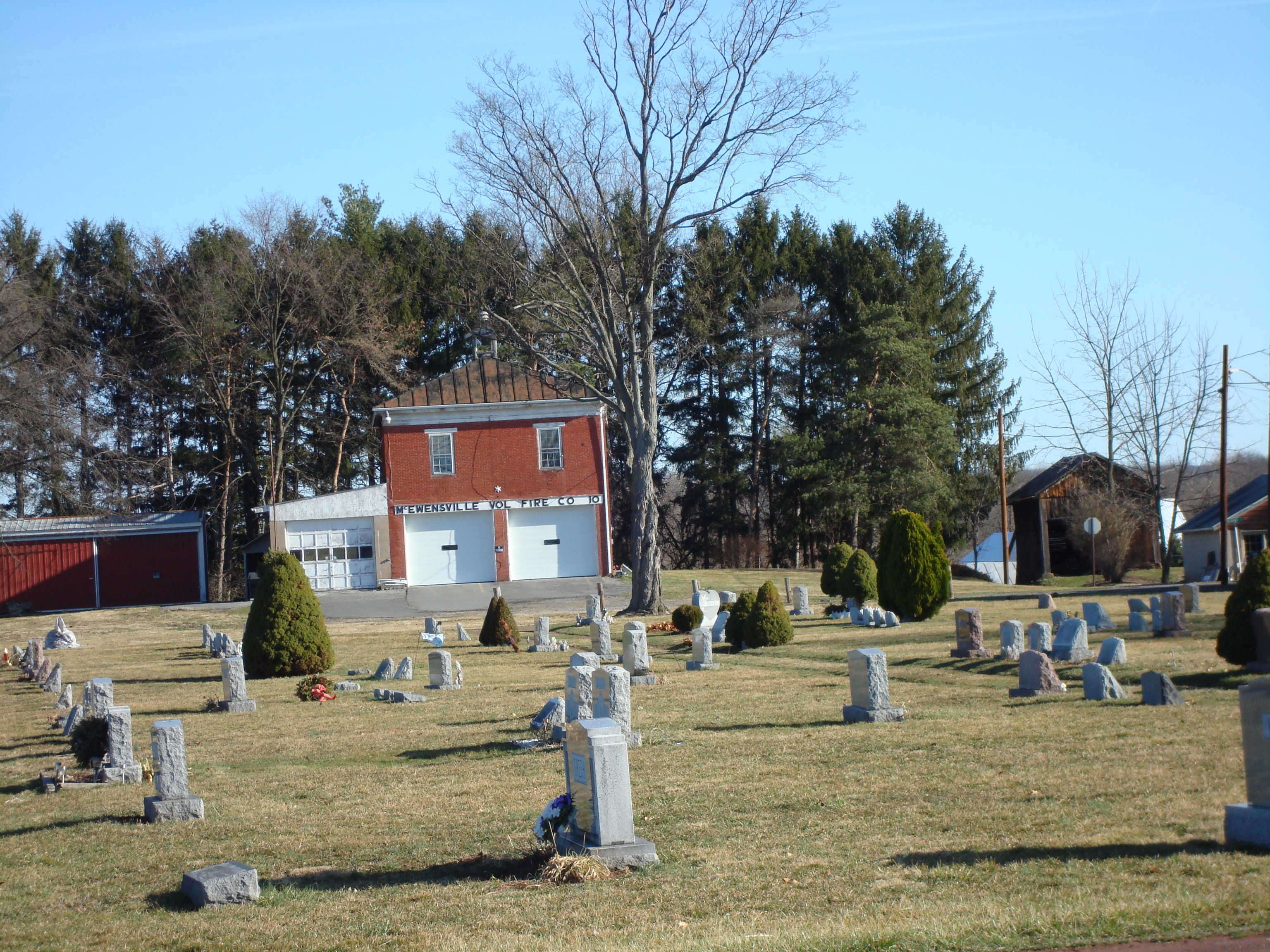
McEwensville Cemetery with old McEwensville High School building in background

Her middle-aged granddaughter’s comments 100 years later:

My son and I visited McEwensville over the week-end. We stopped by the abandoned building that once housed McEwensville High School. Now—just as it did a hundred years ago—the school sits next to a cemetery that is filled with the stories of the past. Each marker has its own story to tell . . .


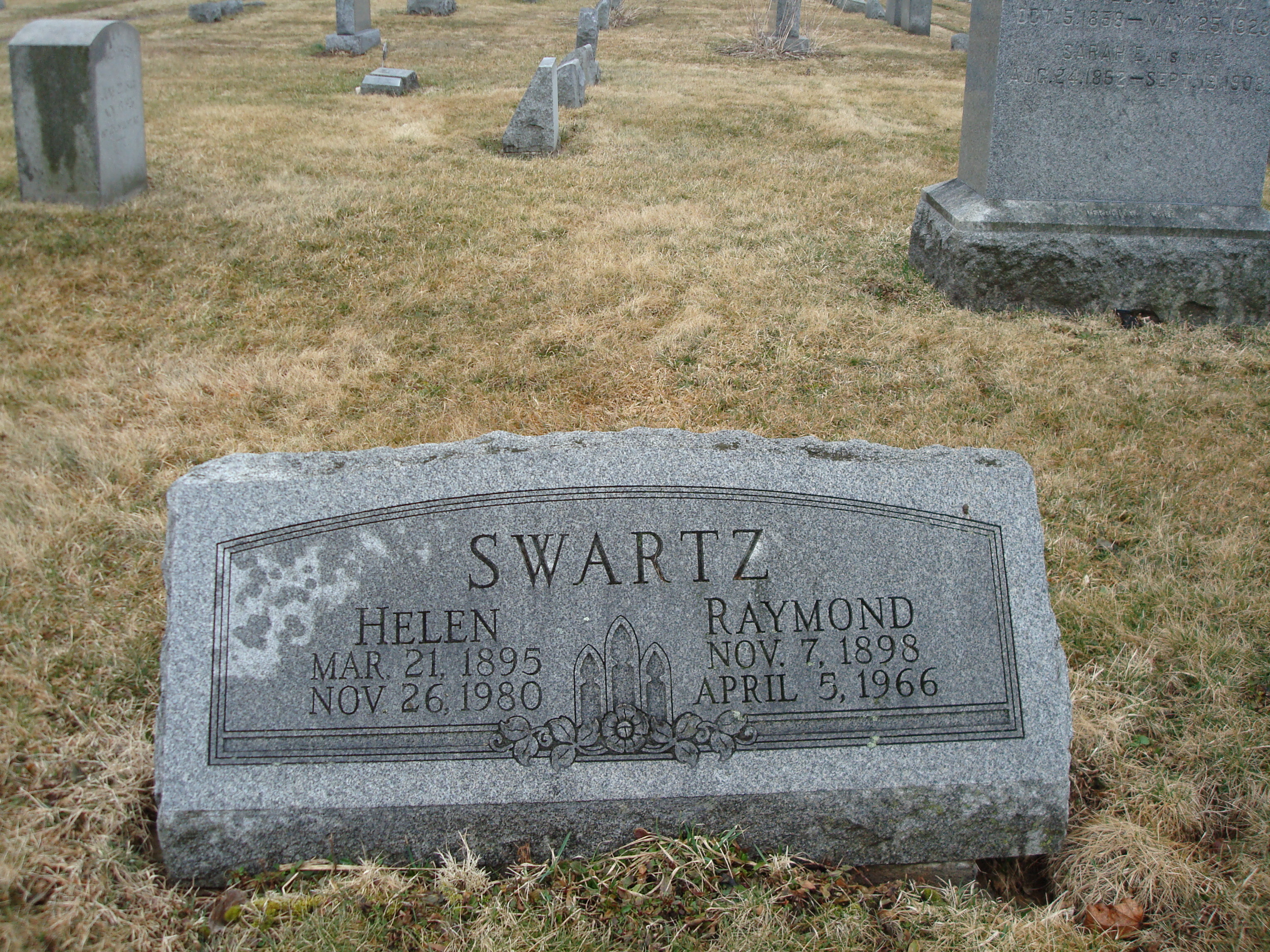
Tombstone of Helen(a) Muffly Swartz and Raymond Swartz

Earlier in the diary I mentioned that Grandma lived her entire life within a 5 mile radius of the farm her family lived on when she kept this diary. The same probably could be said for her sister Ruth.  I find it even more amazing how close together they are buried.

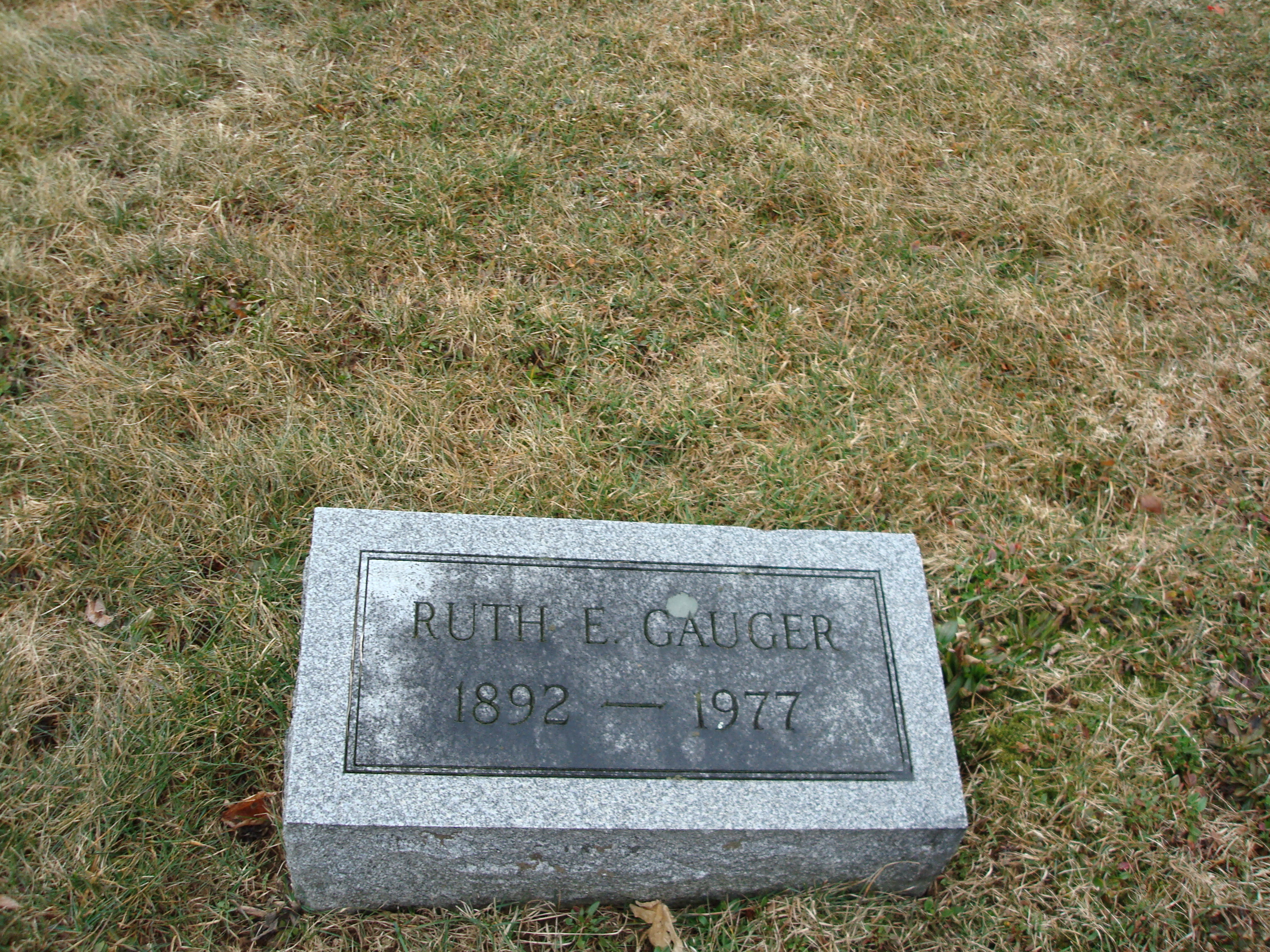
Grandma and Ruth are buried within 50 feet of each other in  McEwensville Cemetery–and within a few hundred yards of the school they attended when they were young. Both sisters married men who also attended McEwensville High school (and who are also buried in the same cemetery).

Tombstone of Ruth (Muffly) Gauger

Over the years there were times when Grandma and Ruth were close confidants and other times when they were less close; there were “spats” and reconciliations—but for perpetuity in McEwensville Cemetery they will remain close.