Bucolic Cows or Poor Water Quality?

16-year-old Helena Muffly wrote exactly 100 years ago today: 

Tuesday, July 25, 1911:  Cows got in the corn again, and as I am the cowboy I had to get them out. Tweetkins was here awhile this afternoon to converse with her dear Ruthie.

Advertisement in June 30, 1911 Issue of Farm Implement Magazine

Her middle-aged granddaughter’s comments 100 years later:

This is the second time during July that the cows got into the corn.

Tweetkins refers to Helen Wesner, who often went by the nickname of Tweet. She was a friend of Grandma and her sister Ruth—though it sounds like she came to visit Ruth (rather than both of the Muffly girls) a hundred years ago today—and that Grandma was unhappy about being excluded from the conversation.

I really like the drawing in the 1911 advertisement that I used to illustrate today’s entry. A stream flows through the farm that Grandma grew up on so the cows probably were pastured in a field that looked similar to the field in the drawing.

Recent photo of the stream that flows through the farm Grandma grew up on (though obviously it is a different time of the year). The old Muffly barn is in the background--and the cows were probably pastured in this field.

I especially like the juxtaposition of the old (bucolic cows) and the new (airplane and sign for a De Laval Cream Separator).

However, when I showed the picture to my daughter she said, “Those cows are in the stream. That’s bad.” She spent a year as an AmeriCorps volunteer with a water quality organization—and spent part of that year encouraging farmers to build fences (or plant natural barriers) to keep cows out of streams.

It’s interesting how an illustration can evoke different feelings in different people. (Personally I still think it shows a peaceful scene with bucolic cows.)
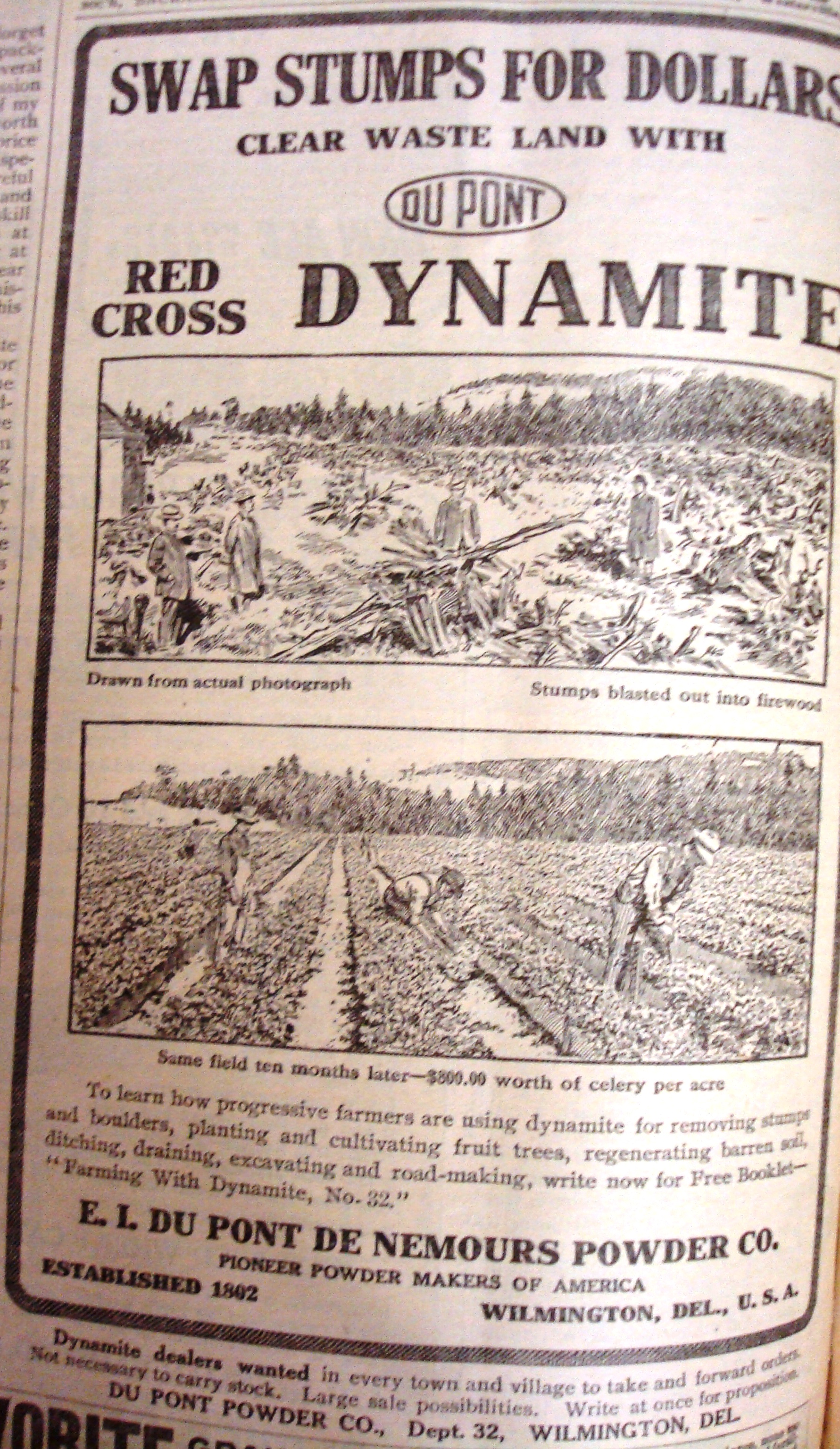
“Free Booklet– Farming with Dynamite, No. 32”

16-year-old Helena Muffly wrote exactly 100 years ago today: 

Monday, July 24, 1911: If I could go elsewhere sometime, I might be able to write something in this diary that would be interesting, and not have every entry fill of stale doings. I’ve expressed my feelings fully for tonight, so good-night.

Her middle-aged granddaughter’s comments 100 years later:

Sometimes I’m amazed at how much times have changed in the last one hundred years. Since Grandma didn’t write much today, I’ll show you an advertisement for dynamite that I found in the August 1911 issue of Farm Journal

The text in the paragraph says:

To learn how progressive farmers are using dynamite for removing stumps and boulders, planting and cultivating fruit trees, regenerating barren soil, ditching, draining, excavating and road-making, write now for Free Booklet–“Farming With Dynamite, No. 32.”

I guess that in some sections of the US, virgin forests were still being cleared and people were blasting out the stumps. Farmers may have also wanted to remove fencerows that contained trees to enlarge fields. Amazingly farmers apparently could just walk into a store and buy dynamite back then.  Whew, it’s scary to think about all of the environmental and safety issues.

No Beaus: So Jealous . . .

16-year-old Helena Muffly wrote exactly 100 years ago today: 

Sunday, July 23, 1911:  Ruth and I were alone here part of today, the rest of the family having gone a visiting. I went to Sunday school this morning. Miss Carrie came over this afternoon. She was telling us about some of her beaus. I’m so sorry for myself, and so very jealous.

Recent photo of house Grandma lived in when she was a teen.

Her middle-aged granddaughter’s comments 100 years later:

Some things never change–I can almost feel Grandma’s pain and jealousy that her friend Carrie has boyfriends and she doesn’t.

I’ve wondered what people did on dates a hundred years ago. A report by published by the City of Chicago in 1911 gave me a few clues about the youth in that city. I know that central Pennsylvania was very different from Chicago, but I still found the worries of the 1911 Chicago commission interesting:

Public Parks. During the summer time young girls frequent these places and sit around on the grass with boys, or go with them in the dark corners and among the shrubbery at night. . . The Commission recommends the removal of seats from the deep shadows.

Recent photo of the park in nearby Watsontown.

Amusement Parks. Incidents have come to their notice showing a laxity of supervision and of the moral dangers surrounding young girls who frequent these places for amusement.

Confectionary and Ice Cream Parlors. A city ordinance declares that it shall be unlawful for any person owning, conducting or managing candy and fruit stores or ice cream parlors to allow any male under the age of twenty-one years or any female under the age of eighteen to remain in such places between the hours of 10:00 p.m. and 7:00 a.m. unless accompanied by one or both parents.  . . The following typical instances came under the observation of investigators of the Commission during its study:

  •  October 10th. Ice cream soda and confectionary. Several girls and boys were seen in this place at 10:35 p.m. Two of the girls appeared to be 16, and 3, 18 years of age; the boys 14 to 20. One of the younger boys asked a girl to hurry up, and they would go to the hallway where they could talk by themselves.
  •  October 11th. Ice cream parlor. Eight girls and 5 boys were seen in this place at 10:50 p.m. The youngest of the girls appeared to be 16 and the youngest boy 17. Three girls who appeared to be 16 were acting very giddy.

The Social Evils in Chicago (1911)

Truck: Archaic Definition

16-year-old Helena Muffly wrote exactly 100 years ago today: 

Saturday, July 22, 1911: I put away some of my truck that adorned the sideboard and stand. Rufus went to Dewart this afternoon. Carrie and I went up to McEwensville this evening.

Recent photo of McEwensville at dusk.

Her middle-aged granddaughter’s comments 100 years later:

Truck: Worthless Stuff or Rubbish

The handwritten diary entry clearly said that Grandma put some of her “truck” away. At first I thought that I’d transcribed something incorrectly, but then I decided to check an online dictionary and discovered that an archaic meaning of truck is worthless stuff or rubbish.

Saturday Happenings

I wonder what Grandma and her friend Carrie Stout did in McEwesnville on a Saturday evening in July. My sense is that Saturday’s are pretty sedate in McEwensville today, but maybe it was livelier a hundred years ago.

In this entry (and in many others) Grandma refers to her sister Ruth as Rufus.

Dewart is a small town a few miles north of Watsontown. It is the first time it has been mentioned in the diary. I wonder why Grandma’s sister Ruth went there and how she got there. Did someone give her a ride in a buggy? . . .did she ride the train. . . or did she walk? (It would have been a long walk— about 4 or 5 miles in each direction).

Helping in the Fields

16-year-old Helena Muffly wrote exactly 100 years ago today: 

Friday, July 21, 1911: I was out in the field with my Daddy helping him with his everlasting work!

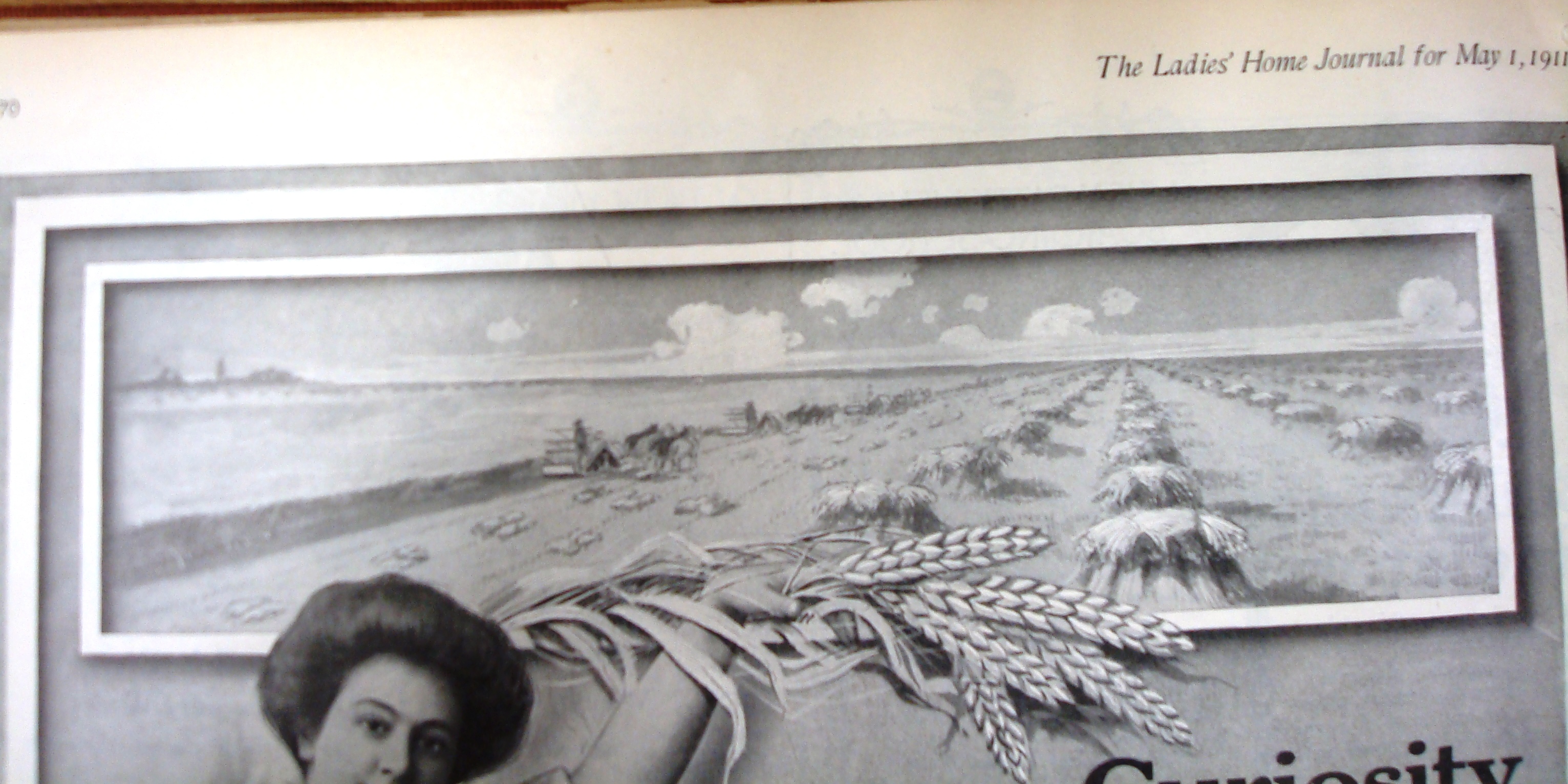
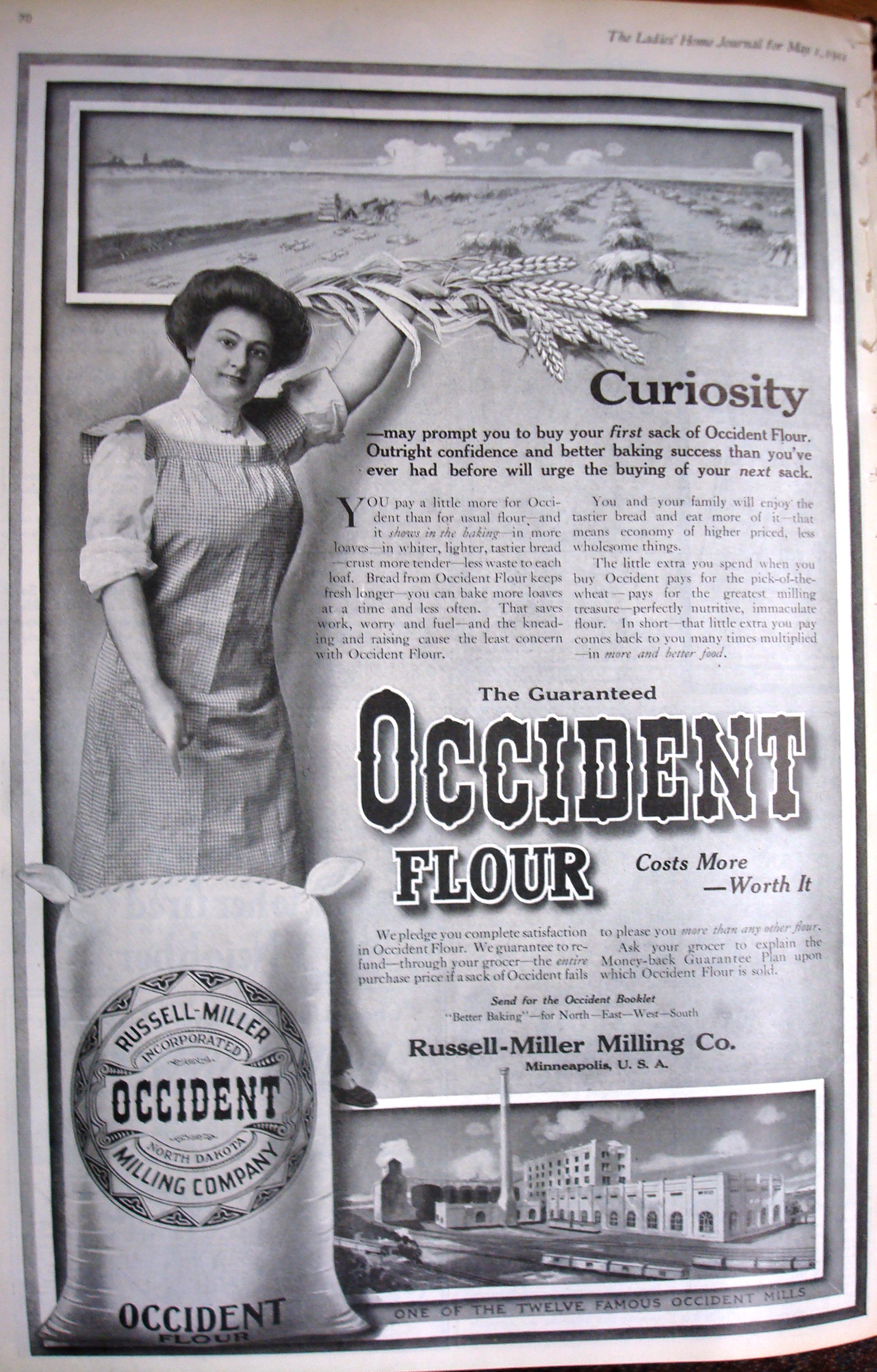
Drawing of grain being harvested in 1911 ad. (Click on photo to get a better view of the harvesting process.)

Her middle-aged granddaughter’s comments 100 years later:

I love this entry–and as someone who grew up on a farm, I can relate to Grandma’s feelings regarding everlasting work.

The small grains are harvested in July.  So Grandma probably was helping her father with some task related to the harvesting of wheat or oats. The grain would have been cut, and then put into sheaves for additional drying. At a later date, neighbors would help each other thresh the grain (separate the grain from the straw).

Here's the complete ad for Occident Flour. It appeared in the May 1, 1911 issue of Ladies Home Journal.

Saccharin Banned

16-year-old Helena Muffly wrote exactly 100 years ago today: 

Thursday, July 20, 1911: Everything is becoming so usual, nothing out of the ordinary at all.

Her middle-aged granddaughter’s comments 100 years later:

Since Grandma didn’t write much today, I going to go off on a tangent–

I was amazed to discover that the use of saccharin was banned in July 1911 by the Pure Food Referee Board in the U.S. Department of Agriculture. According to an article in National Food Magazine called “The Passing of Saccharin”:

 After July 1 when you partake of sweets you may know they are sweetened with sugar or syrup and not with a chemical. Saccharin, a poisonous derivative of coal tar and a near relative of benzoate, has been the popular sweetening agent employed by food adulterators, and heretofore, the government has permitted them to use it, despite the evidence of its harmfulness given by experts in Europe and America.. . .

It has a preservative power and is very cheap. But the Referee Board, which has been investigating Saccharin, has found it guilty of causing indigestion and otherwise injuring the system. Therefore, the government has issued a ruling entirely prohibiting its use after July 1.

National Food Magazine (June, 1911)

In 1912, the government reversed the decision and again allowed the use of saccharin, but it has remained very controversial. Studies in the 1960s and 70s suggested that it caused bladder cancer—and the government again attempted to ban its use in 1972. Diabetics, opposed the ban, and it continued to be allowed (during the 1970s through the 1990s products containing saccharin were required to include a warning label that it was a suspected carcinogen).

Fast forward to today—the nation is worried about obesity—and obsessed with low-calorie foods. Foods containing saccharin are now promoted as “healthy foods.”  For example, Pepsi and Coke promote the use of reduced calorie drinks in schools; and school vending machines are filled with these products as part of lucrative contracts.

Hmm—To frame it from a 1911 perspective: Are we talking about healthy drinks in the schools versus unhealthy drinks, or are we really talking about adulterated drinks versus sugar and corn syrup-laden drinks? (Personally I want to think that there is a third option that includes neither of the above. Somehow schools managed without vending machines filled with drinks in 1911.)

Law on the Farm

16-year-old Helena Muffly wrote exactly 100 years ago today: 

Wednesday, July 19, 1911: Nothing doing.

Her middle-aged granddaughter’s comments 100 years later:

I guess that it was a slow day on the farm a hundred years ago today, so I’ll tell you about an interesting question and answer column call Law on the Farm that I found in the July 1911 issue of Farm Journal. Here are two questions submitted by Pennsylvania subscribers and the answers:

Will of a Married Woman

Where a married woman dies, leaving her husband, but no children surviving, can she give all of her property by will to her niece to the entire exclusion of her husband?

Pennsylvania Subscriber

No; under the Pennsylvania Act of 1893, a married woman is given full power to make a will, provided, however, that nothing in the act shall affect the husband’s right of courtesy nor his right to take against the will as provided by existing laws.

I wonder if the answer would have been the same if a married man died, leaving a wife, but no children.

Here’s another question that was in the column:

Rights in Running Stream

Has the owner of land through in which a stream runs the right to empty slops and wash water into it or to dam the water up? If he does the latter, has the lower proprietor the right to go on the land and turn the water loose?

Pennsylvania Subscriber

Every one who owns land along a running stream owes to lower proprietors the duty not to pollute the stream, nor to dam up or divert the water so as to cause damage to the lower owners. The proper remedies of the latter, however are by an action for damages or an injunction, and the aggrieved parties are not entitled to come on the land of the upper proprietor and turn the water loose unless such action is urgently necessary to prevent serious injury.