Using Salt to Clean Hair

17-year-old Helena Muffly wrote exactly 100 years ago today: 

Monday, October 14, 1912:  There is nothing at all.

Her middle-aged granddaughter’s comments 100 years later:

A hundred-years-ago, Good Housekeeping magazine was chock-full of wonderful tips submitted by readers. Some probably worked—others probably didn’t.

Since Grandma had little to write a hundred years ago today, I’ll share an old tip for cleaning hair with you.

Light hair that has a tendency to become oily is only aggravated by frequent washings. A hairdresser told me that rubbing to the scalp a strong solution of salt and water and then drying the hair in the sun, would not only leave the hair light and fluffy, but would in the end cure the trouble. I have found this excellent, and of great use when I wish to have my hair looking its best in a short time.

R.V. M., California

Source: Good Housekeeping (August, 1912)

A Boring Sunday Afternoon

17-year-old Helena Muffly wrote exactly 100 years ago today: 

Sunday, October 13, 1912: Went to Sunday School this morning. Had to amuse myself this afternoon because no one came to see me and most of the family had gone away.

Source: Wikimedia Commons

Her middle-aged granddaughter’s comments 100 years later:

What might Grandma have done to amuse herself on a boring Sunday afternoon?

Read a book?

Bake cookies?

Go for a walk?

Do a little sewing?

Do a little embroidery?

Do her homework?  . .. . nah

Hulled a Half-Bushel of Walnuts

17-year-old Helena Muffly wrote exactly 100 years ago today: 

Saturday, October 12, 1912:  Was busy hulling walnuts today. I estimated them to have amounted to about half a bushel. My work in that is not finished yet.

Black walnuts that fell on a country road

Her middle-aged granddaughter’s comments 100 years later:

A half- bushel of walnuts is a lot to hull (remove the outer layer)—though it’s going to be a lot bigger job to crack them after they dry.

I also gathered and hulled walnuts this fall—though I only gathered a couple pounds.

This year I wore plastic gloves when I hulled them. Last year I stained my hands while hulling them—and it took at least a week to get rid of the ugly brown stains.

Walnut stains on my hands last year.

Previous posts on gathering and cracking walnuts

Hulling Black Walnuts

How to Crack Black Walnuts

Does Poor Air Quality Cause Colds?

17-year-old Helena Muffly wrote exactly 100 years ago today: 

Friday, October 11, 1912:  I’ve fully awakened to the startling fact that I’m getting another cold. It’s on its way. Had an exam in Caesar.

Maybe cough cream would help cure Grandma’s cold. Was this about the same thing as Vicks Vapor-rub? (Do they still make that?) Ad in November 1912 issues of Good Housekeeping magazine.

Her middle-aged granddaughter’s comments 100 years later:

This is the second cold that Grandma had during Fall, 1912.  On September 1, 1912 she wrote:

I have one cracker jack of a cold. . . . .

I wonder if lower air quality due to the use of a wood or coal stove for heating might have contributed to the current cold. This is what the October, 1912 issue of Ladies Home Journal had to say:

When “Colds” Begin

No sooner do we light our winter fires than we begin to have “colds” and we blame it on the colder weather. Doctors know, however, that it is not the lower temperature that brings on “colds.”

If cold weather produces “colds,” why is it that they do not have such diseases in the Arctic regions, where today they are absolutely unknown? Why is it that Peary and his men never had a single “cold” until they came back to American shores—and our dry-heated homes?

God never created the oxygen in the air to make us sick, but to keep us well. If the fresh air can do so much to heal the lungs attacked by tuberculosis or pneumonia how much more can it do for the healthy lung? If fresh air can heal a diseased lung can it not likewise keep well a healthy lung? It is the dust and the dry heat inside our homes that produce our “cold”: never the fresh air.  . .

Achievement Tests a Hundred Years Ago

17-year-old Helena Muffly wrote exactly 100 years ago today: 

Thursday, October 10, 1912:  The whole school was examined today in order to find out our deficiencies. I know what mine is.

Recent photo of building that once housed the McEwensville School.

Her middle-aged granddaughter’s comments 100 years later:

We hear so much today about state tests being used for accountability purposes. I’ve always thought that the use of tests to see how students were doing was a relatively new phenomenon—but apparently the use of standardized large-scale assessments has been around for at least a hundred years. What as the test that Grandma took like? . . . and what were her “deficiencies”?

This is the second time in the diary that Grandma has suggested that schools were somehow evaluated for quality. The previous year, on September 29, 1911, she wrote:

Teacher has rearranged our classes, and now we’ll have the program every now and then to see where our class comes.

Head in a Muddle

17-year-old Helena Muffly wrote exactly 100 years ago today:

Wednesday 9, 1912:My head is all in a muddle, and I hardly know how to think.

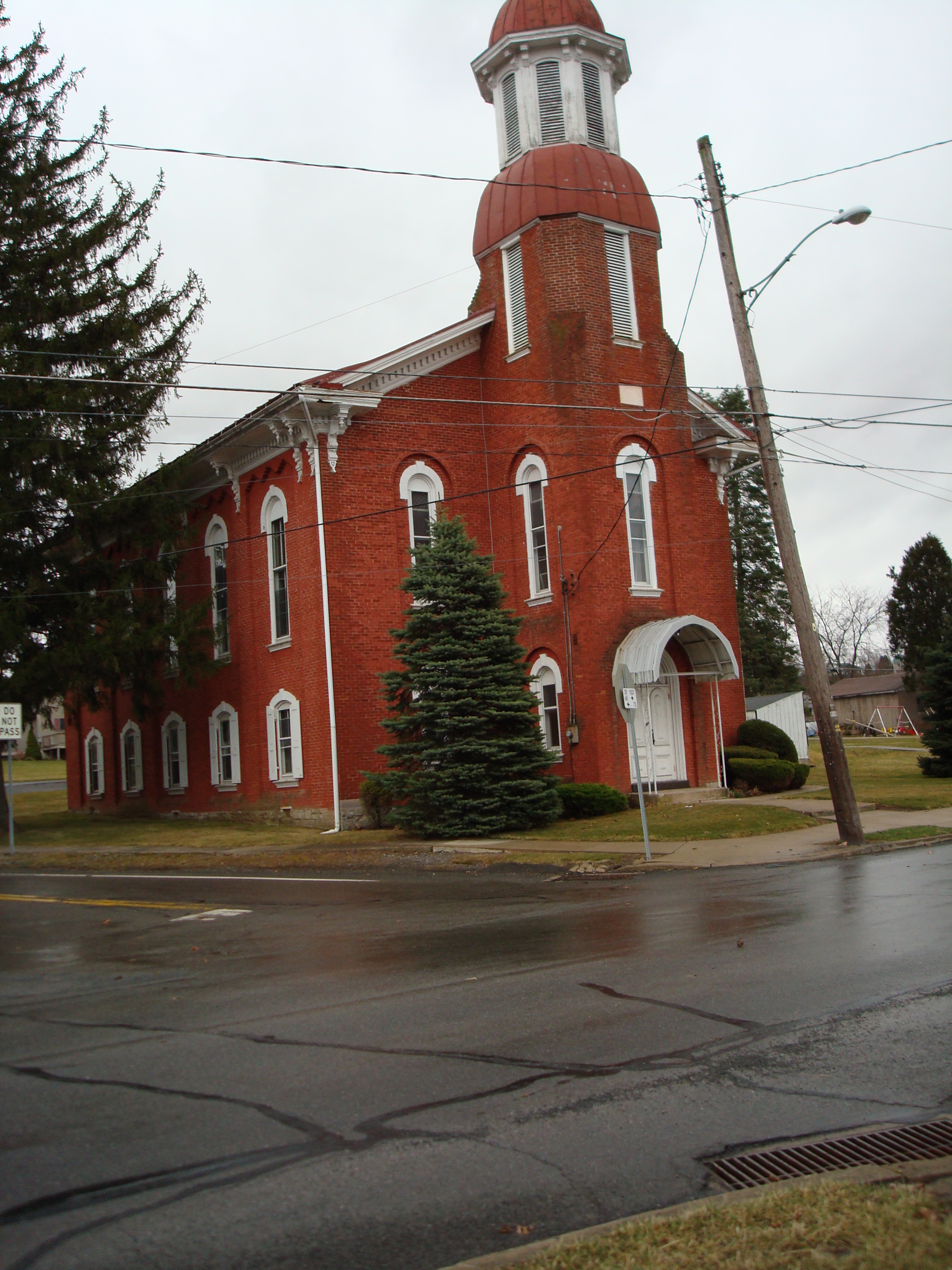
A recent dreary day in McEwensville

Her middle-aged granddaughter’s comments 100 years later:

I’m going to remember the word “muddle.” No more senior moments for me—from now on my head is going to  just be in a muddle whenever I make a silly mistake.

Why was Grandma’s head in a muddle? Was something wrong? Was she worried about something?

Whatever was bothering her has been lost over time. Too bad she didn’t record it in the diary.

Stewed Apples

17-year-old Helena Muffly wrote exactly 100 years ago today: 

Tuesday, October 8, 1912:  Don’t have anything to write.

Her middle-aged granddaughter’s comments 100 years later:

Since Grandma didn’t have much to write a hundred years ago today, I’ll share an old recipe for stewed apples with you. There easy to make, and I make this recipe several times each fall.

Like many old recipes, it doesn’t have exact amounts for ingredients—but it always seems to turn out just fine.

Stewed Apples

Peel apples, remove cores, and cut into quarters. Place them in a saucepan with a very little water. Add sugar and cinnamon to taste. If desired, a few raisins can also be added. Bring to a boil and then reduce heat. Continue to simmer gently until the apples are soft (approximately 10-15 minutes). May be served either hot or cold.