
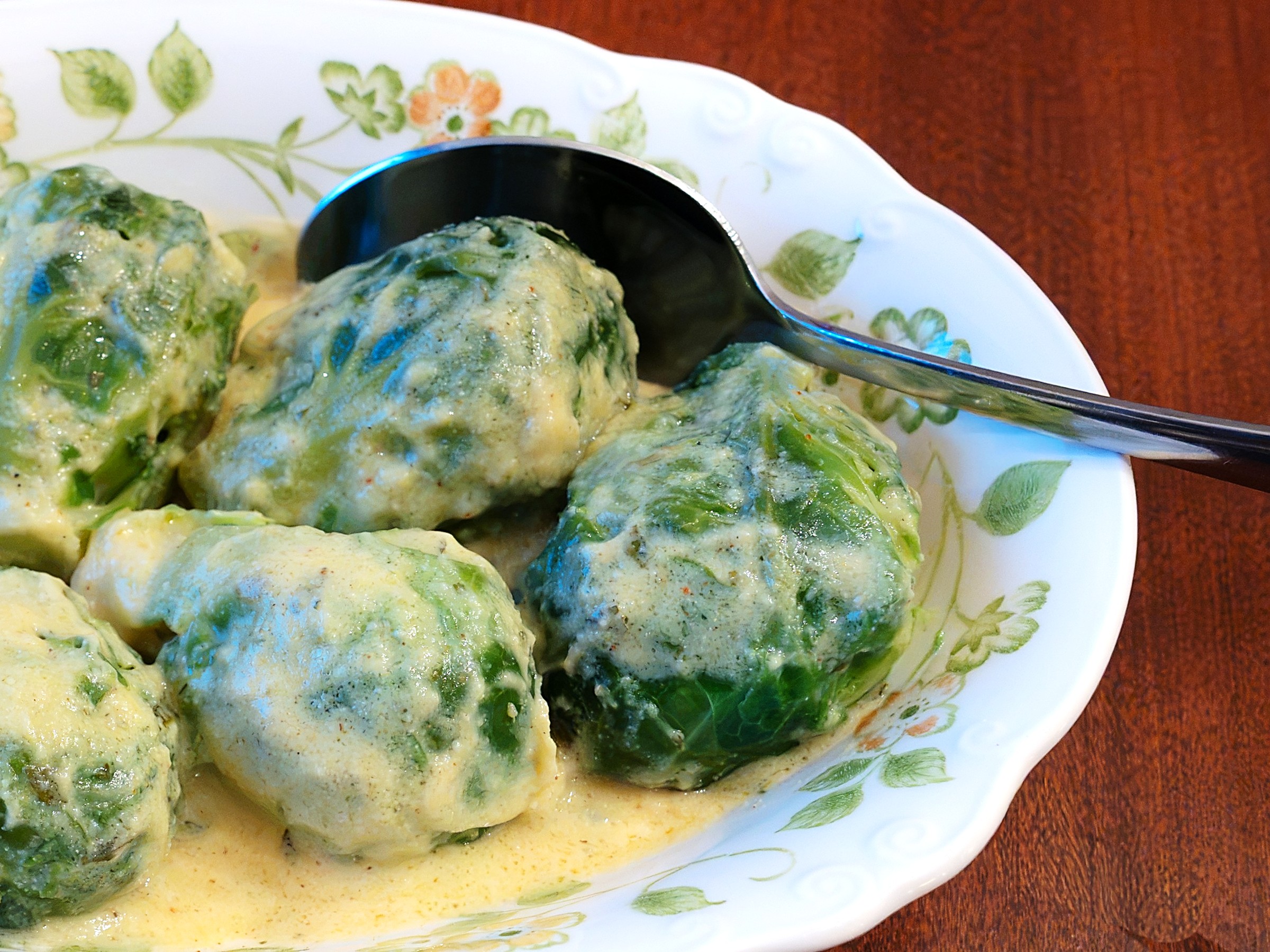
When browsing through hundred-year-old cookbooks, I came across a recipe for Brussels Sprouts with Sauce Piquante. Sauce Piquante is known for its complex, spicy flavor. Since many old-time sauce recipes make very mild and delicate sauces, I was intrigued by this recipe and decided to give it a try.
The Brussels Sprouts with Sauce Piquante was excellent. The delightful, tangy sauce worked well with the earthy, slightly bitter Brussels sprouts. I may not see many old recipes for spicy sauces, but based on how well this recipe turned out, cooks a hundred-years ago definitely knew how to make lovely, lively sauces.
Here is the original recipe:
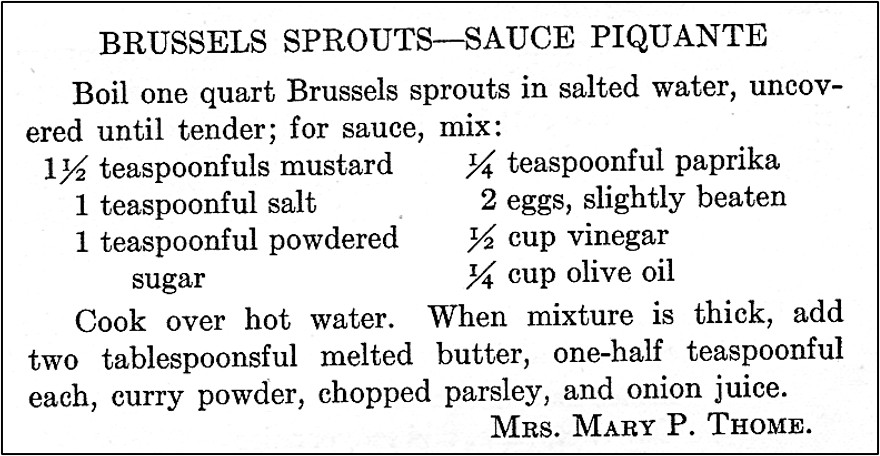
The recipe calls for “mustard.” It does not say whether it is for dry mustard or prepared mustard. In general, hundred-year-old recipes call mustard in a jar “prepared mustard,” so I assumed that the recipe author was referring to dry mustard.
Since the Brussels sprouts were boiled in salted water, adding an additional 1 teaspoon of salt in the sauce seemed like a lot, so I reduced it to 1/2 teaspoon when I updated the recipe.
I didn’t use a double boiler when I made the sauce. Rather I cooked the sauce using medium-low heat while stirring constantly.
Here’s the recipe updated for modern cooks:
Brussels Sprouts with Piquante Sauce
1 quart (about 1 pound) Brussels sprouts
water and 1 teaspoon salt
1/4 cup olive oil
1/2 cup vinegar
2 eggs, beaten
1 1/2 teaspoons dry mustard
1/2 teaspoon salt
1 teaspoon powdered sugar
1/4 teaspoon paprika
2 tablespoons butter, melted
1/2 teaspoon curry powder
1/2 teaspoon, chopped parsley (or use parsley flakes)
1/2 teaspoon onion juice (or use finely minced onions or onion powder)
Step 1. Trim Brussels sprouts and remove any damaged outer leaves. Put in a saucepan and cover with water. Add 1 teaspoon salt. Bring to a boil using high heat, then reduce heat and simmer until tender (about 10 minutes). Remove from heat and drain.
Step 2. In the meantime, put the olive oil, vinegar, beaten eggs, dry mustard, 1/2 teaspoon salt, powdered sugar, and paprika in a saucepan. Stir to combine, then heat using medium-low heat until the mixture thickens while stirring constantly. (If the thickened sauce is lumpy, strain and then return the sauce to the saucepan.)
Step 3. Add the melted butter, curry powder, chopped parsley/parsley flakes, and onion juice/minced onions/onion powder to the sauce. Stir to combine; heat with medium-low heat while stirring constantly until the mixture is hot and just beginning to bubble.
Step 4. Put the cooked Brussels sprouts in a serving dish, then pour the sauce over Brussels sprouts. Serve immediately.

I hate Brussels sprouts, but I love that I can tell you that with a comment!
I also like it that you can tell me that you don’t like Brussels sprouts. This probably isn’t a recipe for you.
I’m not a fan of Brussels sprouts, but your recipe could make them better.
The Brussels sprouts still taste like Brussels sprouts, but the sauce has a tangy flavor that nicely balances the slightly bitter taste of the vegetable.
I am thinking that sauce would make a lo of things better!!! I bet it is great on cauliflower.
I agree- I think that the sauce would be tasty on cauliflower.
I enjoy Brussels sprouts. I usually use a balsamic glaze on mine or roast them. What did the sauce taste like? How does one obtain onion juice? Put an onion in the juicer? I imagine the sauce would be quite piquant with all those different flavors, but adding powdered sugar leaves me wondering.
I like your new header, and the design on the tea set!
I enjoyed the new header as well. It is elegant and pretty at the same time.
I just spent an hour trying to find a pattern like that on the Internet. I did find quite a few similar, and the octagonal design is considered Art Deco and was quite popular at one time. I love vintage tea cups!
My mother-in-law collected vintage teacups and teacup plates. She displayed them beautifully. I loved looking at them.
I collected vintage tea pots and cups and saucers for years. I finally pared them down and only kept about half a dozen that I use regularly. It is just so elegant to drink my tea from a pretty cup, that sits on a saucer. I brew long leaf tea from Rakkasan Tea which makes it even better!
I only have the sets I inherited from my great-aunt Hazel. I love the hand-painted violets. https://retirementrvdream.com/2025/11/16/moving-the-furniture-from-the-u-haul-truck-and-getting-it-set-up/
The teacups look lovely in the hutch. (I love your hutch. It’s so sad that it got scratched. I can feel your pain.)
Thank you. Displaying them behind glass keeps me from having to clean them very often.
I was so mad 😡 that it gave me a migraine.
I like how you actually use your tea cups and saucers. I should do that. I have several old sets of china with beautiful tea cups/saucers; but, except for occasionally using for a blog post picture, I never use them.
A good friend of mine also has a teacup and saucer collection. Like your mother-in-law, she displays them beautifully; but when I see it, I always think about how time-consuming it would be to dust. 🙂
How are it is to keep something clean is something I give serious consideration to. Do I want something enough to clean it? Mostly no. I reached this thought process later in life. Younger me wasn’t as smart as current me. 😆
I see kitchens with all sorts of complicated designs on the cabinet doors. Having lived with some multi-tiered ones, I could never understand why someone wanted those designs. They are so hard to clean. At Blackberry Homestead, my cabinet doors are simple straight edges, but still a pain to clean in the corners. I want to replace them with flat doors. I had flat cabinet doors at my last house and they were so easy to clean.
I got the new header image from an advertisement for Blue Label Ketchup in the Sept. 1926 issue of Ladies Home Journal. It is a portion of an illustration in the ad. I have no idea why the predominant thing in an ad for ketchup was a teapot and teacups. I’m embarrassed to admit it, but I think that the container at the right-hand, bottom of the image contains ketchup. I guess that you were supposed to put it on the fancy sandwiches that are also in the image.
It’s nice to hear that you like the new header. I’d been thinking for awhile that I should change the image in the header, but had a hard time deciding what to replace the old one with.
The sauce was tangy with the mustard and curry powder being predominant flavors. The vinegar makes it a little acidic.
I believe that it’s possible to buy commercially-prepared onion juice, though I don’t think that I’ve ever seen it at the stores where I shop. Crisp Cooking has a post on four easy ways to make onion juice. Basically, they involve pureeing, using a blender, or grating onions; and, then straining out the juice. (The Crisp Cooking post seems to be largely focused on health benefits of onion juice, but I assume that small amounts could be made the same way for cooking purposes.)
The recipe only calls for 1 teaspoon of powdered sugar. I don’t think that such a small amount has much effect on the taste of the sauce, and am inclined to think that the sauce would taste about the same even if no powdered sugar was used.
I’m definitely up for giving this a whirl. Thanks! I wonder if the sprout-haters just cook them too long – the smell in the kitchen of an overcooked sprout is defintely Not Good. A friend of mine from years ago had a grandmother who would put the sprouts for lunch on at 11.50 precisely. Lunch was dead on 12.30…. Can you imagine??
Good grief – I can’t imagine cooking Brussels sprouts for 40 minutes.
… or eating them ….
This really does sound delicious!
It’s tasty.
I love Brussels sprouts and this recipe sounds like a perfect match for them! Thanks for sharing your update.
You’re welcome. I think that you’ll enjoy this recipe.
What a wonderfully inventive throwback recipe, Sheryl! That tangy combination of mustard and curry sounds like an incredible way to dress up greens.
The sauce was lovely.
How cool – I used to hate sprouts when I was a kid, but love them now – this is great! Linda xx
Similarly to you, I like Brussels sprouts more now than what I did when I was a child. I have vague memories of my mother telling me that they were little cabbages when I was small.
I remember my mother trying every trick in the book – it didn’t work! (I’ve since heard someone say that our taste buds change as we age – so sprouts were more bitter than they are now, and we’re more likely to enjoy salt than sugar, etc etc… who knows!)
I’ve also heard that foods taste less bitter as we age. Another thing that I’ve heard that is that Brussels sprouts taste different now than in the past is because plant breeders have developed modern varieties of Brussels sprouts that are less bitter than the old-time varieties.
Oh wow – I bet that’s true! There was no such thing as seedless fruit when I was a kin, and now watermelon, grapes, mandarins are all seed-free… I think you’re onto something!
Wow – it turns out people a century ago really knew what they were doing with Brussels sprouts!
It’s fun to see that they served Brussels sprouts this way a hundred years ago.
Interesting idea to make the sauce with eggs! Will give it a try.
I think that you’ll like the sauce. It turned out well for me.