18-year-old Helena Muffly wrote exactly 100 years ago today:
Sunday, January 11, 1914: Fell down this morning carrying two big buckets full of milk. There was so much less after the fall, but as much of me remained as there was before.
Visited a friend after Sunday School this afternoon. We had no church.
Grandma probably was carrying buckets similar to the ones in the picture. (The women in the picture are using a cream separator.) Source: Kimball’s Dairy Magazine (March 1, 1913)
Her middle-aged granddaughter’s comments 100 years later:
Oops!
Grandma, were you in the barn when you fell? . . . or walking between the barn and the house? Was the walkway icy?
I’m glad you’re still in one piece. Maybe you should carry only one bucket of milk at a time. Two is a lot. . .
—–
There probably was no church service because the church didn’t have a minister. The previous Sunday Grandma wrote:
Our minister is going to leave soon. He preached his farewell sermon today. I am so sorry to see him go. There were some misty eyes in church this afternoon.
18-year-old Helena Muffly wrote exactly 100 years ago today:
Saturday, January 10, 1914: Got my first sleigh ride of the season last night. Most forgot what I did today.
Sleigh in Hadley Farm Museum, MA (Source: Wikimedia Commons)
Her middle-aged granddaughter’s comments 100 years later:
Grandma –
Wow, a sleigh ride! . . . Was it after the dance that you wrote about yesterday? . . .By the way, how was the dance?
Was it a moonlit night? Was the sleigh ride cold? Were there lots of blankets in the sleigh to keep you warm?
Who else went on the sleigh ride? . . . your sister Ruth? . . . .a cute guy you danced with? (Did you snuggle with him under the blankets? . . . Oh, never mind, I just remembered that you are my grandmother, and that’s probably an inappropriate question.) 🙂
18-year-old Helena Muffly wrote exactly 100 years ago today:
Friday, January 9, 1914: Nothing much doing here this afternoon. Started to read a book this afternoon. Ruth and I expect to go to a dance this evening.
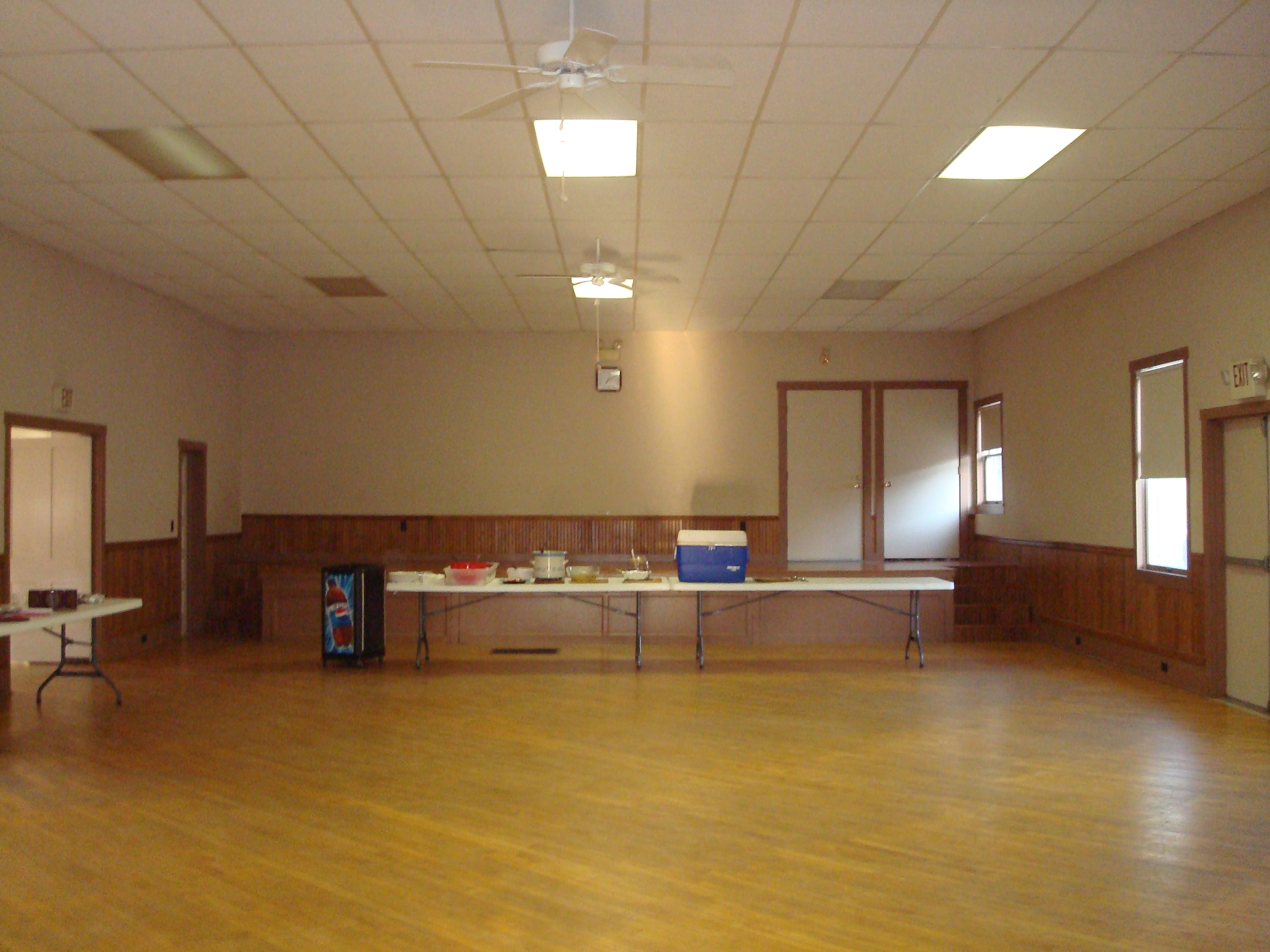
In my imagination, I picture the dance being held at the McEwensville Community Hall. It’s a very old building and existed a hundred years ago.
Her middle-aged granddaughter’s comments 100 years later:
Grandma—
Nothing??? It sounds like the most exciting day in weeks.
What do you plan to wear to the dance? Are you going to do anything special with your hair? Who are you hoping to dance with? Where is the dance? . . . .
The inside of the Community Hall. Also, in my imagination, Grandma is gliding across the floor with the most handsome young man at the dance. (Well, maybe the second most handsome guy. Ruth probably got the most handsome one. Sisters!!)
18-year-old Helena Muffly wrote exactly 100 years ago today:
Thursday, January 8, 1914: Went up to McEwensville this afternoon on an errand of my mother’s, although I couldn’t see that much importance was attached to it.
Her middle-aged granddaughter’s comments 100 years later:
This is the second day that Grandma mentioned the errand. The previous day she wrote:
Went on an errand this afternoon, but didn’t accomplish anything as the people weren’t at home. . .
Her mother apparently thought that it was important, but Grandma didn’t think that it needed to be done.
What we still don’t know:
What was the errand?
Who were “the people” that Grandma needed to visit to accomplish the errand?
Yesterday Barbara commented on the post. She said when Grandma wrote that “the people” weren’t home it made her think they weren’t in Grandma’s regular circle of friends and family or Grandma probably would have named them.
After reading today’s diary entry, I think that I agree with Barbara. The errand probably was a bit stressful—and worthy of mention in the diary—because Grandma didn’t feel very comfortable having to talk with people she didn’t know well.
18-year-old Helena Muffly wrote exactly 100 years ago today:
Wednesday, January 7, 1914: Went on an errand this afternoon, but didn’t accomplish anything as the people weren’t at home. Ruthie and I went up to Oakes’ this evening.
Recent view of the farm where the Oakes lived.
Her middle-aged granddaughter’s comments 100 years later:
What was the failed errand? . . . an attempt to return something? . . . an attempt to buy or borrow something? . . . an attempt to give a message to someone? . . .
The Oakes lived on a farm near the Muffly’s and had several children close in age to Grandma and her sister Ruth. Rachel Oakes was a friend. And, there were at least two boys in the family–Jim and Alvin. Back in n 1911, Ruth dated Jim Oakes.
18-year-old Helena Muffly wrote exactly 100 years ago today:
Tuesday, January 6, 1914:Nothing much doing.
Her middle-aged granddaughter’s comments 100 years later:
It’s cold here! I like to make old-fashioned hearty soups, like Rivel Soup, on icy days like today. I wonder if the Muffly’s regularly ate soup during the winter months.
Here’s an old recipe of Rivel Soup. It is a potato soup with small dumplings (rivels).
My family often ate this soup when I was a child. I didn’t like it back then, but now my husband and enjoy this nuanced and mild, yet delectable, soup.
Rivel Soup
4 medium-sized potatoes, diced into very small pieces
water
2 tablespoons butter
1/2 cup flour
1 egg, slightly beaten
2 cups milk
1 cup cream
salt
crumbled crisp bacon
Put the diced potatoes in a large saucepan and just barely cover with water. Cook diced potatoes in water until soft. Add butter and milk.
Meanwhile, to make rivels, combine flour and egg in a bowl. Drop rivels, which are no larger than a raisin, into the boiling potato mixture, while periodically stirring to prevent the rivels from sticking together.
Cook 5 minutes. Add cream and salt to taste; reheat until hot. Put into serving bowls and garnish with bacon.
18-year-old Helena Muffly wrote exactly 100 years ago today:
Monday, January 5, 1914: Tried my hand at some sewing this afternoon. Teased my mother. (She simply has to take it, when I get busy.) So passed the afternoon.
Took a header on the porch tonight, but managed to go no further than my one knee.
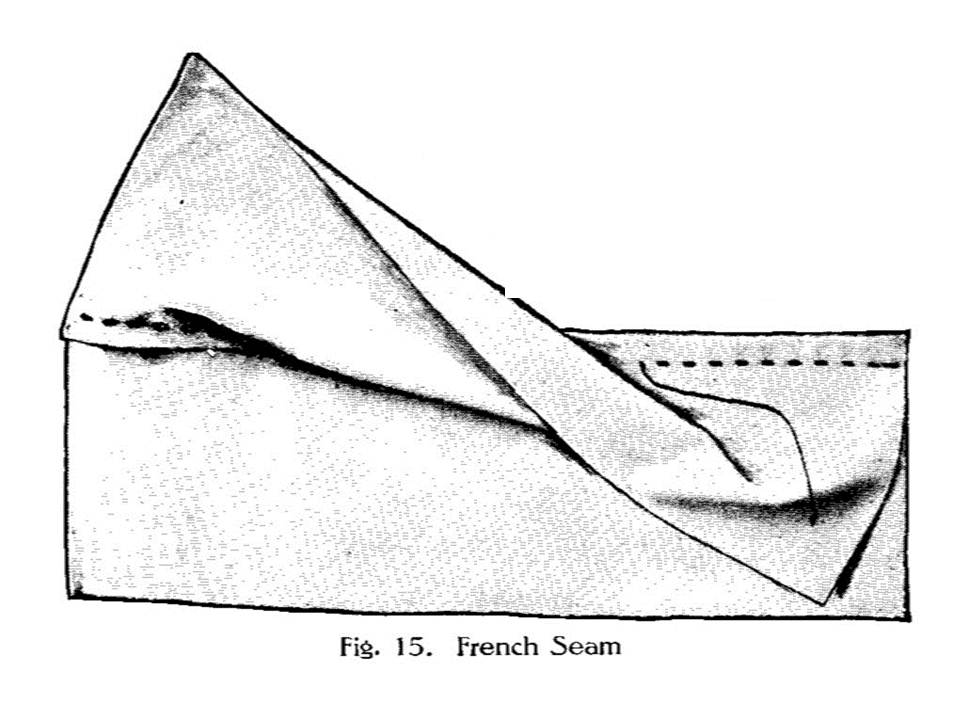
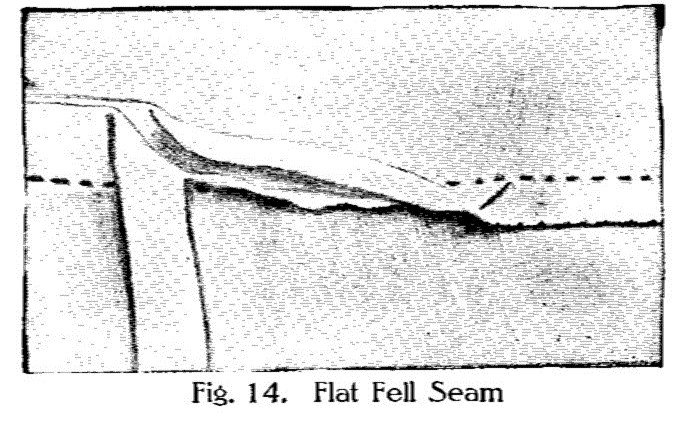
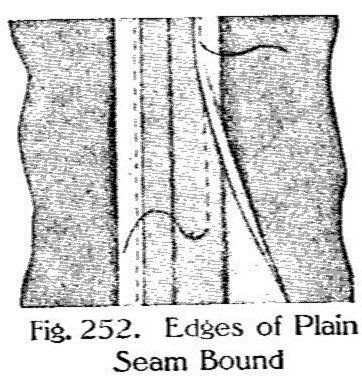
Source of drawings: The Dressmaker by The Butterick Publishing Company (1911)
Her middle-aged granddaughter’s comments 100 years later:
I’d love to know what Grandma teased her mother about. In spite of the tumble–Was there ice on the porch?–, it sounds like a good day.
Did Grandma sew any seams? Here’s some hundred-year-old advice for making high-quality seams.
The Importance of Seams
When it comes to putting a garment together, many problems face the amateur seamstress, not least among these is the finishing of the joinings.
Here is something that needs almost an intuition to solve. Not only do different garments require different finishings but different parts of the same garment require different treatment.
Suppose for example you are making a princess slip-on with a flounce. Now for the body seams of the garment you will want something at once dainty and durable, something that isn’t “bunching,” and yet will be strong enough to withstand strain. For this then the French seam is best adapted. This you make by joining the pieces with a narrow seam on the right side, then turn and make another seam directly over this on the wrong side. Thus you have the raw edges covered up and have a double sewing to give strength to the seam.
The French seam is used also on lingerie waists and children’s dresses, and may be moderately wide or very narrow, according to its place in the garment and the material used. Care must be taken to trim off ravelings before turning the first seam.
In making up heavier goods such as a petticoat of sateen, you will find felled seams are the best. There are two different kinds of these. One is made by opening out an ordinary seam of three-fourths to one inch on the wrong side, turn under the edges and sew down. This is a good seam for baby’s night-gowns since it is the least bunglesome. However, it is not so strong as the single felled seam which is made as follows. Allow one-edge of an ordinary seam to extend out about one-fourth inch over the other. Turn a small hem on this and basted down over the other edge and sew firmly.
The bound seam is used to finish joinings in dresses or skirts of heavy material and is made by binding the edges of an ordinary seam with seam binding which comes for this purpose.
For baby’s flannel petticoats or woolen shirts baste open an ordinary raw seam and feather stitch on the right side. The raw edges on the inside are left unfinished so that the seam will be as flat as possible and there is no danger of chafing baby’s tender skin.
One of the essential things that many amateurs neglect in finishing a garment is a careful pressing of all seams, as the garment is put together and also when it is a finished product. Many a garment loses that “homemade” look and assumes quite a professional air when treated to a good pressing.
In the Homecraft on the Farm section of Kimball’s Dairy Farmer Magazine (February 1, 1914)