18-year-old Helena Muffly wrote exactly 100 years ago today:
Saturday, October 18, 1913: At last my job is finished. I call it about 600 bushels more or less. This will add some to my spending money.
Her middle-aged granddaughter’s comments 100 years later:
Yeah, Grandma! You’ve worked incredibly hard husking corn. 600 bushels is a lot of corn. You began husking corn about three and a half weeks ago—on September 25.
On the October 11, you wrote that you’d received partial payment of $12 for your work. How much were you paid in total?
And, PLEASE tell us what you bought when you spend the money.
—
Based on the information about the number of bushels Grandma harvested in this diary entry, I now realize that I over-estimated how many bushels Grandma had harvested as of October 6 when she wrote that she’d husked about ten wagon loads of corn.
At that time I estimated that Grandma had husked about 1,000 bushels of corn—when actually during the entire harvest she only husked 600 bushels. The wagon loads must have been smaller than I thought.
(I didn’t say that quite right. 600 bushels is still an awfully lot of corn—and I shouldn’t be minimizing how much work Grandma did because of my estimation errors.)
Note to self—Work further ahead (or at least look further ahead ) so I don’t make silly mistakes like this in the future.
18-year-old Helena Muffly wrote exactly 100 years ago today:
Friday, October 17, 1913:
10/13 – 10/17: Nothing worth writing about for these days. Don’t go any place or do anything of much importance.
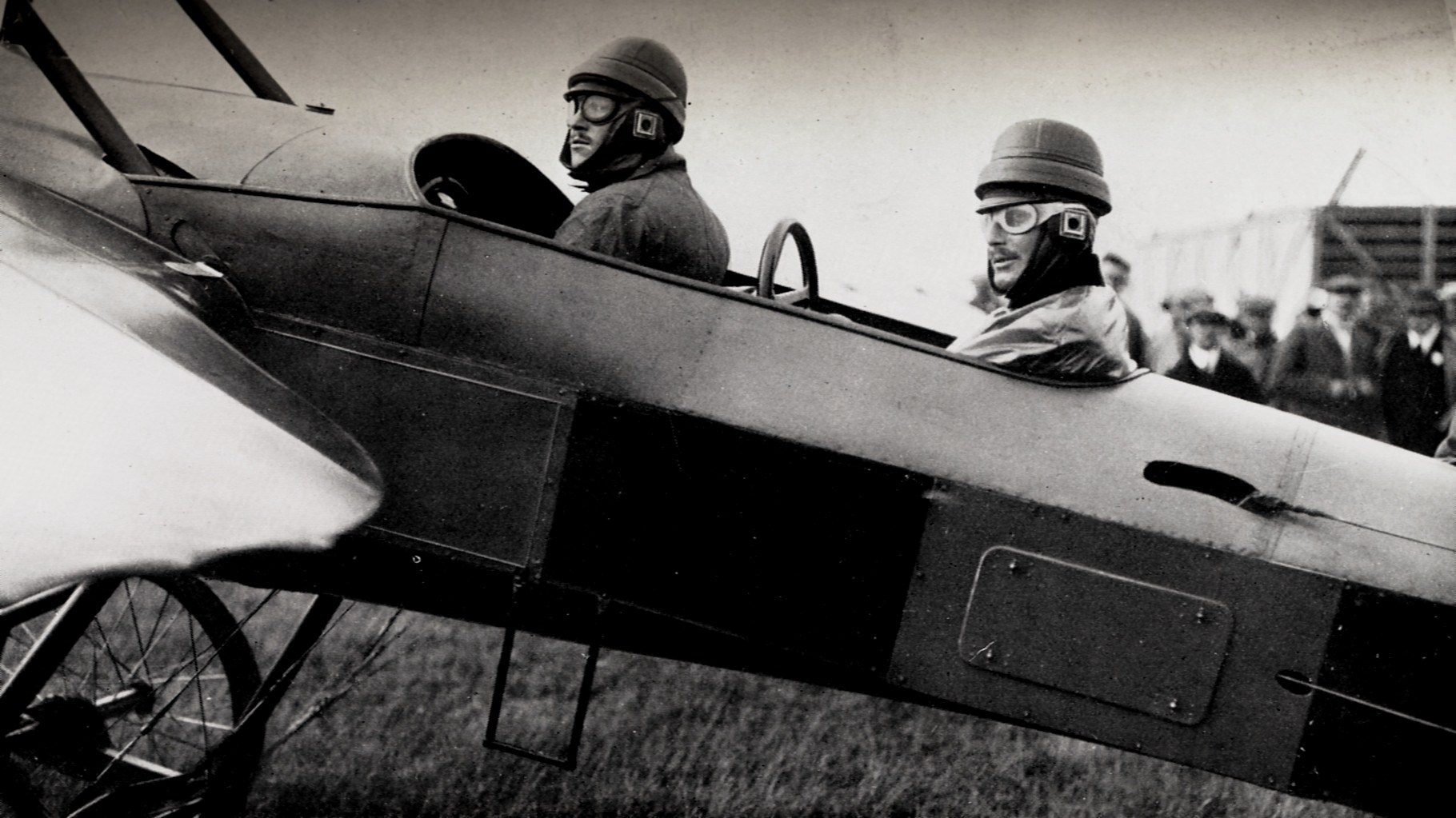
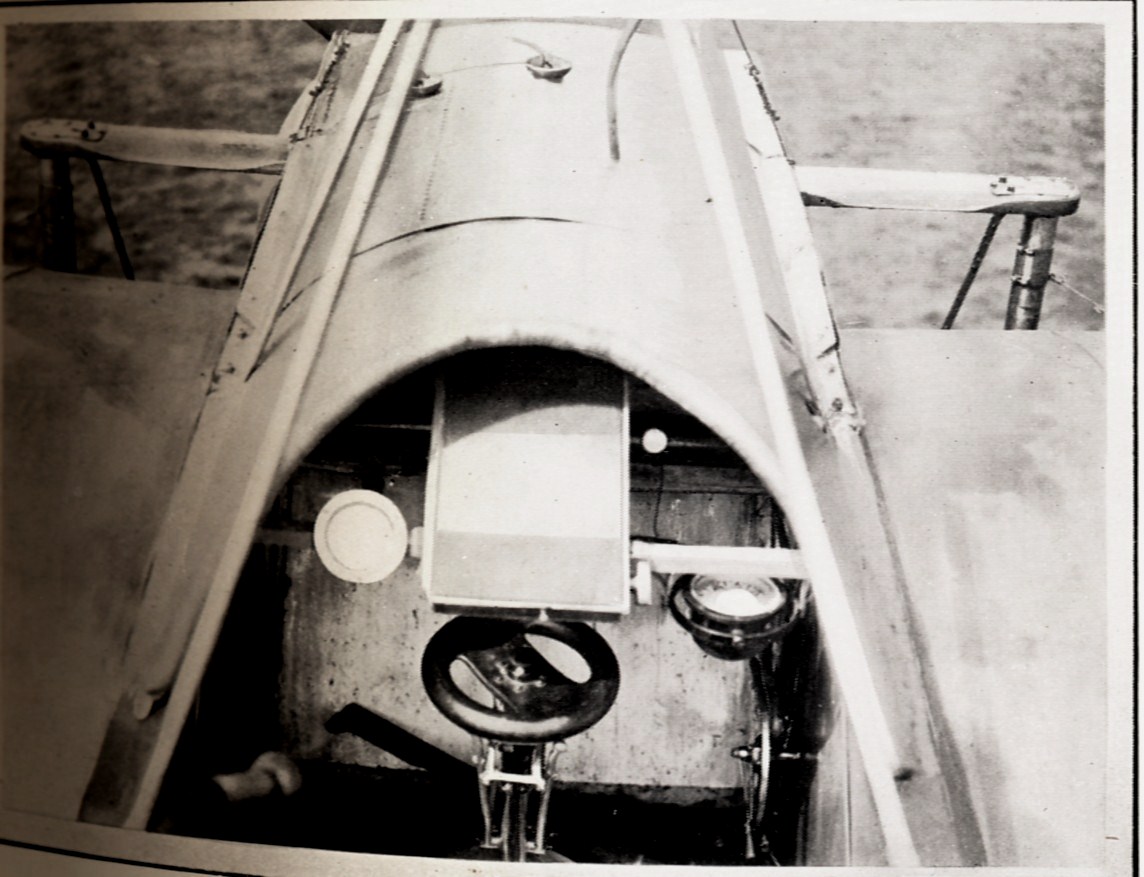
Caption: The above photograph illustrates a Deperdussin monoplane fitted with dual control so that two pilots can alternately take charge while in flight. Source: Aviation: An Introduction to the Elements of Flight
Her middle-aged granddaughter’s comments 100 years later:
Since Grandma didn’t write anything specific for this date, I’m going to share some fun pictures from a book published in 1913 called Aviation: An Introduction to the Elements of Flight by Algernon E. Berriman.
Here’s how Chapter 1 begins:
Everyone nowadays is familiar with the appearance of an aeroplane, but many, nevertheless do not know what, scientifically speaking, an aeroplane is. . .
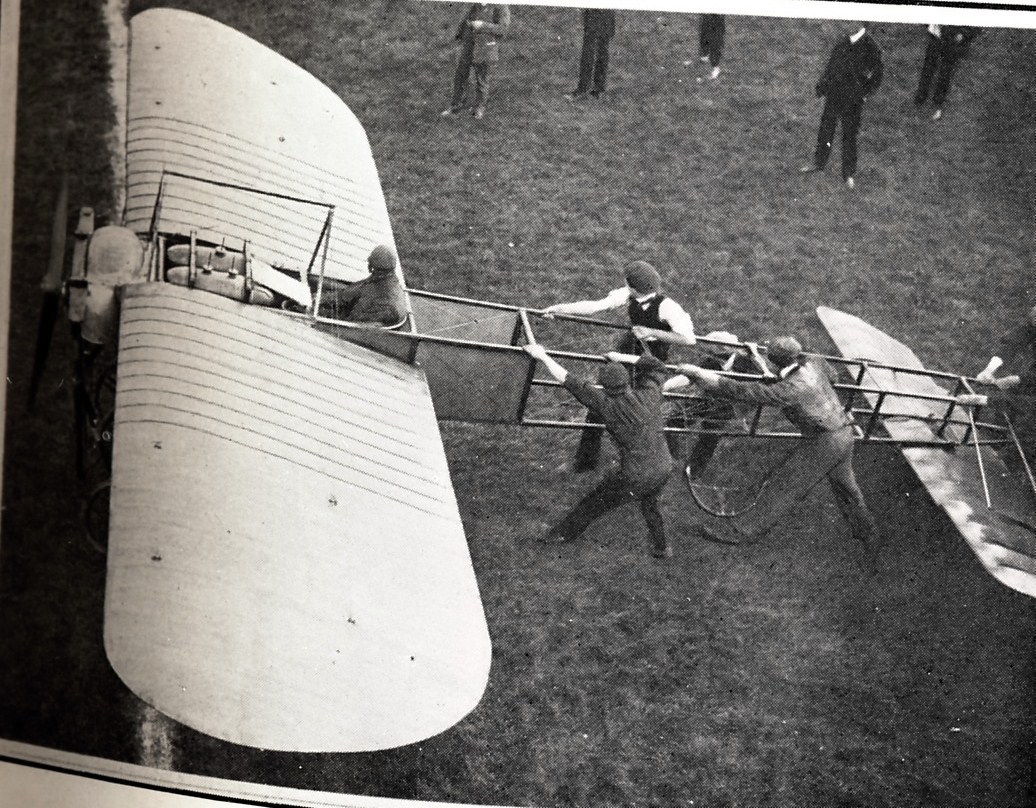
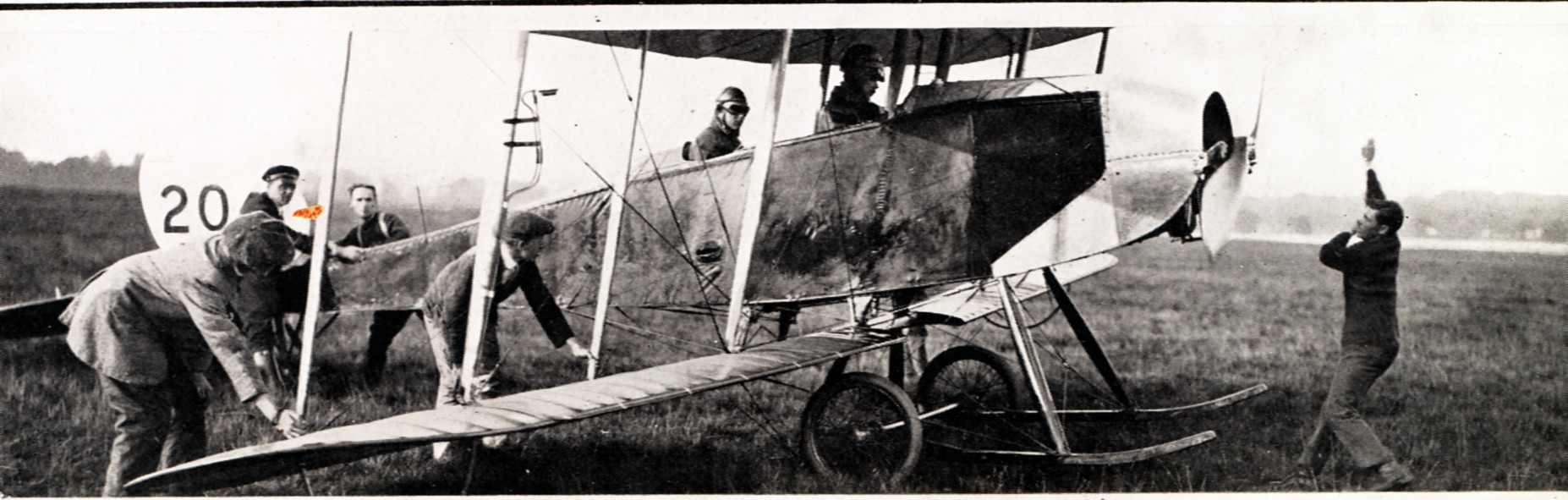
Caption: The pilot is seen seated in a Bleriot monoplane, which is about to start. The mechanics are holding on to the fuselage against the pull of the propeller.Caption: In the photograph, which shows one of the Royal Aircraft Factory’s biplanes, the mechanic has just released the propeller and is getting clear of its rotation.Caption: A view can be seen of the control wheel in front above which is a map holder. On the right is a compass.Caption: A Bleriot monoplane descending and a Farman-type biplane ascending. The biplane is flying away from the camera and the monoplane is approaching from above.
I wonder if the teen who wrote the diary ever thought that she’d ride in an airplane.
Fast forward 50+ years– I can remember picking Grandma up at the Williamsport (PA) airport when she was in her early 70s. She flew back to Pennsylvania after visiting relatives in the Detroit area. She complained about not being able to hear after she got off the plane. I think it was the first time she had ever flown—and she was flustered and wasn’t sure whether she liked flying (though I think that she was proud of herself for being so adventuresome).
18-year-old Helena Muffly wrote exactly 100 years ago today:
Sunday, October 12, 1913: Went to Sunday School this morning. Ruth and I went up to church this evening. It was so nice and moonlight. Some of the girls walked down the road with us coming home.
Her middle-aged granddaughter’s comments 100 years later:
This diary entry makes me feel both good and worried. Let me explain.
First, why it makes me feel good—
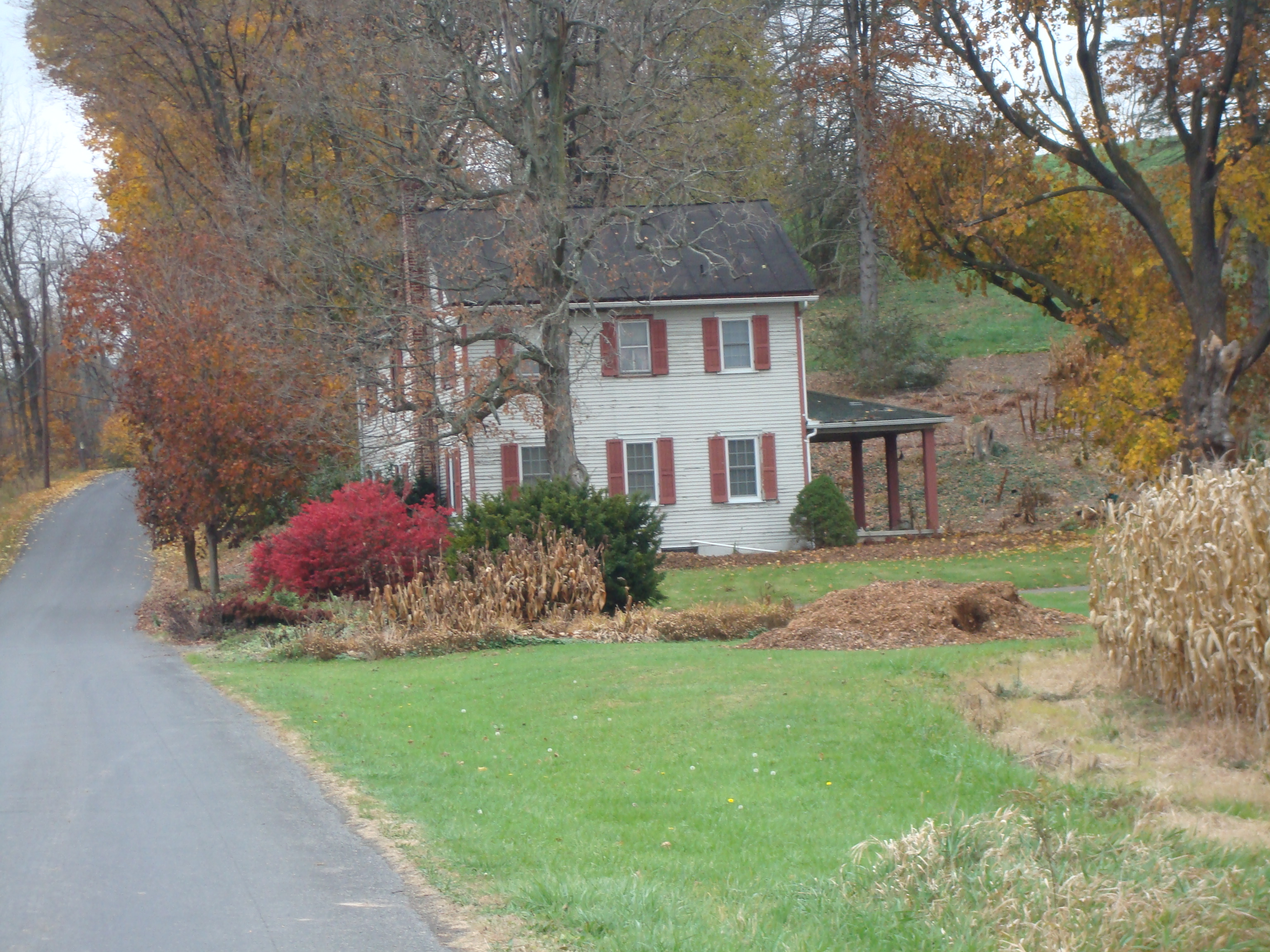
I can picture Grandma, her sister Ruth, and their friends ambling down the road from McEwensville toward the Muffly farm on a beautiful ,unseasonably warm, October evening.
I don’t have an evening picture of the road, but here’s a daylight picture of it.
I imagine a group of five or six girls in long skirts chatting and giggling about guys, friends, clothes, work, and all of the other important things that teens talk about. And, in my mind, I envision that as they neared the midpoint between town and the Muffly farm that the group separated with Grandma and Ruth continuing on—and the other girls returning to McEwensville.
Now why it makes we worry—
This entry reminds me that Grandma often had to walk home alone in the dark after church, community, and (before she graduated) school events. Some of those nights were in the dead of winter—and it must have been excruciatingly cold.
Maybe people were just used to walking at night in rural areas back then, but I worry about her safety. (I know it’s a hundred years too late to worry—but I do it anyhow). Did Grandma ever feel scared during the mile or so walk home through the dark countryside?
18-year-old Helena Muffly wrote exactly 100 years ago today:
Saturday, October 11, 1913: Received part of my pay today. It amounted to twelve dollars. I feel quite rich now. This surely ought to help me out in a pinch.
Her middle-aged granddaughter’s comments 100 years later:
Grandma—
You’ve sure worked hard husking corn, and you deserve every penny you earned. According to an online inflation calculator, $12 in 1913 would be worth about $285 now.
You are extremely fortunate to be paid for doing farm labor. Your parents must have been progressive thinking. Many young women working on their family farms probably received no compensation.
—
I’d like to thank Gallivanta for giving me the idea for this post. Let me share a story—
Gallivanta reads this blog and regularly makes comments. And, I’ve discovered her blog, Silkannthreads. She recently did a post on the lack of appreciation of the domestic work that women do, and on how women generally are not paid for this work (doing laundry, cooking, cleaning, etc.).
I made a comment on her post, and she responded:
. . . By the way, I have been thinking how great it is that Helena is being paid for her work during the corn harvest. She is not being treated as free family labour.
And, a light bulb went off in my head—
Wow, I’ve been feeling sorry for Grandma, when I should have recognized that she was incredibly fortunate to be paid.
Thank you, Gallivanta, for giving me valuable new insights.
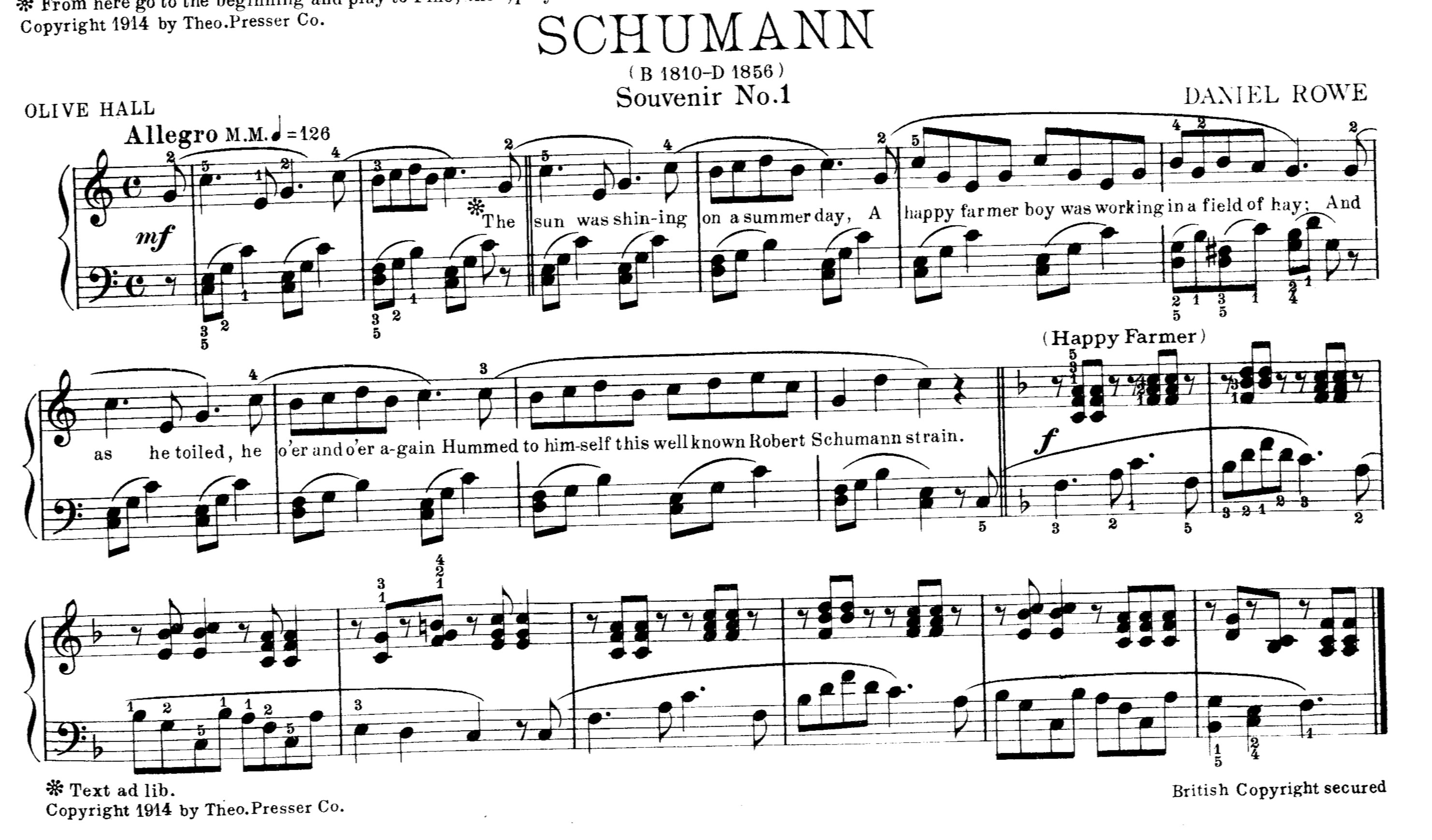
In the past Grandma often struggled to practice her piano lessons.—even when she didn’t seem particularly busy. On the days when she “worked for wages” and had lots to do, did she somehow still manage to find time to practice the piano?
—-
I can remember taking piano lessons for six years when I was a child—and I didn’t like practicing much either. But my goal was to be able to sight read music, so that I could just play songs that my friends might ask me to play.
I never reached that goal and ended up seldom playing the piano once I quit taking lessons.
Did Grandma also want to sight read music? I can’t remember her ever playing the piano, so my guess is that she also never reached that point.
I recently was looking at an old issue of The Etude magazine and came across these tips for sight reading music. Some parts of it really resonated with me and I thought you might also enjoy it:
The Secrets of Sight Reading
Far too much attention seems to be paid to technique these days, and far too little to musicianship. There are scores of young pianists who can play the Liszt Second Rhapsody with much dash and seeming brilliance, but who cannot read a fourth grade piece at sight.
The fact is a musician is not a musician until he can read.
A knowledge of harmony is not essential to good sight reading, but it unquestionably helps very frequently a work that is peppered with accidentals will absolutely fog a student who has no knowledge of harmony, while one who has will go sailing along with the utmost abandon.
A good sight reader reads music phrase by phrase, not note by note.
There is a tendency these days among publishers and editors to avoid putting in too many signs of expression. The less gifted musician needs some signs, but too many fluster him and he ignores them altogether. Nevertheless, it is essential when reading at sight to be careful to observe all fortes and pianos, crescendos, diminuendos, rallentandos, etc. Music which has not variety of expression has no life.
Playing wrong notes is a crime in a piece that has been studied, but in sight-reading a wrong note now and then can scarcely be avoided. If you play a wrong note, however, do not stop, and do not let it get you “rattled.” Go on as if nothing had happened.
The Etude (March, 1914)
Sign. . . I wish I’d somehow learned those lessons about sight reading when I was young.
18-year-old Helena Muffly wrote exactly 100 years ago today:
Friday, October 3, 1913: Working for wages.
Her middle-aged granddaughter’s comments 100 years later:
Grandma worked long days on her father’s farm husking corn. Did she ever wish that she had a job in town—maybe as a clerk in a store?
Postcard showing Marsh Shoe Store in the nearby town of Milton a hundred years ago (postally used December 1910).
It wasn’t all fun and glamor working in a store. Here’s what one of the sonnets published in 1913 in Love Sonnets of Shop Girl had to say:
Sonnet XIII
That floor-walker’s getting’ too breezy;
He hangs around me all the time.
I’ve wanted to let him down easy,
But he doesn’t get wise—he’s a lime.
I don’t like the way that he treats me –
You’d think that he owned me, the slob!
You’d think, by the way that he meets me,
I owed him my life—and my job!
.
He’s got to quit callin’ me “Baby”
And “Sister” and “Honey” and “Pet.”
I’ve quarreled with Terence; but maybe
He wouldn’t be tickled to get
A chance at this floor-walker Willie,
Who tried to get merry with muh!
Oh, wouldn’t he wallop him silly!
And then for the ambulance—huh?
.
But I won’t tell Terence; I merely
Will speak to this floor-walker gink,
And tell him, quite plainly and clearly,
Exactly the things that I think.
I don’t want to act at all shady,
But if he get uppish—the yap!—
I’ll lift up my hand like a lady
And bounce him a biff on the map.
Love Sonnets of a Shop Girl by Berton Braley was published in a 1913 book called Sonnets of a Suffragette. The entire book is available on the Internet Archive.
18-year-old Helena Muffly wrote exactly 100 years ago today:
Thursday, October 2, 1913: Ma and I staid at home today, while the rest of the family attended the Fair. To while away the time I got at my pictures and was quite satisfied with the result.
A woman developing film (photo source: Ladies Home Journal: May, 1913)
Her middle-aged granddaughter’s comments 100 years later:
Grandma–
Yeah! You got a free day when you could relax and enjoy your hobbies.
When I first read this diary entry, I felt sad that you didn’t get to go to the Milton Fair—but when I reread it I decided that you didn’t care.
You’ve worked so hard helping with the corn harvest—and I bet it feels really good that when your dad took a day off to go to the fair, you also got the day off.
You enjoy photography so much, and I can just picture you developing a roll of film and getting some awesome pictures.