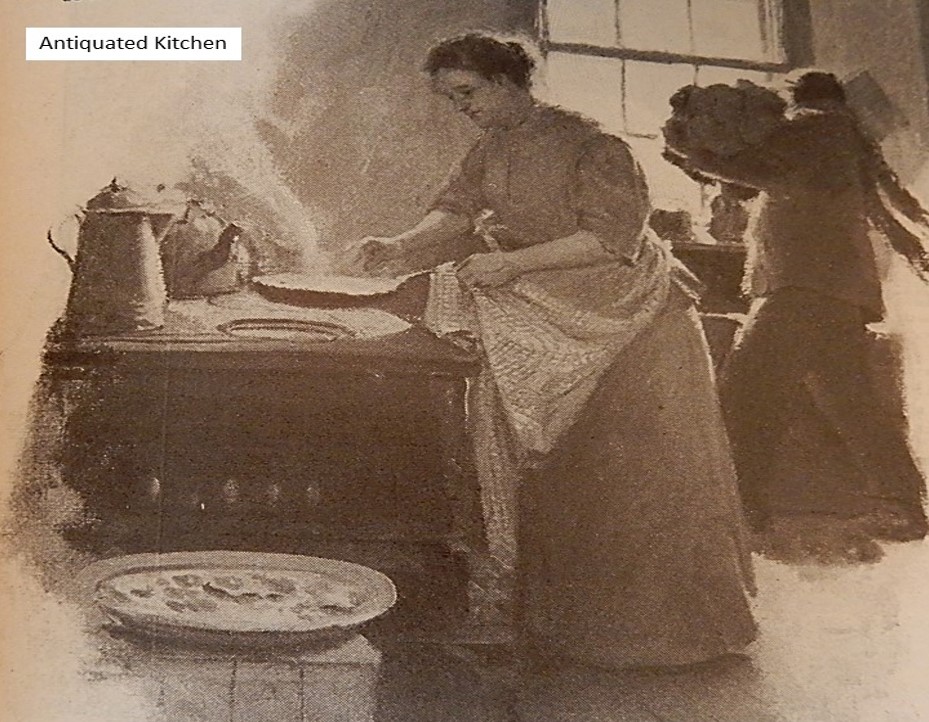
The holidays are winding down and many of us have spent long hours in the kitchen preparing for large family gatherings. Perhaps now is a good time to consider what it was like to prepare meals in kitchens a hundred years ago.
—
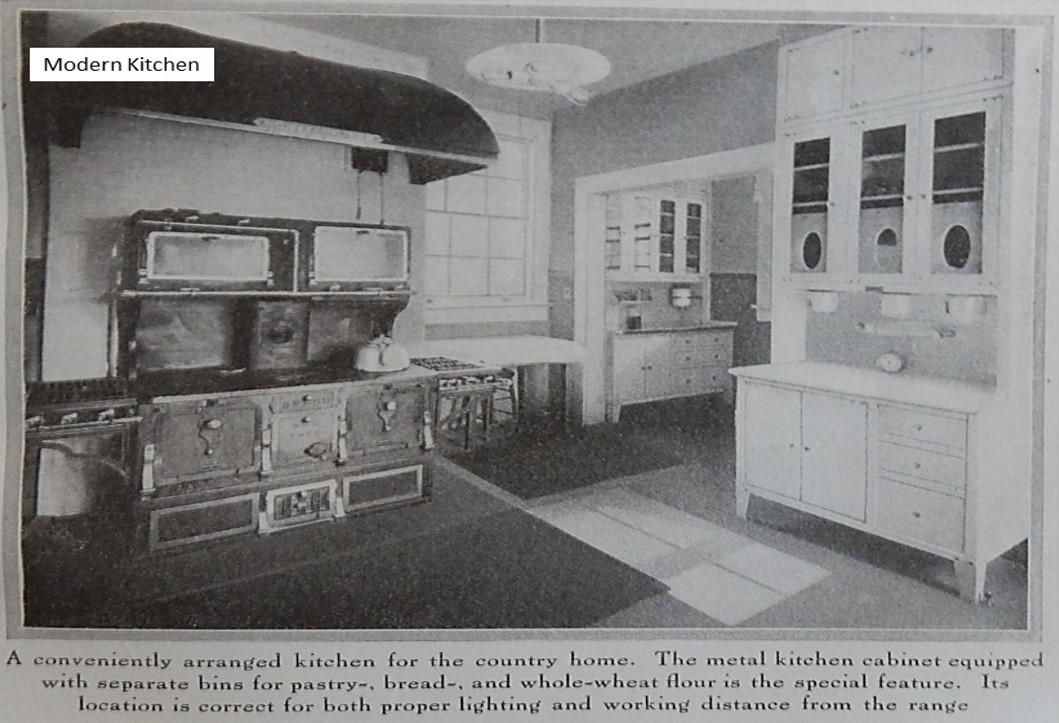
This April, 1915 article in Farm Journal implored farmers to consider how difficult it could be for their wives to cook in antiquated kitchens—and to make sure that modern conveniences were equitably distributed across the farm and the house.
With families averaging 5.2 members in number, the housewife preparing three meals a day, provides in the course of a year 5,694 meals, a discouraging proposition under the best conditions, but cooked in the average kitchen, it becomes deadly monotonous.
The lack of running water, a poor stove, the empty wood box, the heavy teakettle and iron pots, insufficient towels, antiquated woodenware, rusty and battered tin ware, the lack of a pantry, the cold in winter and heat in summer, the lack of screens, –I wonder how many meals the men folks would cook under these conditions.
In these days, when efficiency is required along every line of work. I wonder how our women work against such heavy odds. If the men had to cook and keep the kitchen clean, they would want linoleum on the floor, they would have running water, the stove would not smoke and the wood box would never be empty. There would be good, handy and substantial tools to work with, the teakettle would be easy to lift and easy to clean, the knives would be sharp—oh, I am sure of that!
There would be towels galore, and they would be good ones; a pantry would be built to save running to the cellar, the kitchen would be protected in winter and shaded in summer, doors and windows would be screened, there would be a stool to sit on while doing some kinds of work, and a low, comfortable chair for other work, and a few minutes’ rest, now and then. There would be some good way to prop the ironing-board (no makeshift here) and irons enough to allow time for thorough heating.
As the work is almost entirely done by women, they get along with things as they are, renewing and replacing the old as they have the opportunity.
The farmer and his wife (or daughter, or sister, whoever does the work) should constitute a partnership, and for every convenience secured for his part of the work, there should be one for hers. It need not always represent an outlay of money, but it will represent love, appreciation, the desire to protect and willingness to cooperate, which is the foundation for family happiness and prosperity.