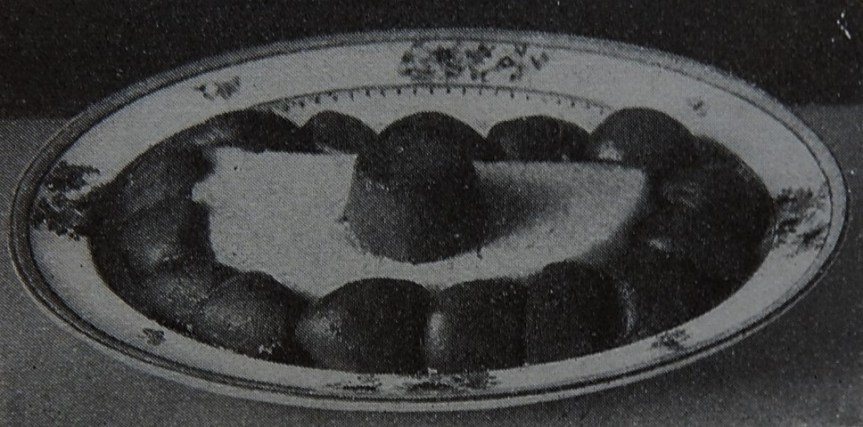
 Photo Caption: Rice cooked with gelatin, molded when cold, and served surrounded with apricots makes a delicious dessert and a very healthful one. (Source: Good Housekeeping, November, 1917)
Do you ever worry about desserts being too expensive?
Well, it was also a concern a hundred years ago. It was the middle of World War I, and food was costly. Here’s some excerpts from a 1917 magazine article:
Desserts We Can Afford
Ought we to deny ourselves desserts? With all the stress that is being placed upon economy of food, many housekeepers are asking themselves this question.
But luncheon without dessert, or dinner without dessert, would be disappointing to many of us who crave something sweet with which to top off a meal. And what would the children do if they could not look forward and guess what was coming at dessert-time?
To omit desserts entirely is too much to ask in the name of economy. And it would be an unnecessary denial. At present, desserts often come as a superfluous course at the end of a heavy meal. This is a mistake. Do not omit them altogether, but make them count as food. They may be made from materials which furnish concentrated nourishment and that are rich in energy-yielding material. A simple, light meal, topped off with such a dessert will be rich in food value while being economical.
Just because you don’t like the old-fashioned rice pudding, don’t discard rice altogether for dessert. Rice, gelatin, and milk combine very attractively.
Fruits, home-canned or the commercially tinned variety, preserved or dried, are a source of inspiration for inexpensive dessert combinations. All of them combine exceptionally well with rice.
Good Housekeeping (November, 1917)
I only occasionally eat desserts – though this article brought back memories of always having dessert after both lunch and dinner when I was a child. I’m probably using my only occasional dessert-eating as an excuse, but I decided to pass on making rice cooked with gelatin and served with canned apricots.