Coachella Date Trees a Hundred Years Ago

date tree
Source: Farm Journal (April, 1919)

When I hear the word “Coachella” I think of the annual music festival at Indio, California, so I was surprised when I recently came across an article in the April, 1919 issue of Farm Journal about Coachella – but it wasn’t about the music festival. Instead it described how the Coachella Valley in California was the perfect spot for raising dates. Here are a few excerpts.

Now, thanks to our wise Government, it is possible to obtain home-grown dates. Our agricultural experimenters found a bit of real Sahara Desert in Southwestern California, the Coachella Valley, only eight miles wide and twenty miles long. This strange little valley is 250 feet below sea-level.

The Algerian tree was dug up and carried to the newly established agricultural station named Mecca, and of course, it felt itself quite at home there. In 1904 it was fifteen feet high; now it is thirty feet high and each year bears great quantities of splendid fruit. It has become the parent tree of a great date colony of 500 acres. The trees are flourishing, thanks to the irrigation system that supplies an abundance of water to their roots.

Four hundred pounds of fruit to a tree is possible each year, and the trees live to be 200 years old.

The U.S. Department of Agriculture is still doing research in Coachella. The Agricultural Research Service is conducting research on how to improve the productivity of “old” date trees in the valley. I don’t know whether any of these old trees are from the original Algerian date tree described in hundred-year-old Farm Journal article – but somehow I want to believe they are.
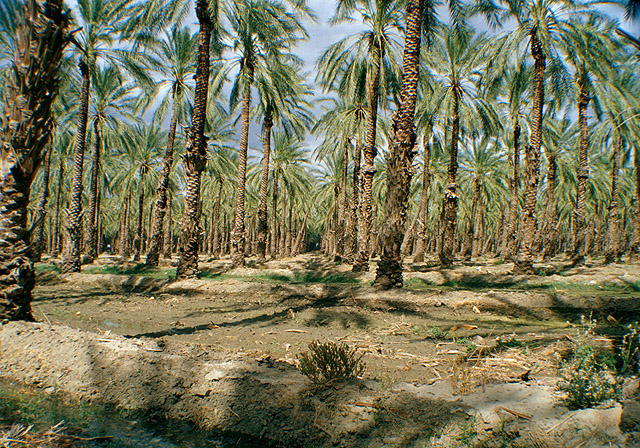
date orchard
Source: USDA ARS Online Magazine. Caption under the photo: Cover crops are being evaluated as an alternative to conventional tillage practices as a means to improve production of older orchards.

Balanced Meals a Hundred Years Ago

Text showing meals that are considered balanced, as well as meals that are not balanced.
Source: Household Engineering: Scientific Management in the Home by Mrs. Christine Frederick (1919)

A balanced diet helps maintain health – though I’m never exactly sure how to determine whether a particular meal is balanced. There are the five food groups, and once upon a time the U.S. Department of Agriculture’s food pyramid was used to help balance meals, but that has been relegated to the nutritional dust bin and now USDA’s MyPlate can be used to balance meals. Is meat good or bad? – Maybe it doesn’t matter as long as we follow the current mantra and eat five fruits and vegetables a day.

A hundred years ago cooks also tried to prepare balanced meals. According to a 1919 home economics textbook:

A “balanced” meal is one in which the various food principles are combined in a proper proportion. The “balanced” meal must contain some protein, some carbohydrate, some fat, some mineral salts, some water, and some bulk. This combination or “balance” should be present in all meals both for the needs of the body and for good digestion. In other words, it will not do to eat nearly all starch at one meal, and nearly all protein at the next.

Household Engineering: Scientific Management in the Home by Mrs. Christine Frederick (1919)


Can Sizes a Hundred Years Ago

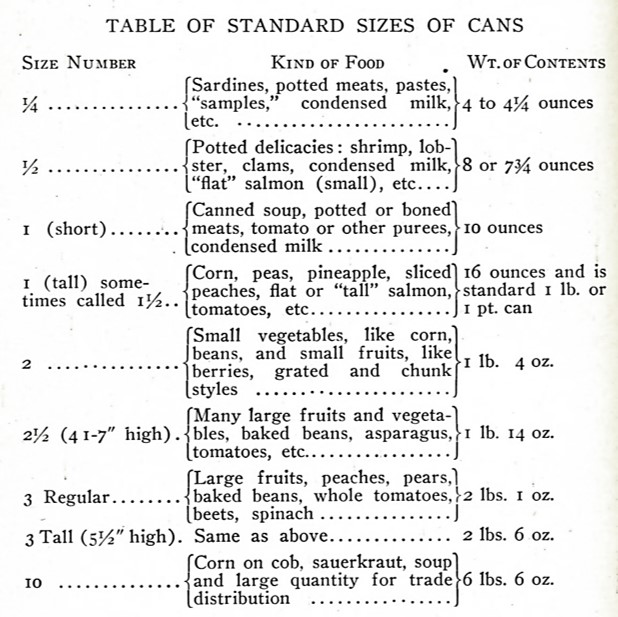
Table with information about selected can sizes
Source: Household Engineering: Scientific Management in the Home by Mrs. Christine Frederick (1919)

Can sizes today seem like they change constantly. I remember when tuna came in 6 3/4 ounce cans, more recently the cans were 6 ounces, and now they are just 5 ounces. Similarly, I remember when commercially-canned peaches were in 1 pound (16 ounce) cans; now the cans are only 15 ounces.

A hundred years ago there were standard can sizes, and people often referred to cans by their size number. For example, I’ve seen old recipes which call for 1 – No. 3 can of tomatoes. There actually still are standard can sizes, but the size numbers aren’t something on the tip of consumers’ tongues like they once were.

picture of various sizes of cans
Source: Household Engineering: Scientific Management in the Home by Mrs. Christine Frederick (1919)

Do Houses Need Kitchens? A Hundred-Year-Old Opinion

Source: Ladies Home Journal (March, 1919)

Sometimes I come across hundred-year-old magazine articles which absolutely stun me. They take positions which in some ways seem very forward thinking (or perhaps forward mis-thinking) – even by today’s standards.

Here’s some excerpts from a 1919 article which argues that there is no need for kitchens – and that cooking should be done in centralized locations:

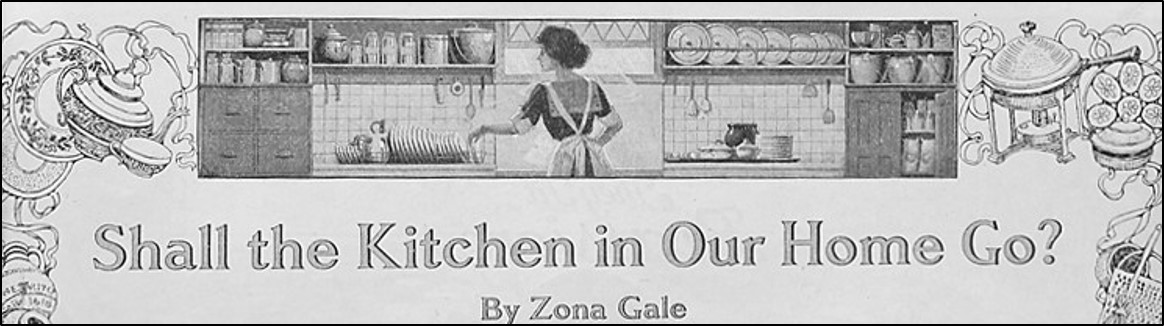
Shall the private kitchen be abolished? It has a revolutionary sound, just as once upon a time there were revolutionary sounds in such propositions as these: Shall private wells be abolished? Shall private kerosene lamps be abolished? Shall we use ready-to-wear garments and factory-canned vegetables?

There must have been thousands upon thousands of men and women who said that these changes could never come to pass. But now we are not only reconciled to these, but delighted with city water, gas and electricity, and factory products.

And now why not get rid of the private kitchen?

The one who has not thought about it will almost invariably give the reply: “Oh, that will never be practicable.”

So now, when these very objections present themselves one after another before the proposition to abolish cooking in the home, it may be that we know how to meet them.

In a small town, it means the establishment of a central kitchen, or in a city the opening of many neighborhood kitchens. It means the preparation there of breakfast, lunch and dinner just as in a hotel or cafe. But the main industry would be the taking of telephone orders and the delivery of cooked food, hot, at the doors. Delivery would be made by auto; and, closed vans, with openings at the sides and filled with small electric ovens, heated by the power which supplies the car, are not such a far cry.

In the kitchen alone the primitive, solitary, unorganized labor of our ancestors continues to be maintained. When one thinks in terms of a whole town of, say, a thousand homes, a thousand stoves going, and the unpaid labor of wives and mothers who are themselves cooks, it is to be seen that the centralized system is exactly as logical in its certainty of economy as the centralized system any other business.

Source: Ladies Home Journal (March, 1919)

Raising Chickens in the Yard a Hundred Years Ago

Source: Ladies Home Journal (March, 1919)

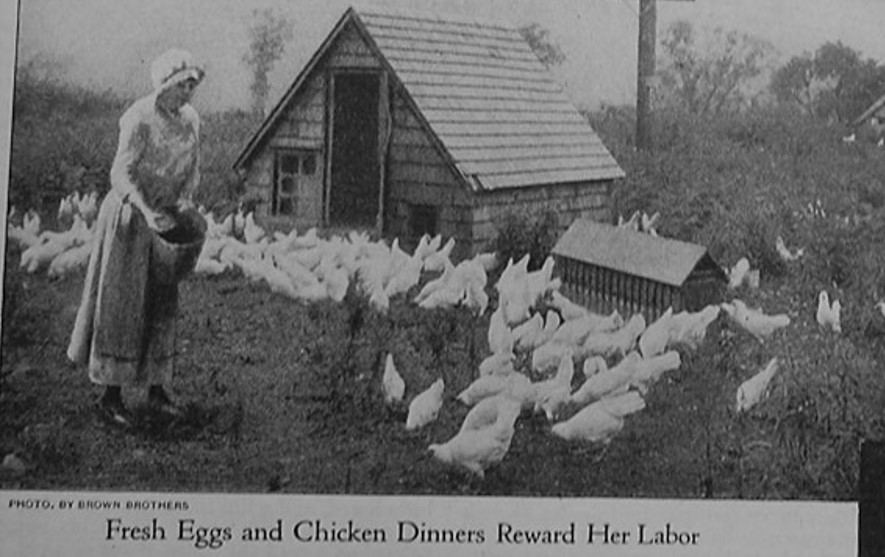
I have friends who raise a few chickens in the suburbs. A hundred years ago, people also raised chickens to get fresh eggs and meat. Here are some excerpts from the March, 1919 issue of Ladies Home Journal:

Did You Ever Think of A Meat Garden?

Why not raise meat in the garden as well as vegetables?

There is no reason why chickens cannot be kept successfully in a town or village lot, provided they are kept in the sanitary condition that is just as essential to the health of the fowls as to the health of the community. Many a family could keep a few chickens, not to make a fortune on selling eggs, but to raise this quick meat for table use or to supply the table with eggs.

The objects attained in keeping chickens for the use of the home table are fourfold: Fresh eggs daily for the children year round; increasing the food supply; raising meat in a short time for the table; saving money on the meat bill.

1919 “Cooking for Profit” Correspondence Course

Source: Cooking for Profit (January, 1919)

Did you ever want to start your own food-related business?

People had similar desires a hundred years ago. The January, 1918 issue of American Cookery magazine had an advertisement for a correspondence course on “Cooking for Profit.”

Today lots of rules and regulations affect the operation of businesses serving or selling food. A hundred years ago there were few regulations.  But people in both 1919 and 2019 had many similar questions when  considering  whether to start a small food-related business – How do you cook foods that people want to buy? What is needed to ensure that the business will be successful? , etc.

Hundred-Year-Old Advice on How to Save Money by Substituting Fats

Today we worry about whether fats are good fats or bad fats. Is a fat saturated or unsaturated? Does it contain trans fats? Does it contain mono- or polyunsaturated fats? Will it increase or decrease cholesterol levels?

A hundred years ago people had different questions about fats. They asked questions like:

  •  How can I get the most calories for the least cost? (Amazingly more calories were seen as better back then.)
  • Does the fat provide sufficient vitamin A? (Fats with more vitamin A were considered better.)

Here’s what a woman wrote in a 1919 magazine article about how she selected fats to serve her family:

When it became necessary to pay two cents for every tablespoon of butter we used in our family, and I knew that we were paying that sum just to satisfy our palates with that specific flavor, I then and there decided that something must be done. I knew that a calorie of energy is as valuable from one source as another and that, measure for measure, other fats than butter would give the same energy.

In choosing a butter substitute, I found that oleomargarine, made largely from beef-oil, contains some, at least of this Fat Soluble A, and if I increased the family milk supply so that the children were getting nearly a quart each day, oleomargarine could replace some butter. I then I could give the family butter only where its flavor was most desirable and expected, and realize that it matters little whether we use lard, cottonseed oil, suet, or the most expensive imported olive oils, from the standpoint of fuel obtained, I could use any clean and wholesome fat in cooking with a perfectly clear conscience.

I found it economic and patriotic, too, to clarify every bit of fat, mixing hard and soft kinds together to get a degree of hardness satisfactory to use in bread, cakes and pastry and in all my cooking. Of course, it costs in time and labor, but save in food and money, and just now there is less food than time or labor.

from “How My Family Saved Fats” by Jessamine Chapman Williams (American Cookery, February, 1919)

The article said that oleomargarine was made from beef oil (tallow?). Today oleomargarine is just called margarine, and is generally vegetable oil product.