Proper Attire When Shopping for Produce

I went to the farmer’s market yesterday. It was a warm day, so I wore my beige shorts, a peach t-shirt, and my old, comfortable, black Clark sandals. I fit right in. Most shoppers were wearing t-shirts – though some had logos. One person had a shirt with a Vikings’ logo,  another shirt said University of Minnesota. A teen was wearing a black shirt that said, “”Don’t follow me, I’m lost too.” Many were wearing shorts, others had on jeans, sweatpants, stretch pants, or leggings.

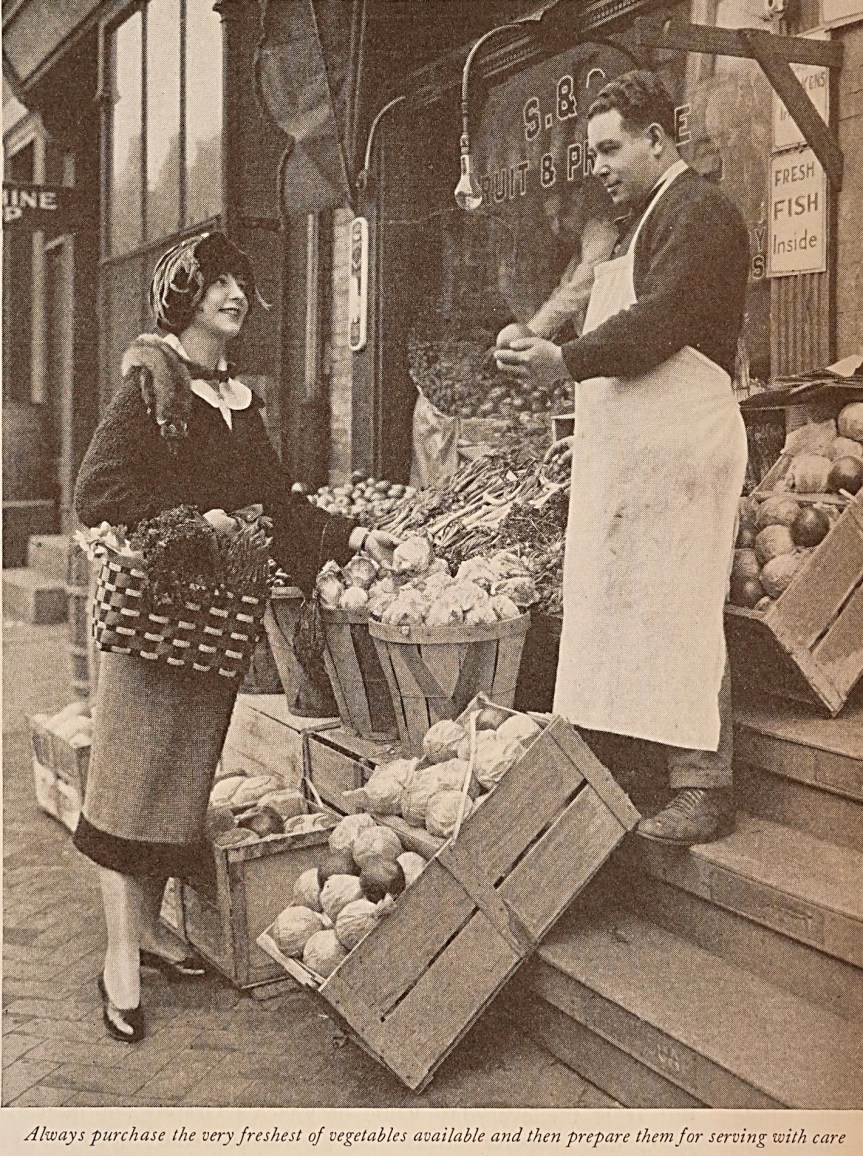
This is very different from a hundred years ago when women (it was usually women back then) shopped for food. Many were homemakers, and shopping was the fun outing for the day (or week). A hundred-year-old photo in the July, 1925 issue of Ladies Home Journal, showed a woman shopping at a produce market. Fresh vegetables sit in crates outside a small store. She is wearing a tasteful knit sweater suit over a  crisp white round-collared shirt, a sophisticated velvet hat decorated with a few feathers, shiny flesh-colored hose, and 1- or 1½- inch pumps. She displayed her prosperity by wearing a fur stole made using a full animal pelt that included the animal’s head and paws.

The picture took me back to my childhood. Each Sunday my family sat on the left side in the fifth pew from the front in a small rural central Pennsylvania church. After all these years, I’m a bit foggy on names, but a family I’ll call the Smith family sat two rows ahead of us. Mr. Smith, a highway contractor, was wealthy by the standards of the isolated area where we lived. His wife, in the spring and on cool autumn Sundays, often topped her church outfit with a mink stole made of four mink pelts, each still with its head and tail. Several of the minks were biting the tail of the mink ahead of it.

My mind would drift away from the minister’s sermon. I was entranced by Mrs. Smith’s stole. It must have cost hundreds of dollars. I dreamed of buying one someday . . . if I ever got rich.

Fast forward, 40 or 50 years. I visited the area where I grew up and, on a lark, went into the Roller Mills Market Place in Lewisburg. It is an old three-story brick flour mill that has been converted into an antique store (aka flea market) with more than 400 venders, each with a small stall. It’s a building where it’s easy to get lost, and time flew by as I looked at old knickknacks, pot and pans, mid-century calendars, tools, and much more.

And, then I turned a corner, and there IT was, draped over an ancient manikin with frizzy, unkempt, blond hair – a mink pelt stole made from four animals with several biting the tail of the one ahead of it. It looked just like Mrs. Smith’s stole. Maybe it actually was Mrs. Smith’s stole. After gasping, I walked over to the manikin, and turned over the attached price tag. $15.

Only $15!! I removed the pelt stole from the manikin and headed to the checkout. I was finally wealthy enough to own a mink stole.

When I got home, I showed it to my husband. He said, “Egad! Why did you buy that?”

I said, “Maybe I’ll wear it a party.”

He said, “I’m not going with you. What would people think? You’ll get into trouble with PETA.”

I said, “That’s silly. These animals were killed years ago. I’m recycling them”

I hung the stole in an empty closet in a bedroom that once had been our son’s room. It’s hung there ever since.mink stole with animal head and tails in closet

While writing this post, I decided that it was time to give the stole another try. I flung it over my shoulder, and looked in a mirror. I looked great. I decided to go outside to take a photo.Mink stole with animal heads

An Excel Energy truck was parked in front of our house and a repairman was fixing a street light. It might just be my imagination, but I think that he gave me a strange look.

I told a friend about the repairman’s reaction. She said, “Next week wear the stole to the farmers’ market. You could be a Glam Gran.”

I thought about it a little, and concluded that I’m not confident enough to wear the stole to the farmers’ market. I’ll never be a Glam Gran. I hung the stole back in the closet.

Oh well. . .I have something that once was a symbol of prosperity, but times change, and that symbol has become flea market junk. I guess that I’ll never look as fashionable as my childhood fashion icon. Sigh. . .I’m just going to have to continue wearing my ratty t-shirts when shopping for vegetables.

1925 Apple Butter Poem


Apple Butter Poem
Source: Farm Journal (September, 1925)

By mid-September 1925, schools were back in full swing. Students often had to memorize poems. The September, 1925 issue of Farm Journal  included a “Good Poem to Recite” about apple butter. There was a section in each issue of the magazine that focused on cooking, sewing, and other household topics. Apparently, the Farm Journal editors thought that teachers read the magazine, and might assign the poem to students to memorize and then recite. Some teachers lived with their families on farms; other teachers in rural areas boarded with farm families.

1925 Cartoon

When browsing through hundred-year-old magazines, I always look for food-related cartoons, but seldom find any. I finally found one in the July, 1925 issue of Ladies Home Journal about baking a pie, but – ouch – it reinforces stereotypes and is very dated. Some things have changed for the better over the past hundred years!

1925 Tips for Selecting Canning Jars, Lids, and Rings

Here’s some tips in a 1925 home economics textbook for selecting canning jars, lids, and rings:

Glass jars rather than metal cans should be used for home canning. Jars should be constructed so that there is no contact of the fruit with the metal, hence a jar having a glass cover is desirable. A large opening, simple construction, ease in cleaning, and perfect sealing are characteristics of good fruit jars.

Glass jars should be tested before using. Partly fill the jar with water, adjust the rubber and cover, seal, invert the jar. Examine carefully for leakage.

Rubber Rings. – Soft, elastic rubbers should be chosen. It is poor economy to use old rubbers. Rubber after usage becomes hard and inelastic; it may cause imperfect sealing and hence decay of the fruit.

In certain processes of canning, it is necessary to subject the jars provided with rubber rings and covers to long periods of boiling or to the intense heat of a pressure or steam cooker. When such a method is followed it is especially necessary that rubber rings of good quality be used. To meet this requirement, the United States Department of Agriculture advises that rubber rings conform to the following:

  1. Inside diameter of 2 1/4 inches (for a jar of standard size).
  2. Width of ring or flange from 1/4 to 12/32 of an inch.
  3. Thickness of 1/12 of an inch.
  4. Tensile strength sufficient to “stretch considerably and return promptly to place without changing the inside diameter.”
  5. Firm enough so that no crease or break shows after it has been tightly folded.

School and Home Cooking (1925) by Carlotta C. Greer

Advertisements in Hundred-Year-Old Church Cookbooks

I have several hundred-year-old church cookbooks. All of them contain favorite recipes of individuals affiliated with the church publishing the cookbook. These cookbooks were also created for fund-raising purposes.  The published cookbooks were sold. They also all have advertising sections at the back. Then (as well as now),  selling ads to local businesses increased the profits. A 1925 cookbook compiled by the Sisters of St. Joseph in St. Paul, Minnesota has a page in the book right before the advertisements calling attention to the ads. And, here’s one of the pages which contained ads:

Ads in cookbook
Source: Diamond Jubilee Recipes (1925), compiled by The Sisters of St. Joseph, St. Paul, Minnesota

The Sisters probably solicited ads from members of the church who owned businesses or from vendors who sold products to the church.

When to Form an Opinion About an Egg

Quote about eggs
Source: The Daily Argus-Leader Home Economics and Cook Book, Sioux Falls, South Dakota (1925)

Old cookbooks have lots of hints and tips. A 1925 cookbook supplement in the Sioux Falls, South Dakota newspaper tells readers to wait to form an opinion of an egg until something happens with the lid. But the old newsprint is blurry and I’m not sure what the last word says. Is it “off”? . . . or “on”? . . or perhaps “of”? (which makes no sense). It may be trying to say that you can’t tell how well fried eggs are going to turn out until the pan lid is removed (assuming that a lid was put on the pan as part of the process of frying the eggs).  Or maybe the egg’s lid” is the shell, and cooks can’t really judge the quality of an egg until the egg is cracked.

Bottom line, I have no idea what this tip means, but I’ve spent much more time than I should have trying to decipher it.

Hundred-Year-Old Tips for Making Croquettes

A hundred-years-ago croquettes were considered a great way to use up left-overs. The texture and taste of croquette was very different from the original food, and “the crisp crust make these little bits acceptable.”

Here are some tips in a 1925 cookbook for making croquettes:

The shape of a croquette adds to its attractiveness or takes away from it. It should never look like a meat cake. If they are meant to be balls, they should be perfectly shaped, or if they are meant to be cone shaped, they should be so carefully handled that they will hold up. It takes considerable practice to make really good looking croquettes.

To make good croquettes, the meat or fish must be minced quite fine and all the ingredients so well combined that the flavors are thoroughly blended. The mixture must be as moist as it is possible to handle without spoiling the shape of the croquette. The cork shaped ones are the easiest to handle. The mixture should be dipped in egg and breaded carefully and then chilled. They are easier to handle in the frying basket if taken out of the refrigerator and will hold together in the fat better.

The sweet croquette is often served as a dessert. After a luncheon of a simple salad, the sweet croquette is just heavy enough to round out the meal.

Home Makers’ Cooking School Cook Book (1925)

I looked through my old croquette posts to find a photo for this post, and realized that none of the croquettes in my pictures are perfectly shaped. Sigh . . .I have only made croquette recipes a few times for this blog because I think that they might not be very healthy since they generally are fried in fat, and because I worry that they will fall apart while cooking.  Maybe I’ll have to try making a croquette recipe again sometime and follow the tips in the old cookbook.

In case you are interested, here are the croquette recipes that I have previously made:

Salmon Croquettes

Mushroom Croquettes

Rice and Celery Croquettes

Potato Croquettes