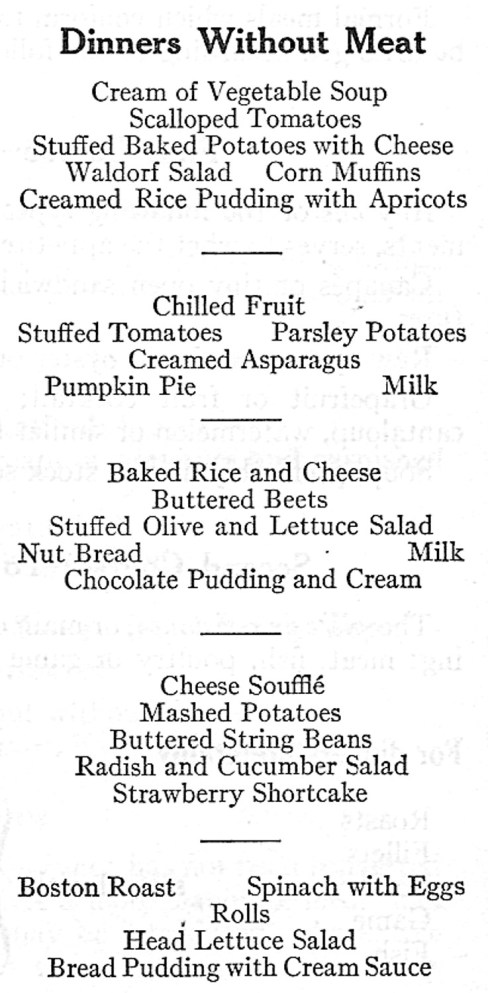
Today people often eat meatless meals for health, environmental, ethical, cost, or religious reasons. A hundred years ago people also sometimes ate meatless meals. Some of the reasons were probably the same – others different.
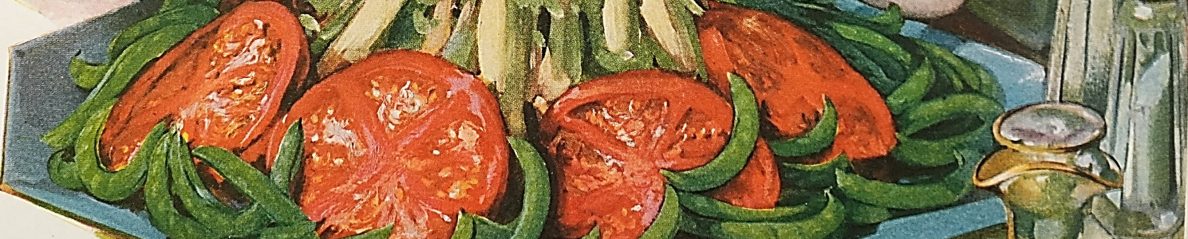
Today people often eat meatless meals for health, environmental, ethical, cost, or religious reasons. A hundred years ago people also sometimes ate meatless meals. Some of the reasons were probably the same – others different.
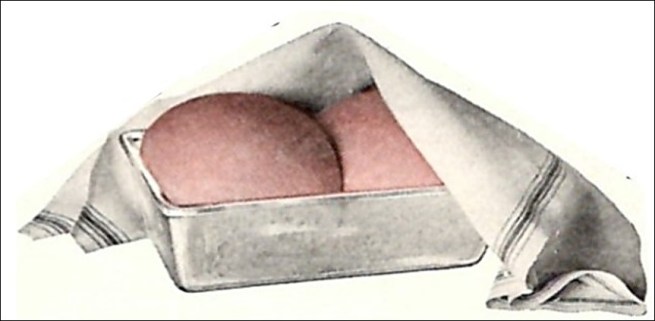
Today we tend to think of gluten in a negative way. But here is what it said about gluten in a 1924 cookbook:
BREADS
. . . The protein in flour is in the form of gluten, and while elasticity is a property of all proteins, the gluten of wheat possesses this property in marked degree. This strong elastic gluten makes a good framework to retain the air and carbon dioxide, and renders wheat the ideal grain for bread making. The protein in oats and corn are deficient in this property and when used in bread making are combined with wheat.
Wheat and flour vary greatly in the quantity of gluten present; even the same variety of wheat will vary from season to season. Also, in connection with the kind of wheat, the time of planting affects the quantity and quality of the gluten. Spring wheat sown in the spring and harvested the same season contains more protein and, consequently, more gluten than winter wheat sown in the fall and harvested in the early part of the summer. Flour from spring wheat, rich in gluten, is well adapted to bread making and is known as bread flour. It is creamy in color, granular to the touch and passes through a sieve easily; a slight jar sends it through. Flour from winter wheat is whiter in color and soft to the touch; if a quantity be crushed in the hand it will retain the impress of the lines in the hand. It tastes sweet. It is adapted to the making of starch. It is adapted to the making of cake and pastry articles; foods in which delicacy rather than strength is sought. Such flour is known as pastry flour.
Source: The Whys of Cooking by Janet McKenzie Hill (1924)

I know that if there is even a bit of yolk in egg whites that they won’t beat well, and that it is impossible to get stiff peaks. Over the years, I’ve often broken a yolk when separating the whites from the yolks and ended up discarding the egg white (or the whites from multiple eggs if I was being cavalier and had assumed that I wouldn’t have problems and directly separated eggs into a bowl that already had whites from other eggs). But I never knew why until I read a short article in a hundred-year-old magazine. (It’s amazing how many new things I’ve learned over the years from old books and magazines.)
Why Does Yolk of Egg Keep White from Beating Stiff?
If even a small portion of the yolk of the egg gets mixed with the white, this will keep the white from beating to the same kind of stiff froth that the white alone will beat into, because there is enough oil present, in the little portions of yolk, to keep down the froth. You know you cannot beat olive oil, for instances, into a froth. You know that “pouring oil on troubled waters” is a very real, rather than poetical expression of the smoothing-down effect of oil on a rough sea and angry breakers. Yet if only a very little of the yolk gets mixed with the white, and if you beat long and hard, you will get a fluffed up mass, though not of the same texture attainable by beating of the white alone.
American Cookery (December, 1924)
Okay, I guess this makes sense – but I’m still a little confused. Why can heavy cream (with lots of fat) be whipped into stiff peaks, while skim milk (with no fat) doesn’t whip at all?

With the new year, I’m moving to 1924 cookbooks. I’m re-energized by the opportunity to explore “new” hundred-year-old cookbooks.
By 1924, more cooks were getting gas and electric stoves, and cookbooks were addressing their challenges as they learned new cooking techniques. The New Home Cook Book noted on the cover that it included a cooking guide for “wood-fire, gas, and electricity.” Cooks apparently found it challenging to know how long foods should be cooked, so the book included a table that could be used for tracking cooking times, temperatures, and the oven rack used.

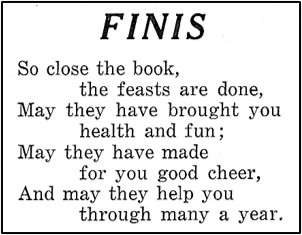
The last page of a hospital auxiliary cookbook published in 1923 had this poem. It fits my mood as 2023 comes to an end. I’ve really enjoyed exploring 1923 cookbooks this year to find foods to make for this blog.
I always do recipes on my Sunday post, so there actually will be one more post on December 31 that contains a 1923 recipe. As I browsed through my 1923 cookbooks one last time to select that recipe, it felt a bit bittersweet. There are so many wonderful 1923 recipes that I never had a chance to make – and that I now will never make as I retire my 1923 cookbooks to the bookshelves in the basement family room; but, at the same time, I can hardly wait to start looking through a whole new (actually old) group of 1924 cookbooks.
Have a happy new year! And, thank you to all the readers that I’ve gotten to know over the past 12 years. You’re awesome. You have made this journey so much fun, and I’ve learned so much from you and your comments. I look forward to exploring 1924 foods with you next year.

Wow! Based on the information in this hundred-year-old advertisement in the 1923 edition of the Boston Cooking-School Cook Book, Baker’s Chocolate has been around for 243 holiday baking seasons.
I’m intrigued by this advertisement because, I posted a very similar advertisement in 2021 from the 1921 edition of the Boston Cooking-School Cook Book. Here’s the image I used from the 1921 cookbook:
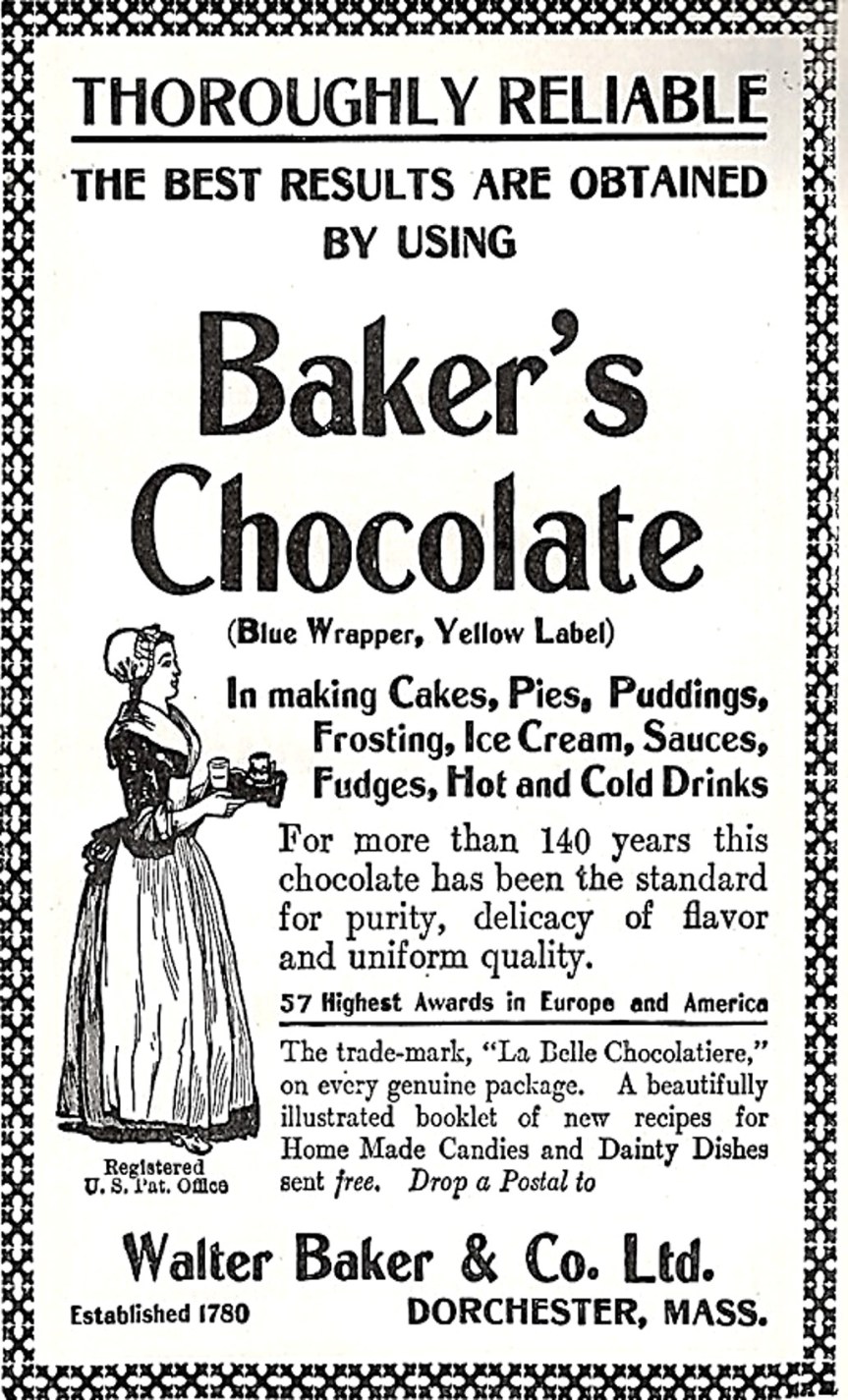
It’s fascinating how there are many tiny formatting differences there are across the two years. For example, “Registered U.S. Pat. Office” is two lines in the 1921 advertisement but has morphed into one line that says, “Reg. U.S. Pat. Off.” by 1923. The border frame is also slightly different on the two ads, and, most intriguing of all, the woman’s face and hair have been tweaked. Why did a graphic designer decide that these changes were needed?
 It’s always hard to know how much to spend on gifts. Here’s what it says in a hundred-year-old home economics textbook:
Gifts
At the end of the year many persons who do not keep accounts would be very much surprised if they could see the total sum of money that has been devoted to gifts. Some would be impressed by the smallness of the total sum, and others would be astonished at the disproportionately large amount used. This represents money used for others, but it cannot be taken as a very valuable index of generosity toward others. The money devoted to church and benevolence is a better indication of generosity.
Gifts are given very frequently to persons from whom gifts are received and it very often happens that they are chosen with the idea of equaling in value a gift received. Very frequently gifts represent a money value entirely out of proportion to the income. This class of expenditures may well receive a more careful consideration by many persons. One’s real regard and generosity to friends never can be measured in money and it is unfortunate to put such emphasis upon gifts.
Economics of the Family by C.W. Taber and Ruth A Wardall (1923)
