
Heat Lemons to Get More Juice

lemon

The household hints section of a hundred-year-old cookbook had the following suggestions for getting more juice from a lemon:

  • A lemon will yield nearly double the quantity of juice otherwise obtainable if it is heated thoroughly before squeezing.

  • Lemons held in hot water yield more juice than otherwise.

The New Home Cook Book, 1924 Edition (Published by the Illinois State Register, Springfield, IL)

1924 Tips for Traveling with a Baby

Baby at the beach
Source: Ladies Home Journal (May, 1924)

It always is complicated to travel with a baby. Here’s some tips that were in a 1924 magazine.

Planning for Baby’s Vacation: Hints for the Journey

The following are good rules for the baby’s vacation, as indeed they are for the proper conduct of his life no matter where he may be:

  1. Keep the baby quiet, clean and contented.
  2. See that his feeding comes at regular hours.
  3. Have his naps come at the same time and last for the same duration each day.
  4. See that his milk supply is pure and safe. Keep the milk clean, covered and cold. It should never be allowed to be warmer than fifty degrees Fahrenheit, until it is finally heated for use.
  5. Dress the baby lightly and in the simplest possible clothing.
  6. Protect the baby from flies, mosquitoes and other insects.
  7. Do not let anyone outside of the family handle the baby.
  8. Keep the baby out-of-doors as much as possible. Let him learn to sleep out-of-doors if it can be arranged.
  9. Remember that no matter where you may take your baby his health and comfort will depend upon what you do for him rather than upon the way in which he travels or the kind of place in which you spend your holiday.
  10. While you are traveling have everything that you will need for the baby easily accessible and where you can get at it at a moment’s notice.
  11. And finally remember that, generally speaking, babies do not need vacations, but if it seems necessary or wise to take them on one there need be no fear of any bad consequences as long as the simple methods of baby care are followed.

Ladies Home Journal (May, 1924)

1924 Buffet Spread Made Perfect with a Table Stove

Table Stove
Source: Ladies Home Journal (February, 1924)

A hundred years ago technology was rapidly changing. By 1924 many homes had electricity, and lots of electric appliances were available in stores (or through mail order catalogs). One appliance was the electric table stove.

I love to have friends over and cook a meal together. If I’d lived back in 1924, here’s how it could be done using a table stove:

Buffet Spreads Made Perfect

For the woman who entertains informally a delightful acquisition is the combination table stove. Constructed with a double set of heating coils between which the toast drawer or the waffle iron may be inserted, it is possible to cook something over the top grill while other food is browning beneath in the lower grill. All these things can be done at the same time, but it requires more time than if just one thing is being cooked, because this device depends upon a single lamp socket for available electricity, and just so much heat and no more can be procured. When three pieces of work are attempted the heat must necessarily be divided among the three.

The electric table stove is just the things on which to cook the evening spread of chicken a la King, shrimp wiggle or any other favorite creamed dish. Get ready  beforehand a tray filled with everything which will be needed for your cooking, with all ingredients measured out. Sometimes it adds to the interest to leave one or two tasks undone as seen in the illustration. The mincing of the green pepper and the opening of the can of fish have been left for the guests to do, thus making the affair as informal as possible –usually the most successful kind of entertaining. While the foundational white sauce is being made in the deep pan placed on top of the grill stove, the slices of bread may be toasted in the toaster drawer.

Ladies Home Journal (February, 1924)

Oven Thermometers: Taking the Hazards and Heartaches Out of Baking

oven heat regulator
Source: Ladies Home Journal (April, 1924)

When baking, many cooks a hundred years ago used a variety of informal ways to figure out whether an oven was very hot, hot, or less hot. However, times were changing and recipes were beginning to indicate the temperature that should be used. This was confusing to some cooks. The April, 1924 issue of Ladies Home Journal advocated for the use of oven thermometers. Here’s a few excepts:

Taking the Hazards and Heartaches Out of Baking: Oven Thermometers Save You Time and Money

Commercial bakers have been using temperature methods these many years in order to produce uniform baking results, while the majority of women who do their own baking still depend upon the hit-or-miss way of oven regulation. The housewife who has used the same range for a long period of time usually judges fairly well, but the inexperienced cook is completely at a loss when she is told to thrust her hand in the oven and count ten, or given some other antiquated method of judging heat.

No longer need women employ such indefiniteness for there are on the market at the present time small portable oven thermometers, reasonably durable in construction, which make guess work in baking a thing of the past, and put the home kitchen on a par with the scientifically correct bakeries of commercial use.

cooking thermometer
Source: Ladies Home Journal (April, 1924)

One can depend on the results every time. There is no chance for burnt or underdone food, once you have learned the control of your oven by temperature. This means a real saving in money because food is not wasted. There’s an added saving, too, for one never need worry about results.

pans for baking cakes
Source: Ladies Home Journal (April, 1924)

Temperature can play a large part in accomplishing perfection in cake baking. A dependable recipe and painstaking mixing are essential, but more cakes are spoiled in the baking than in any other way. This because, by the ordinary method, there has been no way of being absolutely sure that your baking oven today was just like it was yesterday. Luck, good or bad, is a nonessential factor in cake baking if the temperature method outlined is adopted. It becomes an accurate science in which the terrors of possible failure have no place. Different types of cake batter require baking at different temperatures, but the size and depth of the pan also have their effect.

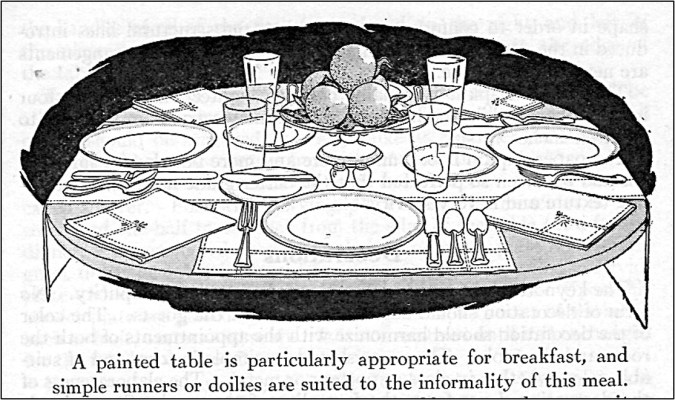
1924 Place Setting Diagram for a Formal Dinner

Place setting diagram
Source: Modern Priscilla Cook Book: One Thousand Home Tested Recipes (1924)

Does anyone host formal dinners anymore? I don’t. They seem like something from the past – though apparently formal dinners were on their way out even a hundred years ago. Here’s what it said in a 1924 cookbook:

A formal dinner is an expensive and elaborate affair not to be undertaken unless one has at her command plenty of help and plenty of money. Very few really formal dinners are given nowadays except in those circles of society where the rigors of etiquette are punctiliously observed. We live in an informal age, and yet through all our informality we observe, generally, more rules of correct usage than the average family has ever done before. That is, there are more of us trying to follow the rules of good manners and consideration (upon which quality all good manner are built) than was the case when one element of society lived and moved by rule, and the rest of it went as it pleased.

The Modern Priscilla Cook Book: One Thousand Home Tested Recipes (1924)

Hundred-Year-Old Directions for Measuring a Spoonful of Shortening

Drawings of how to measure shortening
Source: The Whys of Cooking by Janet McKenzie Hill (1924)

A hundred-year-old promotional cookbook for Crisco shortening had drawings showing how to measure a spoonful (or a half- or quarter-spoonful) of shortening. I knew that the spoon should be scaped to accurately measure a spoonful of shortening. I never would have thought of cutting lengthwise for 1/2 spoonful.

It was expensive to print color pages in a book in 1924. Apparently the cookbook publisher thought that directions for measuring a spoonful of shortening was a high-interest topic. Who would have guessed?