18-year-old Helena Muffly wrote exactly 100 years ago today:
Sunday, June 8, 1913: Went to Sunday School this morning. From there I went along home with Margaret. Spent the afternoon and I came home later on.
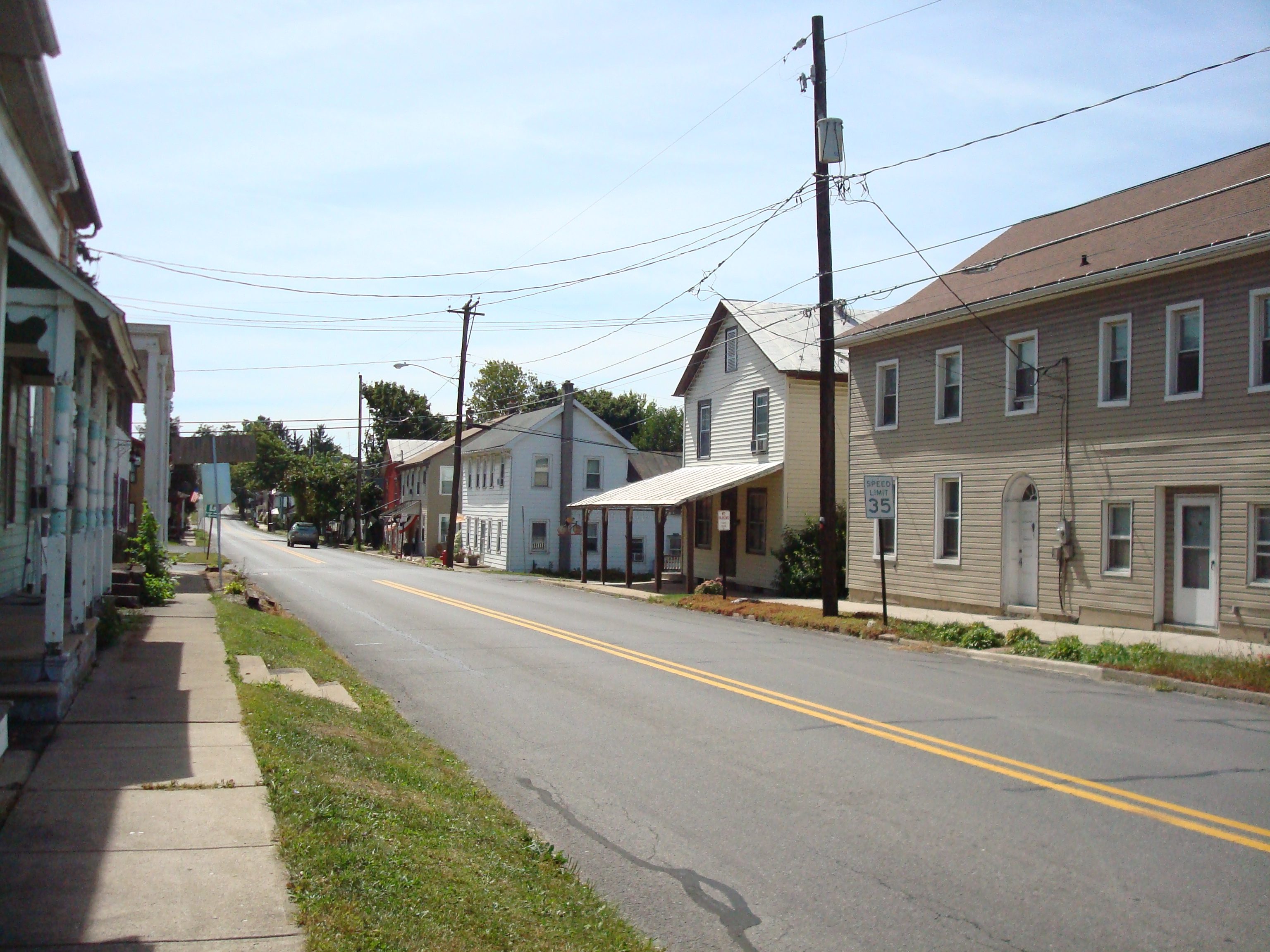
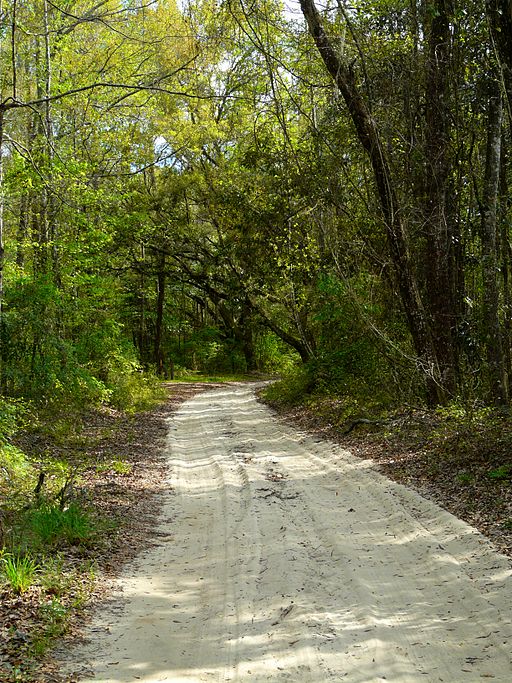
I can picture Grandma and Margaret happily chatting as they walked down this street on a nice June day a hundred years ago.
Her middle-aged granddaughter’s comments 100 years later:
Another minor mystery–Margaret could refer to one of two friends: Margaret Bryson or Margaret G. (I don’t know Margaret G.’s last name. )
My gut feeling is that Grandma went home with Margaret Bryson after Sunday School (though I don’t think that Margaret Bryson generally attended the same church–the McEwensville Baptist Church– as Grandma), because she is the Margaret most recently mentioned in the diary. She was the sister of Blanche Bryson and on May 13, 1913, Grandma wrote:
. . . The Bryson girls were down.
But, then again, Margaret might refer to another friend, Margaret G. On January 29, 1913 Grandma wrote:
. . . Margaret G. came home with me to stay till tomorrow. We had a dandy time this evening, although I am afraid our lessons suffered some. Rufus made candy. And so the evening went.
—
I’d like to thank Janet Shuman for making a comment on the previous post about the Bryson girls. She told me that Margaret was the name of Blanche’s sister. Janet is related to the Brysons—and her comments have really helped me learn more about them.
18-year-old Helena Muffly wrote exactly 100 years ago today:
Saturday, June 7, 1913: Didn’t do very much today, as there wasn’t very much to do.
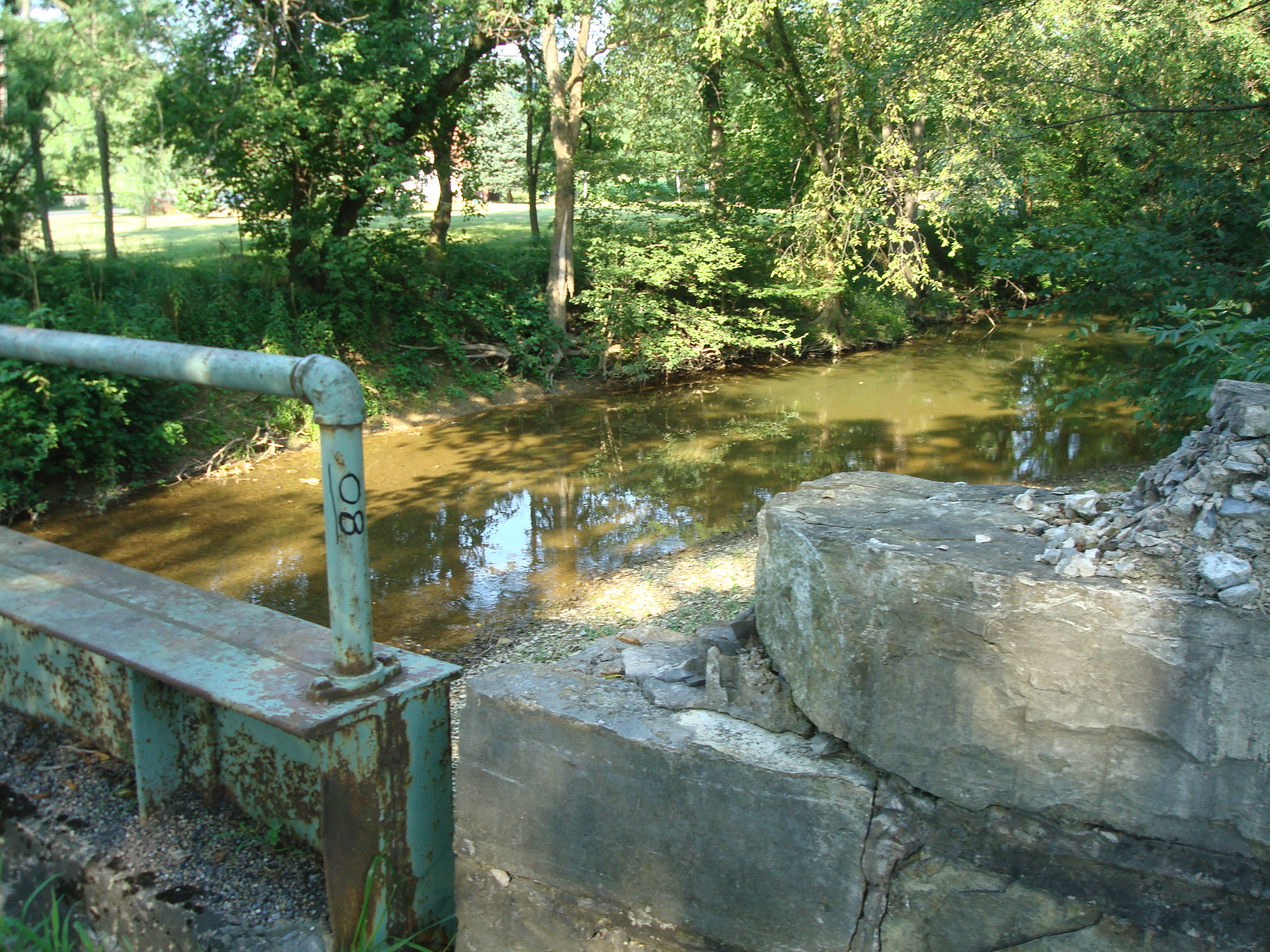
Recent photo of the stream that flows through the farm where Grandma grew up. If you look really hard, you can seen the house and barn through the trees.
Her middle-aged granddaughter’s comments 100 years later:
Sigh . . . Nothing happened, AGAIN???!!!??. . . Grandma must have done something a hundred years ago today.
This is the fourth day in a row that Grandma either wrote that there wasn’t anything worth writing about or that she didn’t do very much.
There are numerous places throughout the diary where Grandma indicated that nothing happened on a certain day –but generally this type of entry was isolated and sandwiched between entries of more substance.
What was happening (or not happening) in Grandma’s life in June, 1913 that made her feel like she had nothing to write about? Was she too tired to write because she was working very hard on the farm? . . . or was she bored now that the excitement over her high school graduation was long past? . . .or . . .
18-year-old Helena Muffly wrote exactly 100 years ago today:
Friday, June 6, 1913: Nothing doing, therefore not worth writing about.
Her middle-aged granddaughter’s comments 100 years later:
Since Grandma again didn’t write much, I’m going to pick up where I left off yesterday. Yesterday I wrote about how an advice columnist named “Aunt Harriet” told young men in the April, 1913 issue of Farm Journal about what they should expect to pay for a wedding and engagement ring.
Aunt Harriet bemoaned the high cost of diamond engagement rings and wrote that:
Of late years it has become quite customary to use the birthstone of the young lady for the engagement ring, and these can be had in a variety of settings and at various prices.
She continued:
The stones for the twelve months are as follows: January, garnet; February, amethyst; March, bloodstone; April, diamond; May, emerald; June moonstone; July, ruby; August, sardonyx; September, sapphire; October, opal; November, topaz; December, turquoise.
I had a vague memory that modern lists of birthstones include zircon for one of the months, so checked the American Gem Society website and found that the stones have changed for a few of the months since 1913.
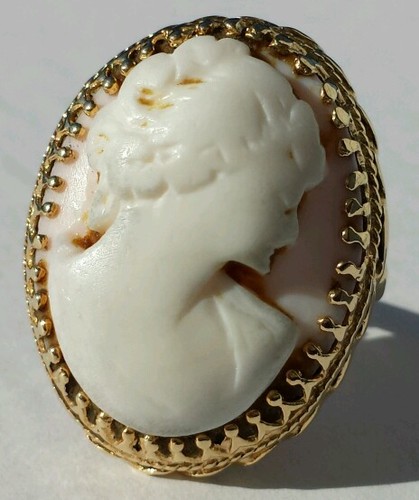
The 1913 August birthstone was sardonyx. It’s a banded mineral that was often carved into cameos.
18-year-old Helena Muffly wrote exactly 100 years ago today:
Thursday, June 5, 1913: Nothing doing, therefore not worth writing about.
Photo source: Wikipedia
Her middle-aged granddaughter’s comments 100 years later:
Since Grandma again didn’t write much, I’m going to continue with the advice that “Aunt Harriet,” an advice columnist in Farm Journal, gave young men in the April, 1913 issue.
Yesterday, I posted Aunt Harriet’s answer to the question, “How much should I spend on a day’s outing with a young lady I hope to win for my wife?”
Assuming, all went well with the outing, young men apparently had a follow-up question:
“How much should I spend on an engagement ring?” and “How much does a wedding-ring cost?” are questions frequently asked me by anxious young men.
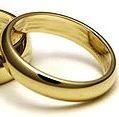
Because the last question is the easiest to answer, we will take that first. A 14-karat ring will cost about $3, while one of 18-karat gold will cost from $5 to $8. What is known as an English ring is the best style. It is narrow, thick, and rounded, inside and out, making it comfortable and durable.
The cost of an engagement ring should be determined by the circumstances of the happy pair. While for years the solitaire diamond has been first choice for such rings, other settings are permissible, and when it comes to a choice between an engagement ring and a balance for necessities or emergencies, the wedding-ring may be made to serve both purposes and the happiness of the marriage will not suffer thereby.
While you can buy a diamond ring as low as $15, the stone will be small and, while genuine, not of the best quality. The average size costs about $100. It requires a good income to live up to such a ring, and a sensible girl would rather have that money in the bank, or invested in home comforts or furnishings.
Of late years it has become quite customary to use the birthstone of the young lady for the engagement ring, and these can be had in a variety of settings and at various prices. . .
18-year-old Helena Muffly wrote exactly 100 years ago today:
Wednesday, June 4, 1913: Nothing doing, therefore not worth writing about.
Photo Source: Wikimedia Commons
Her middle-aged granddaughter’s comments 100 years later:
Since Grandma didn’t write much a hundred years ago today, I’ll share some advice an advice columnist named Aunt Harriet gave a young man in the April, 1913 issue of Farm Journal.
(An aside—I’m amazed that Farm Journal had an advice columnist years ago.)
“How much should I spend on a day’s outing with a young lady I hope to win for my wife?”
When it comes to saying just how much a man should spend on amusements, no stranger can advise. The young man who lives in a scenic district of the United States, writes me, “How much should I spend of a day’s outing when we take a trip over one of our mountain railroads?”
Having invited a young lady to accompany him on such a trip, he should pay all of the necessary expenses, such as carfare, carriage hire, fees, etc.
If the luncheon is not carried along, he pays for this, at a convenient café, and to these necessary outlays, he may add any extra which appeals to their tastes, –a box of candy, a package of picture post cards, a glass of soda water, or any pretty souvenir, which might serve as a memento of a pleasant day’s outing.
Take along enough money to provide for emergencies. The unexpected will sometimes happen, –an accident, a storm, perhaps, something to prevent the carrying out of your plans. Of course your first thought will be the comfort and safety of your companion, and the extra money will ease your way.
In attending a place of amusement, the legitimate expenses are the price of admission and transportation to and from the building. Select as good seats as you can afford; they need not be the most expensive in the house. You can, if you choose, send flowers to the young lady on the day of the entertainment; the florist will help you decide, and the young lady will wear them.
There may be a supper afterwards, but this is not in good taste unless you are in a party. A girl and a man, alone in a restaurant late at night are subject to criticism. As prices vary in different localities, I am sure my young men friends will understand that is impossible for me to state definitely how much they should spend.
18-year-old Helena Muffly wrote exactly 100 years ago today:
Tuesday, June 3, 1913: Had the luck to prick two of my fingers. They hurt some for awhile.
Her middle-aged granddaughter’s comments 100 years later:
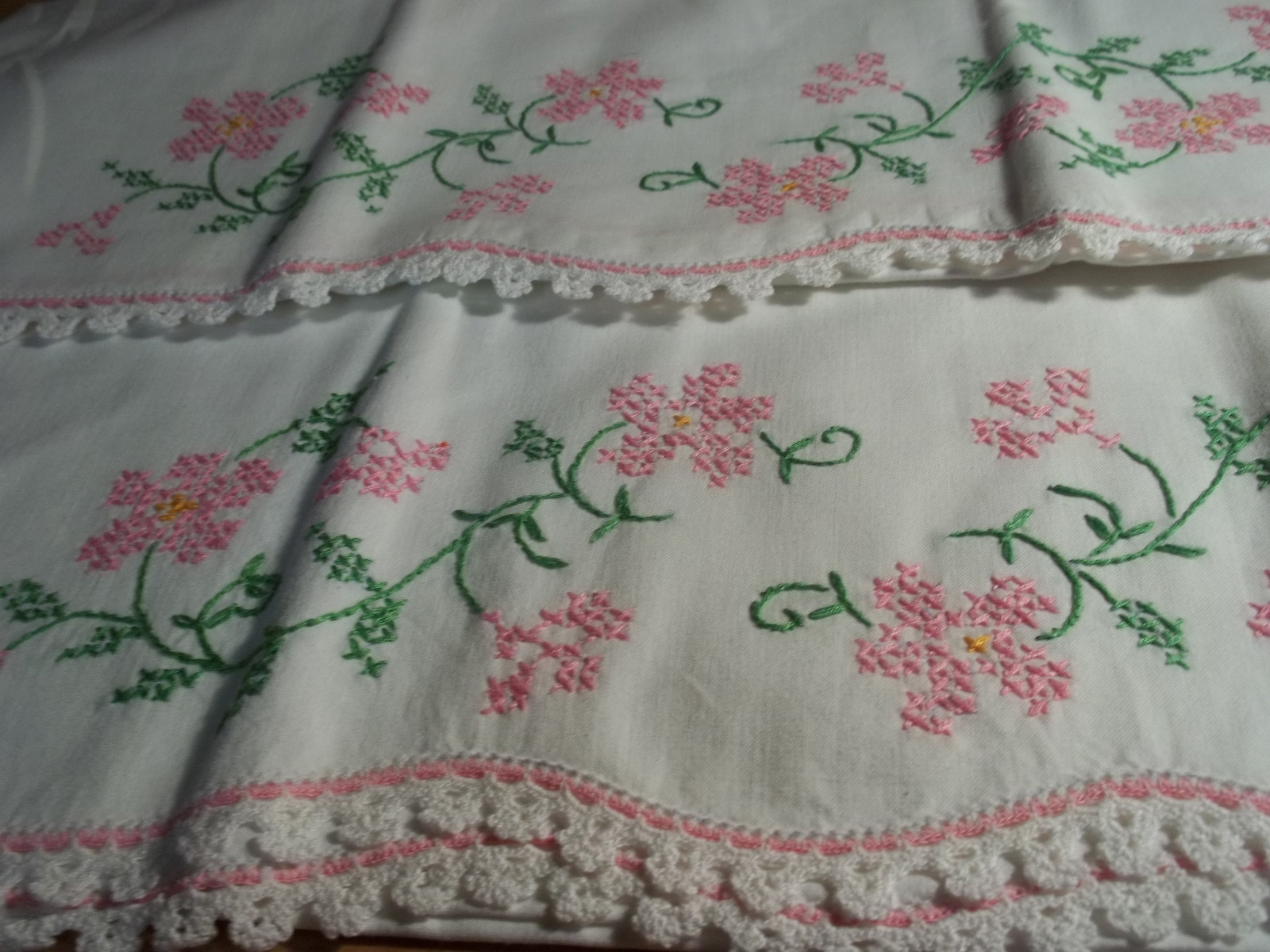
Hmm—any ideas how Grandma might have pricked two fingers? She could have easily pricked one while doing embroidery, mending dress or her father’s torn bib overalls, or doing other hand sewing—but two?
18-year-old Helena Muffly wrote exactly 100 years ago today:
Monday, June 2, 1913: About the same as any other day. Didn’t do anything of note.
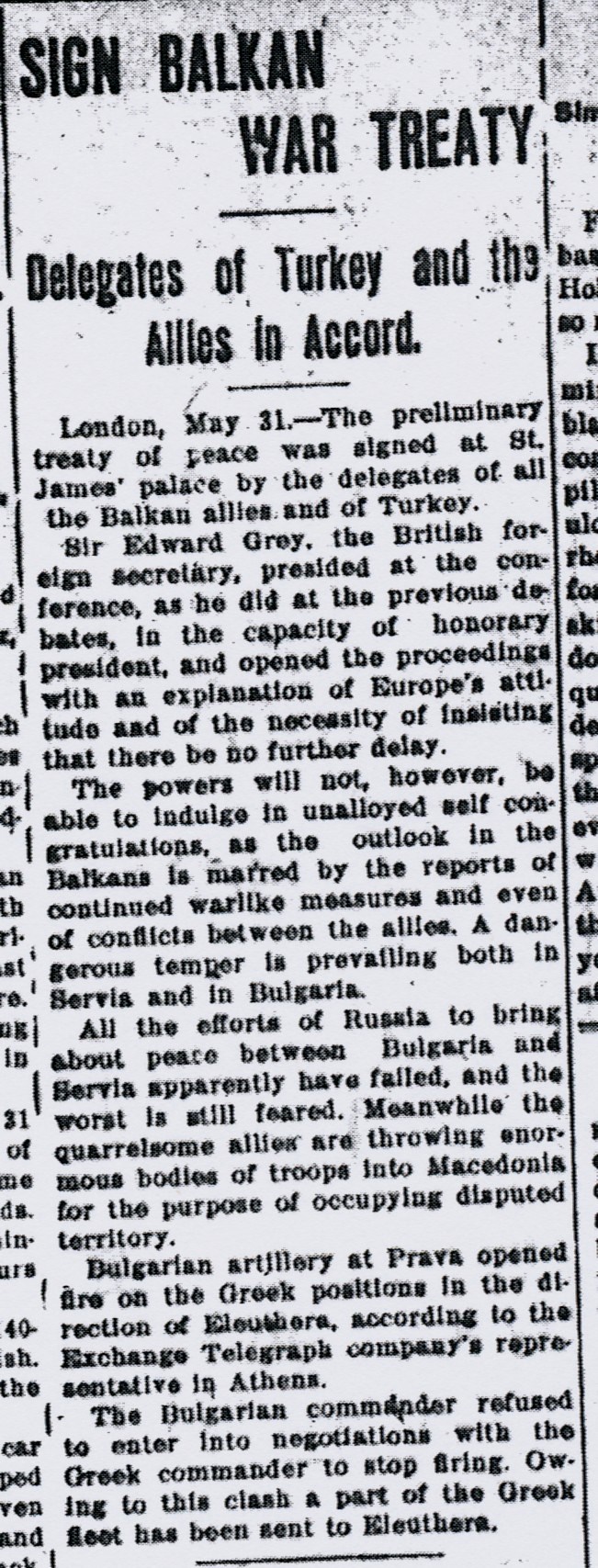
Source: Milton Evening Standard (June 1, 1913)
SIGN BALKAN WAR TREATY
Delegates of Turkey and the Allies in Accord
London, May 31.—The preliminary treaty of peace was signed at St. James palace by the delegates of all the Balkan allies and of Turkey.
Sir Edward Grey, the British foreign secretary, presided at the conference as he did at the previous debates, in the capacity of honorary president, and opened the proceedings with an explanation of Europe’s attitude and of the necessity of insisting that there be no further delay.
The powers will not, however, be able to indulge in unalloyed self congratulations as the outlook in the Balkans is marred by the reports of continued warlike measures and even of conflicts between the allies. A dangerous temper is prevailing both in Servia and in Bulgaria.
All the efforts of Russia to bring about peace between Bulgaria and Servia apparently have failed, and the worst is still feared. Meanwhile the quarrelsome allies are throwing enormous bodies of troops into Macedonia for the purpose of occupying disputed territory.
Bulgarian artillery at Prava opened fire on the Greek positions in the directions of Eleuthera, according to the Exchange Telegraph company’s representative in Athens.
The Bulgarian commander refused to enter into negotiations with the Greek commander to stop firing. Owing to this clash a part of the Greek fleet has been sent to Eleuthera.
Her middle-aged granddaughter’s comments 100 years later:
Grandma’s world often seems so small. The diary provides little evidence that she was aware of happenings across the US and around the world.
But the newspaper that Grandma would have read, the Milton Evening Standard, regularly reported national and world events.
For example, the previous day the paper contained the above article about a peace treaty–it’s called a war treaty in the headline, but the text says it’s a peace treaty– that was signed by the Balkan countries and Turkey.
The article indicates that the treaty may not have been totally successful—and obviously over the longer run it failed since World War I began a little over a year later due to continued unrest in the Balkan countries. The war was triggered when Archduke Ferdinand of the Austro-Hungarian Empire was assassinated in Sarajevo, Serbia on June 28, 1914.
An aside—it’s interesting how the spelling of several cities and countries have changed across the years. In the old article:
–Serbia was spelled Servia.
–Prague was spelled Prava.
–And, I’m not quite sure what Eleuthera referred to in the article (“. . . the Greek fleet has been sent to Eleuthera”), but I’m pretty sure that it wasn’t the island in the Bahamas. 🙂