18-year-old Helena Muffly wrote exactly 100 years ago today:
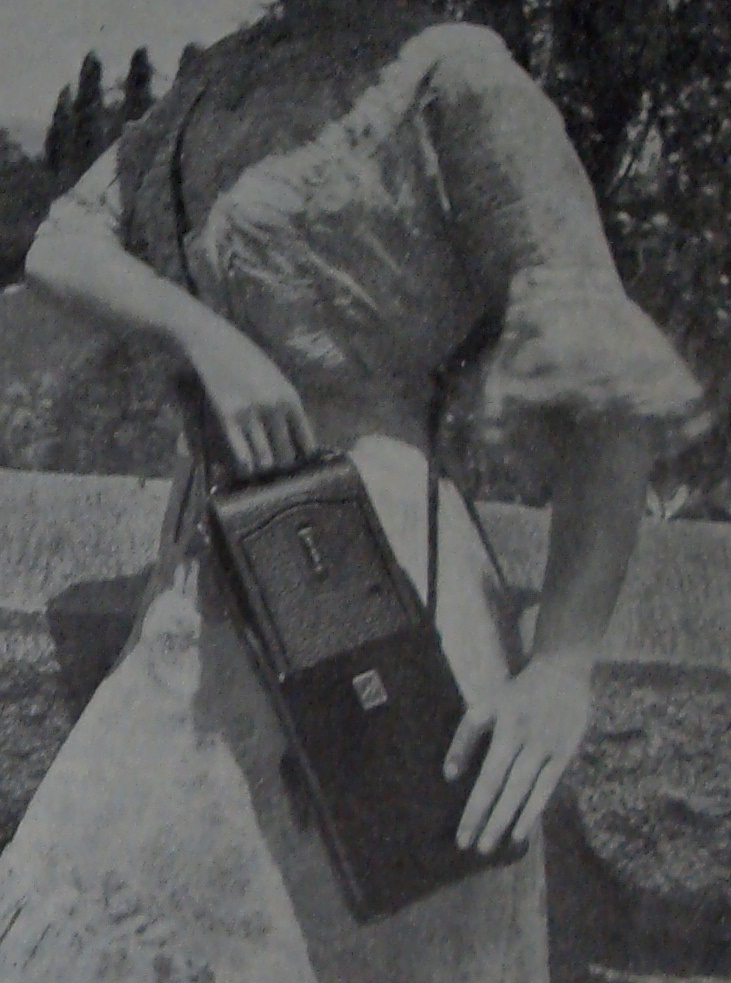
Monday, July 7, 1913:Went into Watsontown this afternoon to see if my camera was there, nor was I mistaken. It was in a big box. I carried it home any way. Wonder if anyone one laughed at me. Perhaps I did look funny.
Her middle-aged granddaughter’s comments 100 years later:
Yeah, Grandma got her camera. She’d ordered it about two week prior to this entry on June 25, 1913.
. . . Nothing less than that I sent off for a camera. I’ve wanted one for a long time, but thought I could hardly afford it. I was reminded that I really wanted it only by finding a camera catalog up in the garret yesterday. And as I had earned almost five dollars during the last two weeks, I carried the project through.
What a typical teen reaction—wondering if anyone thought that she looked funny carrying the large box the mile and a half home from Watsontown.
18-year-old Helena Muffly wrote exactly 100 years ago today:
Sunday, July 6, 1913: I went through a solemn duty this morning. I jointed the church and was baptized. I must strive to keep the promises.
Recent photo of the site where the McEwensville Baptist Church once stood.
Her middle-aged granddaughter’s comments 100 years later:
In the past I’ve wondered which church Grandma attended as a teen—and finally decided that it probably was the Baptist one. This entry provides further confirmation that Grandma was Baptist when she was young.
In 1913 there were three churches in McEwensville—Lutheran, Reformed (United Church of Christ) and Baptist. After Grandma married Raymond Swartz she attended the Lutheran church.
In the diary Grandma mentioned the Lutheran and Reformed churches by name when she visited them for a special event—but she provided no church name when she attended her regular church. This suggests that she didn’t attend either the Lutheran or Reformed church–but rather that she went to the Baptist one.
I’ve been a little uncomfortable with that conclusion since the Baptist Church closed in the late 1910s or early 1920s—and the building was torn down many years ago. In the diary, Grandma seemed to really enjoy attending Sunday School almost every week which suggests that the church was still very active in 1913—but I’m now almost certain that she attended the Baptist Church.
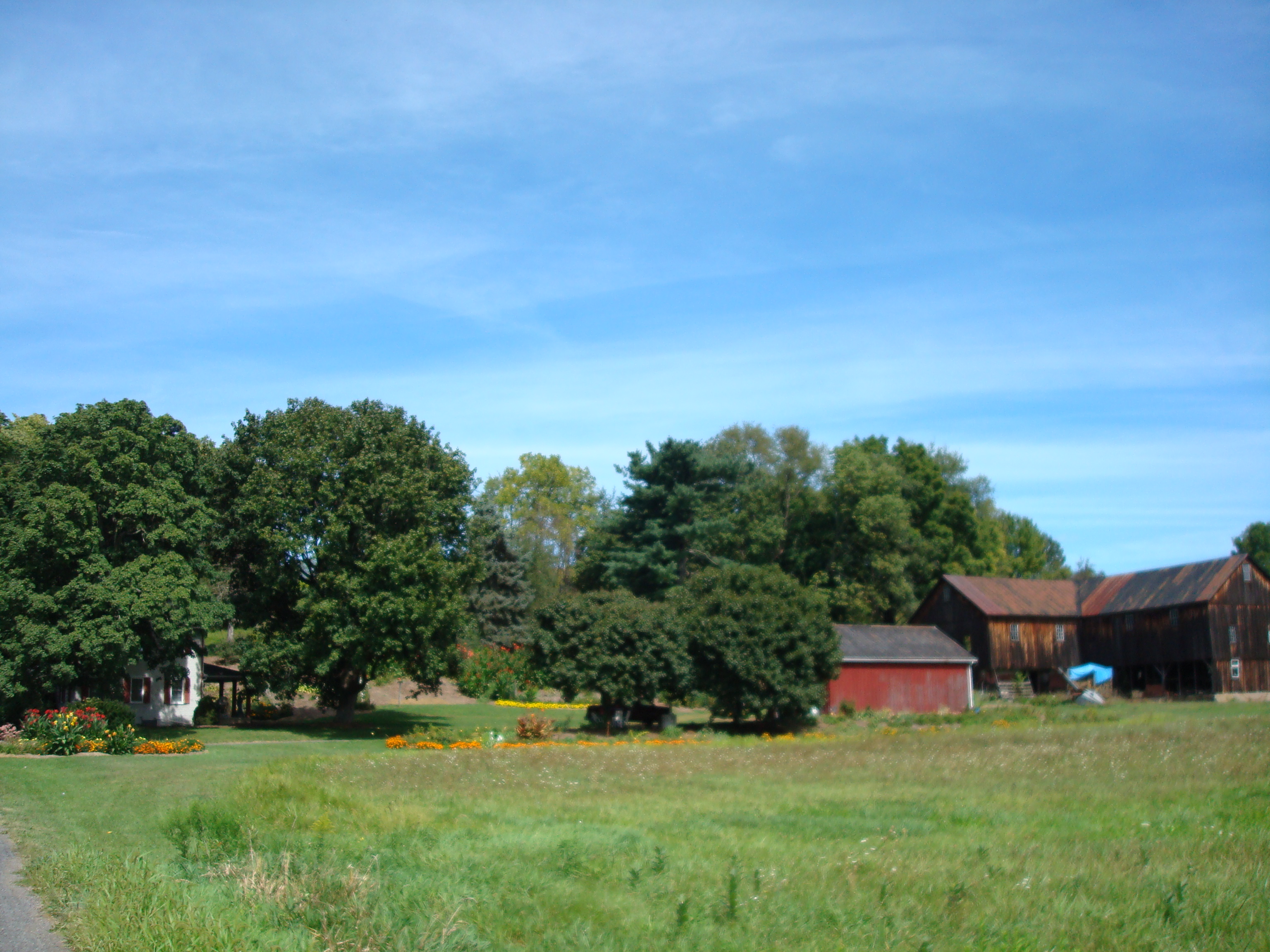
I wonder if Grandma was baptized in Warrior Run Creek. It flows through McEwensville (as well as along the edge of the Muffly Farm).
Her middle-aged granddaughter’s comments 100 years later:
Speck is an old-fashioned term for weight. I think that the way it is used in this sentence has Pennsylvania Dutch or German origins.
I bet Grandma lost a pound or two. I’ve chased pigs a few times in my life and they are darn hard to catch.
I’m not talking about greased pigs that are sometimes seen in competitions at fairs. I’m referring to chasing a run of the mill farm pig that has escaped from a field or pen. You’d think that it would be easy to chase back into the field or pen. Wrong!!
When chasing a cow, all you need to do to get it to turn is to stand in front of it—and the cow will immediately turn and can be directed back into the pen or field. Pigs, however, are very smart (and surprisingly fast), and they know where you want them to go. No matter what you do, a pig will refuse to head in the direction you want it to go. If you stand in front of a pig to try to make it turn, it will almost run you over as it continues going wherever it feels like going.
18-year-old Helena Muffly wrote exactly 100 years ago today:
Monday, July 1, 1913:
The hottest month of the whole year ‘round.
We may surely call July
When the sun shines down and makes us brown.
Then, oh then we often sigh.
(For a day in winter.)
The beginning of this month finds me at the same things I was doing yesterday.
Her middle-aged granddaughter’s comments 100 years later:
In the diary Grandma began each month with a poem. I’ve periodically pondered whether she wrote the poems herself—or got them from some other source.
Over time, I’ve gradually (with the help of some blog readers) come to the conclusion that she wrote them herself. This poem provides even stronger evidence that she wrote them herself.
The previous day she complained about getting a tan and this poem continues along the same vein.
I’m getting a liberal covering of tan on my arms. As for my hands they experienced that some time ago.
I decided to see how Grandma’s poems have changed across the years. Surprisingly (at least to me) the poems she wrote in July, 1911 and July, 1912 had similar themes to this one.
Her middle-aged granddaughter’s comments 100 years later:
Two days ago Grandma wrote that she had to help make hay. They probably were still making hay. I picture Grandma leading horses, or using a pitchfork to sling hay onto the wagon, with the hot sun beating down on her.
An aside: I’m intrigued by the picture that I found to illustrate this post. Is it my imagination or is there a huge bridge in the background of this 1913 photo? There couldn’t have been many bridges like that a hundred years ago in agricultural areas. Does anyone have any idea where the photo may have been taken?
18-year-old Helena Muffly wrote exactly 100 years ago today:
Sunday, June 29, 1913: Went to Sunday School this afternoon. Tweet came down this evening.
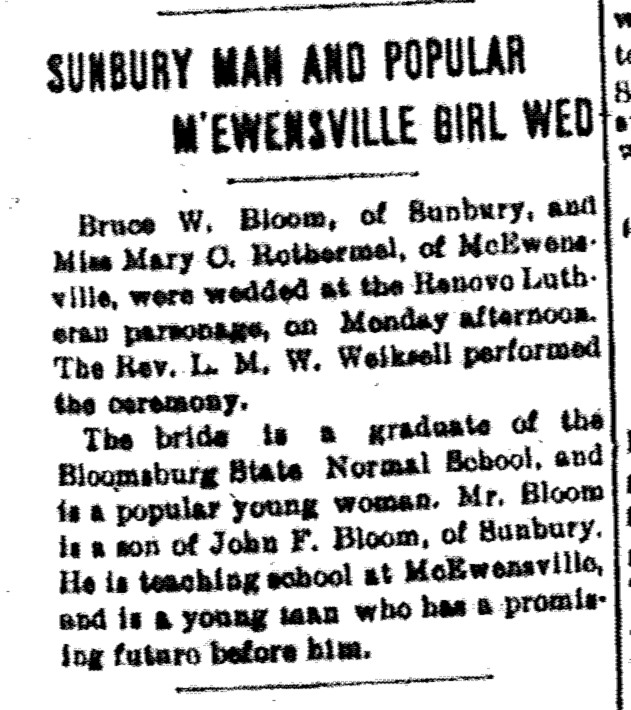
Source: Milton Evening Standard (June 26, 1913)
Her middle-aged granddaughter’s comments 100 years later:
Tweet was a nickname of Helen Wesner. She was a friend of Grandma’s .
Did Grandma and Tweet gossip about the latest news in McEwensville a hundred years ago tonight?
An aside–All of the pieces don’t quite fit together in this post, so feel free to take the information with a grain of salt, but here goes—
Grandma’s former teacher at McEwensville got married. . .to a former student!
On August 26, 1912 Grandma described Bruce Bloom, her teacher during her senior year:
. . . He is rather wide, wears a pair of pinchers, and has yellow hair. Not so very cross, but I believe he could be.
The newspaper clipping says that Bruce married Mary C. Rothermel of McEwensville on the previous Monday (June 23, 1913).
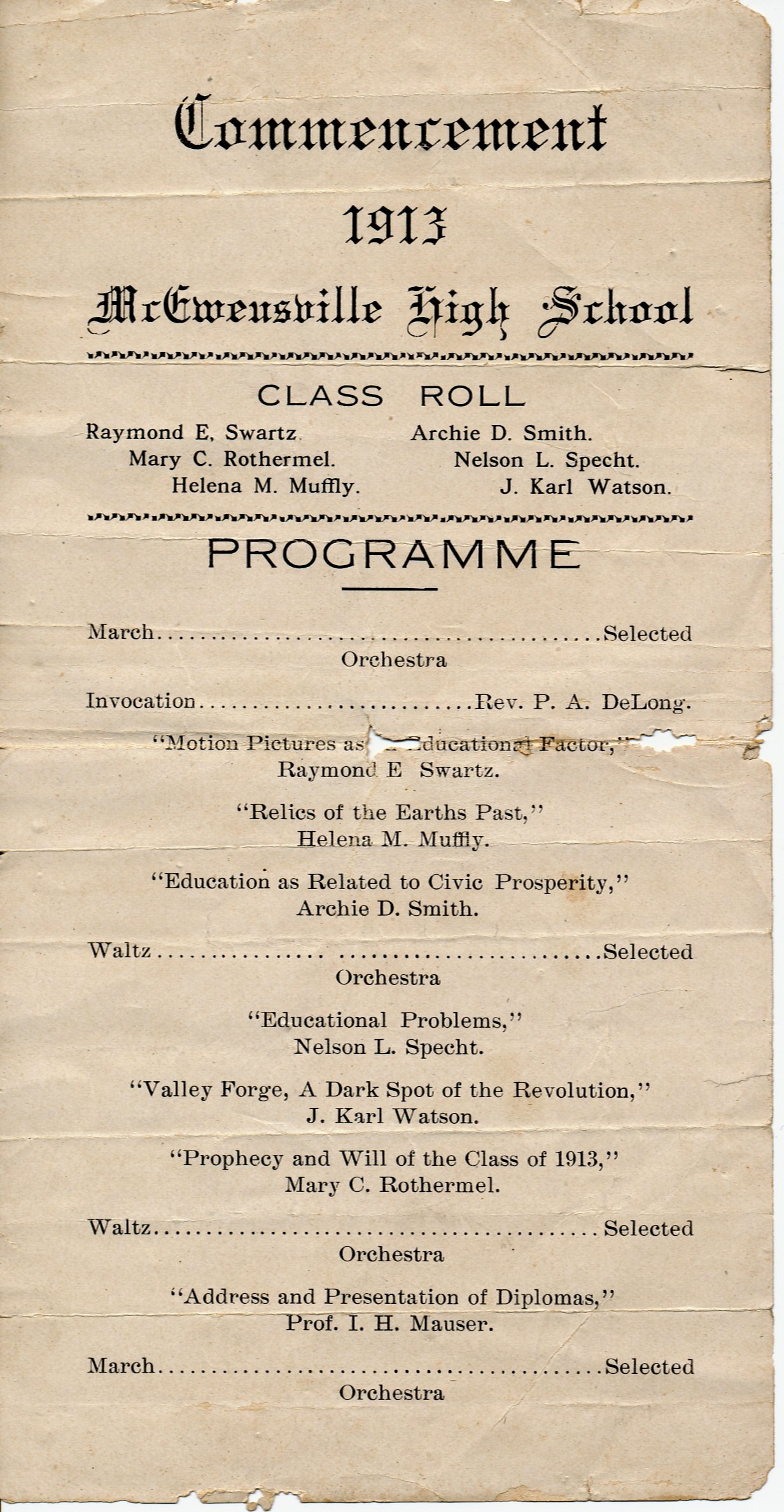
I have the 1913 commencement program for McEwensville High School and it indicates that Mary C. Rothermel (as well as Grandma) were members of the class of 1913.
Now to the part about all of the pieces not quite fitting together—the newspaper article indicates that Mary C. Rothermel was a graduate of Bloomsburg State Normal School which suggests that she was a little older and not a recent graduate of the high school. . . But in a tiny village like McEwensville how could there have possibly been two Mary C. Rothermels?
I’m probably way off base—and trying to create something to gossip about a hundred years later when there really is nothing of particular interest—but I almost want to argue that the newspaper made a typo and that the groom rather than the bride was the graduate of Bloomsburg State Normal School.
And, while I’m worrying about the details, there’s another little thing that bothers me–Why did Bruce and Mary get married in Renovo on a Monday at the church parsonage? Mary was from McEwensville; Bruce was from Sunbury which is about 20 miles south of McEwensville. Renovo is a very remote town way up in the mountains about 75 miles northwest of McEwensville. Did they elope?
Whoa! I need to rein myself in. . . Improbable as it seems, there probably were two Mary C. Rothermels in McEwensville . . . and the boring newspaper clipping probably accurately tells the entire story.
18-year-old Helena Muffly wrote exactly 100 years ago today:
Saturday, June 28, 1913: Got initiated into the hay field this afternoon, and I can say that I didn’t stay there very long either.
Source: Ladies Home Journal (July, 1913)
Her middle-aged granddaughter’s comments 100 years later:
How did Grandma manage to convince her father that she didn’t need to help for very long? It takes a lot of labor to make hay, and I’m surprised that he allowed her to be a slacker.
First the grass needed to be cut, and periodically turned as it dried.
After the grass had dried into hay, it was loaded onto wagons. Horses needed to be held and led as the hay was gathered, and workers needed to fork it onto the wagon.
And, of course, this all needed to be done very quickly—with eyes always looking towards the sky for any clouds that might suggest an impending storm. As the old saying says—Make hay while the sun shines.
You may also enjoy a previous post about how hay was unloaded from wagons a hundred years ago and moved into the haymows in the barn: