Winter Salad Suggestions a Hundred Years Ago


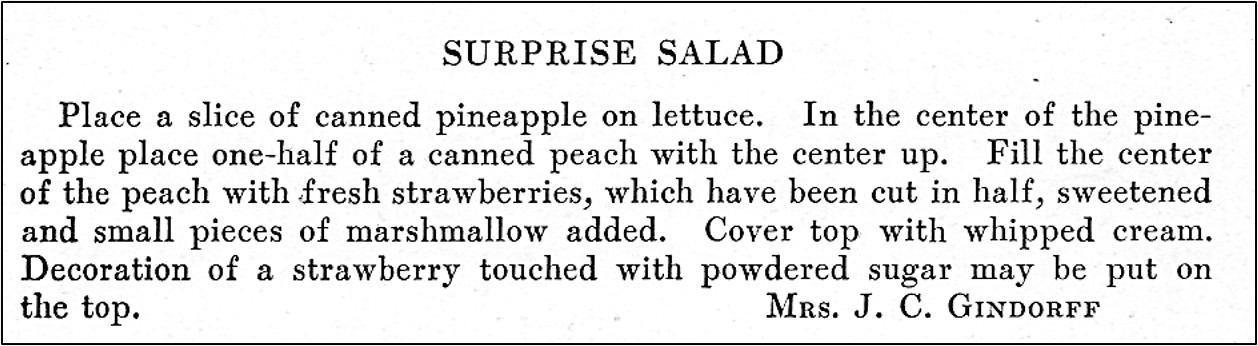
Lettuce with Cucumber Sauce on plateA hundred years ago salad options during the winter months were more limited than they are today. Here is what it said in a 1925 cookbook:

Almost every variety of vegetables and fruits may be made into salads. Eggs are used also, as well as many kinds of fish and meat. Vegetable salads are the most common and should therefore receive first consideration.

Naturally, lettuce heads the list. It is more popular because we can get it when other vegetables are almost unobtainable. The round, close heads are more generally used than the long-leaf variety. Curly lettuce, while pretty, is tougher than either of the other two. Lettuce contains little nutriment, but is rich in mineral salts. . .

In winter, when fresh salad plants are hard to obtain, a tomato jelly or salad made from canned or fresh (cooked) string beans, or even from the remains of baked beans seasoned with parsley and onion juice, is economical and satisfying.

Rumford Complete Cook Book (1925)

Old-Fashioned Macaroni with Spinach

Marcaroni with Spinach

Macaroni with Cheese is the ultimate comfort food, but it can get a little boring. So, when I saw a hundred-year-old recipe that called for adding spinach I decided to give it a try.

The Macaroni with Spinach was tasty – though not creamy like most modern Mac and Cheese recipes. It was not creamy because the old recipe did not call for adding any milk. Because of the lack of liquids, I needed to use care when baking this dish to ensure that the macaroni did not dry out and get hard. I covered the baking dish for most of the time it was in the oven and then removed the cover for the last few minutes to crisp the bread crumb topping.

I had some leftovers when I made this recipe which I carefully put in another dish. I added some milk before reheating which helped keep the macaroni moist.

Here is the original recipe:

Macaroni with Spinach
Source: American Cookery (February, 1925)

Spinach cooks down a great deal, but two pounds of fresh spinach seemed like a lot of spinach when the recipe only called for 1/2 pound of macaroni (about 2 cups of dry macaroni). One pound of spinach would be plenty.  When I made this recipe I substituted a 12-ounce bag of frozen spinach for the fresh spinach. I am not sure why the recipe author called for pressing the spinach through a colander after it was cooked. I tried to do this. (Actually, I pressed it through a Foley mill.) I ended up with a small amount of puree and lots of spinach that wouldn’t go through. I ended up finely chopping the spinach that didn’t go through the mesh and stirring it into the puree. This worked fine, but I realized that if I was going to use all the parts of the spinach that I didn’t need to press it through a colander or Foley mill so I revised the recipe to just indicate that the spinach should be finely chopped.

Here’s the recipe updated for modern cooks:

Macaroni with Spinach

  • Servings: 6 - 8
  • Difficulty: moderate
  • Print

1 pound fresh spinach (or 1 12-ounce bag frozen chopped spinach)

2 cups macaroni

2 cups grated cheese (I used cheddar.)

approximately 1/2 cup fine breadcrumbs (I grated 1 slice of bread.)

1 tablespoon butter

hard-boiled egg for garnish (optional)

tomato slices for garnish (optional)

Preheat oven to 375◦ F. Wash spinach then put in a large skillet and sauté using medium heat with just the water that clings to the leaves until it wilts. Remove from heat and finely chop. (Alternatively use frozen chopped spinach that has been thawed.)

In the meantime, cook the macaroni following package instructions.

Also, in a small skillet melt the butter. Add the breadcrumbs and stir. Cook until the bread crumbs are just beginning to brown while stirring occasionally (about two minutes).

To assemble the dish put one half of the cooked macaroni in a baking dish. (An 8 X 8 dish or a 1 1/12 quart dish works well). Then put a layer containing one half of the chopped spinach on top of the macaroni. Next add a layer containing one-half of the grated cheese. Repeat the layers with the remainder of the macaroni, spinach, and cheese. Top with the buttered breadcrumbs.

Cover and put in the oven. Bake until hot (about 30-40 minutes.) Remove the lid for the last 10 minutes so that the breadcrumbs will be crispy.

Remove from oven and (if desired) garnish with hard-boiled egg slices and tomato slices.

http://www.ahundredyearsago.com

Old-Fashioned Cream of Onion and Potato Soup

Cream of Onion and Potato Soup in bowl

Brrr. . . it’s freezing outside, and soup’s the perfect food to warm body and soul. So when I saw a hundred-year-old recipe for Cream of Onion and Potato Soup, I decided to give it a try.

The soup was lovely. It was creamy, comforting, and flavorful.

Here’s the original recipe:

Recipe for Cream of Onion and Potato Soup
Source: American Cookery (November, 1924)

Here’s the recipe updated for modern cooks:

Cream of Onion and Potato Soup

  • Servings: 5 - 7
  • Difficulty: moderate
  • Print

3 potatoes, peeled and cut into 1/2 inch cubes (about 2 1/2 cups cubes potatoes)

5 medium onions, coarsely chopped (about 2 1/2 cups chopped onions)

4 tablespoons butter

4 tablespoons flour

4 cups milk

1 1/2 teaspoons salt

1/2 teaspoon pepper

parsley sprigs (for garnish)

1 hard boiled egg (for garnish)

Put the cubed potatoes and chopped onions into a large saucepan. Cover with water and bring to a boil using high heat; reduce heat and simmer until tender (about 12-15 minutes). Remove from heat and cool slightly, then puree. (A food processor or blender works well.) Set aside.

In the meantime, put the butter in a Dutch oven or other similarly-sized pan; melt butter using medium heat. Stir in the flour, then gradually add the milk while stirring constantly. Add the salt and pepper, then stir in the pureed vegetables. Bring to a boil while stirring occasionally.  When served, if desired, the soup may be garnished with parsley sprigs and slices of a hard-boiled egg.

http://www.ahundredyearsago.com

Old-Fashioned Whipped Gelatin

Whipped Gelatin in bowlWhen my mother hosted family Christmas gatherings when I was a child, she always made two bowls of “Fluffy Jello;” one made using red gelatin and the other green. She said that “the kids like Fluffy Jello.” She made it by using electric beaters to add lots of air and foam to cooled gelatin that was almost ready to set. I hadn’t had Fluffy Jello in years and had forgotten all about it until I saw directions for making whipped gelatin in a hundred-year-old cookbook.

Directions for whipping gelatin
Source: The New Home Cook Book, published by the Illinois State Register, Springfield, IL (1924)

I decided to whip some gelatin. It was airy and light – and brought back lots of warm memories of day and people from long ago. It’s not just kids who like “Fluffy Jello.”

The 1924 directions called for using a Dover mixer, which is a hand-turned rotary mixer, to whip the gelatin but otherwise it is very similar to how I remember my mother doing it. The old directions also called for using a metal mixing bowl and setting it in ice water to keep everything very cold. This worked well and the gelatin whipped very nicely. I used a box of gelatin that called for using 2 cups water, and said that it made 4 servings. The gelatin did double in volume, and in my opinion it would make 6 to 8 servings, not the 12 mentioned in the directions.  This suggests that the author of the directions used a larger package of gelatin than what I used.

Here’s the recipe updated for modern cooks:

Whipped Gelatin

  • Servings: 6 - 8
  • Difficulty: easy
  • Print

1 3-ounce box of flavored gelatin

Prepare gelatin in a mixing bowl according to package instructions.  Put the mixing bowl with the gelatin in the refrigerator.  Refrigerate until the gelatin just begins to thicken, then set in a pan of ice, and beat with electric beaters until the gelatin is very foamy. Pour into serving dish (a 1-quart bowl works well) and refrigerate until set (at least 2 hours).

http://www.ahundredyearsago.com

Old-Fashioned Mexican Chocolate (Hot Chocolate)

Mexican Cocoa

Brrr. . . It’s snowy outside and time for a hot chocolate drink. I started searching in my 1924 cookbooks for an old recipe that would fit the bill. When I saw a recipe for Mexican Chocolate (Hot Chocolate), I immediately knew that was the one I wanted to try.

I’ve always liked Abuelita Mexican Hot Chocolate with its wonderful spicy hints of cinnamon, and wondered if Mexican Chocolate would have a similar taste.

The verdict: The Mexican Chocolate was delightful with a lovely combination of chocolate, cinnamon, and expresso flavors. It is similar in taste to Abuelita Mexican Hot Chocolate, but not sweet. If desired, sweetened whipped cream can be added to sweeten it.

Here’s the original recipe:

Recipe for Mexican Chocolate (Hot Chocolate)
Source: Modern Priscilla Cook Book (1924)

When I found this recipe, I thought that it would be quick and easy to make. I was surprised that it required more interpretation than I thought it would, and I ended up googling hot chocolate recipes to get a better understanding of the process required to end up with a smooth and creamy drink. When I make hot chocolate I generally use cocoa, but I interpreted “chocolate” in this recipe to mean unsweetened baking chocolate and I needed help in figuring out how to proceed when using baking chocolate. To get a smooth and frothy drink, I learned that the melted chocolate and boiling water should be combined in a saucepan, heated, and stirred until smooth; then the hot milk mixture should be gradually added while whisking constantly.

A hundred years ago, baking chocolate often came in one-ounce squares. Today, the squares are often 1/2-ounce. I used two 1/2-ounce squares.

I substituted instant coffee for the ground coffee to eliminate the need to strain the hot chocolate.

The old recipe says that it makes 3 servings, yet only calls for two cups of milk (and 1/4 cup of water). Given the size of modern mugs, this recipe actually only makes enough for two relatively small mugs.

Here’s the recipe updated for modern cooks:

Mexican Chocolate (Hot Chocolate)

  • Servings: 2
  • Difficulty: moderate
  • Print

2 cups milk

1 1/2 tablespoons instant coffee

1 stick cinnamon

1 ounce baking chocolate (2 1/2-ounce squares), melted

1/4 cup water

sweetened whipped cream, if desired

In a saucepan combine the milk and instant coffee; add the cinnamon stick and heat the mixture until hot and steamy using medium heat while stirring constantly. Remove from heat and remove the cinnamon stick.

In another saucepan combine melted chocolate and boiling water; stir until smooth. Turn heat to medium, and gradually add the hot milk mixture while whisking constantly. Continue heating until steamy and frothy. If desired, serve with sweetened whipped cream.

http://www.ahundredyearsago.com

Old-Fashioned Caraway Cookies

Caraway Cookies

When I was a child, I remember making Caraway Cookies to put on holiday cookie trays, but I had not had any in years; so when I came across a recipe for them in a hundred-year-old cookbook I decided to give it a try.

The Caraway Cookies were simple to make, and they turned out well. They have an old-fashioned goodness, and the warm, earthy flavor of the caraway seeds was delightful. They are not nearly as sweet as many modern cookies, and can nicely balance some of the other sweets on a cookie tray. They are also very nice with coffee, tea, or milk.

Here’s the original recipe:

Recipe for Caraway Cookies
Source: The New Butterick Cook Book (1924)

When I made this recipe, the dough was very sticky, so I added additional flour to make the dough a better consistency for rolling. I used butter rather than a butter substitute.

caraway cookies

Here’s the recipe updated for modern cooks:

Caraway Cookies

  • Servings: about 60 cookies
  • Difficulty: easy
  • Print

1/2 cup butter, softened

1 cup sugar

1 egg

3/4 cup milk

2 cups flour + additional flour if needed

2 teaspoons baking powder

1/2 teaspoon salt

1 1/2 tablespoons caraway seeds

Preheat oven to 400° F. Cream butter and sugar; then stir in egg and milk.  Add the baking powder and salt; stir until combined. Add the flour and stir until well mixed. If the dough is not the right consistency to roll; add additional flour. Roll out to 1/4 inch thick; then cut into shapes. Place on greased baking sheets. Bake 9-12 minutes or until lightly browned.

http://www.ahundredyearsago.com

Old-Fashioned Preserved Pumpkin

Preserved Pumpkin in jars

I’ve had a large pumpkin sitting on my front porch for close to two months. Now that the Fall holidays are past, it was time to compost it – but then I remembered seeing a recipe for Preserved Pumpkin in a hundred-year-old magazine. I dug out the recipe. Preserved Pumpkin actually was a pickled pumpkin recipe. In addition to strips of pumpkin, it called for sugar, lemon juice and peel, and ginger. The recipe looked intriguing – but like many pickle recipes it looked like a lot of work and required letting the pumpkin strips sit in the syrup for several days before cooking. I kept thinking – just toss the pumpkin and be done with it. But. . .

I couldn’t get the Preserved Pumpkin recipe out of my mind (my life must be boring), and ended up making a small batch. And, I’m glad that I did.  I peeled, seeded, and cut into strips about one quarter of the pumpkin and composted the rest.

The Preserved Pumpkin was wonderful with a lovely sweet, citrusy flavor. I’m not exactly sure how to describe the texture. The pumpkin strips were sort of crunchy – or perhaps they were slightly chewy. Maybe a better description is that the texture was at the intersection of crunchy and chewy, if there is such a thing. The Preserved Pumpkin almost seemed gourmet and I could picture it being served at a very nice restaurant as a palette cleanser. I anticipate that I will make this recipe again next year.

Here’s the original recipe:

Recipe for Preserved Pumpkin
Source: American Cookery (November, 1924)

When I made this recipe 1/2 inch seemed very thick for the slices, so I made them approximately 1/4 inch thick. I also ended up with about 2 1/2 pounds of pumpkin strips (rather than the 2 pounds called for when doubling the recipe). I decided to proceed with a little extra pumpkin and the recipe worked fine.

Preserved Pumpkin

Here’s the recipe updated for modern cooks:

Preserved Pumpkin

  • Servings: 2 pints
  • Difficulty: moderate
  • Print

approximately 2 1/2 pounds pumpkin, peeled and seeded then cut into strips 1/4-inch thick

2 pounds sugar

2 teaspoons ground ginger

lemon peel from 2 lemons, cut into thin strips

juice from 4 lemons

1  cup water

Put a layer of pumpkin slices in an enameled pan, crock, or large baking dish. Put a layer of sugar over the pumpkin, as well as some lemon peel strips and ground ginger. Repeat alternating layers. Pour the lemon juice over the layered pumpkin mixture. Cover and set in the refrigerator or other cool spot for two t0 three days. Then put the mixture in a large enamel or stainless steel pan. Add the water. Bring to a boil using medium heat; then reduce heat and simmer until the pumpkin slices are tender and translucent (about 20-3o minutes). Lift the pumpkin slices and lemon strips out and pack them into pint jars. Continue boiling the syrup for another 10-15 minutes, then pour the hot syrup over the packed pumpkin and lemon. Fill to 1/4 inch of top. Wipe jar rims and put lid on. Process in boiling water bath for 5 minutes.

http://www.ahundredyearsago.com