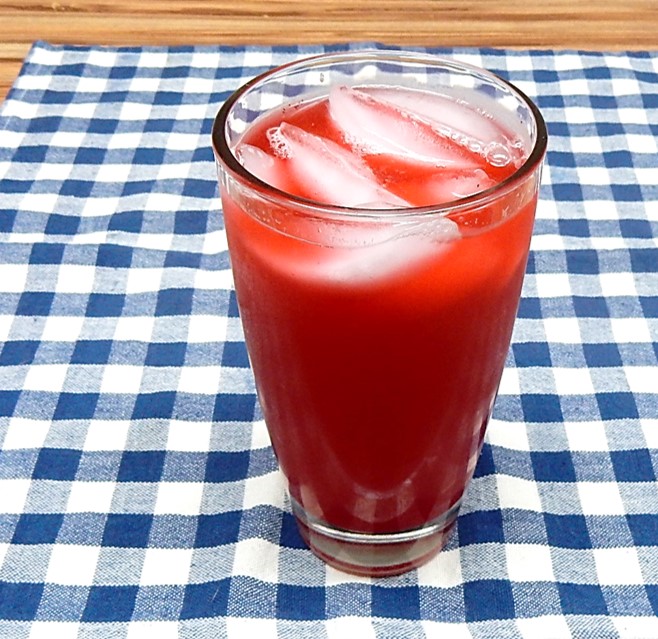
It’s so much fun to go to “pick-your-own” berry farms, but I always pick lots of berries and end up searching for new recipes to use them. Yesterday, I picked some lovely red raspberries, and was pleased when I found a hundred-year-old recipe for Raspberry Nectar. It’s a winner.
The Raspberry Nectar contains both red raspberry juice and lemon juice so the nectar was fairly tart with the delicate essence of raspberry. My husband said that it looked like Kool-Aid – but once we tasted the Raspberry Nectar, we immediately knew that there was no comparison. Raspberry Nectar has the rich nuanced taste of the fresh fruits, and is refreshing on a hot summer day.
Here’s the original recipe:
Source: The New Cookery (1921) by Lenna Frances Cooper
I’m surprised that the old recipe indicates that the serving size is only 3 1/2 ounces. Somewhere I have some very small juice glasses that I got as a shower gift many year ago – and they may have been about this size. The small serving size makes we wonder if the recipe author considers Raspberry Nectar to be a breakfast drink. Both raspberries and lemons are chock-full of vitamin C, so it would be a good substitute for orange juice. That said, I served this drink mid-afternoon over ice; and, it was a nice change from my usual summer drinks (iced tea and lemonade).
1 cup red raspberry juice (Can be made with about 1 1/2 pints red raspberries)
1/4 cup lemon juice
4 tablespoons sugar
1 3/4 cups water
To make the red raspberry juice, put the red raspberries in a bowl and mash with a fork. Put the pulp in a strainer and strain to get the juice. Set the juice aside.
Combine the lemon juice, sugar, and water. Stir until the sugar is dissolved; then add the raspberry juice and stir to combine. Chill and serve.
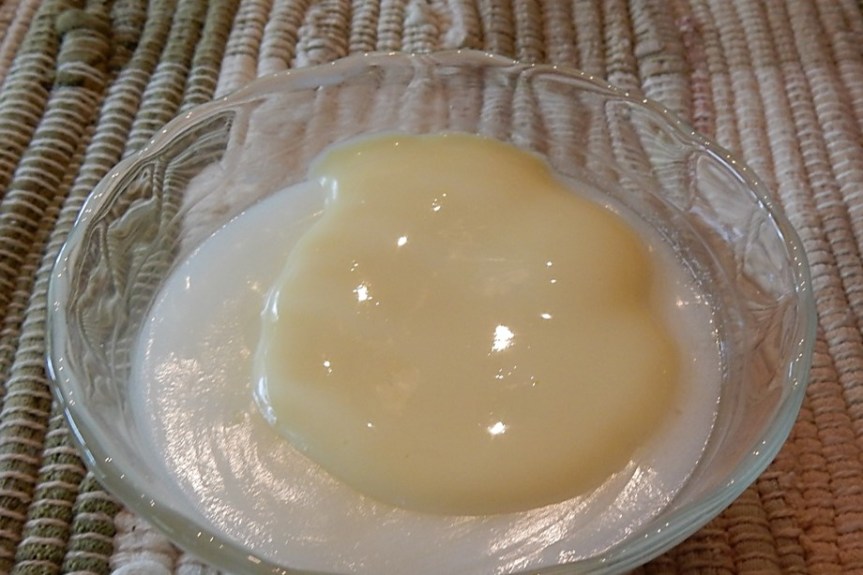
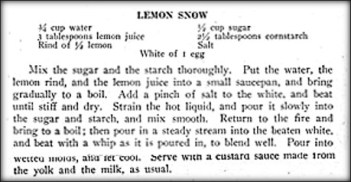
During the summer heat, cool desserts are the best. So when I saw a hundred-year-old recipe for Lemon Snow, I decided to give it a try. The Lemon Snow is served with Custard Sauce, and, if desired, could also be topped with Whipped Cream. I skipped the whipped cream.
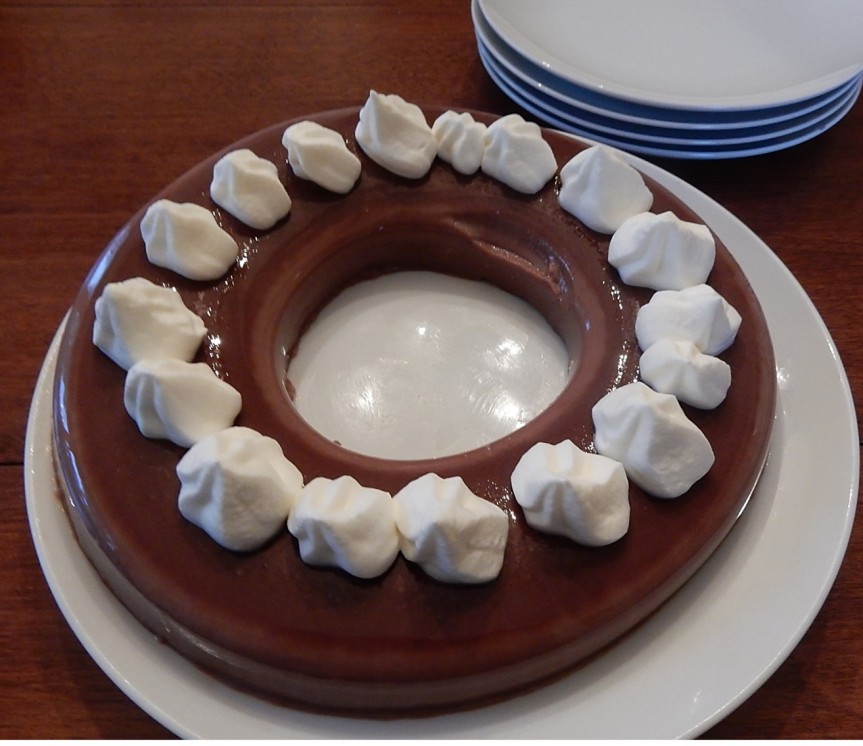
The Lemon Snow was light and had a sunny, lemony flavor. The creamy Custard Sauce paired nicely with the Lemon Snow.
Here are the original recipes:
Source: The Science of Food and Cookery (1921)Source: The Science of Food and Cookery (1921)
I put the Lemon Snow in custard cups. It may be possible to remove the chilled Lemon Snow from the cups (molds) for serving, but I served the chilled dessert in the cups. When I made this recipe, I served the Lemon Snow with Custard Sauce, but I skipped the whipped cream.
Since hot liquid is stirred into the beaten egg whites, the egg whites may be largely cooked, but I used a pasteurized egg for extra safety.
Put the sugar and cornstarch in a bowl; stir to combine. Set aside.
Put the egg white and the dash of salt in a bowl; beat until stiff. Set aside.
Put the water, lemon juice, and lemon rind in a sauce pan. Using medium heat, bring to a boil. Remove from heat and strain the hot liquid.
Slowly pour the strained liquid over the sugar and cornstarch mixture. Stir until smooth. Return this mixture to the saucepan, and bring to a boil using medium heat while stirring constantly.
Remove from the heat and slowly pour over the beaten eggs whites while using a whisk to combine.
Rinse 2 or 3 custard cups with water. Pour the Lemon Snow mixture into the wet cups. Put in the refrigerator to chill (at least 2 hours).
If desired, serve with Custard Sauce or Whipped Cream.
Custard Sauce
2/3 cup milk
1 egg yolk
1 teaspoon sugar
3-4 drops (a dash) of vanilla
Put the egg yolk and sugar into a small bowl; beat until smooth. Set aside.
Put milk in a saucepan. Using medium heat, heat until hot and steamy while stirring constantly. Put a small amount of the lot liquid in the bowl with the egg yolk mixture while rapidly stirring. Then slowly add the egg mixture into the hot milk while stirring constantly. Continue cooking, while stirring, until the hot mixture thickens slightly and coats a spoon. Remove from heat and stir in the vanilla. Strain and then put into a bowl; chill in the refrigerator.
Fruit salad is perfect for hot summer days, so I was thrilled to find a delightful hundred-year-old recipe for Pineapple and Strawberry Salad. The fruits are paired with a sunny dressing that contains lemon juice, and pineapple or other fruit juices.
Here is the original recipe:
Source: The New Cookery (1921) by Lenna Frances Cooper
And, here is the original recipe for Golden Dressing:
Source: The New Cookery (1921) by Lenna Frances Cooper
Three-fourths cup of Golden Dressing seemed like a lot, so I used about 1/3 cup which seemed like plenty.
Here’s the recipe updated for modern cooks:
Pineapple and Strawberry Salad with Golden Dressing
2 cups diced fresh pineapple (dice into bite-sized pieces)
1 cup strawberries (cut into half – or quarters if the strawberries are large)
1/3 cup Golden Dressing – use more if desired
Put pineapple and strawberries in a bowl. Add Golden Dressing and stir gently to coat the fruit with the dressing.
Golden Dressing
2 eggs
1/4 cup pineapple juice, apple juice, or other light-colored fruit juice
1/4 cup lemon juice
1/3 cup sugar
Beat eggs for the yolks and whites until combined (but not foamy). Add the remaining ingredients, and beat until mixed. Put in a saucepan and cook using medium heat until the dressing thickens; stir constantly while cooking. Remove from heat and strain. Put in the refrigerator to cool. May be stored for several days.
Food preferences change across the years. Some foods increase in popularity over time, while other foods that were once common are now seldom made. As I work on this blog, I often think about food fads and trends over the past hundred years. Occasionally 1921 cookbooks and magazines provide a window into even earlier times. For example, in 1921 a reader of American Cookery asked for a recipe that she remembered from her childhood.
Source: American Cookery (Aug./Sept., 1921)
Gingered Rhubarb apparently was a food that was eaten in the late 1800’s in Scotland, but by 1921 it apparently was not part of the repertoire of cooks on the U.S. side of the Atlantic. Why had it become less popular? Was it already considered an old-fashioned dessert a hundred-years ago?
The query also contains a serving suggestion. The individual requesting the recipes states that she remembers eating Gingered Rhubarb on rice desserts (which I took to mean rice pudding).
In any case, I was intrigued and decided to make Gingered Rhubarb. I also made Rice Pudding to serve with the Gingered Rhubarb. The recipe I found was for a Baked Rice Pudding (rather than the type of Rice Pudding that is made in a saucepan on top of the stove).
The verdict: Gingered Rhubarb is a tart sauce embedded with sweetened chunks of rhubarb. It goes nicely with Baked Rice Pudding (which is drier and less sticky than many modern Rice Puddings). That said, you need to enjoy rhubarb and its intense flavor to like this recipe. My husband and I both liked the Gingered Rhubarb with Baked Rice Pudding. However, our daughter did not think it was edible. My conclusion- this recipe features rhubarb with its unique tart taste. If you really like that taste, you’ll enjoy this recipe. However, if you are lukewarm to rhubarb, this recipe is not for you.
Here are the original recipe for Gingered Rhubarb:
Source: American Cookery (Aug./Sept., 1921)
I put the rhubarb mixture in a large glass casserole bowl and let it sit overnight on my kitchen counter. The next day, I put the mixture in a stainless steel pan and cooked. it I used ground ginger when making the recipe.
I was pleased with how well the rhubarb pieces retained their shape when I cooked the Gingered Rhubarb. I think that allowing the rhubarb and sugar mixture sit overnight before cooking may have helped the pieces retain their shape. The sugar drew liquid out of the rhubarb.
The 1 1/2 hour cooking time seemed long to me, but I think that it allowed the flavors to concentrate as some of the liquid boils off. The rhubarb turned brownish as it is cooked (similarly to how apples turn brownish when cooked for a long time to make apple butter).
This is a very large recipe. When I made the recipe, I halved it.
Here is the original recipe for Baked (Plain) Rice Pudding:
Source: The New Cookery (1921) by Lenna Frances Cooper
Cooks many years ago would have made both the Gingered Rhubarb and the Baked Rice Pudding using a wood or coal stove. Both of these recipes have a long cook time – but that probably wasn’t considered an issue when the stoves operated constantly, and foods could be cooked for several hours with little attention from the cook.
Here’s the recipes for Gingered Rhubarb updated for modern cooks:
3 pounds rhubarb, cut into 1/2 pieces (about 6 cups of pieces) -Do not peel.
4 cups sugar
1 tablespoon ground ginger
In a crock or large glass casserole bowl combine the sugar and ground ginger. Add the rhubarb pieces and stir to coat the rhubarb with the sugar mixture. Cover, and let sit overnight at room temperature.
The next morning put the rhubarb mixture in a stainless steel pan and bring to a boil using medium-high heat. Reduce heat to low and simmer for 1 1/2 hours. Gently stir several times while it is cooking.
Remove from heat. May be serve hot or cold. If desired serve with rice pudding, ice cream, or other dessert.
Preheat oven to 325° F. Wash the rice, and combine with all the other ingredients. Pour into a 2-quart buttered baking dish. Place in oven and bake for a total of three hours.
During the first hour, stir three times. Then reduce heat to 3oo° F. and continue baking. After another hour, stir again. Continue baking for an additional hour, or until a knife inserted in the center comes out clean. If desired, when the rice pudding is set, the Rice Pudding can be put under the broiler for a short time to lightly brown the top. May be served hot or cold. Refrigerate, if not served immediately.
Spice cakes are a favorite around our house, so when a birthday rolled around I got the usual request for a spice cake. I wanted to honor the request – yet at the same time, do something different – so I was pleased to find a hundred-year-old recipe for Ribbon Cake, which is a three-layer cake. There are yellow cake layers on the top and bottom with a spice cake layer in the middle.
The spice cake layer contained two dried fruits- chopped raisins and chopped figs. I’ve often eaten spice cakes with raisins. This is the first time I’ve ever had one that also contained figs, and they were a wonderful addition. When eating the cake, I couldn’t distinguish between the chopped figs and the chopped raisins – but together they added a richer and more nuanced flavor and texture than if just raisins had been used.
Here’s the original recipe:
The old recipe doesn’t say to beat the egg white before adding to the cake batter, but I did since I couldn’t figure out why else the recipe would have called for separating the eggs. Adding beaten egg whites results in a lighter cake.
Preheat oven to 350° F. Grease three 9-inch round cake pans; line with waxed paper or parchment paper, then grease again and lightly flour.
Put egg whites into a mixing bowl, and beat until peaks form. Set aside.
Put butter, sugar, egg yolks, milk, flour, and baking powder in a large mixing bowl. Beat until well-mixed. Fold in the beaten egg whites. Pour the 2/3’s of the batter into two cake pans (1/3 in each pan).
Add the cinnamon, mace, nutmeg, and molasses to the remaining batter. Gently stir until thoroughly combined, then gently stir in the raisins and figs. Put in the third cake pan.
Bake the three layers for 25 to 30 minutes or until a toothpick inserted in center comes out clean. Cool 5 minutes. Remove from pans. Cool 1 hour or until completely cooled.
Trim cake layers if needed to make even, then put a yellow cake layer on a plate. Spread with apple jelly, and then put the spice cake layer on top of it. Spread with apple jelly, and then place the remaining yellow cake layer on top.
If desired, frost cake. (I frosted the cake with buttercream icing that was flavored with maple extract.)
Frozen Tom and Jerry is an ice cream that is named after a classic cocktail called a Tom and Jerry. The cocktail is a hot holiday drink that is similar to hot eggnog, but contains both rum and brandy. Frozen Tom and Jerry is a delightful ice cream that has a hint of rum and brandy, and is perfect for a hot summer day.
I found the recipe in the 1921 edition of the Boston Cooking-School Cook Book. According to my daughter, Frozen Tom and Jerry could be served at a party, and no one would guess that the recipe was a hundred years old. (I think this is a compliment.)
I was intrigued that this recipe (as well as others in this cookbook) called for alcohol. Since prohibition began in the U.S. in 1920, and alcohol was prohibited, few 1921 cookbooks list any alcoholic beverages as a recipe ingredient. The Boston Cooking-School Cook Book is an exception and there are numerous recipes which call for alcohol – maybe because it was an update of a pre-prohibition cookbook. I wonder where cooks were supposed to purchase the brandy and rum used in the recipe.
Here’s the original recipe:
Source: The Boston Cooking-School Cook Book (1921 Edition)
In a large saucepan, put milk, sugar, egg yolks, and salt; stir to combine. Using medium heat, cook the mixture while stirring continuously until the mixture is hot and steamy, and coats a spoon. It should be removed from the heat before it boils. Strain; then put in the refrigerator to chill. When cold, stir in the cream, put in ice cream freezer and freeze. When the ice cream is frozen and close to being done, add the rum and brandy. Continue freezing in the ice cream freezer until the rum and brandy is thoroughly mixed into the ice cream (about 2-3 minutes).
When I made this recipe, I used a 1 1/2 quart automatic ice cream maker that used a bowl which is frozen in the freezer overnight, but a regular ice cream maker would also work.
Hundred-year-old cookbooks sometimes contain very basic recipes, such as a recipe for stewed prunes. I’m a little surprised when an author puts such a simple recipe in a cookbook – though I also find it fascinating how basic foods have changed over the past hundred years. Back then (and even when I was young) prunes were very dry and needed extensive soaking and cooking to make tender stewed prunes; whereas today many supermarket prunes are very moist when taken out of the package and need to be stewed for only a few minutes.
Here’s the original recipe:
Source: The New Cookery (1921) by Lenna Frances Cooper
One-half pound of prunes is about 1 cup of prunes. I’m not clear why the directions refer to 1/4 cup of sugar and 1 tablespoon of lemon for each two cups of prunes. Maybe the author was referring to the volume of prunes after they are soaked. In any case, when I updated the recipe, rather than trying to estimate the volume of the prunes, I assumed that the recipe calls for adding 1/4 cup sugar and 1 tablespoon lemon (if desired).
1 cup water (more may be needed if the prunes are very dry.)
1/4 cup sugar, if desired
1 tablespoon lemon juice, if desired
Put prunes and water in a saucepan. If desired, stir in the sugar. Bring to a boil using high heat, then reduce heat until it simmers. Cook until the prunes are tender and the liquid is syrupy (about 15 minutes – if the prunes are moist; longer if they are very dry). Remove from heat, and, if desired stir in the lemon juice.