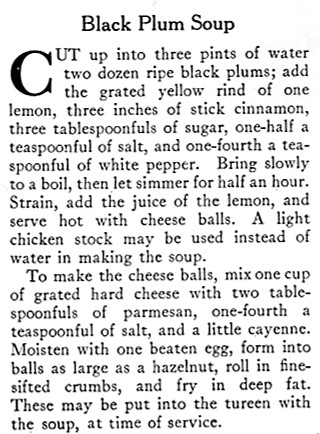
Green peas are a vegetable I often cook when I’m uninspired, so I was intrigued when I came across a recipe in a hundred-year-old cookbook for Green Peas Maitre d’Hotel. It sounded so fancy – and suggested that a boring vegetable could be really special. So I decided to give the recipe a try. The peas are immersed in butter, chopped mint leaves, and lemon juice.
The verdict: Green Peas Maitre d’Hotel were nice with a hint of mint, but the mint taste was very mild and nuanced; and I was a little disappointed that the peas in this recipe seemed very similar to just plain peas.
In a small bowl mix butter, chopped mint, lemon juice, and a dash of salt and pepper.
In the meantime, cook the peas in a small amount of boiling salted water until tender; drain. Then gently stir in the butter mixture. Return to heat until the butter melts, then serve.
I was surprised to recently discover a hundred-year-old recipe for Asparagus with Orange Sauce that called for blood orange. I don’t think that I’ve ever previously seen a recipe for blood orange. The recipe turned out nicely. The sauce had a lovely sunny citrus flavor that nicely complemented the asparagus.
Source: American Cookery (April, 1922)Source: American Cookery (April, 1922)
Until I read this old recipe, I had never realized that blood oranges were considered a spring citrus fruit a hundred years ago.
`Wash and trim asparagus. Put in steamer pan. Add water to bottom, and steam for about 5 minutes or until tender.
In the meantime to make the sauce, combine paprika, salt, grated orange rind, lemon juice, and water in a pan. Bring to a boil using medium heat, boil for several minutes until the volume is reduced by half. Remove from heat.
In a separate pan beat butter until creamy, then add to the grated orange rind and lemon mixture. Next add the egg yolks, one at a time, while beating into the mixture. Set pan with mixture into a pan with hot water. Continue stirring until the mixture thickens, then stir in the juice from the blood orange. To heat, put on medium heat for a few seconds while continuing to stir. Remove from heat and serve over the asparagus.
At potluck dinners when I was young, someone always seemed to bring a salad (or maybe it was a dessert) made with whipped topping, fruit, and marshmallows, so I was intrigued by a hundred-year-old recipe for Marshmallow Strawberry Pudding. It looked similar to more modern renditions – but called for real whipped cream.
I tend to think that a dessert made with lots of whipped cream, marshmallows, and sugar may not be particularly healthy, but that said, the Marshmallow Strawberry Pudding was delicious.
1 cup strawberries, sliced (or if small cut in half) + several additional whole strawberries for garnish
1/3 cup small marshmallows, cut in half
1 cup whipping cream
1/3 cup sugar
1 teaspoon vanilla
Beat cream until stiff peaks form, then gradually add the sugar and vanilla while continuing to beat. Gently fold in the marshmallows and strawberries. Either put in a large bowl to serve or in individual dishes or cups. Garnish with whole strawberries.
Occasionally, an old recipe surprises me. A hundred-year-old recipe for Sponge Pudding called for putting the pudding mixture in a casserole dish, sitting it in a pan of hot water, and then baking in the oven, I thought that the Sponge Pudding would be a baked custard-style pudding, or maybe similar to the filling of a sponge pie, and decided to give it a try.
The recipe only had five ingredients – sugar, flour milk, eggs, and butter. Most of the ingredients are first cooked on top of the stove, and then stiffly-beaten egg whites are folded in. The mixture is then put in the casserole dish and baked.
A few minutes after I put the Sponge Pudding in the oven, I took a peek and was shocked to discover that the baking mixture had risen several inches above the top edge of the casserole dish – and that I actually was making a souffle-type dessert rather then a custard. I turned the oven light on, and nervously watched the baking Sponge Pudding, fearful it would expand so much that it would spill over and go all over the oven. But, fortunately that didn’t happen, and I soon had a lovely very high lightly-browned dessert.
The Sponge Pudding was delightful – though not even close to what I had been expecting.
Here’s the original recipe:
Source: Cement City Cook Book (1922) compiled by the First Baptist Church, Alpena, Michigan
Preheat oven to 425° F. Beat egg whites until stiff; set. aside.
Then in a separate bowl, beat egg yolks until smooth; set aside.
Mix sugar and flour in a small bowl. Gradually stir in the 1/4 cup milk; continue stirring until the mixture is smooth. Set aside.
Put the 2 cups milk in a sauce pan, bring to a boil using medium heat while stirring constantly. Put a small amount of the hot milk into the flour and sugar mixture and stir until smooth. Repeat several times until the flour and sugar mixture is fairly thin. Then stir into the boiling milk; continue stirring until the mixture thickens and is smooth. Remove from heat.
Put a small amount of the hot mixture into the bowl with the beaten egg yolks, and immediately stir. Then stir the egg yolk mixture and the butter into the hot thickened milk mixture. Fold the beaten egg whites into the mixture., and then pour into a 2- or 2 1/2-quart casserole dish. Put the dish in a pan of hot water and put in the oven. Bake until the pudding rises and is light brown (about 30 – 40 minutes). Remove from oven and serve.
Concordia Pineapple Salad is a lovely old-fashioned individually-served salad that makes a nice presentation. A slice of canned pineapple is put on a bed of lettuce. The center of the pineapple is filled with a mixture of diced cucumber and mayonnaise. The mounded cucumber mixture is then garnished with crossed pieces of green pepper or pimento. The pineapple and cucumber combination is unusual, but surprisingly tasty.
I came across this recipe in a 1922 cookbook. A hundred-years-ago, an attractive presentation was an important aspect of many salads. And, they were often served on individual salad plates on a bed of lettuce.
Here’s the original recipe:
Good Housekeeping’s Book of Menus, Recipes, and Household Discoveries (1922)
1 cup diced cucumber (peeled and diced into 1/4 inch pieces)
1/4 cup mayonnaise
8 slices of canned pineapple
16 canned pimento strips or narrow green pepper strips (each approximately 1 1/2 inches long) (I used green pepper strips.)
lettuce
additional mayonnaise, if desired
Put the diced cucumber and 1/4 cup mayonnaise in a bowl, gently stir to coat the cucumber pieces with the mayonnaise. Set aside.
To assemble salad: Each serving should be put on a separate plate. Arrange a serving of lettuce on plate, then lay a slice of pineapple on top of the lettuce. Fill the cavity in the center of each pineapple slice with a spoonful of the diced cucumber and mayonnaise mixture. Cross two strips of pimento or green pepper on top of the mounded cucumber and mayonnaise mixture. If desired, may be served with additional mayonnaise.
Stewed prunes are delicious, so when I saw a hundred-year-old recipe for Cinnamon Prunes, I decided to give it a try. The recipe called for adding both stick cinnamon and lemon or orange slices to prunes and water, and then stewing. The Cinnamon Prunes were tasty with a sunny citrus undertone and a hint of cinnamon. The recipe’s a keeper. I’ll definitely make it again.
Here’s the original recipe:
Source: Good Housekeeping’s Book of Menus, Recipes, and Household Discoveries
When I was flipping through a hundred-year-old recipe book published by Good Housekeeping, I was intrigued by this recipe – and then when I saw that the recipe author was from Danville, Pennsylvania, I just knew that I needed to make it. I grew up about 20 miles from Danville – and I seldom see recipes from this area of central Pennsylvania in hundred-year-old cookbooks. The cookbook doesn’t give the author’s name – and maybe it’s a stretch – but could my ancestors have known the author?
When I made this recipe I skipped the overnight soaking of the prunes. I have vague memories of prunes being very dry years ago – and that they needed to be soaked for a long time before cooking; however, modern prunes are generally moist, and just heating them with a little water is sufficient to get prunes that are nice and soft.
Put prunes in a saucepan and cover with water; add stick cinnamon and lemon or orange slices. Using medium-high heat, bring to a boil, then reduce heat and simmer for 15 minutes. Can be served warm or cold.
Loaf cakes are easy to make – and a nice size for our small family, so when I saw a hundred-year-old recipe for Almond Loaf, I decided to give it a try. I was also intrigued that the old recipe did not call for any baking powder or baking soda – nor it call for any fat. Instead of leavening, beaten egg whites cause the Almond Loaf to rise a small amount.
The recipe made a small loaf cake that was only about two and a half inches thick. Each slice of the Almond Loaf had just the right amount of sweetness, was chockful of chopped almonds, and was lovely with coffee. The slices reminded me a little of biscotti – though it was much softer. Is there such a thing as a soft biscotti?
Here’s the original recipe:
Source: Good Housekeeping’s Book of Menus, Recipes, and Household Discoveries (1922)
I don’t know where to get unblanched almonds so I just bought a bag of sliced almonds at the store. I then coarsely chopped the sliced almonds to use in this loaf. I also didn’t have pastry flour, so I used all-purpose flour, which worked well.
1 cup almonds (I used sliced almonds that I coarsely chopped.)
Preheat oven to 335° F. Put egg whites in a mixing bowl, and beat until the whites are stiff. Set aside.
Put egg yolks in a mixing bowl; beat until smooth. Add sugar, all the flour except for 2 tablespoons, and salt; stir until combined. The mixture will be very dry and crumbly. Fold in the beaten egg whites and the remaining 2 tablespoons of flour. Gently stir until combined, then stir in the chopped almonds. Put the mixture in a loaf pan that has been greased and floured. Bake until the loaf is lightly browned, and an inserted wood pick comes out clean (approximately 1 hour).