18-year-old Helena Muffly wrote exactly 100 years ago today:
Wednesday, September 17, 1913:
September 16 – 17 – 18 – 19: Nothing much of importance happened during these days. I have to help Pa some and get put at rolling for one thing. Of course I had my mishaps even to going off of the roller. That work is all done by this time.

Her middle-aged granddaughter’s comments 100 years later:
This was the second of four days where Grandma wrote a single diary entry. Yesterday I described how Grandma rolled the fields in preparation for planting winter wheat. Since Grandma didn’t write anything specific for this date, I’m going to share something I learned when I was doing research for this series of posts that surprised me.
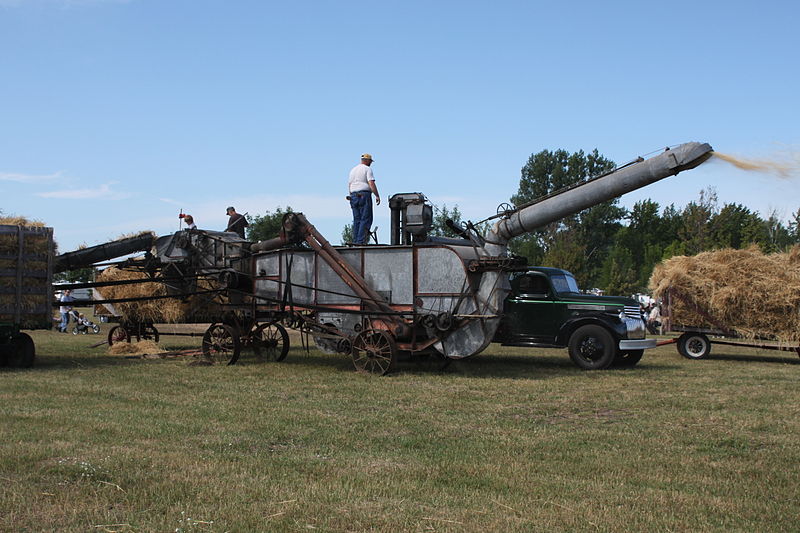
Did you know that there were some huge, highly-mechanized, wheat farms in the United States in the late 1800s and early 1900s?
There were 91 large “Bonanza Farms” ranging in size from 3,000 to more than 30,000 acres in North Dakota and Minnesota.
In 1864 the US government gave a group of investors millions of acres of land to finance the building of the Northern Pacific Railroad from Minnesota to the west coast. During the Panic of 1873, the investors got into financial difficulty and needed to raise funds to complete building the railroad so they let stockholders buy large tracts of land in the Red River Valley at low rates.

The farms had professional managers and migrant labor did much of the work. (During the winter months many of the farm laborers worked in logging camps in Michigan, Minnesota, and Wisconsin.)
By the early 1900s wheat prices were low, labor costs were rising, and the Bonanza Farms weren’t very profitable.
There also was a lot of concern that the Bonanza Farms weren’t good stewards of the land. For example, the opening paragraph in a bulletin published by the US Government in 1908 said:
Experience has shown that when excessively large companies farm great tracts of land the tendency is to exploit the land for the greatest immediate profit at the expense of the permanent value of the soil. Proper soil-cultural methods are not observed: rotations for the preservation of soil fertility are neglected; the main crop, wheat, is grown continuously, and the seed is allowed to degenerate through careless methods. Undoubtedly there are exceptions to this rule. It is not the writer’s wish to intimate that rational dry farming is impossible when carried on by large companies, but the general rule has been as stated here. It is evident that the homesteader, having in mind the value of his home and the welfare of his posterity, is more likely to perpetuate and increase the value of his land.
Dry-land Grains (U.S. Department of Agriculture, Bureau of Plant Industry, Circular No. 12, 1908)
These concerns led, in part, to changes in tax codes that discriminated against Bonanza Farms which made them even less profitable.
At the same time more people wanted to farm in the upper Midwest and the land was becoming more valuable, so many of the Bonanza Farms were divided into smaller plots and sold to family farmers.
—
Here’s links to several sites that have additional information about Bonanza Farms:
Bonanza Farming (Encyclopedia of the Great Plains)
The Bonanza Farms of North Dakota (Teaching with Historic Places, National Park Service)
.