I recently was surprised to find several recipes for Asian foods in a hundred-year-old U.S. cookbook. The introduction to the chapter on luncheon and supper dishes in a 1926 cookbook called Mrs. Peterson’s Simplified Cooking says:
So many persons have asked for some reliable recipes for Chinese dishes that I have included some favorite ones here. These dishes are unusual and delicious in flavor. The bamboo shoots, water chestnuts, and sauces called for may be purchased canned from any grocer who imports.
The cookbook included recipes for Chop Suey, Chinese Rice, Fried Rice, Chow Mien, and Egg Foyung. The cookbook author spelled both the Chow Mein and Egg Foo Young differently than we spell them today. I am not sure if she was uncertain how to spell them and tried to spell the words the way they sounded to her, or whether they are archaic spellings.
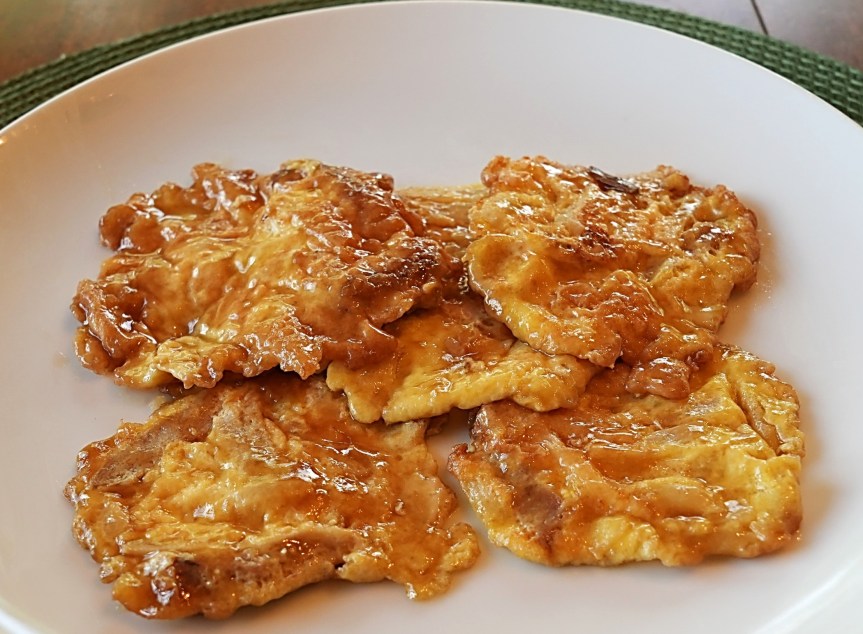
I have no idea how authentic the recipes are, but am guessing that they are different from foods actually served in China. In any case, I decided to give the Egg Foyung (Egg Foo Young) a try.
The old recipe calls for many of the same ingredients that modern Egg Foo Young recipes call for (eggs, bamboo shoots, water chestnuts, pork or chicken); however, the process for making the dish is a little different from most modern recipes. Many modern recipes call for pouring a soy sauce mixture on egg pancakes (or omelet), while this recipe calls for coating the cooked egg pancakes with a soy-based gravy by putting them in a skillet with the hot gravy, and then flipping to coat the other side.
The verdict: The Egg Foyung (Egg Foo Young) was fun to make and tasty.
Here’s the original recipe:
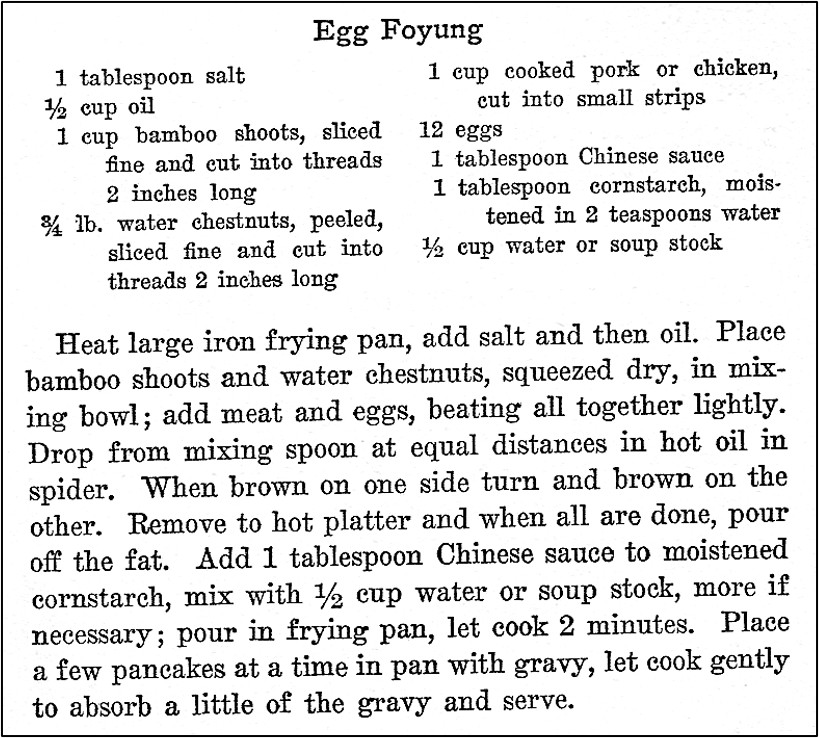
This recipe makes a lot of Egg Foyung, so I halved the amount of batter that I made, but used the amount of vegetable oil that the original recipe called for to ensure that the oil was an adequate depth. I also made the original amount of the gravy; however, when I started putting the egg pancakes into the gravy to absorb some of the liquid, I quickly ran out of it and had to make more. So, when I updated the recipe, I doubled the ingredients used to make the gravy.
When I halved the batter-portion of the recipe, I used half of an 8-ounce can of sliced water chestnuts and half of an 8-ounce can of bamboo shoots. I refrigerated the extra water chestnuts and bamboo shoots. To use the remaining water chestnuts and bamboo shoots, I made the recipe a second time several days later.
I assumed that “Chinese sauce” referred to soy sauce. I reduced the amount of salt when I made the recipe. It seemed like the old recipe called for too much, especially since the gravy contained substantive salt because of the soy sauce in it.
Here’s the recipe updated for modern cooks:
Egg Foyung (Egg Foo Young)
1/2 cup bamboo shoots (I used half of a 7-ounce can.)
1/2 cup sliced water chestnuts (I used half of a 7-ounce can.)
1/2 cup cooked pork or chicken, cut into thin 2 inch strips (I used pork.)
6 eggs, slightly beaten
1/2 teaspoon salt
1/2 cup vegetable oil
2 tablespoons corn starch
4 teaspoons water
2 tablespoons soy sauce
1 cup broth or water (I used beef broth.)
Step 1. Cut the water chestnuts and bamboo shoots into thin strips. If the bamboo strips are longer than two inches, cut them in half.
Step 2. Put the eggs, water chestnuts strips, bamboo shoot strips, and pork or chicken strips into a mixing bowl; stir to evenly distribute all the ingredients.
Step 3. Put the oil and salt in a large heavy skillet and stir, then heat until hot using medium heat.
Step 4. Drop the egg mixture from a tablespoon into the hot oil. Evenly space the spoonfuls of the mixture in the pan. Cook until the egg mixture thickens, then flip and cook the other side. Remove from pan and put on a warm oven (275° F.) while while making the remaining ones. The egg pancakes will need to be cooked in several batches.
Step 5. Once all the egg pancakes have been made, pour any remaining oil out of the skillet. Turn off heat until the soy gravy is mixed.
Step 6. To make the soy gravy, put the cornstarch in a bowl, add 4 teaspoons water, then stir until the mixture is smooth. Stir in the 1 cup of broth or water.
Step 7. Reheat skillet using medium heat, then add the gravy mixture. Heat until the mixture thickens, while stirring continuously.
Step 8. Place a few of the egg pancakes in the gravy, then flip, and remove from the skillet. Repeat until all of the pancakes are coated with the gravy. Serve immediately.

I would not think Chinese food was popular 100 years ago. Of course, my family could not break out of the PA Dutch only cuisine. The recipe looks delicious, and I like that they use corn starch instead of flour.
It’s nice that this recipe is a gluten free recipe. I also was surprised to see these recipes, though I have previously read articles about how Americans in the early 20th century were fascinated by global cultures.
My mama always said that the biggest mistake she made cooking was learning how to make Chinese food in Hawaii when daddy was stationed there. It cut down on going out to eat the real stuff!!!
What a fun story! Thanks for sharing.
That looks interesting. I have never had luck making Asian or Middle Eastern food. Working with corn starch….the best is to go to a local neighborhood which carries Asian and Middle Eastern.
I occasionally make Asian and Middle Eastern foods. Fortunately, they’ve generally turned out fine.
Yes, mine have been good but not as good as the ones in the restaurants, so I leave it up to them.
Although I cook a lot of dishes from India, Thailand, Vietnam, the Middle East and so on, I don’t feel I’ve ‘cracked’ Chinese cookery yet. But your recipe looks pretty similar to more modern versions. Just rather heavy on the cornflour! Maybe you can be the one to set me on the path to Chinese cookery!
You should give it a try. I think that you’d like it.
👍That’s the plan! Thanks!
That was an unexpected choice Sheryl!
Early last week, I was looking through old cookbooks and magazines trying to get an idea for my Thursday post on a food-related topic. One thing I did was read the introductory page at the beginning of each chapter in an old cookbook. I was surprised to see the paragraph in the introduction to the “Luncheons and Suppers” chapter that I quoted in this post about people asking for Chinese recipes. I then decided to make the Egg Foyung (Egg Foo Young) for today’s post (and to do something else for last Thursday’s post).
Well, I really enjoyed your detour!
Not only is this on the menu this week, but I’m going to dig out my 1914 Chinese-Japanese cookbook. You’ve lit a match under me.
Btw, the Old-Fashioned Macaroni Chicken Salad was delicious.
Wow, it’s awesome that you have a 1914 Chinese-Japanese cookbook. It wonderful to hear that you made the Macaroni Chicken Salad and that it turned out well.
This is wonderful. I love Egg Foo Young and this is an easiest recipe so far.
Thank you for sharing and will make it this week
I had fun making this recipe. I think that you’ll like it.
Very surprising!
It’s fascinating how people a hundred years ago were interested in cooking international foods. They probably considered themselves very modern.
I imagine so:)
WHO knew! I don’t think I’ve ever tried making Chinese food. Yay for you for a new adventure!!
I’ve occasionally made Asian foods over the years. I think that you’ll enjoy this recipe. I had fun making it.
I have one of my mother’s old recipe books (a Kate Aiken cook book – she was something of a Martha Stewart before there was a Martha Stewart – here’s a Wikipedia entry about her if you’re interested: https://en.wikipedia.org/wiki/Kate_Aitken ) and found a couple of recipes for Chinese dishes that date to the early 1930s, so getting close to a hundred years.
Thanks for your adjustments to this recipe for us, especially with the salt. It looks like a good one. The spelling is so interesting. I looked it up and found that there are numerous other variations: egg fooyung, egg foo yong, egg foo yung, egg fu yung, or fu yung hai. Cheers.
I enjoyed reading about Kate Aiken. Her career as a homemaking expert and in broadcasting is fascinating. Thanks for sharing the link. The fact that her cookbook also included some recipes for Chinese foods further confirms that making international recipes was popular in the first half of the 20th century. It’s really interesting how many different ways Egg Foo Young can be spelled.
The earliest mention I found for egg foo yung (they called it foo yung dan) was in a 1922 newspaper recipe from California. It was a Hong Kong Cantonese dish and immigrants brought it to the US, and the adaptations to the western palate began. The 1922 recipe in the Los Angeles Times sounded more like the Cantonese version. You find the most interesting recipes!
And, I so appreciate all the wonderful research that you do. The information you find really deepens my understanding of so many topics that I post about. It makes sense that Chinese immigrants brought the dish to the U.S., and then that people started making adaptions for western palates.
I always get curious–as you already know! I love finding out things from the newspaper archives. It also reinforces how globally connected we are to those from other countries and places.
You find the most fascinating things in those 100 year old cookbooks! I cannot imagine my grandmother cooking any Asian recipes, but who knows what may have gone on in her kitchen?
Your grandmother’s approach to recipe selection may have been more adventuresome than you realized. I have a lot of fun doing the posts, it’s wonderful to hear that you enjoy the things that I post about. I am so fortunate to have thoughtful readers like you.
Interesting! And it looks yummy.
It was tasty.
Some cooks were quite adventurous in those days. My mother and her mother were meat and three veg girls. It was toward the end of my mother’s life that she became a little more adventurous. She and my father had a regular ‘date’ at the local Chinese restaurant…
Thanks for sharing. It’s fun to read about how your parents had a regular “date” at a Chinese restaurant in their later years.
Golden, puffy and loaded with nostalgia, and nothing beats it smothered in savory brown gravy!
The gravy in this recipe is a lovely soy sauce-based gravy.