
When I update hundred-year-old recipes for baked goods, I regularly get comments that say something like, “I can only eat gluten-free foods. Would it be possible to convert this recipe to a gluten-free one?”
Since I’m not gluten-free, I had never revised a recipe to make it gluten-free, but I decided that now was the time to give it a try. And, I knew just the person who might be able to help. My friend Christine Rooney at The Rustic Foodie posts seasonal gluten free recipes.
I asked Christine if she’d help me adapt a hundred-year-old recipe to make it gluten free, and I was thrilled when she generously agreed.
We decided to adapt a recipe for Date Muffins. A hundred years ago, the muffins might have been served at any time during the year, but they probably were primarily a winter food. Years ago, dried dates were a very popular winter fruit. Back then, most fresh fruits weren’t available in the winter, and those few that were available (such as oranges and other citrus fruits) were quite expensive in most parts of the U.S.
Christine adapted the recipe to make it gluten free. She then made the muffins and photographed them. I also made the muffins and took them to a coffee group gathering. We then made a few final tweaks to the recipe directions.
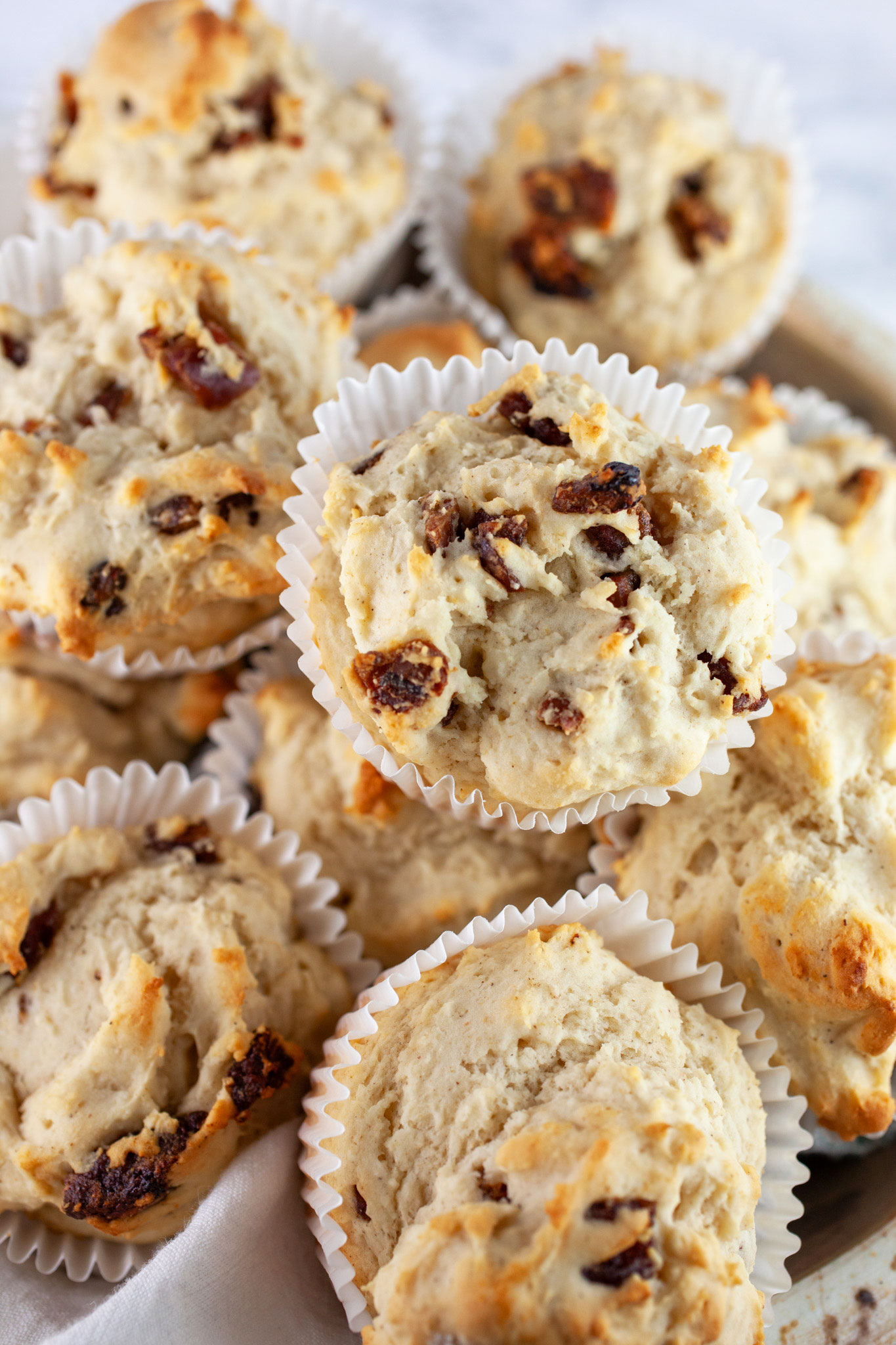
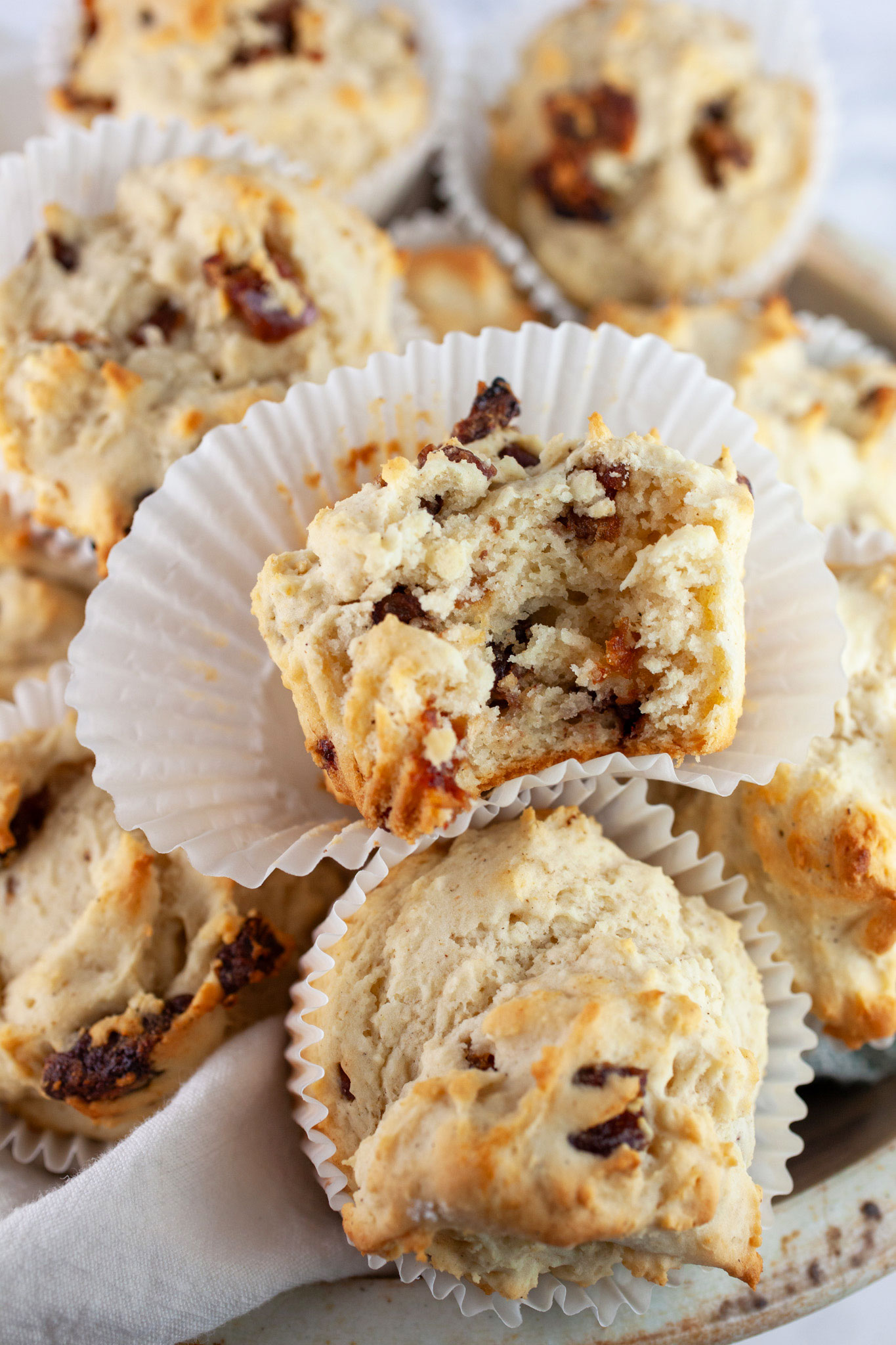
Our adventure adapting the recipe was a success. The date muffins had a great taste and texture. The texture was somewhere between a drop biscuit and a scone; the outside was a bit crispy and the inside was moist. They were sweet; but not overly sweet. The dates gave them lovely bursts of rich caramel.
Here’s the original recipe:

Gluten free baked goods sometimes tend to crumble. The key to making them less crumbly is to use the right gluten free blend flour, to ensure that the batter has sufficient moisture, and not to overbake them.
Christine said that a gluten free 1-to-1 blend flour (Bob’s Red Mill Gluten Free 1-to-1 Baking Flour, Cup4Cup Gluten Free Multi-Purpose Flour, or other similar gluten free blend flour) should be used. The flour should contain xanthan. Baked goods made with gluten free flours can be crumbly because of a lack of binders in some gluten free flours. Xanthan is a binder that mimics the elasticity provided by gluten in wheat flour recipes. It helps ensure that gluten free baked goods are not crumbly. (Do not use gluten free all-purpose flour, or other gluten free flours, such as almond flour or oat flour, when making the recipe as this will likely yield different results).
Christine suggested adding a little additional milk when making the batter. Gluten free flour is a little denser and absorbs more liquid than all-purpose wheat flour. The additional milk also reduces the chance that the muffins will be crumbly.
It is also important not to overcook the muffins (they will tend to crumble) or to undercook them (they will be gummy).
And, here is the updated recipe:
Date Muffins
1/3 cup unsalted butter, softened (Do not melt.)
1/4 cup sugar
1/4 teaspoon kosher salt
1 egg
3/4 cup milk + an additional 2 – 3 teaspoons milk
2 cups 1-to-1 gluten free flour blend (Bob’s Red Mill Gluten Free 1-to-1 Baking Flour, Cup4Cup Gluten Free Multi-Purpose Flour, or other similar gluten free flour that contains xanthan)
4 teaspoons baking powder
1/4 pound (4 ounces) dried dates, chopped
Step 1. Preheat oven to 350 degrees Fahrenheit.
Step 2. Place muffin liners in a 12-cup muffin pan.
Step 3. Put the butter and sugar in a bowl, then use an electric mixer to beat until light and fluffy.
Step 4. Add egg to the butter and sugar mixture, and beat until light and fluffy.
Step 5. In a separate bowl, put the 1-to-1 gluten free flour blend, baking powder, and kosher salt. Stir until completely combined.
Step 6. Add the butter mixture and 3/4 cup of milk to the dry ingredients alternately, stirring to combine after each addition. Continue until all of the ingredients are combined. The batter will be very thick; Add an additional 2-3 teaspoons of milk to thin it out a bit and stir again until combined. (It will still be quite thick).
Step 7. Add chopped dates to the batter and fold until combined.
Step 8. Place an equal amount of the batter into each muffin cup. (An ice cream scoop can be used to measure to help ensure that an equal amount is put in each cup.)
Step 9. Place the muffin tin in the oven and bake for approximately 20 minutes. A toothpick poked into the center should come out clean when done baking.

Thanks! Gluten-free baking can be very challenging, and it is hard to make it work. I found out that baking flours are very different after making popovers with a different brand of GF flour. They were not the same mix, as I found out after reading the ingredients. I do very little baking, and even the boxed mixes, such as coffee cake or brownies, are only OK and tend to go stale quickly. On my blog, I have recipes for flourless chocolate cake and flans that do not require any flour. Hats off to the bakers who can make GF baking work.
Your comment gives me greater insight into some of the issues that need to be considered when making gluten free baked goods. This was the first time that I ever did any gluten free baking, and it really helped to have an experienced gluten-free baker helping me.
Thank you for this!
You’re welcome. It’s wonderful to hear that you enjoyed this post.
You’re very brave! I tend not to buy gluten-free flours as I use them so rarely, and haven’t been that successsful with them anyway. So when my coeliac friend comes round, I tend to favour recipes made with, say, almond flour or polenta. There seem to be quite a few recipes around once you get your eye in!
Maybe I’m just paying more attention to it, but I’m also noticing more gluten-free recipes. There are a lot of people who are sensitive to gluten.
While I am fortunate to have no gluten concerns…Some friends are not so this could come in handy….
Good to know that you found this post useful. I also have some friends who can’t eat foods that contain gluten.
Wow, when I read the original recipe, I thought the 1 – 3 cup meant 3 cups of butter. I didn’t see how that would work! Then I read your updated version and laughed at myself.
I was amused by the casual remark, “Mix in the usual way.”
It’s fascinating how sparse directions often are in old cookbooks. There’s a saying, that probably is not totally accurate but it might be close, that cooks used to cook 3 times a day, 365 days a year. I guess that when someone cooked that often that they probably had a good sense of “the usual way” when preparing common foods.
It has been fascinating to see the original recipes in the 100-year-old cookbooks. I enjoy seeing your updates and comparing them to the originals.
It’s nice to hear that you enjoy seeing both the original recipes and the updates. The original type fonts, formats, and way of wording things really pull me back to the times when these recipes were originally written. I find it interesting that recipe authors of recipes in community cookbooks often refer to themselves using “Mrs.” and their husband’s first name. Times have changed. I also always feel like readers should be able to see the original recipe so they have the option of interpreting it differently if they don’t agree with how I did it.
They do look good… I don’t have gluten probs, nor those I feed, but, you never know ‘who’ is just around the corner…
You never can tell when you might discover that a friend or relative eats gluten free.
I won’t bake gluten free food, but I admire you for persevering to get it right.
I had fun collaborating with someone who is an expert on gluten free cooking when doing this post. I learned a lot.
I have found baking with gluten free flour a challenge, but thanks for these tips.
Baking with gluten free flour is definitely different from using wheat flour. I’m definitely still in the learning phase when it comes to gluten free baking, but have enjoyed becoming more knowledgeable about some of the basics.
My daughter loves to bake but she has a health condition that requires her to be gluten free. She has found that gluten free flours just keep getting better and better in regards to using them in her favourite recipes!
It’s good to hear that gluten free flours keep getting better and better. I’ve also heard that gluten free dishes at restaurants have gotten much better in recent years.
I love that you collaborated to adapt a recipe, and that it looked and even more importantly, tasted good! I feel quite fortunate to not have a dietary issue with gluten but my husband had DM. I tried to make a “diabetic” dessert for Valentines Day, and while it wasn’t too bad, I did not do my homework and had the wrong flour. I’ll do better next time!
Similarly to you, I’m learning the importance of doing my homework when making major (and sometimes seemingly minor) changes to recipes to address health concerns.
This came across my email (I subscribe to it) and thought of you…a new book on old recipes – https://shorturl.at/ZofxH
Thanks for sharing. The book sounds fascinating. I’ll have to see if I can get it via interlibrary loan. Just reading the short review gave me lots of things to think about. I found it particularly interesting that there is a chapter on “international transmission” of recipes. When working on my blog, I’m often curious about the origins of recipes in old community cookbooks, and think that many of the recipes probably were originally brought to the U.S. by immigrants. I also find it fascinating that there was a chapter on “professional and trade ownership” about recipes compiled by men, and another chapter on “women’s recipe collections.”
I am so glad! They reviewed a book I am ordering on the history of keeping notebooks….very unusual topics!
You’ll have to let me know if you like it. I never would have thought of researching or writing on this topic, but I’m intrigued by it. I wonder what inspired the author to write a book on the topic.