
There are many recipes in hundred-year-old cookbooks that call for graham flour. Back then, graham flour was a popular type of flour, and cookbooks contained recipes for graham bread, graham muffins, graham pudding, and other graham foods. But, now graham flour is almost impossible to find, so when browsing through hundred-year-old cookbooks, I generally skip over any recipes that call for it. I even did a post several years ago titled “Why is it so Difficult to Find Graham Flour?”
But, I recently looked through Beth Dooley’s Forever Green Cookbook, and came across this statement:
Kernza flour resembles whole wheat flour and has a nutty, earthy flavor that is reminiscent of graham flour.
I was ecstatic. If Beth was right, maybe I could make some of those old recipes that called for graham flour. I have known Beth since I took a food writing class from her many years ago. Beth is a James Beard Award-winning author, has written numerous cookbooks, and is a food writer for the Minneapolis Star Tribune. She also has a Substack newsletter called Beth Dooley’s Kitchen, as well as held an endowed chair at the Minnesota Institute for Sustainable Agriculture at the University of Minnesota. Much of her recent work focuses on integrating traditional knowledge with the latest science to help support healthy eating and regenerative farming practices. Soon Beth and I had an email conversation going about how to substitute Kernza for graham flour.
What is Graham Flour?
Graham flour is a coarsely ground whole wheat flour that contains the endosperm, bran, and wheat germ of the wheat kernels. Year ago, it was considered a health food. Graham flour is named after its inventor Sylvester Graham. He began making graham flour in the 1830s, and promoted it as part of a health movement which encouraged eating vegetarian meals and unseasoned foods.
Even if graham flour is found today, it may not contain the wheat germ. Modern graham flours sometimes have most of the wheat germ removed to prolong shelf life and to help keep it from going rancid. In the past, I sometimes substituted whole wheat flour for graham flour, but was not totally pleased with the results.
What is Kernza?
Kernza is an intermediate wheatgrass. According to the Forever Green Cookbook:
Kernza: This relative of wheat, developed by The Land Institute and the Forever Green Initiative, is high in nutrients and long on flavor. Unlike wheat, it’s a perennial crop and its ecological benefits to the land are immense – filtering water, retaining topsoil and nutrients, and providing habitat for wildlife while producing a kernel that may be milled for flour.
A New York Times article provides additional information about the environmental benefits of Kernza:
Kernza, which can be used as a substitute for wheat, has roots that can stretch more than 10 feet into the ground, allowing it to absorb more carbon dioxide than many crops. And because Kernza is a perennial grain and doesn’t need to be replanted each year, it requires less water and fertilizer than traditional wheat, making it a boon for cost-conscious farmers.
Updating a Hundred-Year Old Graham Nut Bread Recipe to Use Kernza Flour
I looked through my 1926 cookbooks, and found several recipes that called for graham flour. I shared them with Beth, and we decided that a recipe for Graham Nut Bread would be a good one to try updating:

We decided to substitute Kernza flour for the graham flour at a 1:1 ratio. In other words, instead of using 2 cups of graham flour, I used 2 cups of Kernza flour. Since the old recipe called for baking the bread in a “moderate” oven, I baked it at 350° F. until a wooden pick came out clean (about 1 hour and 15 minutes).
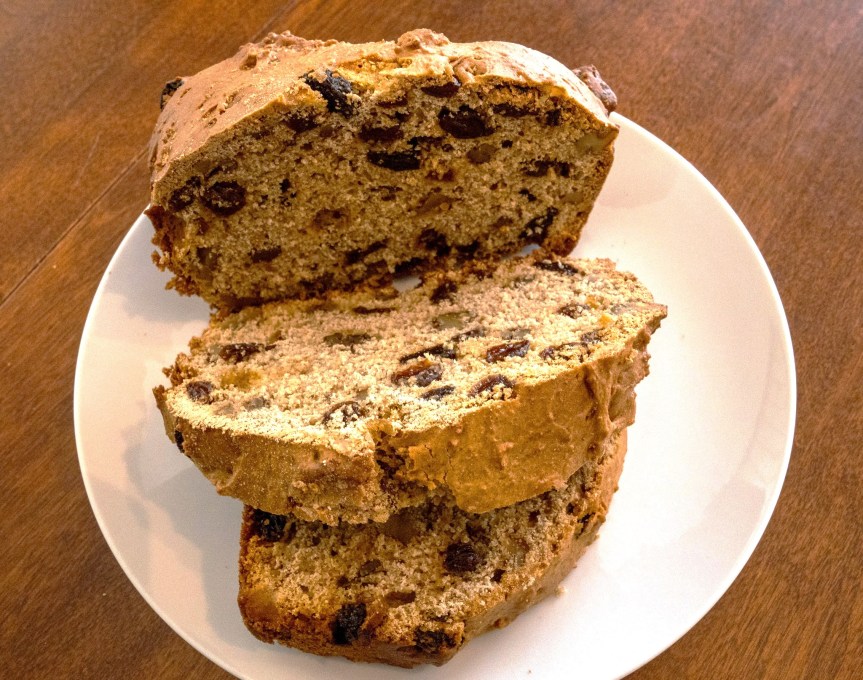
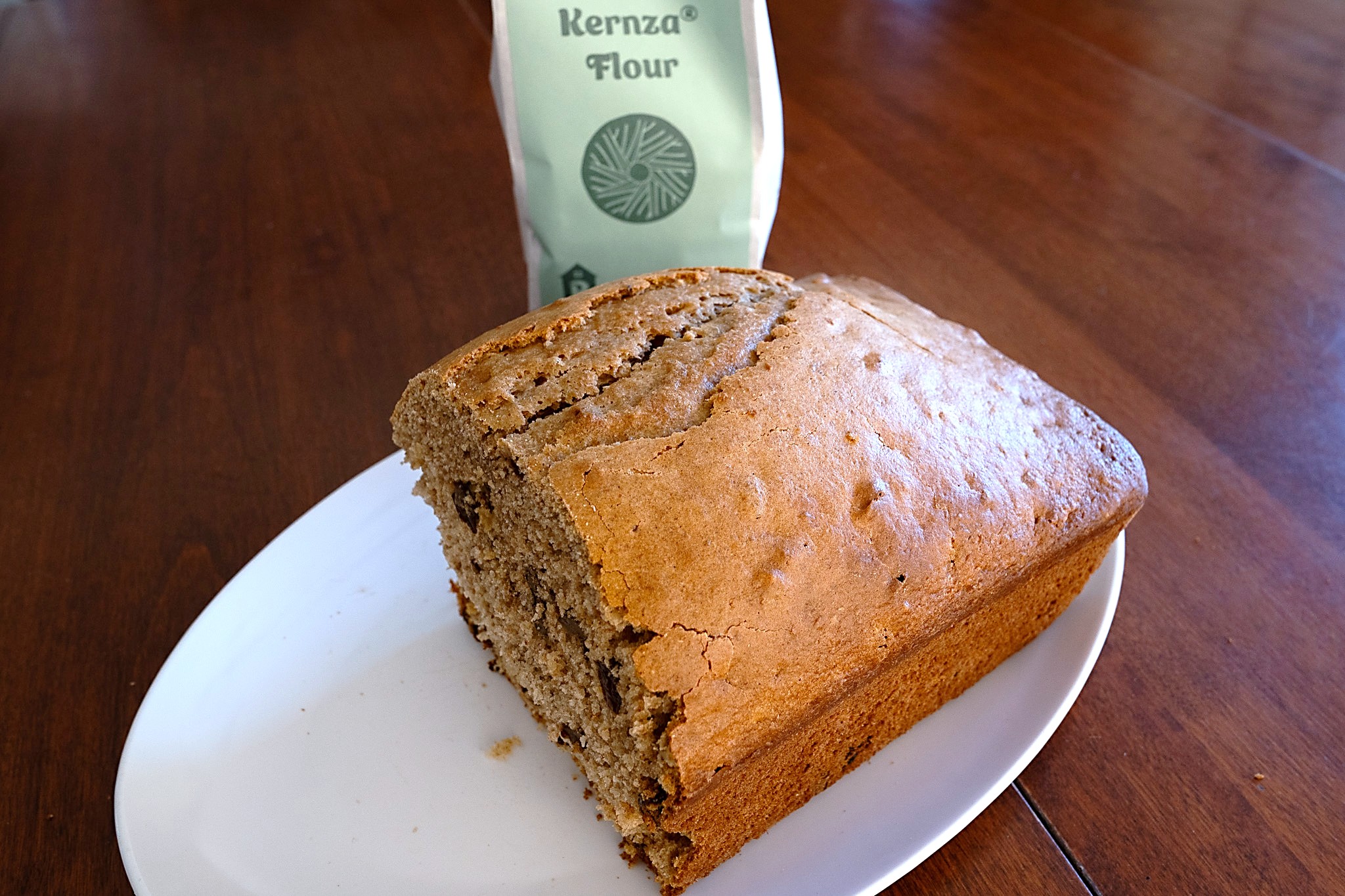
The bread was sweet, had a rustic, firm texture, and contained lots of chopped walnuts and raisins. It was not crumbly. In my opinion, the crust was a little thick, though when I took it to a coffee group gathering, it was a huge success. They loved it, and two people even asked if they could have slices to take home.
I also shared my experience making the bread with Beth, and she said that the crust might be better if I baked the bread at a lower temperature (325° F). This would also mean cooking it for a little longer. Additionally, she suggested adding ¼ cup of melted butter.
I made the bread again using Beth’s suggestions, and the bread was perfect. The crust had just the right amount of crustiness, and the bread still had a lovely rustic, firm texture. Success! Kernza flour was a great substitute for graham flour (and it has the added bonus of being good for the environment).
A minor issue is that many stores do not carry Kernza flour, but it is available at some food co-ops and online. Hopefully, before too long, it will be more readily available.
Here is the updated recipe:
Kernza Nut Bread
2 cups all-purpose flour
2 cups Kernza flour
3 teaspoons baking powder
2 eggs, beaten
1 cup sugar
1/8 teaspoon salt
¼ cup butter, melted
2 cups milk
1 cup walnuts, chopped
1 cup raisins
Step 1. Preheat oven to 325° F. Grease a 9” X 5” loaf pan.
Step 2. Combine Kernza flour, all-purpose flour, and baking powder; set aside.
Step 3. Put the eggs, sugar, and salt in a mixing bowl; stir to combine. Add butter, then stir. Alternately add the flour mixture and the milk (add about a third of each at a time). Stir until just mixed.
Step 4. Add chopped walnuts and raisins; stir just enough to distribute throughout the batter.
Step 5. Put batter into prepared loaf pan.
Step 6. Put in oven and bake for about 1 hour and 30 minutes (or until a wooden pick comes out clean). Remove bread from oven, and allow it to cool for about 10 minutes before removing it from pan.

I’m going to try this. A quick glance through the online offerings included a farm in Wisconsin that will provide one-pound bags, which is just right for trying it out. I’ve already copied your recipe, with the additional tips.
I think that you’ll like it. A 1-lb. bag of Kernza flour provides enough flour to make the recipe two times – with a little left over.
I’ll let you know how it turns out.
After you make the recipe, I’m looking forward to hearing what you think.
I’m going to see if I can find the kernels or seed heads to make my own flour! This sounds wonderful!!
It is yummy. Kernels or seed head might be available. I didn’t look for them when I was shopping for the flour. Fingers crossed that you can find them.
Found some!! At breadtopia
Yay! It’s wonderful to hear that you found some.
I’ve yet to come across Kernza. I wonder if we have it here?
hmm. . . I don’t know if it is available in the U.K.
Apparently it is, though not widely. I’ll investigate when we get back home.
Good to hear that it is at least limited availability in the U.K. Hopefully you can find some.
I am definitely going to look for this one!
I hope you can find it. I’ve enjoyed experimenting with using Kernza flour in recipes.
This sounds really interesting. I’m going to have to ask my ag scientist hubby if he’s familiar with kernza. I’ve never heard of it before, and it’s obviously something we don’t grow here. I definitely want to try this.
Kernza is grown mostly in the Upper Midwest and Great Plains. I really liked the Kernza Nut Bread.
Never heard of kernza flour but am going to look for it. Thanks for the fun recipe. Edie
You’re welcome. I enjoyed this recipe and think that you’ll like it.
The recipe looks good, but I was hoping graham flour was not made of wheat.
This probably isn’t a recipe for you. Graham flour (as well as Kernza flour) contain gluten.
This was most interesting to read, but I doubt I’ll find Kernza flour.
Hopefully more stores will stock Kernza flour soon. It takes awhile for supply chains and markets to develop for new crops.
I had not heard of Kernza before. I’ll have to see if I can find some online. It sound interesting to try in bread. I like supporting farmers who are trying to provide good food sustainably.
I had fun figuring out how to use Kernza flour when making the nut bread. Like you, I like to support farmers as they grow crops that are environmentally friendly and work to create more sustainable agricultural systems.
Sounds like a lot of bread baking going to be happening after this post! I will be looking into kernza also. I may or may not try using it to make this bread, but I do appreciate the sustainable aspect of the plant and its uses.
Hopefully Kernza will be easier to find before too long. It’s really interesting how so many things need to come together for a new crop to go from the development stage to widespread availability – plant genetics, supply chains, development of markets, etc.
I don’t know about in local stores yet, but there are several places where the products could be purchased on sites related to the Land Institute locations, and the Kernza organization website. It is really an interesting story.
Wowza! I have some recipes that call for graham flour. This is all new info re: kernza. I’m going to have to look it up at the health food co-op! That would mean I could make some of the recipes that I haven’t tried in over 30 years!! Thanks tons Sheryl!!
Glad to be of service. Hopefully your food co-op carries Kernza flour – though, if not, it is possible to find it online. Similarly to you, I don’t make some really good old-time recipes that call for graham flour because I can’t find it. I’m looking forward to to trying Kernza flour in some additional recipes. (As an aside, I’m glad that I found a substitute for graham flour, but I’m still a little bummed that flour producers don’t make graham flour anymore.)
Sheryl I have a cookbook from WWII that my grandmother used – she has substituted graham flour in place of whole wheat in several of the recipes (along with her notations in the margins for tweaks). I asked her why the substitution and she said that graham flour was healthier (and cheaper than the regular whole wheat or white flour)… When I was first married I made the nut bread using the graham flour and it looked very much like yours, I also made Third bread using the graham flour in place of the rye flour and it was a big hit…
It’s fascinating how your grandmother substituted graham flour for whole wheat flour both for nutritional and cost reasons. It’s interesting that graham flour was less expensive than whole wheat flour years ago.
It was cheaper when I used it back in 1980s… My grandmother used to make “Gluten Bread” and would buy gluten to add to her bread. It made the bread chewier – kind of like English Muffin Bread… I can’t find gluten anymore either!
The availability of some foods sure changes across the years. I’ve seen hundred-year-old recipes for Gluten Bread as well as hundred-year-old advertisements for gluten flour. Several years ago, I even posted an advertisement for Farwell & Rhines Gluten Flour. I wonder if there are any good substitutes for it.
Gluten is now a dirty word so I’m guessing there aren’t any substitutes – it wouldn’t be economically viable….
Hi Sheryl I have heard of Graham flour but not Kernza thank you so much for the information apparently its gaining traction here in Artisan bakeries and as its eco friendly so I will be keeping my eyes out for it 🙂 x
It’s awesome to hear that some artisan bakeries are using Kernza flour. Hopefully more will decide to try it. My sense is that most people are not yet familiar with Kernza so bakeries that sell products containing Kernza may need to educate their customers.
It is Sheryl …Give it 6 months and the market will be flooded with it 😊
Very interesting!
I had a lot of fun updating this recipe to use a new flour.
Funny I can get graham flour locally at a health food store. I can also get vital wheat gluten as it is often used in whole wheat bread to improve the structure. I have never heard of Kernza which is odd as I am loosely tied into the ag extension program at PSU. I am very intrigued. Wonderful to be learning new things from everyone’s comments and with a real cold spell upon central PA I think it is time to do some breadbaking.
Sounds like the perfect time to do some bread baking. You’re fortunate to live in an area where graham flour (as well as wheat gluten) are available. It seemed like graham flour vanished from the stores around here during the Covid era, and never came back. My understanding is that Kernza is grown in the U.S. primarily in the Upper Midwest and in the Plains states, though I’m a little surprised that some isn’t also grown in Pennsylvania.
Hi Sheryl – thank you for sharing this wonderful Kernza recipe! At The Land Institute, we love seeing all the unique ways folks are using Kernza and supporting the perennial agriculture movement, and we agree that Beth Dooley’s cookbook is a fantastic resource.
We see that other folks here are equally thrilled about this recipe and are interested in where they can find Kernza flour. Here are the links to a few different distributors who sell Kernza flour (and other products like whole grain Kernza) online and ship across the continental United States:
We hope this is helpful for those who might not be able to find Kernza products locally! We’ll also be sure to share this recipe with our staff and researchers at The Land Institute, who are always excited to see how people are enjoying this grain.
I appreciate all you are doing to develop and promote Kernza. Thanks for sharing the links to the online sources for Kernza flour. Readers of A Hundred Years Ago will find this very helpful. As you noted, there is a lot of interest in trying this recipe.