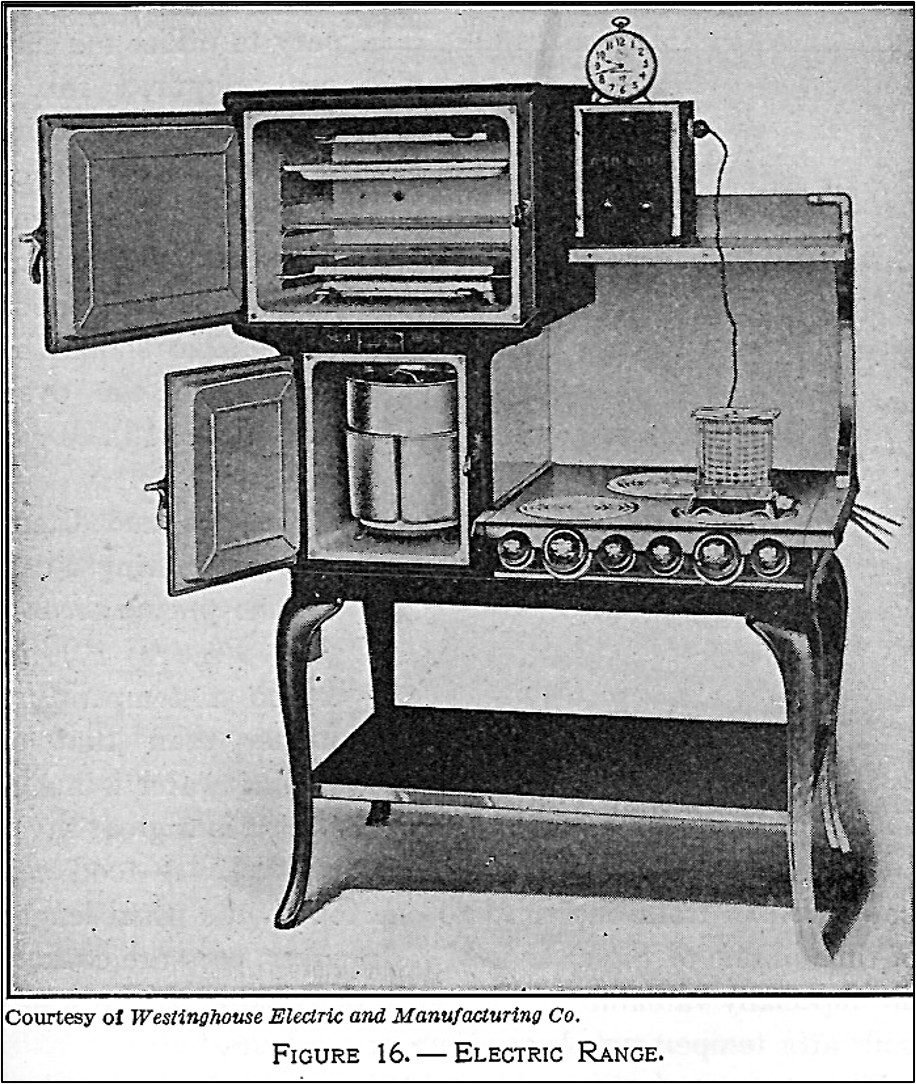
Electric stoves were just beginning to be commonly used in 1925. Here’s a description of electric stoves in a 1925 home economics textbook:
Electric Stoves
It was mentioned previously that electricity is not a fuel. Hence electric stoves are not provided with burners. They have heaters which contain coils of wires through which an electric current passes.
Electricity is the cleanest source of heat for cooking. But in order to operate an electric stove economically, it is necessary to utilize the current required for a heating element to its great extent. For example, if the current is turned on to heat the oven as many foods as possible should be cooked in the oven.
School and Home Cooking by Carlotta C. Greer (1925)
The textbook includes a note to teachers which indicates that if none of the pupils have an electric stove in their home that “the portion of the lesson regarding these stoves may be omitted.”

I always enjoy your posts. That really is rather a thing of beauty.
I saw one (a light green color) in use during the tour of a house, and thought it the most beautiful stove I had ever seen. I have no idea what it would have been like to cook on it, but the woman who owned the house still used it.
Wow, it’s amazing that someone who has one of these stove is still using it. Years ago, companies made products that were so durable. Since the picture I found was b&w, I never would have guessed that the stoves came in fun colors like green. I can see why you thought it was beautiful.
It’s nice to hear that you enjoy my posts. I have a lot of fun researching and then doing the posts for this blog.
Interesting distinction — I never thought about it before — but we wound up calling an electric stove’s “heaters” burners after all.
It is interesting that we ended up calling them burners anyway. Similarly to you, I found it fascinating that the author found it important to distinguish between other types of stoves having burners while electric stoves have heaters. When I came across this description in the old book, I had to read it two or three times to understand what the authors was saying.
Sounds like you need to really plan your meals to utilize the current.
You don’t want to waste energy (or pay a lot for the electricity whose use is not maximized). 🙂
Do any of you know what that large pot box does? The oven overhead I get…not sure about what the other enclosed space is. You can tell this was not a farmers wife stove …not enough room to feed a family and hands from it!
Possibly a small oven. I found several advertisements referring to a large and small oven, and the “double oven” for the Westinghouse model.
That makes sense. It would allow the cook to bake foods at two different temperatures. I find it interesting that the bottom oven appears to have a large stew pot (or something similar) in it. Today, we’d cook stews on top of the stove.
I agree, Sheryl. It could have been a warming oven, but then I thought that would not make good use of the “current” for cooking as much as possible in the same current use. I think later electric stoves had a hot water well, but that would not make sense as you would have to take the pot out of the shelf to get it. Perhaps it was for making roasts, or stews–it does look like it is sitting on a coil burner to me.
You may be right that the pot is sitting on a coil burner. I have no idea how the lower compartment was used, but one random thought. . .
Electric stove “burners” back then may not have been hot enough to quickly heat liquids. Maybe putting a burner in an insulated compartment enabled the cook to heat large containers of food more quickly.
That makes sense!
Farmers’ wives probably were still using wood or coal stoves. I’m not sure when farm homes typically got electricity, but I’m guessing that most may not have yet had electricity in 1925.
I think you are right again, Sheryl. Rural electricity was not common until the New Deal Administration pushed it with the Rural Electrification program in 1936, and still some areas did not have it until later. My parents had to use gas refrigerator, gas heat, and gas stove in the 1940s because their rural area had no access. I still remember my grandmother climbing onto a step ladder to plug items into the light socket in the ceiling. Their farm house had a central socket in each room for a light that was turned on and off with a string cord. Later, the light socket adapter was invented and you could screw in the adapter to plug in a radio or iron. I even found one ad in 1925 that advertised an electric stove that plugged into that light socket adapter. I cannot imagine the fire hazard that might have been!
Whew, I can’t imagine having to climb onto a step ladder to plug items into a light socket adapter. We’ve sure come a long way over the past hundred years.
This is a really interesting topic, and a really interesting conversation.
Up until now, I really had no idea when electric stoves started to become common. I wouldn’t have guessed it was this early.
Over the 14 years that I’ve been doing this blog, advertisements and articles about electric appliances have become much more common.
Wouldn’t their eyes pop out at microwave ovens?
They sure would. I can’t even imagine how I’d describe a microwave to someone who lived back then.
Fascinating! Different terms and these explanations show the unfamiliarity of it. This was a wonderful look at electric stoves in their infancy, Sheryl, thanks.
I’m glad you enjoyed this post. It’s fun to explore how people cooked a hundred years ago.
Believe it or not, when I was a student back in the late 60s, early 70s, our flat had a cooker not unlike that one!
Wow!