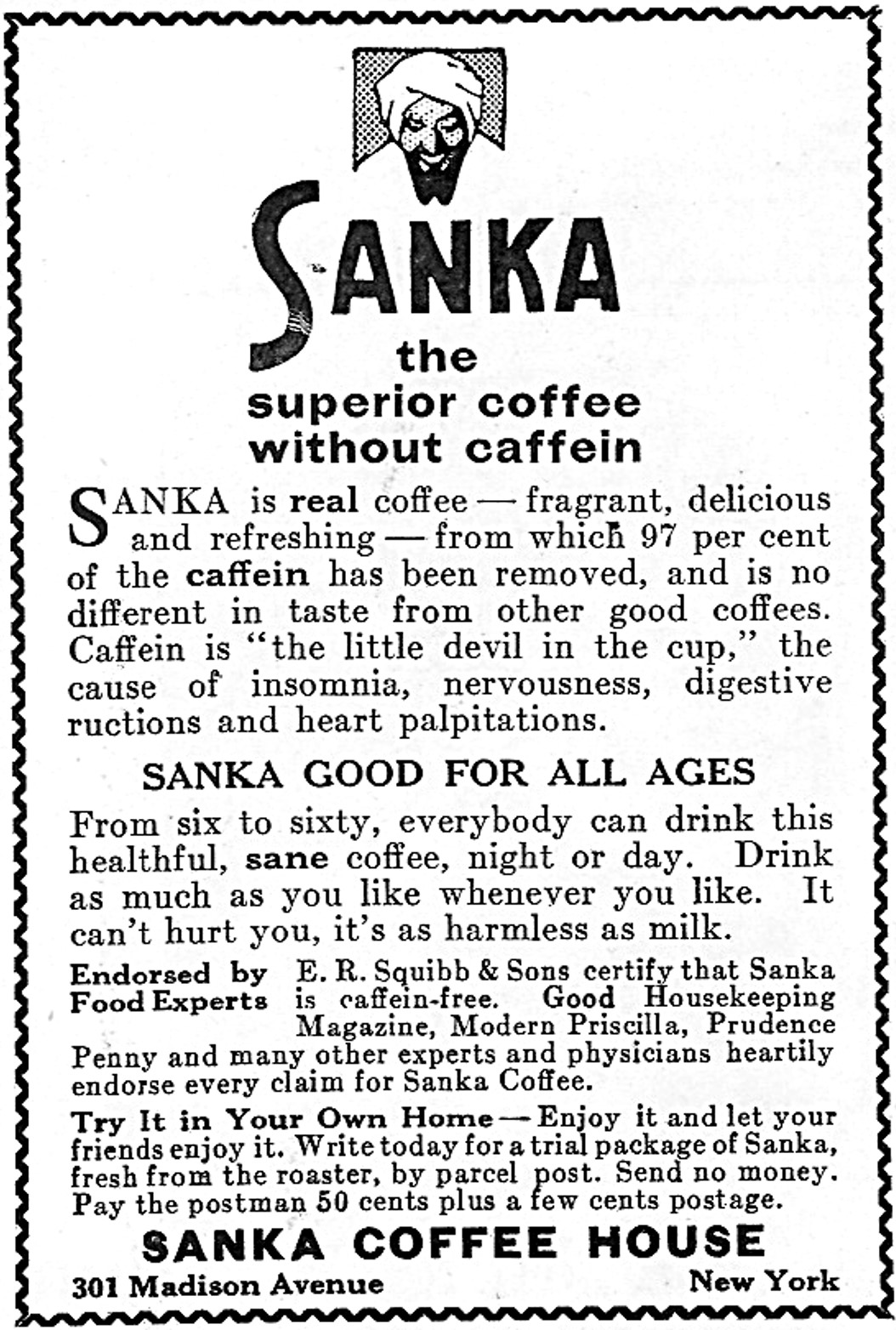
Sanka Coffee has been around for more than a hundred years. It is one of the oldest decaffeinated coffees. Sanka is considered a healthy alternative since it does not have caffeine. The advertisement recommends it for children as young as six, which seems extremely young to me. Should children really be drinking any kind of coffee?
It is also intriguing that the ad refers to caffein. Apparently that is an archaic spelling of caffeine.

I’m glad the coffee was sane!
I won’t want insane coffee. 🙂
I remember that, when I was young, Sanka was the only decaffeinated coffee. My mom had a middle/inner ear condition that prohibited her from having caffeine. So if we were in a restaurant, there was no pot of decaf coffee as there is today. They would bring her a cup of hot water and a packet of instant Sanka. She brewed Sanka at home until other brands of decaf started to appear, all of which were better than Sanka 🙂
I can also remember people sometimes ordering hot water and instant Sanka when I was a child.
I remember Sanka. My parents allowed us to drink hot tea before elementary school. Not as much caffeine as coffee, but I guess we were really awake for the day.
Hot tea probably tasted really good before heading out to school on cold winter days.
I love old ads and also de-caff, at certain times of the day. Sanka was ok, my aunts had it on hand, but I buy ground de-caff beans now, for my drip coffee machine. Thanks for the memories ; )
It’s nice to hear that you enjoyed this post and that it brought back some good memories.
Interesting about the man in the turban on the label. I wonder if that was an example of the European waiter?
Coffee was an is heavily associated with Arabia, and that was somebody’s idea of what an Arab looks like. Cans of Hills Brothers coffee had an image of an Arab man drinking coffee even fairly recently.
Interesting. I thought the turban would indicate Turkish coffee, but the precursor to Sanka before it was marketed in the US was from Germany. So perhaps it was Madison Avenue that thought we would appreciate a coffee named Sanka (derived from French for “sans cafeine” allegedly) more if we thought it from Arab countries…who stole it from Ethiopia where it originated? Those Madison Avenue ad guys had such a playful sense of humor…
I learned something new. I hadn’t realized that Sanka was derived from French and means “sans caffeine.”
Interesting. Never have heard of this brand but it goes to show decaf has been around longer than I ever imagined.
According to Wikipedia the process for making decaffeinated coffee was developed in 1903.
I would have guessed in the 50s or 60s.
My father used to drink Sanka in the morning, and then other kids of instant coffee that came in glass jars.
I used to before leaving home to go to college as well, and then of course packages of instant coffee came in C Rations and MRE’s (C Rations certainly dates me).
Frankly, they’re all awful and I don’t think I could get through a cup today (having become a dedicated coffee drinker).
I think you could say that other kinds of instant coffee were indeed “kids” of Sanka. 😁. (Seriously, we all do typos, and sometimes it is due to auto-correct!). When I was in South Africa the first time in 2001, it was surprising how common instant coffee still was.
I think that instant coffee is still very popular in Africa. Nescafe was particularly popular.
It’s not as good as drip coffee, but I must admit that I drink instant coffee from time to time. It is so easy and convenient to make if I just want one cup.
Apologies on my typos today. Uff.
No need to apologize. We all make typos.
I remember my parents having Sanka around – interesting advertisement!
It’s nice to hear that you enjoyed this post.
I remember Sanka, even though my parents did not keep it in the house. I don’t think I have seen that name in many years.
I think that it is still sold, but that it is not very popular anymore.
Couldn’t stand the stuff!😁 I rather have my child ( which they did) drink coffee than a soda that’s loaded with sugar.
I hadn’t thought about it like that, but you’re absolutely right, coffee is a healthier option than soda that’s loaded with sugar.
My grandmother gave me Sanka coffee when I was around six. She’d add milk and sugar to it. It was such a treat!
What a lovely memory!
Sanka used water treatment to remove caffeine, whereas when growing up in the 60s+ decaff usually had a strange chemical taste. Soon it was talked about using a “Swiss” water process. Sanka had been doing that 40+ years before.
I need to look up Sanka, and I use a special technique for making instant. I enjoy using instant coffee for hot chocolate, baking, etc. This might be the new solution.
Btw, growing in a Nordic family with over a hundred locals in our community we boiled standard Robusta coffee mostly. Now it is harder to find, since estate coffees became the rage. Arabica beans have about half the caffeine of Robusto. I laugh when people talk about drinking Starbucks and getting a big rush from it. Oh well, different strokes, eh?
I’m so glad to participate with the fans here on ahundredyearsago. Woo Hoo!
It’s wonderful to hear that you enjoy this blog. It’s interesting how there are several different processes that can be used to remove caffeine from coffee. When I buy coffee, I don’t generally pay attention to the type of beans. Next time I shop, I’m going to have to look and see if I can find any coffee that is Robusto.