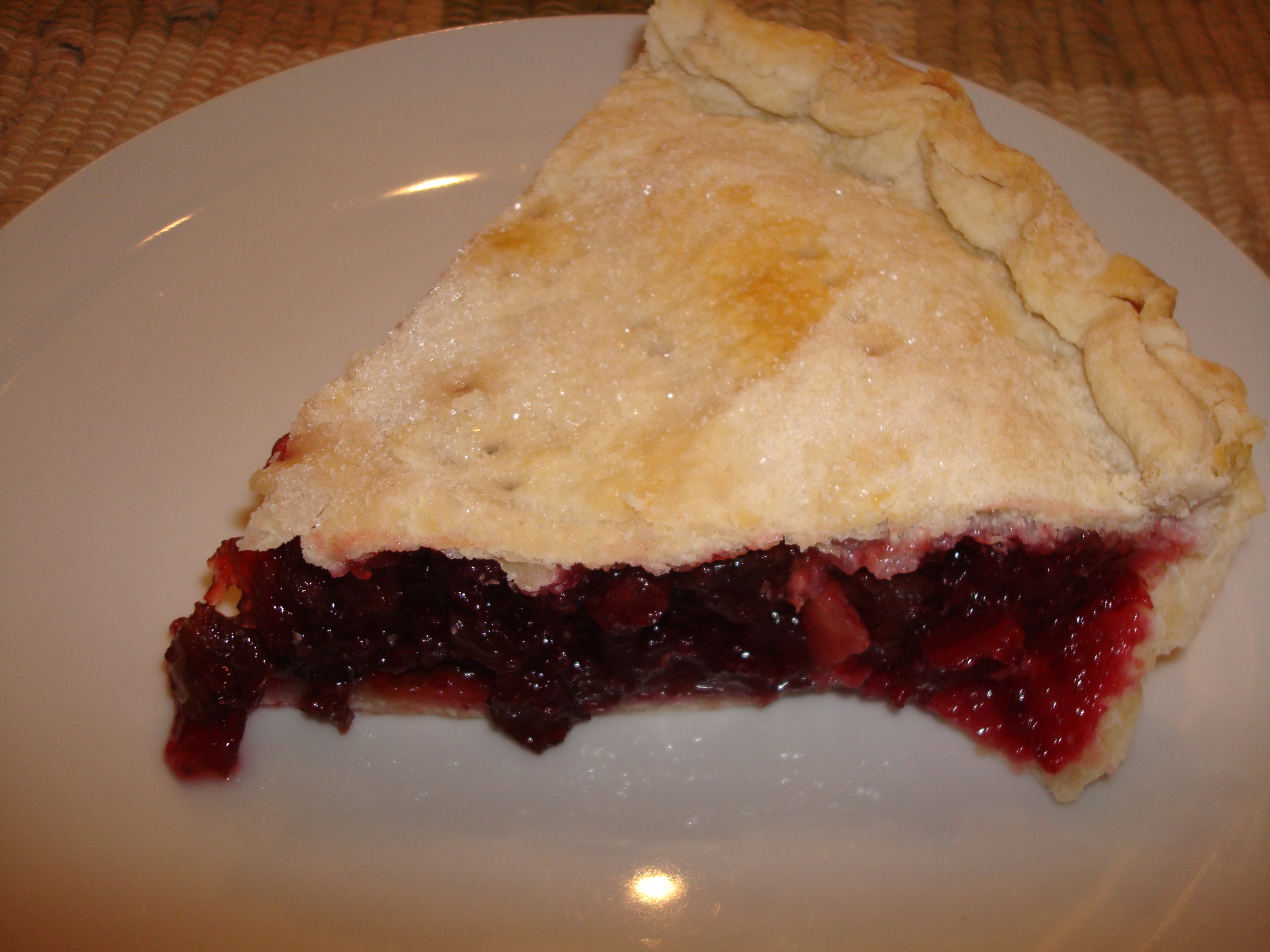
Hundred-year-old Lemon Cream (Lemon Meringue) Pie Recipe

lemon cream pie c

There’s nothing quite as delicious as some of the classic pies.  I found a hundred-year old recipe for Lemon Creme Pie – more commonly known as Lemon Meringue Pie – in a small promotional cookbook published by the Calumet Baking Powder Company. The accompanying picture brought back memories of delectable pies made by my grandmother and great aunts at family gatherings – and I immediately knew that I needed to try it.

Source: Reliable Recipes, Published by Calumet Baking Powder Co. (1912)
Source: Reliable Recipes (1912)

The lemon juice and grated lemon peel combine beautifully with the other ingredients to create a refreshingly tart pie covered with billows of light, slightly sweet meringue. This recipe is definitely a keeper.

Here’s the recipe updated for modern cooks:

Lemon Cream Pie (Lemon Meringue Pie)

  • Servings: 6 - 8
  • Difficulty: medium
  • Print

1 cup sugar

3 tablespoons flour

4 eggs, separated

approximately 1/2 cup lemon juice + 1 tablespoon lemon juice  (juice from 2-3 lemons, depending upon size)

grated lemon peel from 2 lemons

1 1/2 cups hot water

1 9-inch baked pie shell

1/4 cup  powdered sugar

Preheat oven to 350° F. Combine sugar and flour in a mixing bowl, then stir in egg yolks. Add 1/2 cup lemon juice, grated lemon, and water; beat until smooth. Put mixture into a saucepan; bring to a boil using medium heat while stirring constantly. When the mixture begins to boil, reduce heat and continue cooking for 1 minute or until it thickens.  Put filling into the pie shell.

To prepare the meringue, put the egg whites into a mixing bowl. Beat until stiff peaks form, then beat in the powdered sugar and 1 tablespoon lemon juice. Spoon the meringue onto the top of  the pie, and then swirl. Bake in the oven for approximately 10 minutes or until the meringue is a light brown.

Here’s the original recipe:
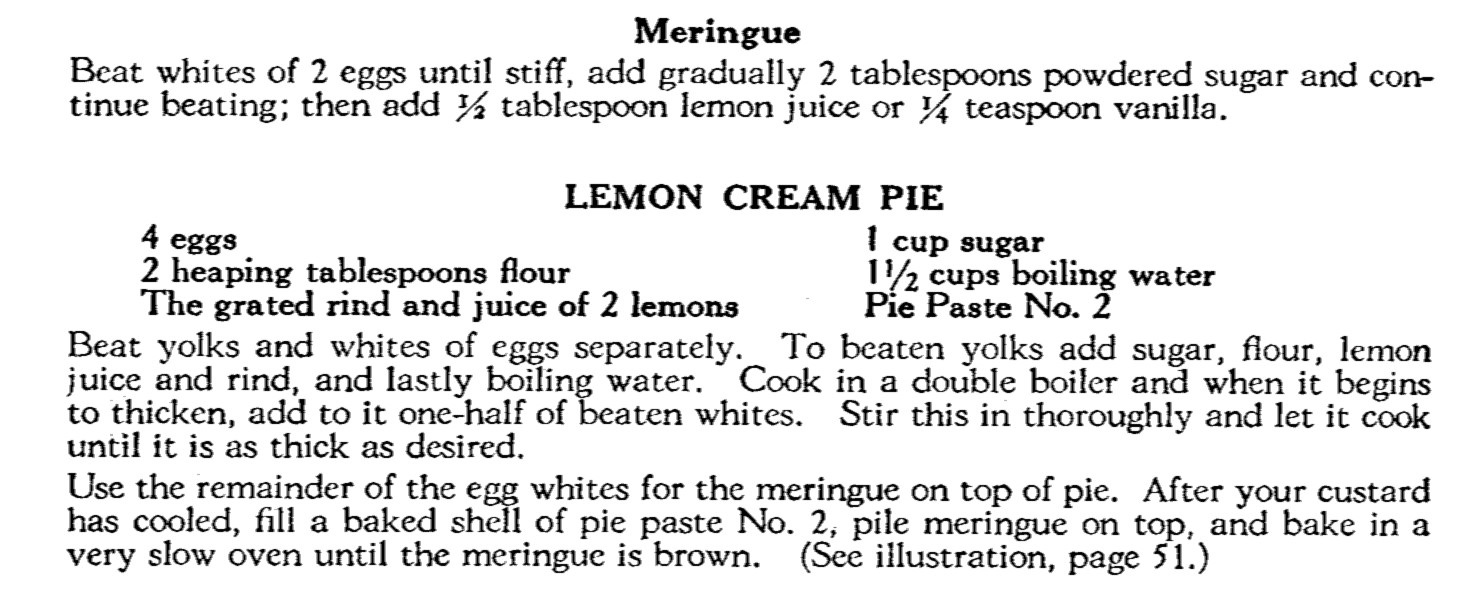
lemon cream pie recipe
Source: Reliable Recipes, published by Calumet Baking Powder Co. (1912)

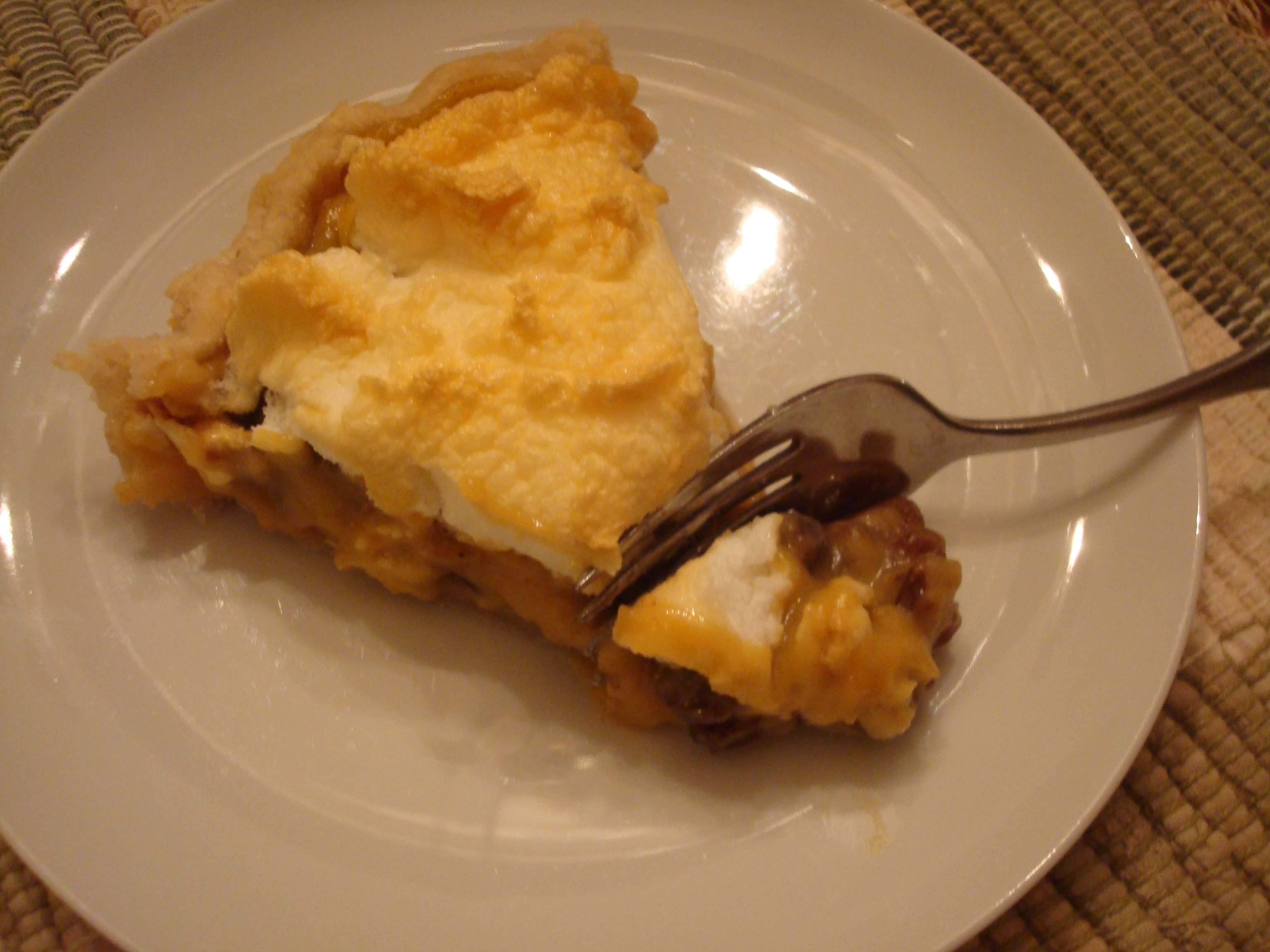
Old-fashioned Butterscotch Pie with Meringue Topping

butterscotch pie 3

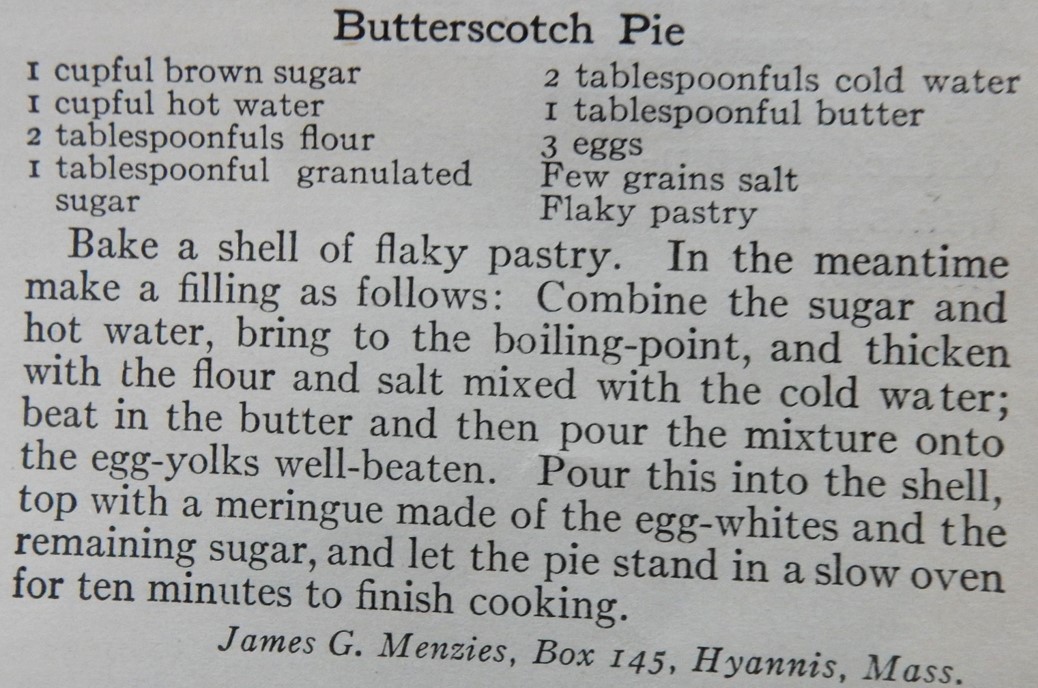
People knew how to make lovely pies a hundred years ago. An old-time winter favorite was Butterscotch Pie with Meringue Topping. I found this classic recipe in the February, 1916 issue of Good Housekeeping.

The Butterscotch Pie is irresistible with a smooth, buttery pudding and a light, delightful meringue. Here’s my adaptation of the recipe for modern cooks:

Butterscotch Pie with Meringue Topping

  • Servings: 4 - 5
  • Difficulty: medium
  • Print

1 cup brown sugar

1 cup hot water

2 tablespoons flour

1/8 teaspoon salt

1 tablespoons cold water

3 egg yolks, beaten

1 tablespoon butter

1 8-inch (small) baked pie shell

3 egg whites

1 tablespoon granulated sugar

Preheat oven to 325° F. Combine brown sugar and hot water in a saucepan, bring to a boil. In the meantime, in a small bowl combine the flour and salt. Gradually stir the cold water into the flour mixture to create a smooth paste; then stir in the beaten egg yolks. Add one tablespoon of the hot sugar liquid to flour and egg yolk mixture and stir to combine; then add several additional tablespoons of the hot sugar liquid while stirring constantly. When enough liquid has been added to make a thin paste,  stir the flour and egg yolk mixture into the remaining hot sugar mixture in the saucepan. Using medium heat, bring to a boil while stirring constantly; reduce heat and simmer  while continuing to stir until the mixture thickens. Remove from the heat and stir in the butter. When the butter is melted, pour into the pie shell.

To prepare the meringue, put the egg whites into a mixing bowl. Beat until peaks form, then beat in the granulated sugar. Spoon the meringue onto the top of  the pie, and then swirl. Use care to get the meringue spread all the way to the edge of the pie. Bake in the oven for approximately 10 minutes or until the meringue is a light brown.

Here is the original recipe:

Source: Good Housekeeping (February, 1916)

Old-fashioned Apple Custard Pie


apple custard pie 2

Custard pies were very popular a hundred years ago. One of the old-time fall favorites is Apple Custard Pie. The delicate custard taste mingles with the apples and a hint of cinnamon to create a truly special pie.

Old-Fashioned Apple Custard Pie

2 1/2 cups apples (cored, peeled and sliced)

1/2 teaspoon cinnamon

2 tablespoons water

4 eggs

1/2 cup sugar

1/2 teaspoon salt

2 cups milk

1 10-inch (large) pie shell

Combine apples, cinnamon, and water in a saucepan. Using medium heat, bring to a boil and then reduce heat; stir occasionally. If needed to prevent scorching on bottom of pan, add a small amount of additional water. Continue to simmer gently until the apples are soft (approximately 10-15 minutes). Cool slightly; then strain the apple mixture. Keep the cooked apples and discard the liquid. Set aside.

Heat oven to 425 degrees. In a bowl, beat eggs slightly. Add sugar, salt, and milk. Beat until blended. Stir in the cooked apples. If the apples are still hot, use care to stir while pouring them into the custard mixture to ensure that none of the egg coagulates from the heat. Pour into the pie shell, then bake at 425 degrees for 15 minutes. Reduce heat to 350 degrees, and bake an additional 1 – 1 1/2 hours or until knife inserted into center pie comes out clean.

This pie takes a long time to bake. If the top looks like it might start to burn before the center of the pie is solid, reduce heat to 325 degrees.

For this recipe, I used apples from a tree in my yard that, when cooked, get soft and do not hold their shape particularly well. I like how the cooked apples are widely dispersed in the custard; though, if preferred, firmer varieties may be used.

Green Tomato Mincemeat Pie Recipe

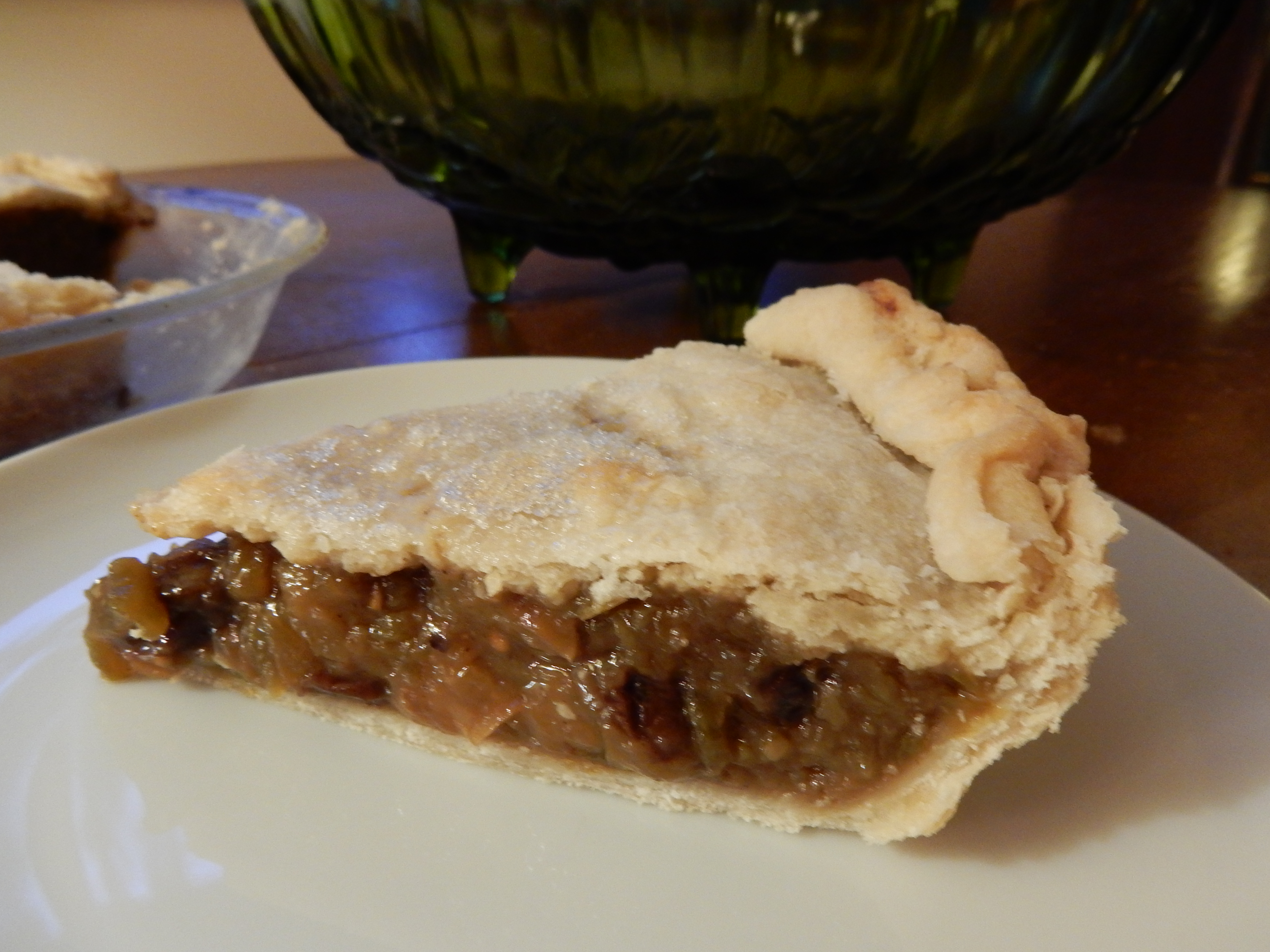
green tomato mince meat pieTomatoes, tomatoes everywhere.  The tomato plants are heavily laden with tomatoes–many still green.

When I wake up in the mornings I’m starting to feel a slight chill in the air. It won’t be long until there is frost. It’s time to make Green Tomato Mincemeat.

This traditional “mock” mincemeat has been made by frugal cooks for countless years. And, no wonder–it tastes as good, if not better, than real mincemeat and make the perfect mincemeat pie.

For my husband and me, Green Tomato Mincemeat Pie is an Autumn comfort food. We remember our mothers’ and grandmothers’ (and the church ladies) making this scrumptious pleasantly sweet, yet tart, traditional pie with its tangy blend of spices.Mince Meat 1

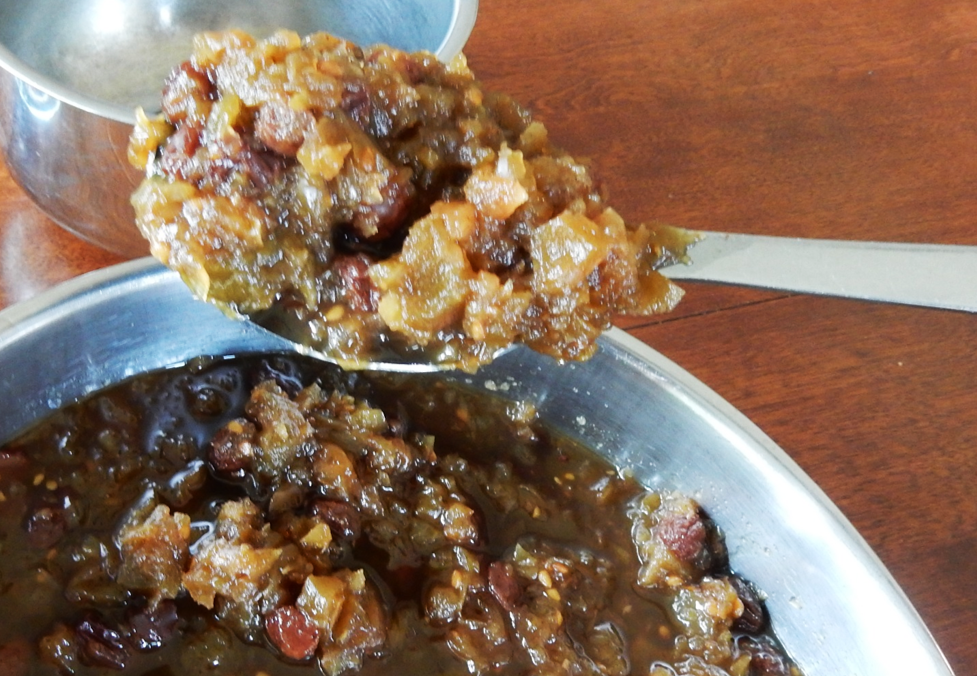
Green Tomato Mincemeat

6 cups green tomatoes

2 cups tart apples

1 cup raisins

2 cups brown sugar, firmly packed

1 cup strong coffee

1 lemon (grated peel and juice)

1/4 cup apple cider vinegar

1/2 teaspoon salt

1/2 teaspoon nutmeg

1/2 teaspoon allspice

Core and quarter tomatoes and apples; put through food processor or chopper. Combine all ingredients in large saucepan. Simmer 2 hours, stirring occasionally. May be canned or frozen.

Amount: This recipe makes enough mincemeat for 2 9-inch pies.

Green Tomato Mincemeat Pie

1 quart (approx. 4 cups) green tomato mincemeat

1/4 cup flour

9-inch double-crust pie shell

milk (optional)

sugar (optional)

Preheat oven to 425 degrees. Stir the flour into the mincemeat; place in pastry-lined pie pan. Cover with top crust. Seal and crimp. Cut slits in top crust (or poke top crust several times with a fork). If desired, brush with a small amount of milk; sprinkle with sugar. Bake in oven for 10 minutes; then reduce heat to 350 degrees. Bake an additional 20 to 30 minutes or until crust is browned and juice just begins to bubble through slits in crust.

Old-Fashioned Raisin Meringue Pie Recipe (Funeral Pie Recipe)

18-year-old Helena Muffly wrote exactly 100 years ago today: 

Wednesday, November 19, 1913:  Ditto

raisin meringue pie (funeral pie)

Her middle-aged granddaughter’s comments 100 years later:

Huh???? The previous day Grandma wrote “nothing much,” so I guess that it was another slow day from Grandma’s perspective; but two days prior to this entry Grandma’s maternal grandfather, John Derr, died in the nearby town of Turbotville.

I hope no one’s upset, but  I broke a rule I have and peaked ahead in the diary–Rules are made to be broken, aren’t they?—so I know that Grandma will attend his funeral on November 21.

Perhaps Grandma wasn’t doing much, but I bet that friends and neighbors were preparing food to serve for the traditional family gathering after the funeral.

Were they making funeral pies? In the old days in Pennsylvania, raisin pies were often served at funerals and they were called funeral pie.

I’ve seen other blogs that give recipes for a funeral pie that is basically just a two-crust raisin pie.  But my memory is that old-fashioned raisin pies in central Pennsylvania generally were raisin custard pies with a meringue topping, so I’ll give you that recipe.

Old Raisin Meringue Pie (Funeral Pie) Recipe

1 cup raisins

water

1 tablespoon flour

1 tablespoon corn starch

3/4 cup sugar

1 cup milk

2 egg yolks, slightly beaten

2 egg whites

1 9-inch pie shell, baked

Put raisins in small sauce pan, and just barely cover with water. Bring to a boil, then remove from heat and cool. Drain the cooled raisins. Stir the flour, corn starch, and sugar into the raisins; then add the milk and egg yolks. Stir and cook over medium heat until the mixture thickens (comes to a boil). Pour into a pie shell which was previously baked.

In a separate bowl make the meringue. Place egg whites in the bowl, and beat the egg whites until they form stiff peaks. Then spoon on top of the pie. Bake at 350° for 15 minutes or until the meringue is lightly browned.

This pie is different from the typical modern pie, but I really like it. I want to say that this pie will appeal to sophisticated palates—but somehow that doesn’t quite seem right when I’m talking about an old-fashioned food from rural Pennsylvania.

The delicate custard filling has a subtle and nuanced raisin flavor. And, the juicy plumped raisins provide a nice texture contrast to the smooth custard and the airy meringue.

I’m definitely going to make this pie again—and I don’t plan to wait until a funeral to serve it.

Old-Fashioned Mock Cherry (Cranberry Raisin) Pie Recipe

17-year-old Helena Muffly wrote exactly 100 years ago today: 

Monday, November 25, 1912:  Today, don’t remember.

Her middle-aged granddaughter’s comments 100 years later:

Sounds like a slow day for Grandma. Since she didn’t write much I’ll share a hundred-old-recipe for Mock Cherry Pie that I made for Thanksgiving.

The pie is made with cranberries and raisins. It’s enticingly  tart–yet sweet–and a nice addition to my repertoire of Thanksgiving pies; but it tastes  (surprise, surprise) more like a cranberry raisin pie than a cherry pie.

Mock Cherry Pie

Pick over and wash three cupfuls of cranberries, and cook in half a cupful of water until broken.  Add one cupful of sugar and one cupful of raisins. Bake between crusts in 9-inch pan.

Adapted from recipe in Good Housekeeping (November, 1912)

Open-faced Apple Pie

17-year-old Helena Muffly wrote exactly 100 years ago today: 

Tuesday, October 15, 1912:  Ditto.open-faced apple pie

Her middle-aged granddaughter’s comments 100 years later:

Another slow day a hundred years ago. . . .

This Fall, I’ve enjoyed making old-time apple recipes. Here’s another one that I really like.

Open-faced Apple Pie

Pastry for a 1-crust pie

3/4 cup sugar

1/4 cup flour

1 teaspoon cinnamon

Approximately 5-6 medium Macintosh apples*

1 tablespoon milk

Preheat oven to 425 degrees F. Line 9-inch pie pan with the pastry.

Put the sugar, flour, and cinnamon into a medium bowl; stir together. Peel, core, and quarter the apples. Put the quartered apples into the bowl with the sugar mixture; stir gently to coat apples. Arrange the apples in the pie pan by  placing the apples closely together on their sides. Small pieces of apples can be used to fill any gaps between the apple quarters. Add the milk to the pie by pouring it between any two of the apples.

Cook the pie at 425 for 10 minutes. Then reduce the heat to 350. Cook approximately 25 additional minutes or until the apples are tender when poked with a fork.

*Other apple varieties that keep their shape when cooked can be substituted for the Macintosh apples.

In case you have lots of apples like I do, here are links to some previously posted apple recipes.

Stewed Apples

Old-fashioned Apple Dumplings

Two Apple Crisp Recipes

Traditional Apple Betty

Old-Fashioned Apple Sauce