16-year-old Helena Muffly wrote exactly 100 years ago today:
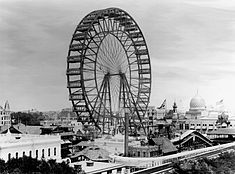
Thursday, September 21, 1911: Went to the Fair today with Miss Carrie of course. We took a ride on the Ferris Wheel (a thing I was never on before) and a ride on the Curling Wave. Saw a good many people I knew and more that I didn’t know. I got rather tired walking around all afternoon and sot such a thumping headache. Got home about six o’clock and then had to do all the milking as Ruthie hadn’t yet made her arrival.
The Ferris Wheel at the World's Columbian Exposition in Chicago in 1893 (Photo Source: Wikipedia)
Her middle-aged granddaughter’s comments 100 years later:
Grandma and her friend Carrie Stout went to the Milton Fair. According to yesterday’s entry McEwensville High School gave the students the day off to attend the fair.
The rides sound exciting. I checked Wikipedia and discovered that the first Ferris Wheel was at the 1893 World’s Columbian Exhibition in Chicago. It was invented by a bridge builder named George Ferris, and manufactured by Bethlehem Steel in Pittsburgh.
I was somewhat surprised that a fair in central Pennsylvania would have a Ferris Wheel only 18 years after very first Ferris Wheel was created. I imagined that new technology once diffused more slowly than it does today. But I guess that 18 years was a long time—both then and now.
I asked my father about the Milton Fair. He cannot remember there ever being a fair at Milton, but says that when he was young, people called the area on both sides Route 405 near the Arrowhead Restaurant “the fairgrounds”.
16-year-old Helena Muffly wrote exactly 100 years ago today:
Wednesday, September 20, 1911: Guess this was our teacher’s last day, and I’m not sorry. Our real teacher is coming next Monday so I have heard. Papa and Mamma and Jimsey went to the fair this afternoon. I expect to go tomorrow if the weather is favorable. We have Thursday and Friday off for the fair.
I always feel especially energetic and alive on beautiful fall days--I wonder if that's how Grandma felt as she planned her trip to the fair. (McEwensville is in the background of this recent photo.)
Her middle-aged granddaughter’s comments 100 years later:
The students at McEwensville High School have had a substitute teacher since the beginning of the school years (see yesterday’s post for more details).
McEwensville High School and the primary school shared a building (the high school was on the second floor; Grades 1-8 were on the first). Apparently the primary school didn’t have classes a hundred years ago today—since Grandma’s little brother Jimmy went with her parents to the fair. I wonder why the high school had school. You’d think that two schools would have been on the same schedule.
Well as least she got Thursday and Friday off—and is ready for some fun.
16-year-old Helena Muffly wrote exactly 100 years ago today:
Tuesday, September 19, 1911: Thought this would be the last day for our substitute, but afterwards learned that he is going to teach tomorrow instead of having it off for the fair.
Recent photo of building that once housed McEwensville School.
Her middle-aged granddaughter’s comments 100 years later:
It sounds as if the teacher had the option of deciding whether to give students the day off to attend the fair in nearby Milton.
I don’t know why there was a substitute teacher for the first several weeks of the school year (the teacher from the previous year was slated to return the following week) — but Thomas Kramm, in his History of McEwensville Schools, wrote:
The election of a teacher from the available candidates sometimes became a serious problem. In 1901, a sixth ballot was required to break the previous five tie ballots. In 1904, seven ballots did not results in the an election of a teacher. All candidates were rejected, and a slate of new applicants was considered. Just before school was to start, the eight ballot resulted in an election. This suggestions that there were probably power struggles within the board membership.
. . . At least one teacher and perhaps more would not return to teach the following year because the school board refused to increase the teacher’s salary.
Throughout the United States in 1911 there were more school board members than teachers. This had both advantages and disadvantages.
For example, in McEwensville there were two teachers (an elementary and a high school teacher)–yet there probably were either 4 or 6 members on the board.
The community was very involved in ensuring that the schools were high quality and met the needs of the community–but they also sometimes micromanaged the schools and perhaps didn’t always make decisions in the best interest of the students (as suggested by the quote above).
16-year-old Helena Muffly wrote exactly 100 years ago today:
Monday, September 18, 1911: This is fair week. It was rather doubtful looking this morning. Mother wanted me to take an umbrella, but thought it wouldn’t be called for. Pretty soon the sun burst forth and shone in all its radiance. Hope the rest of this week will be as nice as it was today.
Her middle-aged granddaughter’s comments 100 years later:
According to the Milton Evening Standard the 1911 Milton Fair was going to be the best ever:
. . . only clean shows
. . . the amusements will be fit for man, woman, or child.
As to the horse racing, it will be better than ever. The purses are the largest ever offered.
16-year-old Helena Muffly wrote exactly 100 years ago today:
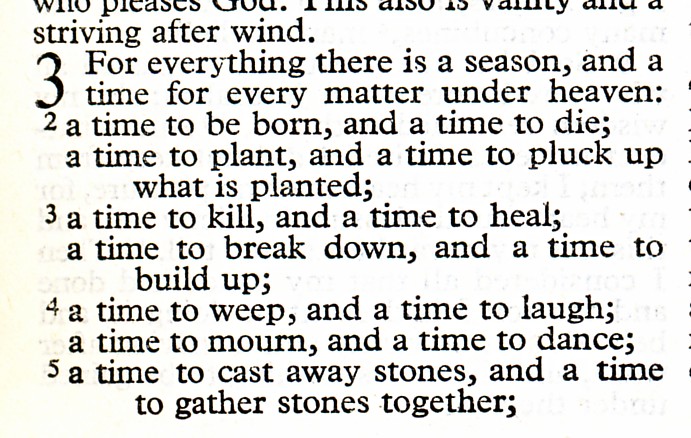
Sunday, September 17, 1911: Went to Sunday School this morning. I usually get there every Sunday. In fact I haven’t missed going since in January. One reason for my regular attendance is that if you learn a number of verses from the Bible (over 700 it is) you will in the course of time receive a Bible. I got a test of merit and a book this morning.
I only know a few Bible verses. I wonder if these were among the ones Grandma memorized.
Her middle-aged granddaughter’s comments 100 years later:
Whew, I can’t even imagine memorizing more than 700 Bible verses. It sounds like Grandma’s part way through the task. If it was me, I think that I’d give up before I even started.
Will she do it? . . .or will she give up?
This entry resolves one mystery. It explains why Grandma was so determined to attend Sunday school each week– even though she often was the only student in her class. For example, the previous week Grandma wrote:
Went to Sunday School this afternoon. I was the only one in my class today. It has happened that way for the past three Sundays. It is simply provoking the way the other girls attend Sunday School.
16-year-old Helena Muffly wrote exactly 100 years ago today:
Saturday, September 16, 1911: This Saturday was rather dull. I did some mending this afternoon I have four or five problems. I should have worked tonight, but will procrastinate if until tomorrow or some other convenient time only so I have them done by Monday noon.
Her middle-aged granddaughter’s comments 100 years later:
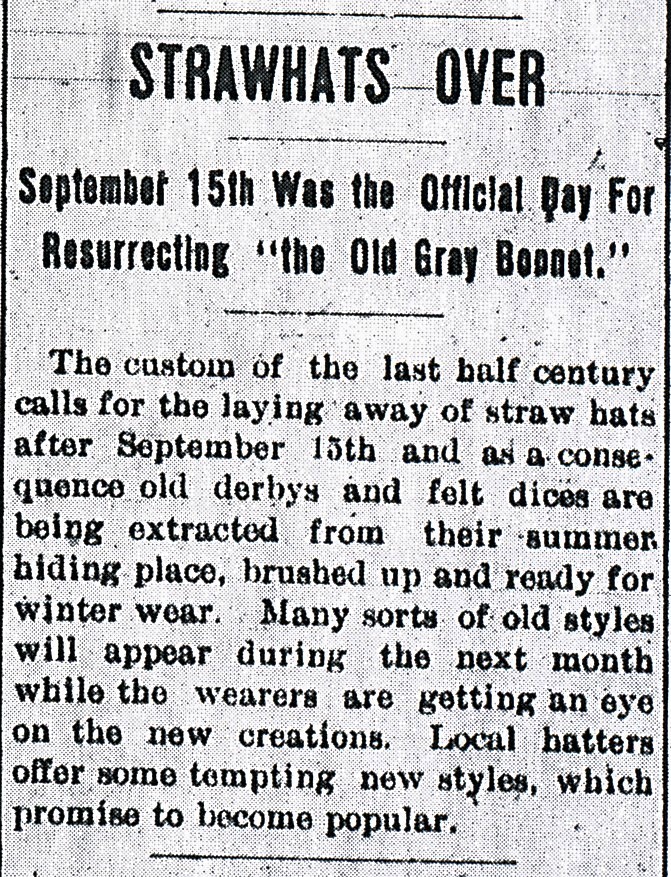
It’ sounds like a boring afternoon. . . I wonder if Grandma felt down because fall was fast approaching and straw hat season was over:
16-year-old Helena Muffly wrote exactly 100 years ago today:
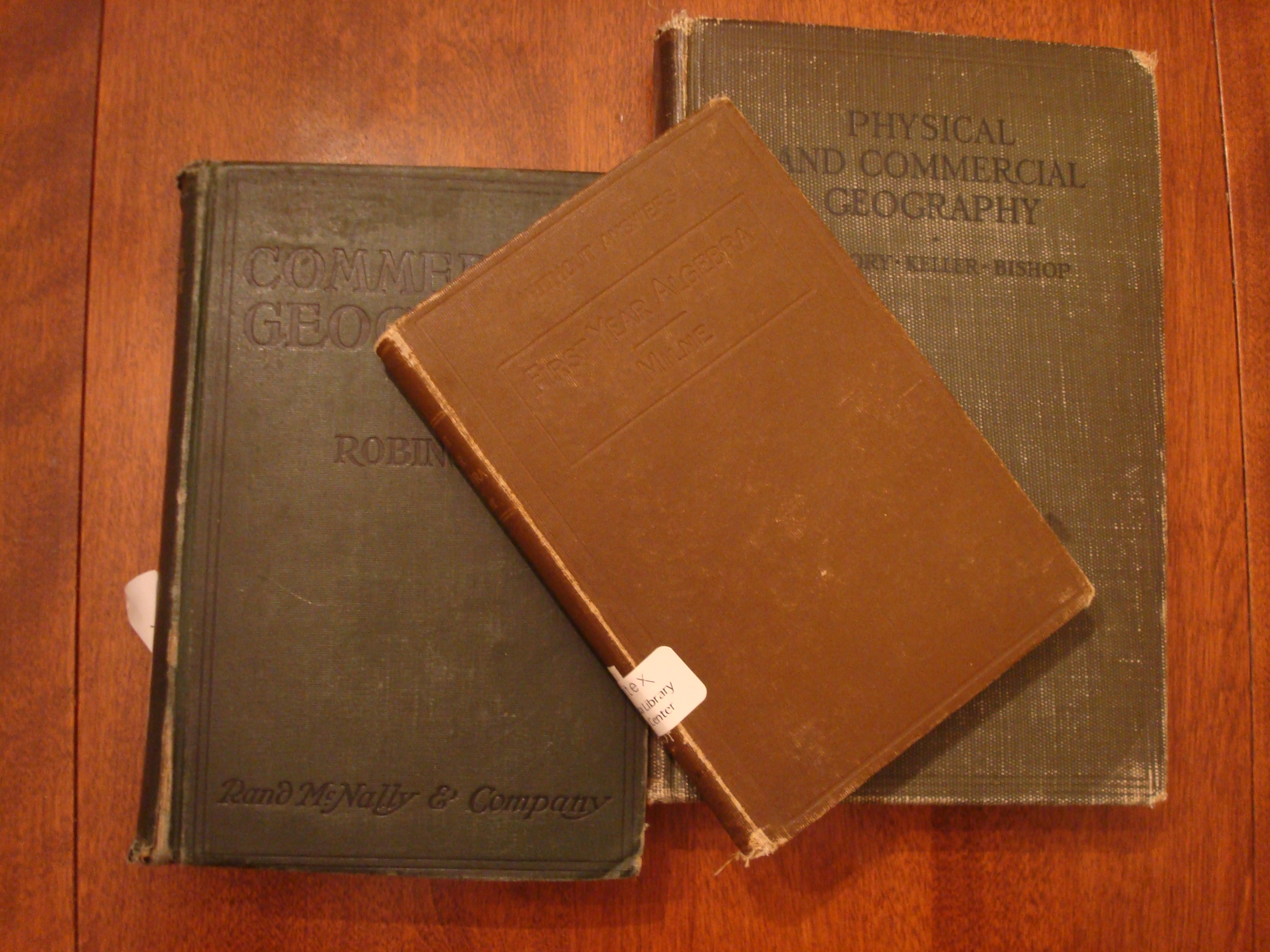
Friday, September 15, 1911: Had visitors at school today, but fortunately they didn’t stay very long. I’m so nervous on such occasions for fear I’ll make a break in reciting at class. More so if the visitor is an important one.
Textbooks published in 1910 and 1911.
Her middle-aged granddaughter’s comments 100 years later:
Since the high school had had a substitute teacher since the beginning of the school year, I’m guessing that school board members or the county superintendent of schools visited the school to see how things were going.
When I read this entry I wasn’t quite sure what reciting meant in this context—though it had a negative connotation and made me think about students’ memorizing poems.
I was surprised to discover that recitation referred not only to orally presenting memorized text, but also to orally responding to questions by the teacher. And that it was commonly used with small groups of students in multi-grade classes. Some students would be working with the teacher while others were working independently.
The one-teacher country school regularly faces the challenge of a wide range of grade levels and academic growth. One response to the multi-age conditions of this naturally small institution is a teacher’s regular use of “recitation” lessons with individual and small groups of students. This pedagogical device is a common legacy of the one-teacher country school. . .
. . . This instruction involved little more than the teacher lecturing and students reciting memorized passages or orally answering a series of questions as directed by the teacher’s textbook guide. Student learning was determined through the accuracy of the recitation and appropriateness of responses to teacher questions. Students were then introduced to the next topic and their assignment in the textbook. They were expected to work quietly and individually on their preparations for recitations.
It requires a good deal of self-discipline on the part of the student. “Doing school” for the students means continually keeping up with one’s work, knowing that you will face the teacher regularly, and understanding that neither is a choice. It is traditional in the sense that is presents itself as common sense, or just the way things are done.
While very few would advocate this as an acceptable model of instruction in public schools today, the form of the country school recitation, with its predictable student-teacher interaction and emphasis on independent work, nonetheless appears today as a sensible practice for curriculum and student management.
“Notes on a Country School Tradition; Recitation as an Individual Strategy,” by Stephen Swidler (Journal of Research in Rural Education, Spring 2000)
This description brings back memories of my mother. She taught in a one-room school-house for a year or two when she was in her early twenties. She used to say that she thought that multi-grade classrooms were the best place for learning. Students who excelled could listen to the lessons directed at an upper grade class and accelerate their learning.–and the student who was behind could discretely listen to the material being taught to a lower grade. It gave the child the opportunity to relearn the material that he or she hadn’t grasped the previous year without embarrassment.