Class Colors

17-year-old Helena Muffly wrote exactly 100 years ago today: 

Friday, September 13, 1912:  Found a pocket knife on the way to school this morning. Wonder who lost it?

We chose our class colors this week. Think it was last Wed. They are maroon and gold. They don’t suit me very well. I preferred to have green and white, but didn’t get them.

Her middle-aged granddaughter’s comments 100 years later:

It’s too bad that Grandma wasn’t able to convince her classmates that green and white would be better class colors. . .though two schools that I attended had maroon and gold (or orange) as their school colors so I have somewhat of a personal affinity for the maroon and gold.

Now that I think about it, I don’t think that we had class colors—just school colors. Does anyplace still have class colors?


Important to Memorize Latin Vocabulary–Though Difficult to Dig Into Studies

17-year-old Helena Muffly wrote exactly 100 years ago today: 

Tuesday, September 10, 1912:  Such a time as I have been having a digging at my studies.

Roman temple
Picture of Roman Temple in An Elementary Latin Course (1909)

Her middle-aged granddaughter’s comments 100 years later:

Which subjects was Grandma having difficulty digging into?  Latin is the only subject that she’s mentioned since school began in late August.

Maybe she needed to memorize some Latin vocabulary words.

A Latin textbook from the early 20th century gave teachers the following pedagogical advice:

Have the material in each lesson taken up and learned in the order in which it comes. The vocabularies are so short that the pupil can be required to learn them before attempting to translate the sentences.

In assigning the lesson, pronounce the new words to the class before they have seen them, having each word pronounced in turn by some pupil; give the meaning and call for English cognates if there are any. Then have the pupils read the words and commit them to memory. They will have a better command of words learned in this way than when they are learned merely as they are met in the sentences. Drill the class constantly on vocabularies past and present.

An Elementary Latin Course (1909) by Franklin Hazen Potter

(An aside—I don’t think any textbooks today would direct teachers to “drill” the students. I guess that pedagogical methods have changed over the years.)

Cause of Sleepiness

17-year-old Helena Muffly wrote exactly 100 years ago today: 

Monday, September 9, 1912:  July, I mean Sept. 9. Don’t know what to write for today. So good night and sweet dreams.

moonlight
Source: Wikipedia

Her middle-aged granddaughter’s comments 100 years later:

Seems odd that Grandma first wrote July—she must have already been half asleep when she wrote this.

Maybe Grandma’s mind was “benumbed” by all of her schoolwork.

According to a hundred-year-old book called Personal Hygiene and Physical Training for Women:

The sleepy feeling is caused by fatigue due to the circulation in the blood of toxins resulting from tissue waste, which benumb the brain-cells; while the feeling of freshness and bien-etre with which one awakens in the morning is due to the elimination of the fatigue products from the blood.

The medical authorities of today are pretty well agreed that eight hours of sleep is the minimum required for the maintenance of health, and all concede that the brainworker requires more sleep than the manual laborer.

Proscrastinate First, But Then Get to Work

17-year-old Helena Muffly wrote exactly 100 years ago today: 

Saturday, September 7, 1912:  My Saturday’s work is done for today, but I still have a heap of lessons to digest before Monday makes its appearance again. It usually takes me awhile to get myself in the notion of studying. After which I usually go to work.

Recent picture of the house and yard where Grandma lived when she wrote the diary.

Her middle-aged granddaughter’s comments 100 years later:

I’m surprised how insightful Grandma was when she realized that even though she tended to procrastinate that she would eventually accomplish the task at hand.

When I was a teen, I got mad at myself for dawdling—yet I continued to do it over and over; and never seemed to “learn” to get things started early.

I don’t think that I knew myself well enough when I was young to realize that I will eventually get a task done (and done well) even if I delay starting it. Now I see procrastination as part of the process (and a time for creative thinking).

Page from Latin Textbook Used a Hundred Years Ago

17-year-old Helena Muffly wrote exactly 100 years ago today: 

Friday, September 6, 1912:  We had a test in three of our studies today. Didn’t make a very good mark in Caesar, but because I omitted to look up some rules, so you see whence I got to today, I was at a loss what to write.

page from Latin text book
Source: An Elementary Latin Course (1909). Click on page to enlarge.

Her middle-aged granddaughter’s comments 100 years later:

Latin sounds hard. Apparently the class was reading Caesar–probably Caesar’s Gallic War.

The introduction to a Latin text published in 1909 describes how the students first study grammar to prepare to read Caesar.

The lessons have been made fairly comprehensive, in order to afford an adequate preparation for reading Caesar.

The vocabulary of the seventy-eight lessons includes about six hundred words exclusive of proper names. Caesar uses about ninety-four percent of these words of these words and Cicero ninety-six percent.

An Elementary Latin Course by Franklin Hazen Potter

Hundred-Year-Old Fashions for Stout Women

17-year-old Helena Muffly wrote exactly 100 years ago today: 

Thursday, September 5, 1912: Ditto.

1912 Dress and Coat for Obese Women
Source: Ladies Home Journal (February, 1912)

Her middle-aged granddaughter’s comments 100 years later:

Hmm—I guess that it was a slow week for Grandma. This is the third day in a row that she hasn’t written much. It seems odd. It’s the second week of the school year—and I’d have guessed that she would have been bubbling about the happenings.

In any case, I’m going to go off on a tangent . . .

Several days ago, a reader commented that in the old days that wealthy people were often overweight—or to use the term that was commonly used a hundred years ago, “stout.”

Her comment reminded me that the February, 1912 issue of Ladies Home Journal showed fashions for stout women:

Many distinctive features favorable for the woman who is included to stoutness of form are typified in the graceful, fringed wrap on the first figure in the group above. It is made of dull-finished black satin—for the stout woman will wisely pass by the more lustrous satins, which tend to accentuate plumpness.

A charming house dress for afternoon or for more informal evening occasions is pictured on the second figure in the group above. Here a soft old-rose satin is used for the foundation dress, brought into a subjection more becoming to the stout woman by the overdress of marquisette in the same shade.

1912 woman's suit

There is a pleasing fitness not only in the quiet colors used for the semi-dressy tailored suit, but also in the right placing of the lines of the coat and skirt for a figure inclined to overfullness.

Newspaper Headlines: Labor Day, 1912

17-year-old Helena Muffly wrote exactly 100 years ago today:    

Monday, September 2, 1912:  Had to go to school, even if it is labor day. We had this day off last year.

Cold isn’t much better. Have to blow my whistle almost all the time, which constant usage make it rather sore and pink.

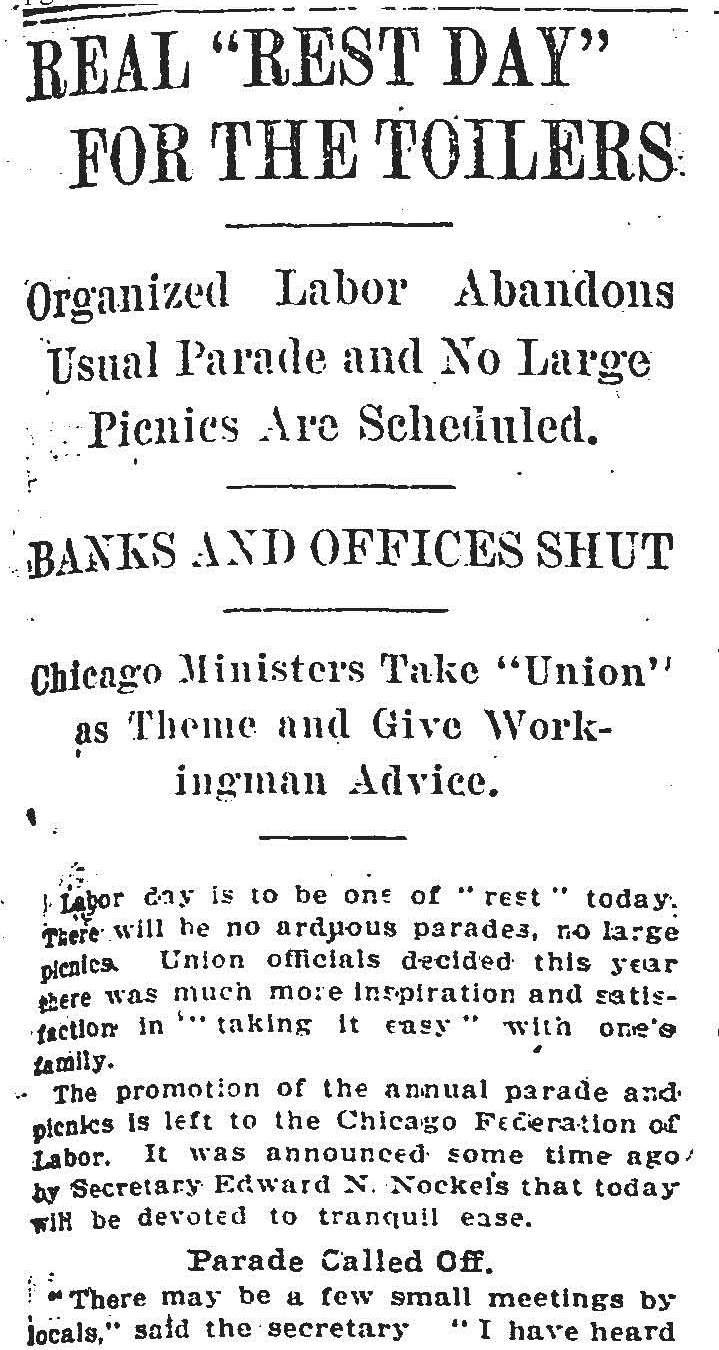
Labor Day, September 2, 1912 Chicago Morning Tribune Article
Source: Chicago Morning Tribune (September 2, 1912)

Her middle-aged granddaughter’s comments 100 years later:

It’s interesting that in 1911 the students didn’t have to go to school on Labor Day—but that in 1912 they did. Was Labor Day an important holiday in 1912?

A quick scan of newspaper headlines from September 2, 1912 shows that  in 1912 the nation was engaged in a debate over the role of labor and unions (as well as whether woman should be paid the same as men).

Representative Newspaper Headlines

Labor Day, September 2, 1912

Cathedral Packed for Labor Service: Mgr. Lavelle Points Out Socialism’s Weakness to Vast Throng of Union Men (New York Times)

Labor Day Parade: Large Squad of Police Detailed to Assist in Keeping Order-Line of March (Los Angeles Times)

Labor Will Parade Today, While City Lends Cheers: Predicted That 50,000 Persons Will Attend Celebration at Armory (Minneapolis Morning Tribune)

Minnesota State Fair to Open This Morning: Exposition Gates to be Thrown Wide to Northwest Visitors: Labor Program Planned (Minneapolis Morning Tribune)

Urges Pay Raise to Save Women: Bishop Samuel Fallows Advocates Putting Them on an Equal Basis with Men: Bar to Immorality (Chicago Daily Tribune)