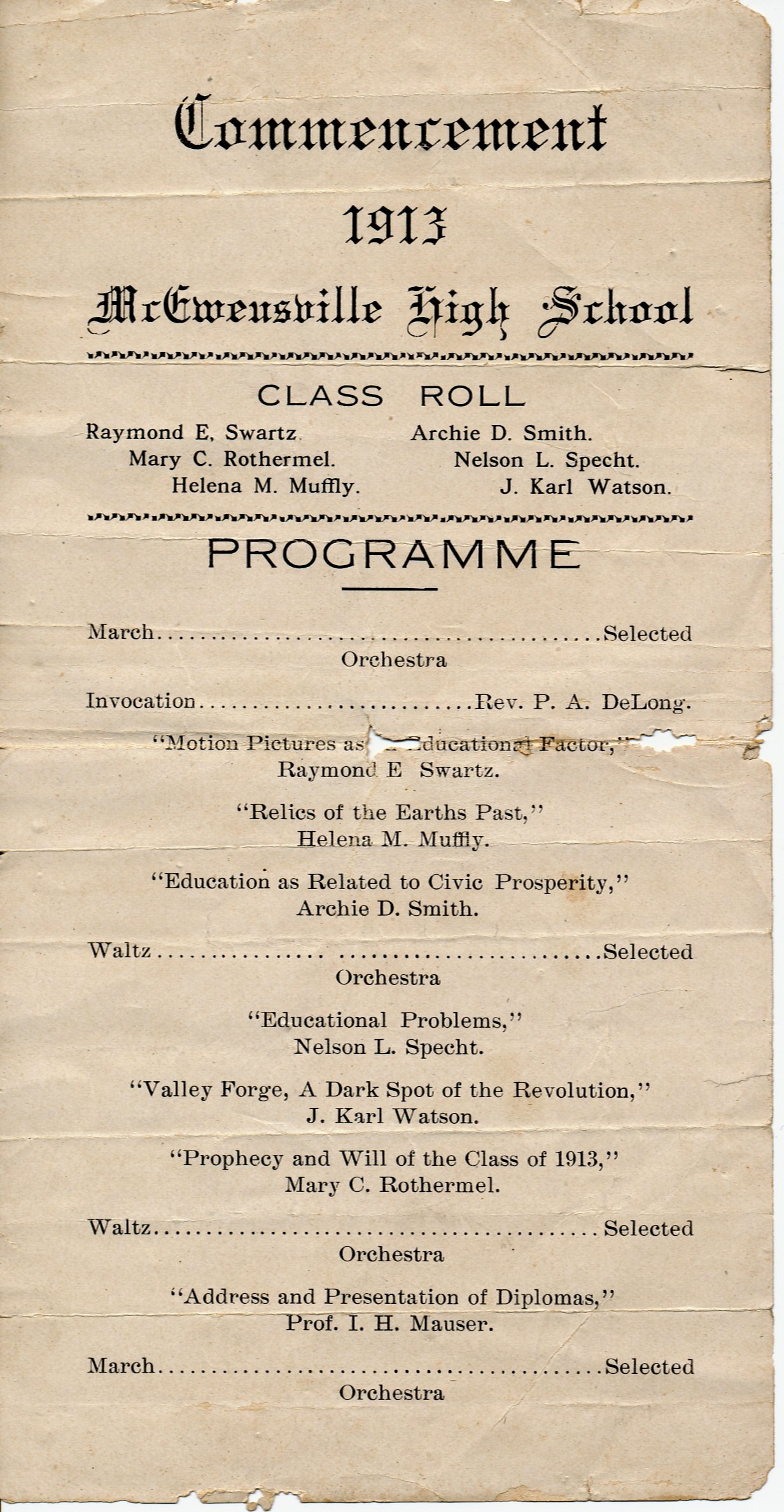
Was the speech about fossils? . . . dinosaurs? . . . evolution? Was it controversial?
Grandma graduated well after the publication of the Origin of the Species (1859), but well before the Scopes Trial (1925). If the speech was about evolution, how did she frame it?
18-year-old Helena Muffly wrote exactly 100 years ago today:
Sunday, April 20, 1913: Went to Sunday School this afternoon.
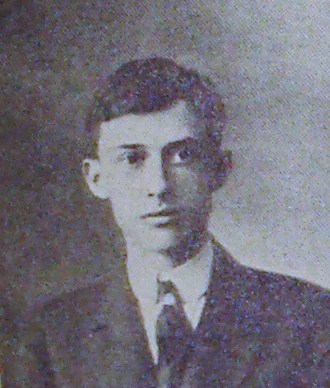
Raymond Swartz
Her middle-aged granddaughter’s comments 100 years later:
Three more days until graduation! Since Grandma didn’t write much a hundred years ago today, I’m going to continue to dive deeper into the information provided by her commencement ceremony program.
Six students, including my grandparents—Helena Muffly and Raymond Swartz— graduated from McEwensville High School in 1913. Both spoke at the commencement.
The title of Grandpa’s speech was Motion Pictures as an Educational Factor.
This was the era of silent films and lots of melodrama. When I researched this topic, I was surprised to learn that in 1913 many people thought that movies were a bad influence on young people.
According to Laura Wittern-Keller in her dissertation:
Movies with themes that challenged traditional values, shown in the dark to a mixed audience with larger-than-life figures, spawned a “moral panic.”
Hmm–Grandpa spoke on a controversial topic. He apparently took the side that his high school class mates would have approved of—but that their parents might have objected to.
How did Grandpa build his argument that movies were educational? . . . Maybe he argued that they enabled people in rural Pennsylvania to see “see the world” . . . or that some of the movies were about historic events. . . or that they were works of art. . .or . . . .
In my imagination, I picture his classmates giving him a standing ovation, while their elders tried to frown but their lips turned up in slight smiles of approval.
This diary entry raises more questions than answers for me.
Today we seldom see $2 bills—and they often seem special when we get one. Were they also unusual a hundred years ago—or were they readily available?
Why did Grandma say the gift was from her mother instead of from her parents? Why is her father so seldom mentioned in the diary? He was a farmer—and it seems like he should have been mentioned more often than he was.
18-year-old Helena Muffly wrote exactly 100 years ago today:
Friday, April 17, 1913: Our class was invited out to supper this evening. It broke up rather early. My first presents arrived today. A gold hat pin and a handkerchief.
Lillie. Raymond (standing), and Michael Swartz (1913)
Her middle-aged granddaughter’s comments 100 years later:
Grandpa must have been at the supper—but Grandma doesn’t mention him and it sounds like the dinner was boring since the party broke up rather early.
According to the Commencement Program there were only six people who graduated from McEwensville High School in 1913, and two of them were my grandparents–Helena Muffly and Raymond Swartz.
In such a tiny class they had to have known each other—yet Grandma never mentioned him in the diary. Why?
Raymond was much younger than Grandma—perhaps he wasn’t on her radar screen at the time. He was only 14 1/2 years old when he graduated; she was 18. He must have skipped several grades.
Maybe Raymond was really quiet and Grandma barely noticed him. His mother had died several years previously. He lived on a farm with his father. He only had one sibling—a sister, Lillie, who was 12 years older than him.
Or maybe he was smart and annoying. . . .
One place in the diary where I want to think that Grandma referred her future husband was on February 6, 1911:
. . . Got too close to the stove pipe at school today and burned my hand. Didn’t feel very good. Put some black on a kid’s face, and then he put some on mine. I tried to prevent him. Got my arm scratched and tore my waist. . .
It almost seems like the two students were trying to get each others attention, and that maybe they liked each other just a little. Grandpa would have seemed like a kid at the time. . .could it have been him?
18-year-old Helena Muffly wrote exactly 100 years ago today:
Thursday, April 17, 1913: Our exams are now entirely over. I think I passed. No more examinations at school to bother me.
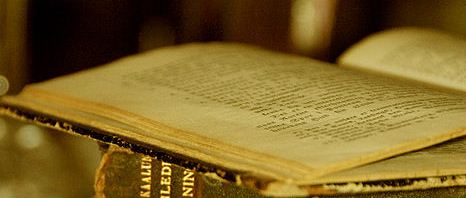
Hundred-year-old textbooks ready to be returned to the library
Her middle-aged granddaughter’s comments 100 years later:
Yeah!—Grandma, it’s awesome that you’ve completed the final hurdle before graduation. You’re awesome!
But I’m feeling a little sad. I enjoyed reliving your high school years with you—the drama, the joys and the defeats. It was fun imagining you walking to school each morning; and I loved skimming hundred-year-old textbooks in search of perfect quotes to illustrate diary entries—but those days are now behind me.
I’m looking forward to learning more about your life after graduation, but I’ll miss your school days!
18-year-old Helena Muffly wrote exactly 100 years ago today:
Wednesday, April 16, 1913: We had three today. Think I passed all three of them. Was trying to work some problems this evening, but got stuck on some of them.
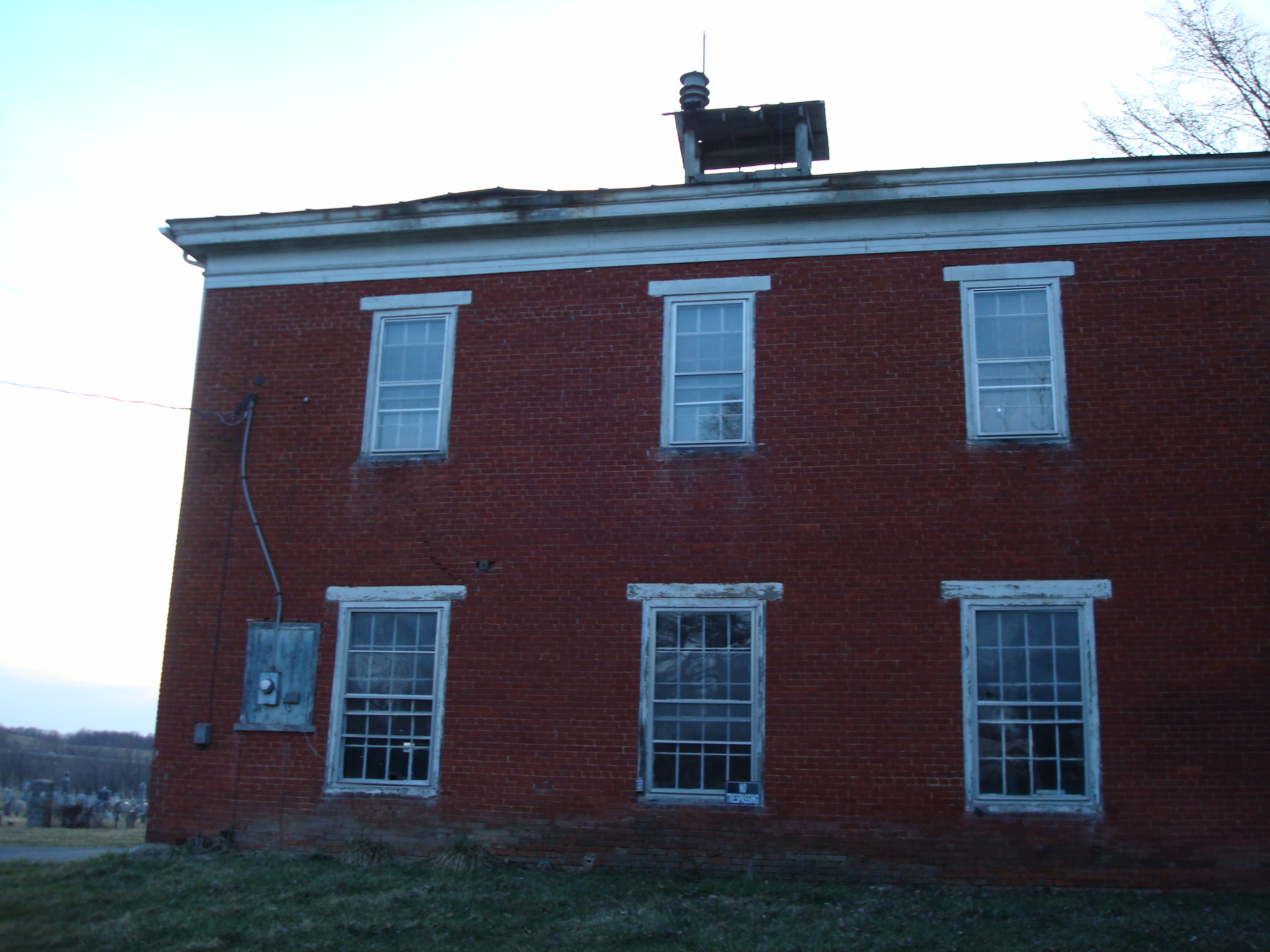
Recent photo of the building that once housed the McEwenvsille School.
Her middle-aged granddaughter’s comments 100 years later:
Grandma –It’s a good sign when you feel confident that you passed the final exams. I bet you did well on them.
In the evening, were you trying to work problems that had been on the exam to see if you got the right answer? . . . or were you doing problems to study for one of the upcoming tests?
18-year-old Helena Muffly wrote exactly 100 years ago today:
Tuesday, April 15, 1913: Tomorrow witnesses the beginnings of our final examinations. I do hope that I’ll pass.
Source: Wikimedia Commons
Her middle-aged granddaughter’s comments 100 years later:
Hang in there Grandma—you’re almost there. Your graduation invitations have been mailed. You’ll navigate your way through this final hurdle.
—
The way students are tested today is controversial. I was amazed to discover that people also had concerns about exams a hundred years ago.
Here is an excerpt from an article in the October 1912 issue of Ladies Home Journal called “The Black Beast in Every Child’s School Life”:
No evil in the present American public-school system is, to my mind so great and so manifestly unjust to the pupil as what may very aptly be called “the black beast of every child’s school life”: examinations, as they for the most part now are conducted. .
Examinations, as they are now almost universally conducted in our schools, are a memory extortion pure and simple. An examination is supposed to be a final twist which will forever fix in the memory as a whole the items that have been put into it one at a time.
Why should we longer put our children to these terrible strains as we do now? I have tried to think out a good reason and I am unable to do so.
The dictionary is always at hand when the pupil is studying his lesson, and so can be referred to at will. Besides this the grammar is always accessible, to explain new an unusual forms and phrases that appear in it.
But when examination day s comes every one of these rightful and useful helps in his work is taken away from him, and arm’s length of memory alone if he is asked to translate, give forms of words and account for constructions, without any assistance from the tools that he ordinarily has been permitted to use.
Memory-test examinations must be abolished. Time was when the word “scholar” meant a wailing dictionary. There are too many words now, and knowledge has too vast a reach, to be compressed into any one single head. Besides, what’s the use? Dictionaries are cheap. The missions can have cyclopedias now; and things are so much easier to get at, so much more reliable withal so much more liable to keep in any climate when preserved for ruse in this way.