Corn Harvest Finished!!!

18-year-old Helena Muffly wrote exactly 100 years ago today: 

Saturday, October 18, 1913: At last my job is finished. I call it about 600 bushels more or less. This will add some to my spending money.

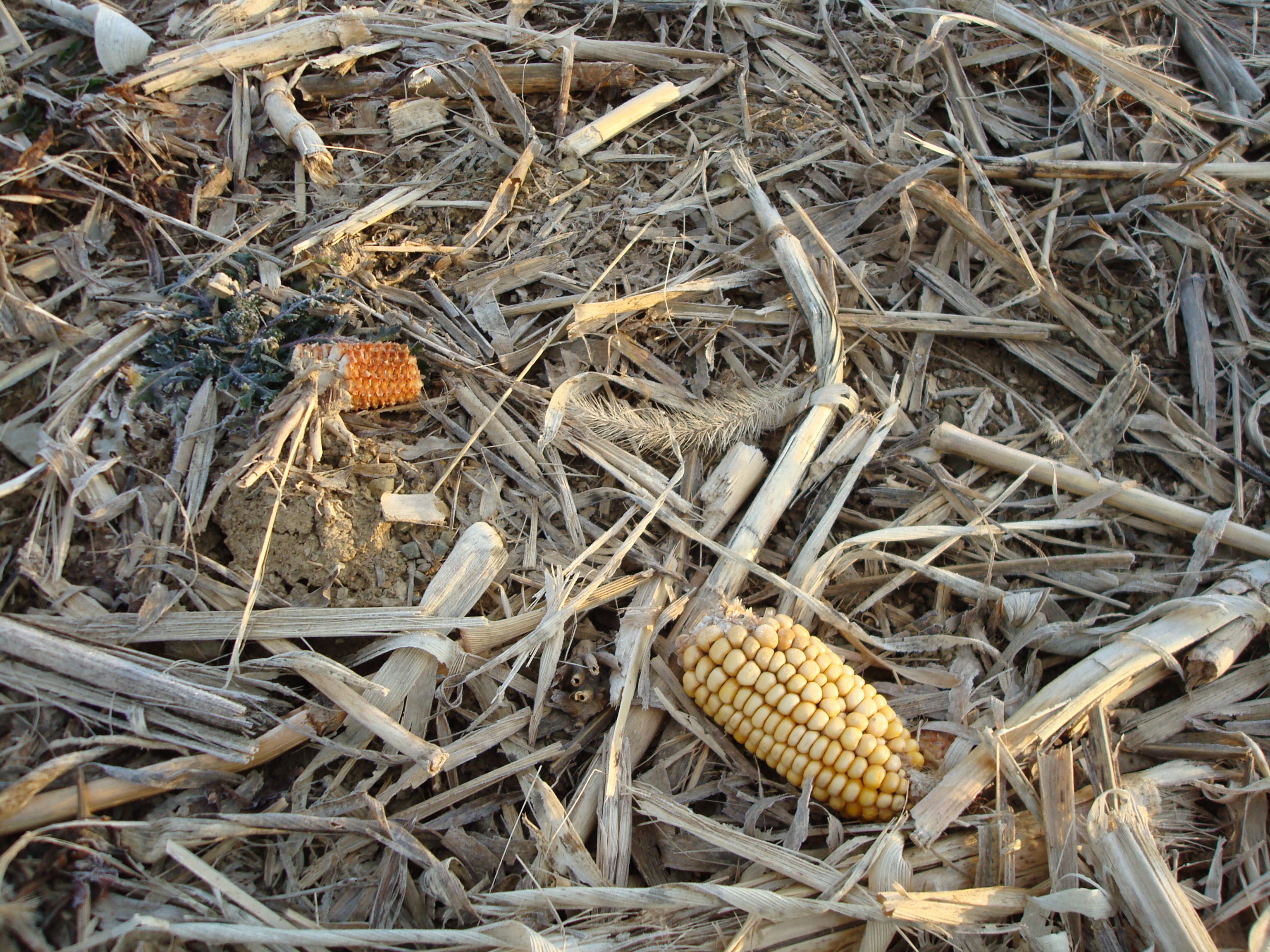
DSC02184

Her middle-aged granddaughter’s comments 100 years later:

Yeah, Grandma! You’ve worked incredibly hard husking corn. 600 bushels is a lot of corn. You began husking corn  about three and a half weeks ago—on September 25.

On the October 11, you wrote that you’d received partial payment of $12 for your work. How much were you paid in total?

And, PLEASE tell us what you bought when you spend the money.

Based on the information about the number of bushels Grandma harvested in this diary entry, I now realize that I over-estimated how many bushels Grandma had harvested as of October 6 when she wrote that  she’d husked about ten wagon loads of  corn.

At that time I estimated that Grandma had husked about 1,000 bushels of corn—when actually during the entire harvest she only husked 600 bushels. The wagon loads must have been smaller than I thought.

(I didn’t say that quite right. 600 bushels is still an awfully lot of corn—and I shouldn’t be minimizing how much work Grandma did because of my estimation errors.)

Note to self—Work further ahead (or at least look further ahead ) so I don’t make silly mistakes like this in the future.

1913 Airplane Pictures

18-year-old Helena Muffly wrote exactly 100 years ago today: 

Friday, October 17, 1913:

10/13 – 10/17: Nothing worth writing about for these days. Don’t go any place or do anything of much importance.
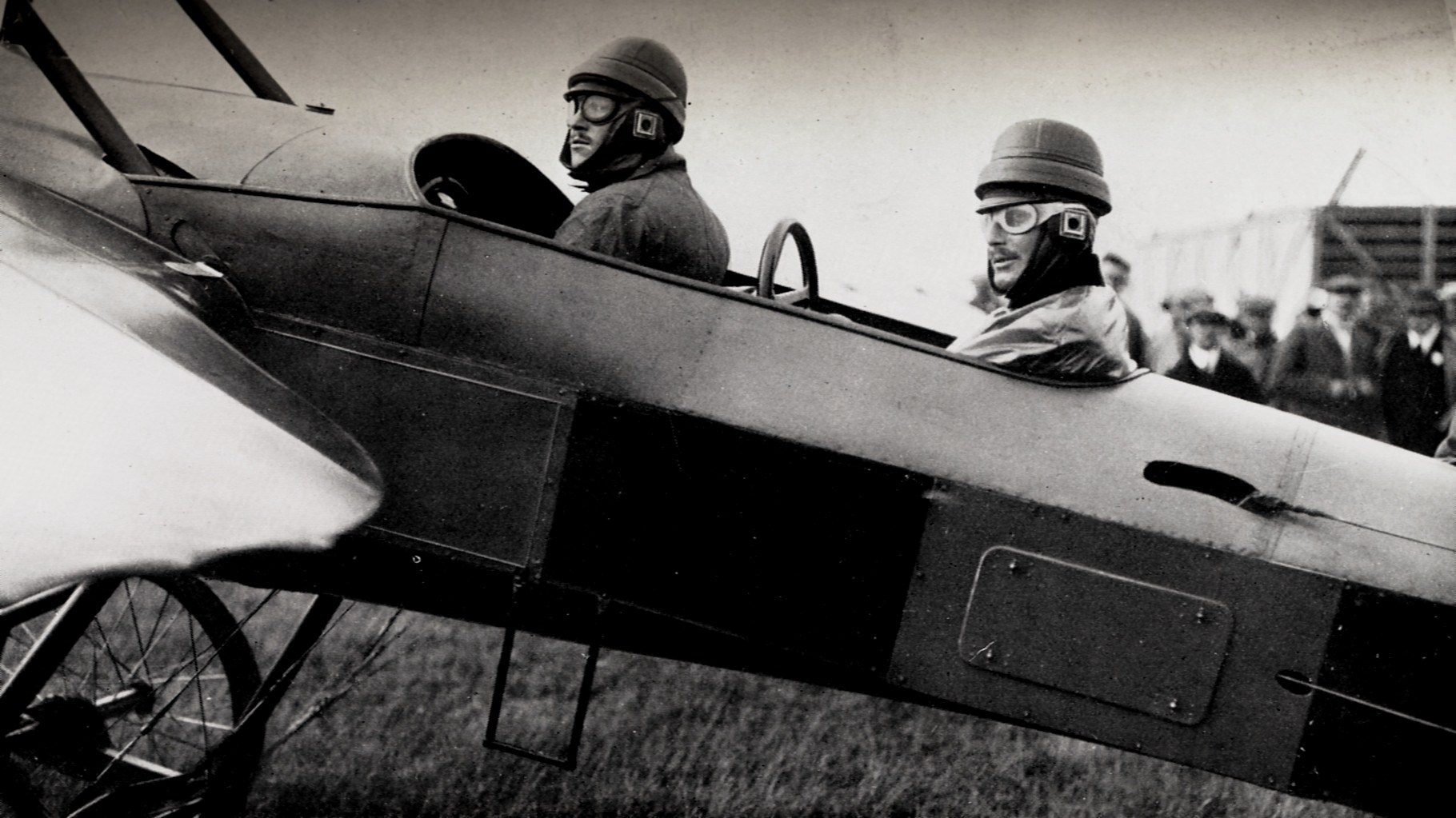
Caption: The above photograph illustrates a Deperdussin monoplane filtted with dual contraol so that two pilots can alternately take charge while in flight.
Caption: The above photograph illustrates a Deperdussin monoplane fitted with dual control so that two pilots can alternately take charge while in flight. Source: Aviation: An Introduction to the Elements of Flight

Her middle-aged granddaughter’s comments 100 years later:

Since Grandma didn’t write anything specific for this date, I’m going to share some fun  pictures from a book published in 1913 called Aviation: An Introduction to the Elements of Flight by Algernon E. Berriman.

Here’s how Chapter 1 begins:

Everyone nowadays is familiar with the appearance of an aeroplane, but many, nevertheless do not know what, scientifically speaking, an aeroplane is. . .

aviation.3
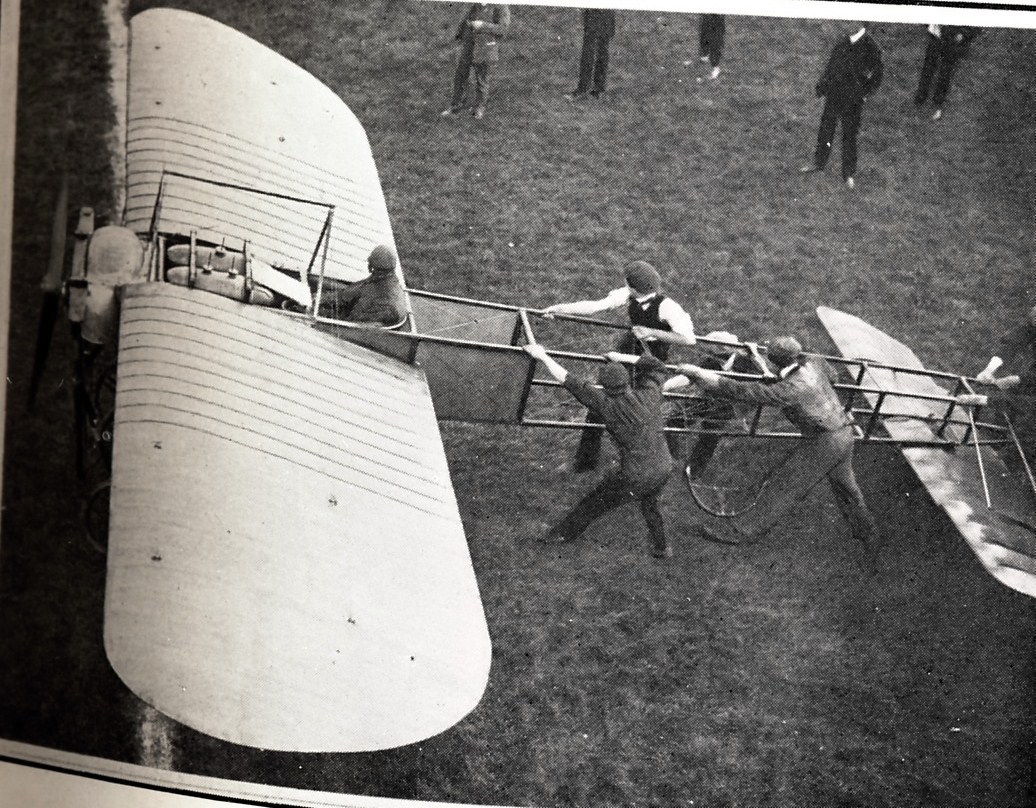
Caption: The pilot is seen seated in a Bleriot monoplane, which is about to start. The mechanics are holding on to the fuselage against the pull of the propeller.
Aviation.2
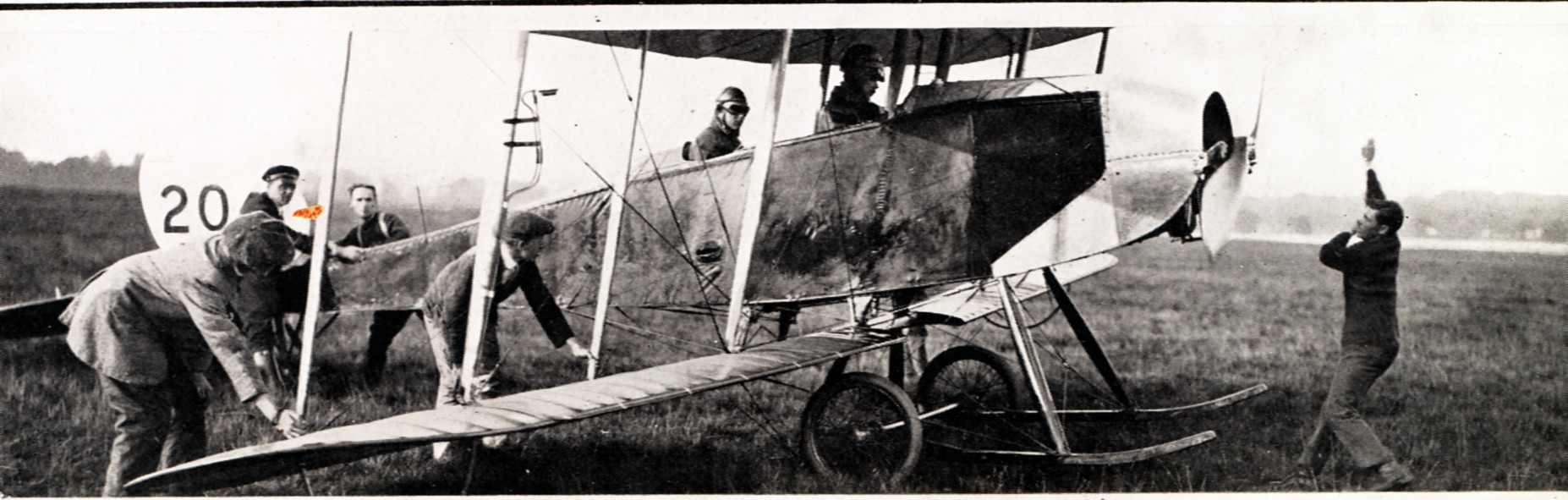
Caption: In the photograph, which shows one of the Royal Aircraft Factory’s biplanes, the mechanic has just released the propeller and is getting clear of its rotation.
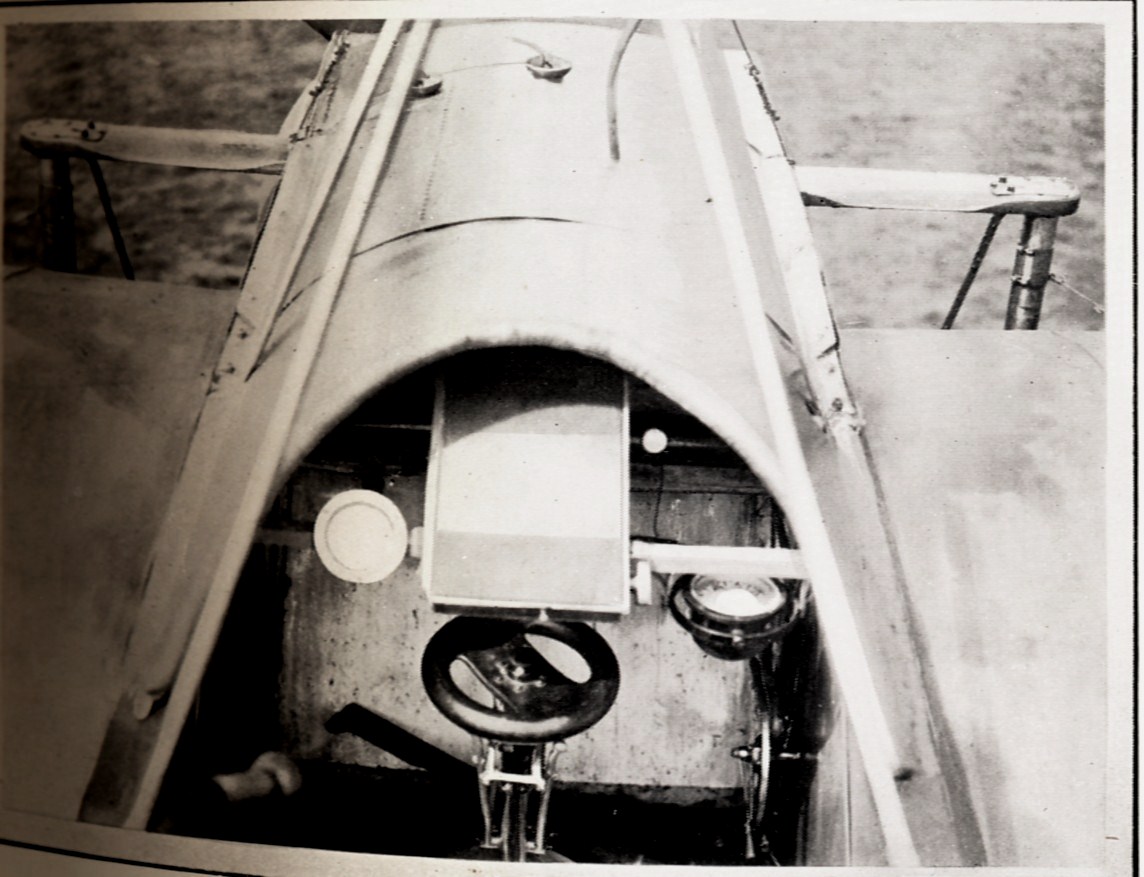
Caption: A view can be seen of the control wheel in front of which is a map holder. On the right is a compass.
Caption: A view can be seen of the control wheel in front above which is a map holder. On the right is a compass.
Caption:  A Bleriot monoplane descending and a Farman-type biplane ascending. The biplane is flying away from the camera and the monoplane is approaching from above. (Source: Aviation: An Introduction to the Elements of Flight (1913)
Caption: A Bleriot monoplane descending and a Farman-type biplane ascending. The biplane is flying away from the camera and the monoplane is approaching from above.

I wonder if the teen who wrote the diary ever thought that she’d ride in an airplane.

Fast forward 50+ years– I can remember picking Grandma up at the Williamsport (PA) airport when she was in her early 70s. She flew back to Pennsylvania after visiting relatives in the Detroit area. She complained about not being able to hear after she got off the plane.  I think it was the first time she had ever flown—and she was flustered and wasn’t sure whether she liked flying (though I think that she was proud of herself for being so adventuresome).

The Goop Directory

18-year-old Helena Muffly wrote exactly 100 years ago today:

Thursday, October 16, 1913:

10/13 – 10/17: Nothing worth writing about for these days. Don’t go any place or do anything of much importance.

Goop.3

Her middle-aged granddaughter’s comments 100 years later:

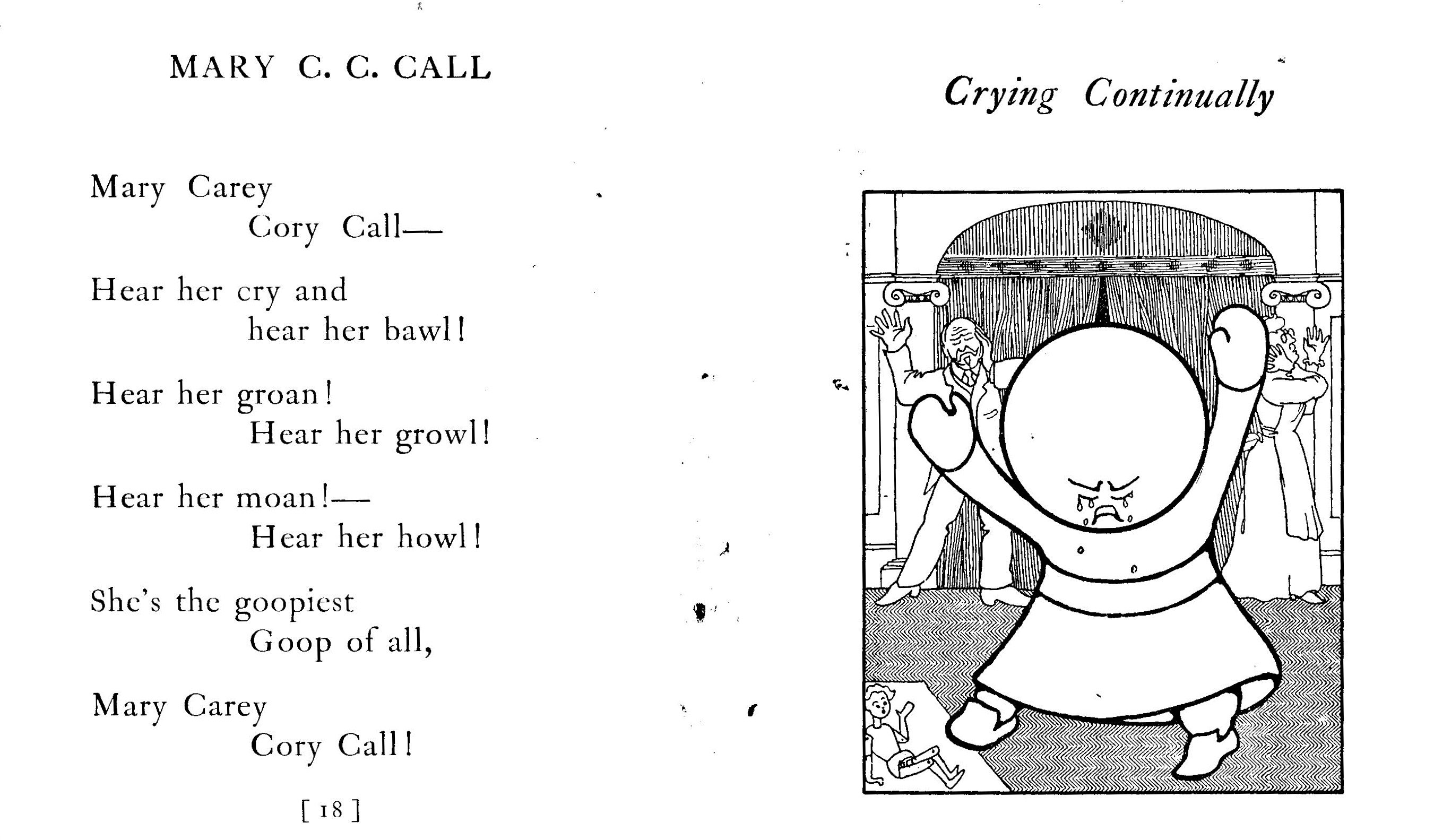
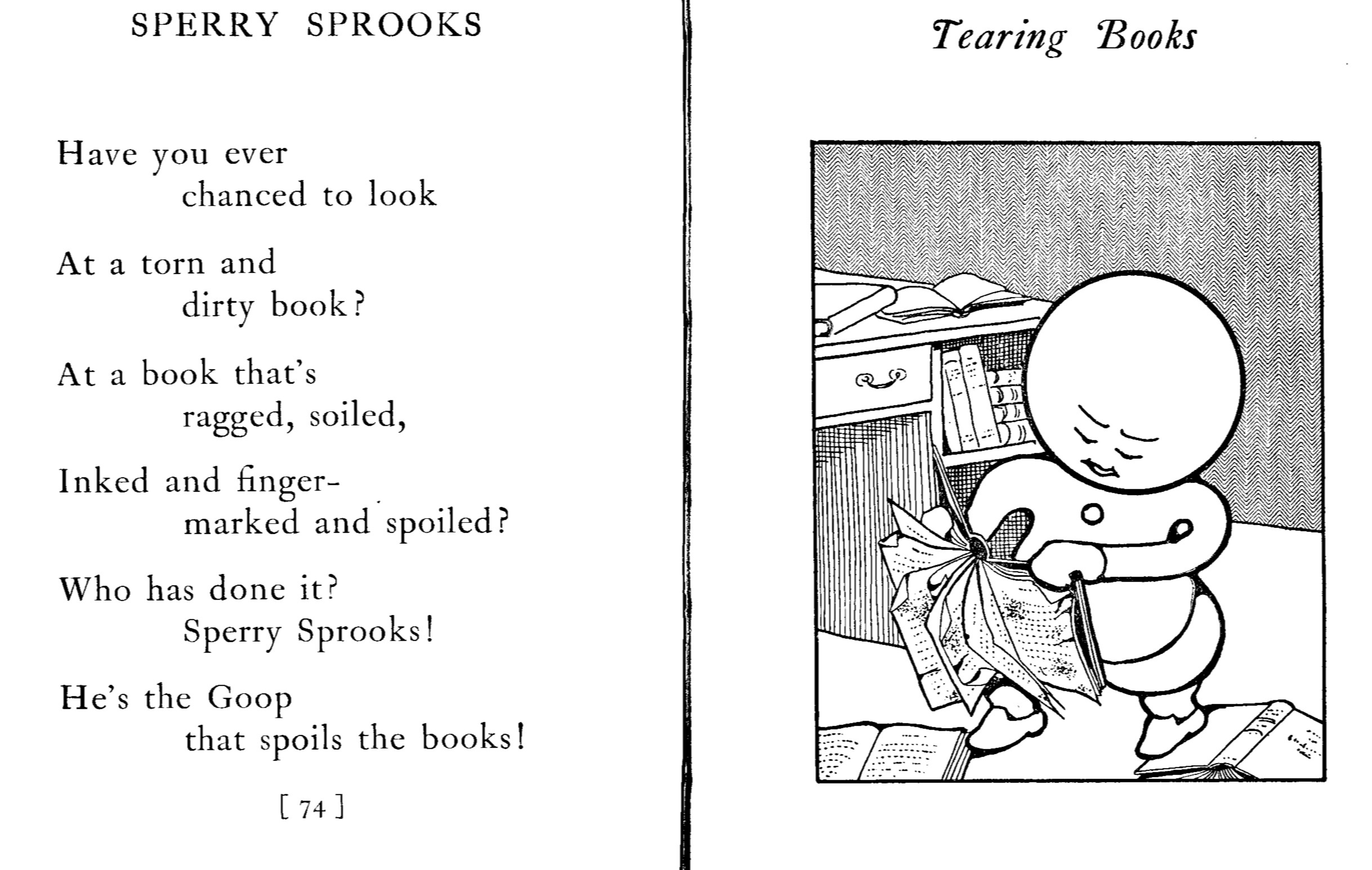
This is the fourth of five days that Grandma combined into one entry. Since she didn’t write anything specific for this date I’m sharing several pages from a fun children’s book published in 1913 that I found.

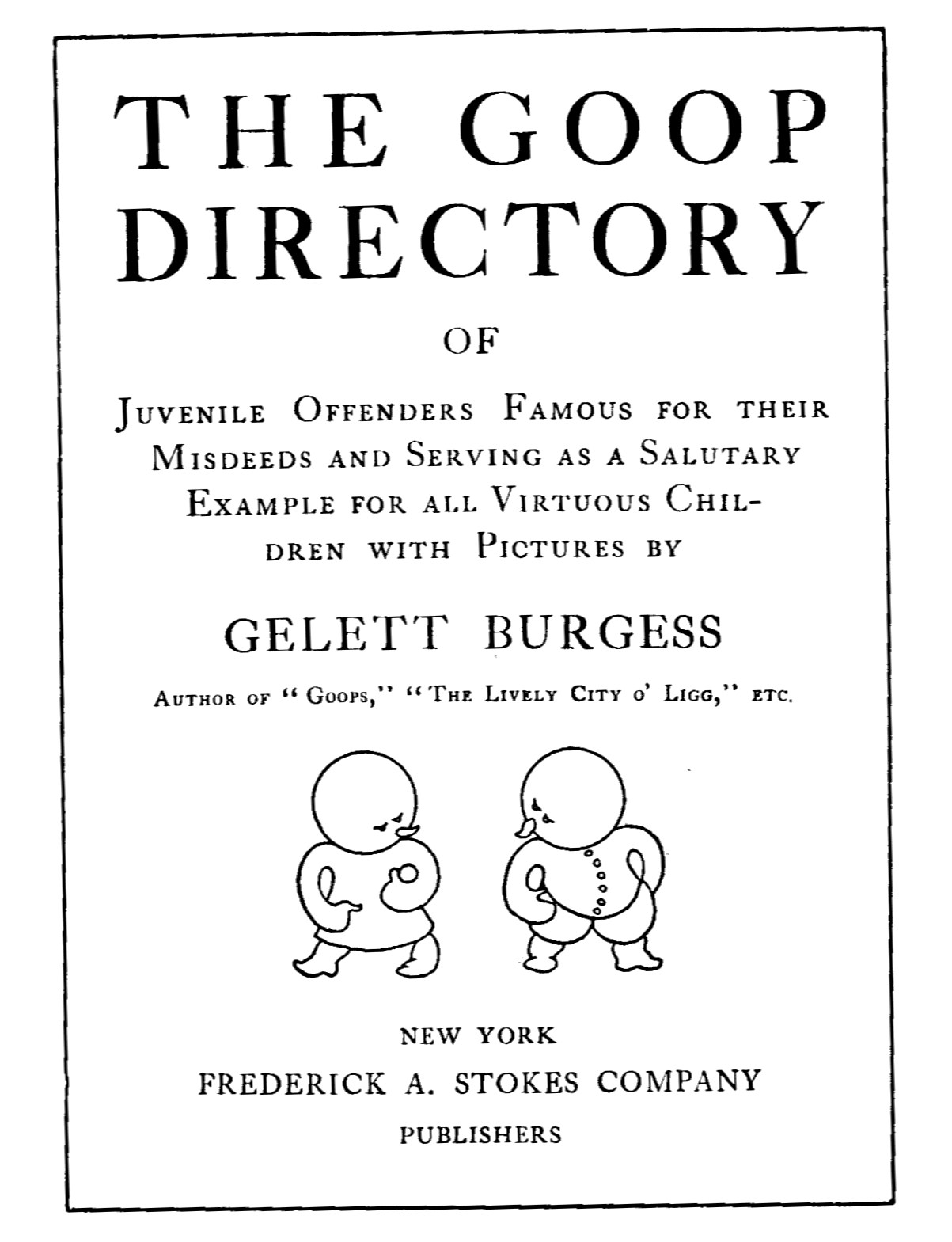
The book is called The Goop Directory and contains short scenarios of children who were naughty—or, using the terminology in the book, “Goops.”

title page
title page

Goop.1

Goop.2

The book that I have was well-loved—perhaps that isn’t exactly the right term—and some pages have coloring on them.

Other pages have remnants of names written in pencil that were later erased.  I can just picture a child going through the book and identifying which of their playmates were like each of the characters in the book. Obviously a Goop once owned this book!

Goop.5

.

Hundred-Year-Old Rural Math Problems

18-year-old Helena Muffly wrote exactly 100 years ago today: 

Wednesday, October 15, 1913:

10/13 – 10/17: Nothing worth writing about for these days. Don’t go any place or do anything of much importance.

Source: Rural Arithmetic (1913)

Her middle-aged granddaughter’s comments 100 years later:

I’m still fascinated by the 1913 textbook I found called Rural Arithmetic by John E. Calfee that I mentioned the previous two days. Since Grandma didn’t write anything specific for this date a hundred years ago, I am going to share a few more problems today.

Here are the problems:

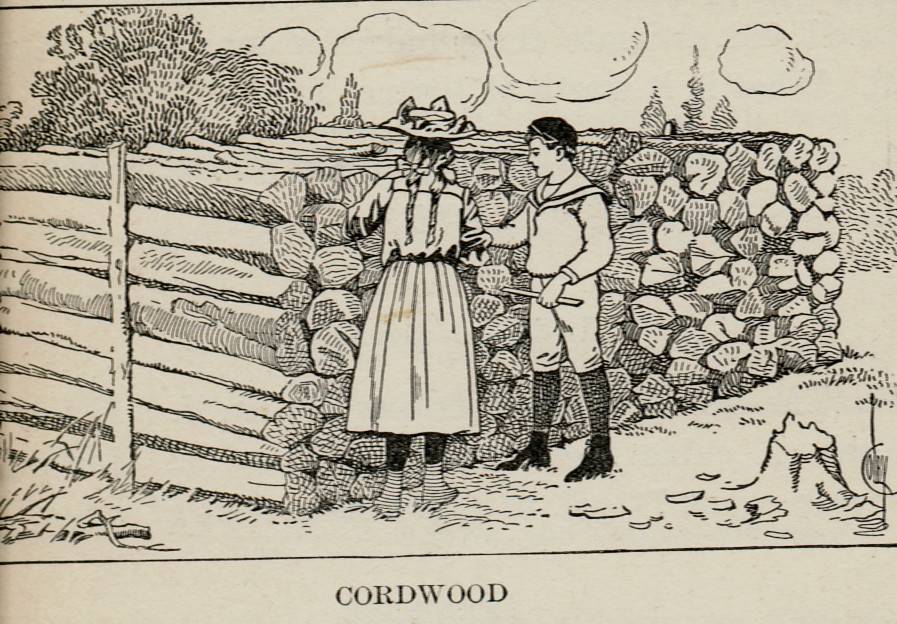
1.  If a cord of wood for cooking purposes lasts a family 3 weeks, how much does the family pay out in the course of a year for cook-stove wood when wood is $2 per cord? . . . when wood is $3 per cord?

2. If a quail, in the course of a year, eats 25¢ worth of grain, and destroys $2 worth of harmful insects and weed seed, how much has a farmer injured himself by killing 3 pairs of quails if a pair raise a brood of 12 each year?

3. If the water running from a piece of land that has been planted with corn contained 1 pound of sediment for every 250 gallons of water, how much soil was carried away from a 40-acre corn field after a 2-inch rainfall, with 1/4 of the water running off?

4. If a team travels 16 1/2 miles a day with a breaking plow, how many days work can a man save in plowing 30 acres (110 rod by 43 7/11 rod) by using a 16-inch instead of a 12-inch plow?

5. A county store on a gravel road pays 1¢ a mile for each 100 pounds of freight hauled from the railroad station.; a county seat of the same road 24 miles from the railroad, 18 miles of which are not gravel, pays 2¢ a miles for hauling 100 pounds of freight. What is the annual bad-road tax paid by this county seat upon 300,000 pounds of freight?

rural.arithmetic.p. 86

rural.arithmetic.p. 87

It’s amazing how much you can learn about routine activities (as well as issues and challenges) a hundred years ago from word problems.

It’s also intriguing to think about how pedagogical experts a hundred years ago must have believed that it was important to have textbooks with problems that were designed specifically for the rural context that the students experienced in their day-to-day lives.

.

1913 Math Problems Designed to Motivate Students to Get an Education

18-year-old Helena Muffly wrote exactly 100 years ago today: 

Tuesday, October 14, 1913:

10/13 – 10/17: Nothing worth writing about for these days. Don’t go any place or do anything of much importance.

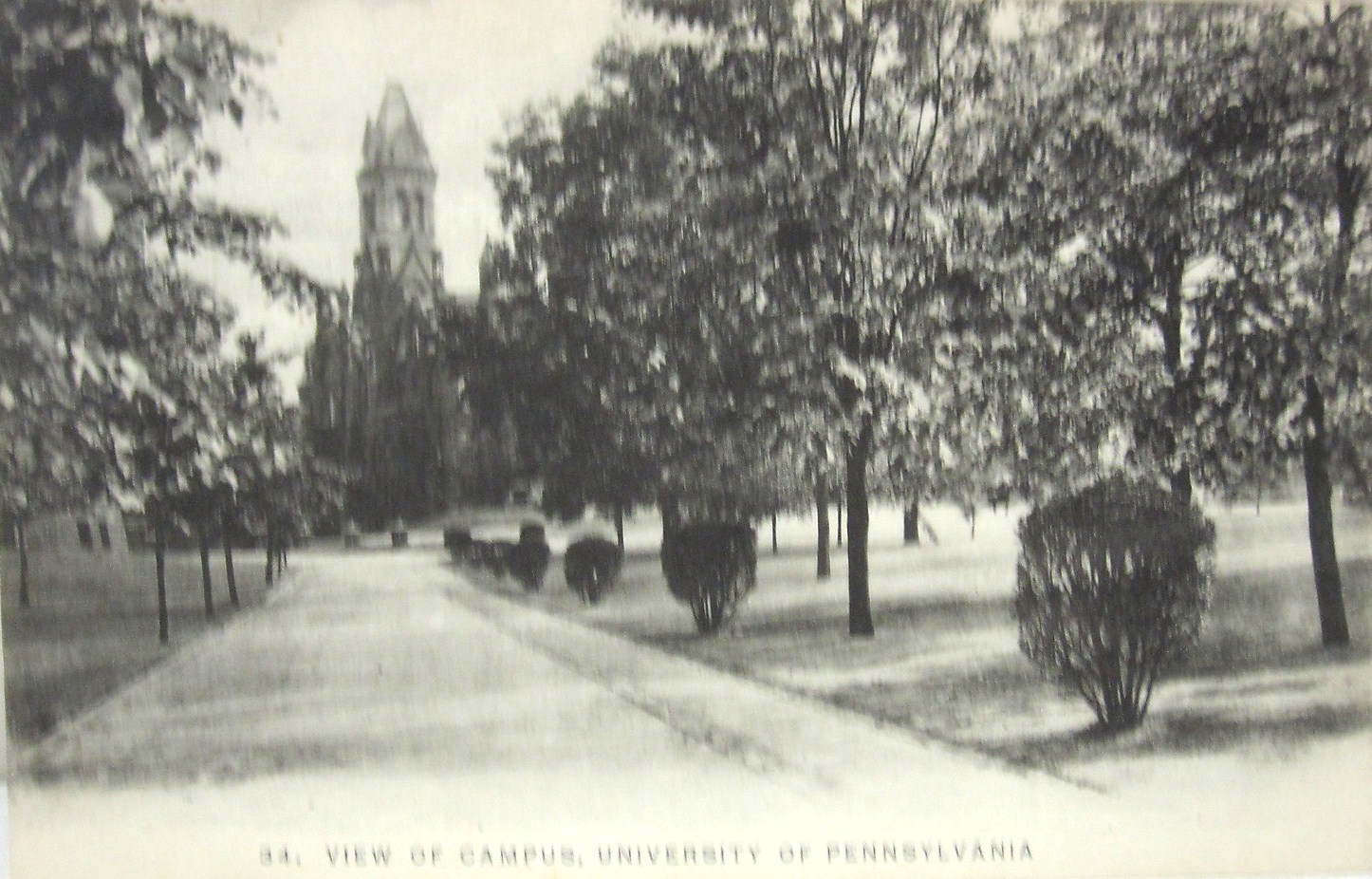
Postcard with picture of Old Main at Penn State (postally used: 1908)
Postcard with picture of Old Main at Penn State (postmark: 1908)

Her middle-aged granddaughter’s comments 100 years later:

Since this is the second of five days that Grandma combined into one diary entry, I’m going to pick up where I left off yesterday.

Yesterday, I told you a little about a 1913 math textbook called Rural Arithmetic by John E. Calfee that included a section titled “Educated Labor.” That section included word problems apparently designed to motivate students to continue their education.

Here’s a couple problems from the book:

1.  Two classmates leave the country school, one for work for 75¢ a day with board; the other borrows $250 and goes away for 3 years to a trade school and learns a trade which pays him $1.75 a day with board. Counting each able to average 285 days a year, at the end of 10 years from the time they leave the country school which will have earned more money?

2. The average salary of the man who has completed a college course is about $1000 a year, and the average wages of the man who has completed the common-school studies [an 8th grade education] are almost $450. If it takes 1440 days to complete a high-school and college course, what is the average value of each day spent in taking such a course? (The college-trained man spends 8 years of the work period in school, and has an annual expense of $450 for college.)

Rural Arithmetic (1913)

.

Was a College Degree Worth More a Hundred Years Ago than it is Now?

18-year-old Helena Muffly wrote exactly 100 years ago today: 

Monday, October 13, 1913:

10/13 – 10/17: Nothing worth writing about for these days. Don’t go any place or do anything of much importance.

Salaries.education.level.1913.2013

Her middle-aged granddaughter’s comments 100 years later:

Some days are just like that—they barely seem worthwhile. Today I hear so many recent college graduates worrying about whether it was worthwhile getting a college degree since the job market is so tight.

Was a college degree worth more a hundred years ago than it is now?

1913

According to a 1913 book called Rural Arithmetic by John E. Calfee:

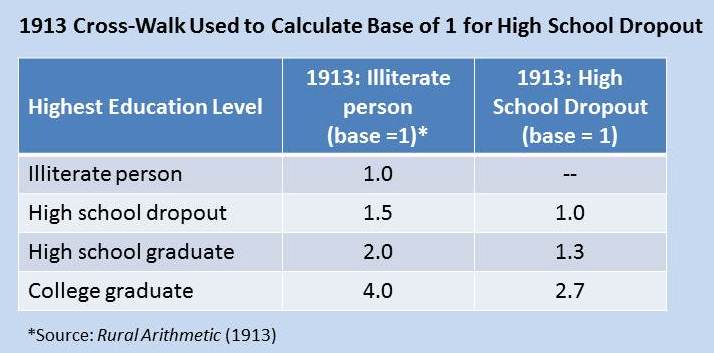
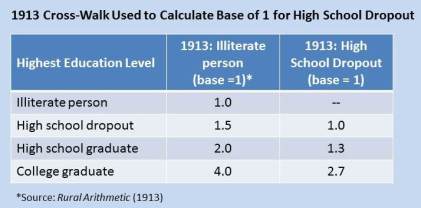
A business  man who has studied the productive power of intelligent labor in New York reports that the man with a common-school education is able to produce one and one-half times as much wealth as the illiterate man, the high-school man two times as much, and the college man four times as much.

2013

According to Frontline on PBS (Public Broadcasting Service), today:

The average dropout can expect to earn an annual income of $20,241, according to the US Census Bureau. That’s a full $10,386 less than the typical high school graduate, and $36,424 less than someone with a bachelor’s degree.

Comparison

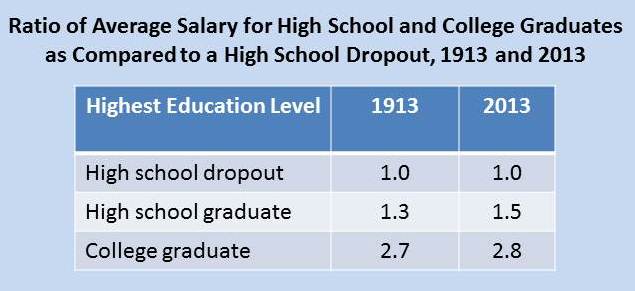
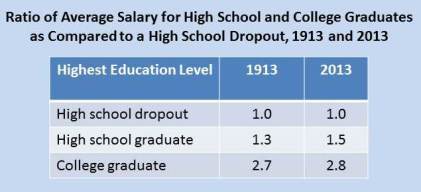
There’s more of an income benefit of earning a high school diploma today than back then—and the value of getting a college has also increased slightly.

In other words, today someone with a high school diploma earns on average 1.5 times as much as a high school graduate and someone with a college degree earns 2.8 times as much.

This can be compared to 1913 when (after the base was converted to 1 for a high school dropout), a high school graduate on average earned 1.3 times as much as the dropout,  and the college graduate earned 2.7 times as much as the dropout.

For those who care about the details–

I assumed that the benefit of a college degree didn’t change much between 2012 and 2013. The data I used was from a 2012 article.

Rural Arithmetic is a math textbook. A subheading in one of the chapters was “Educated Labor”.  The quote above was pulled from the introduction to that subsection. It was followed by a series of word problems about the value of education.

The 1913 book used the term “common school graduate” to refer to someone who had completed 8 years of education.  For the purposes of this analysis I considered a common school graduate to be a high school dropout.

And, here is a chart that contains a crosswalk between the base (salary of illiterate person=1) used in the 1913 book, and the base (salary of a high school dropout = 1) that I used in the chart at the top of this post.
Salaries.education.level.drop-out

An aside–We must be doing something right with education today since we no longer even think about what the salary would be for an illiterate person.

.

Walking Home with Friends on a Moonlit Night

18-year-old Helena Muffly wrote exactly 100 years ago today: 

Sunday, October 12, 1913: Went to Sunday School this morning. Ruth and I went up to church this evening. It was so nice and moonlight. Some of the girls walked down the road with us coming home.

moonlight.2.crop

Her middle-aged granddaughter’s comments 100 years later:

This diary entry makes me feel both good and worried. Let me explain.

First, why it makes me feel good—

I can picture Grandma, her sister Ruth, and their friends ambling down the road from McEwensville toward the Muffly farm on a beautiful ,unseasonably warm, October evening.

I don't have an evening picture of the road that went from McEwensville toward the Muffly farm, but here's a daylight picture of the road .
I don’t have an evening picture of the road, but here’s a daylight picture of it.

I imagine a group of five or six girls in long skirts chatting and giggling about guys, friends, clothes, work, and all of the other important things that teens talk about.  And, in my mind, I envision that as they neared the midpoint between town and the Muffly farm that the group separated with Grandma and Ruth continuing on—and the other girls returning to McEwensville.

Now why it makes we worry—

This entry reminds me that Grandma often had to walk home alone in the dark after church, community, and (before she graduated) school events. Some of those nights were in the dead of winter—and it must have been excruciatingly cold.

Maybe people were just used to walking at night in rural areas back then, but I worry about her safety. (I know it’s a hundred years too late to worry—but I do it anyhow).  Did Grandma ever feel scared during the mile or so walk home through the dark countryside?

.