18-year-old Helena Muffly wrote exactly 100 years ago today:
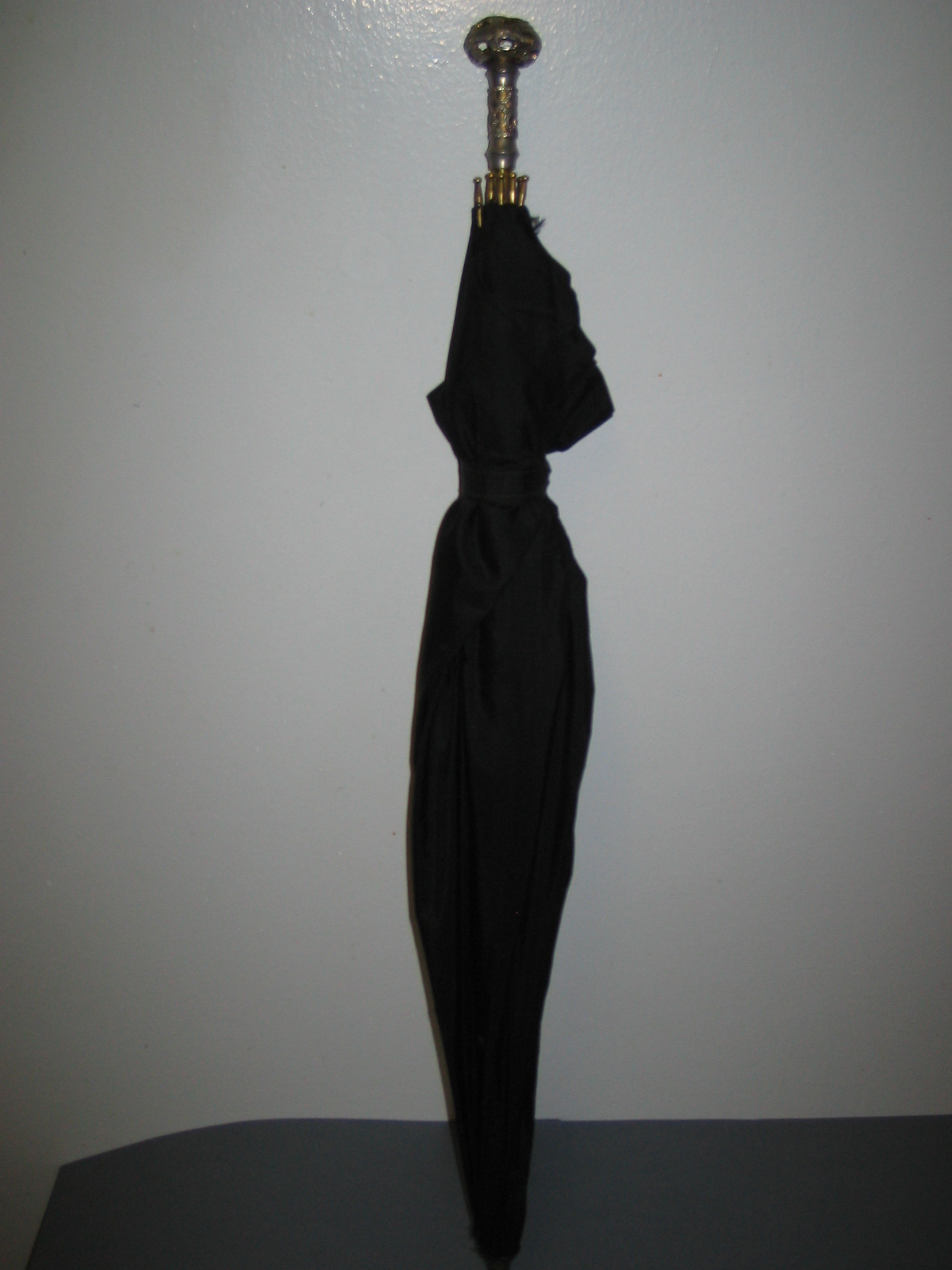
Sunday, October 26, 1913: Went to Sunday School this morning. Took my umbrella it didn’t rain. Other Sundays when it rains my umbrella is likely to be at home. No one came this afternoon and I didn’t go any place, but managed to put the time in somehow.
Her middle-aged granddaughter’s comments 100 years later:
The same thing always happens to me. When I take an umbrella, and am prepared, it doesn’t rain—and when I don’t, it inevitably does.
There seems to be strong correlation between taking an umbrella and no rain (and vice versa), but I suppose that I just remember the times I’m over-prepared (or under-prepared).
18-year-old Helena Muffly wrote exactly 100 years ago today:
Saturday, October 25, 1913: Ma and Jim went to Milton this morning. They both got new beds. Ruth also has her fine apparel. I am beginning to wonder when poor insignificant me can sport something new.
Source: Ladies Home Journal (October, 1913)
Her middle-aged granddaughter’s comments 100 years later:
It must have been a good year for the Muffly’s. It sounds like they felt like they were “in the money,” if both Grandma’s mother and little brother Jim got new beds, AND her older sister Ruth has nice clothes.
The family just finished harvesting the corn. It must have been a good year. The success or failure of crops means the difference between a good year and a devastating year for farmers.
Poor Grandma–Why didn’t she use any of the money she earned from husking corn to also buy something new?
An aside—I think this is the first time Grandma called her little brother Jim. In the past she’s always referred to him as Jimmie. He was eight-years-old, and must not longer seem really little.
18-year-old Helena Muffly wrote exactly 100 years ago today:
Thursday, October 23, 1913:
10/20 – 10/24: It’s been so rainy and dreary this week that I begin to feel awful grouchy. I certainly am under the weather these days. Any way October never was a favorite month of mine. I don’t have much to write about for her.
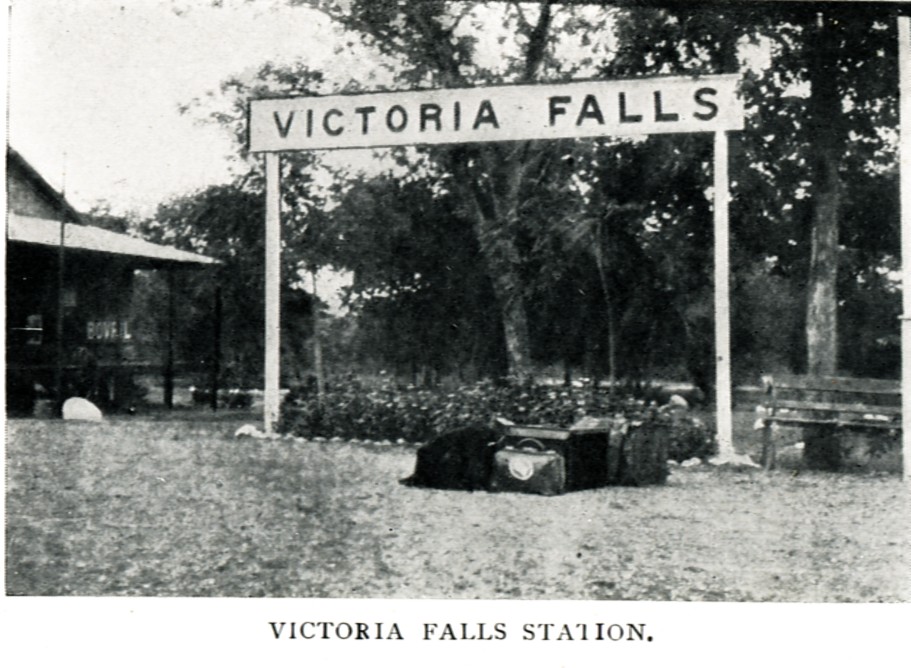
Victoria Falls (Source: A Woman’s Winter in Africa, 1913)
Her middle-aged granddaughter’s comments 100 years later:
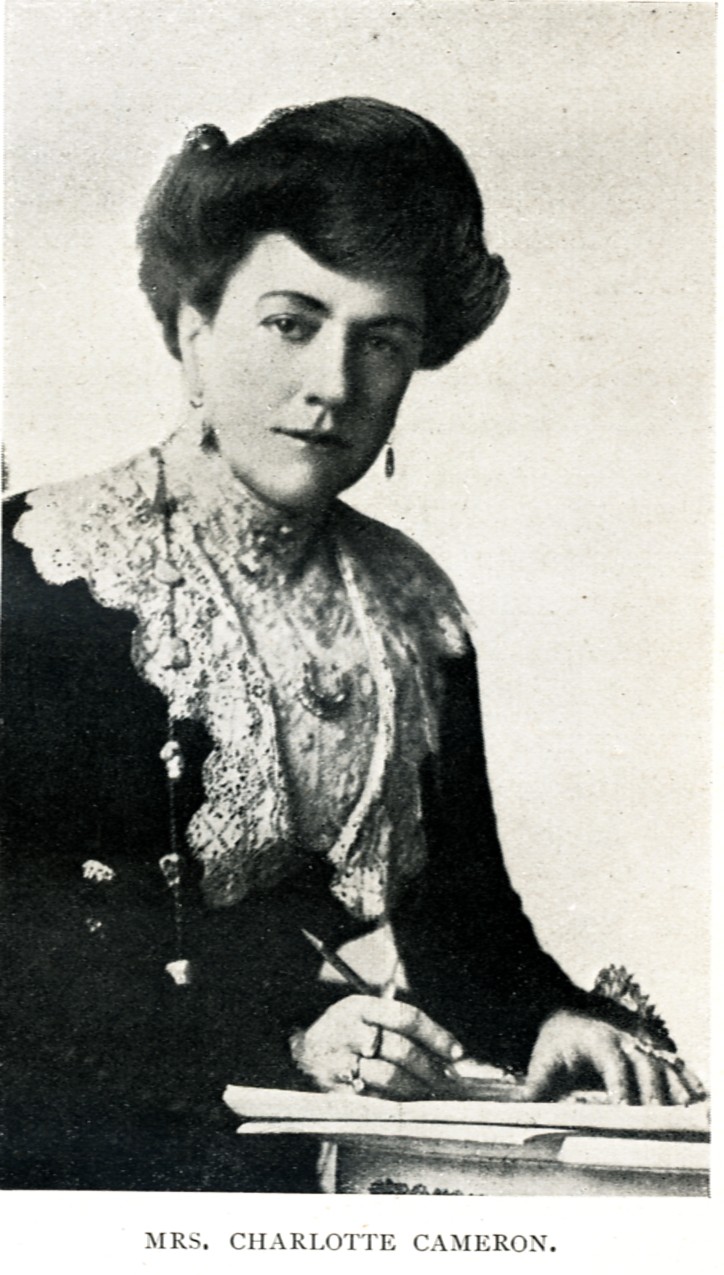
Yesterday, I shared some excerpts from a 1913 book called A Woman’s Winter in Africa: A 26,000 Mile Journey by Charlotte Cameron Since Grandma didn’t write a separate diary entry for this date I’m going to share some more from the book. I’m still amazed at how adventuresome some women were a hundred years ago.
Here’s some quotes from the chapters about Mrs. Cameron’s visit to Victoria Falls. The falls are located on the Zambezi River at the border between what is now Zambia and Zimbabwe.
In a short time the train stops in a sort of wood. A small tin station stands close by—and a big white wooden signboard spells: “Victoria Falls.”
Five minutes’ walk under trees, and through pretty gardens which, have large whitewashed stones round the flower-beds brought me to the Victoria Falls Hotel. After registering I passed through the hall to the verandah.
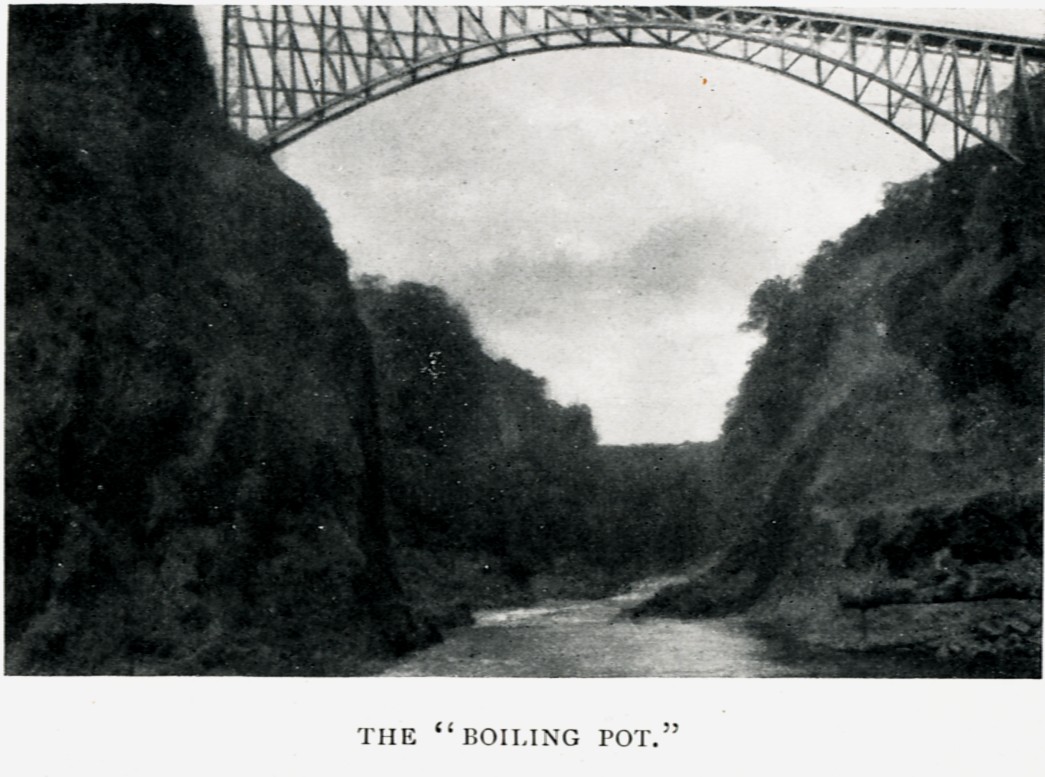
A beautiful view greats you as you look down two great gorges covered with fresh trees and kept ever verdant by the ceaseless spring. Victoria Bridge, 600 , foot high, with a cantilever span of 500 feet, is the loftiest bridge in the world, and in the blue distance resembles filigree work I take a hasty breakfast feeling I must lose no time before seeing the Falls. I set off, camera, sunshade, and notebook in hand.
The managing clerk accompanies me to the end of the verandah. “Don’t you think I should have a guide?” I inquire. “Oh, no it’s not necessary,” he responds. “The paths are well laid out, as you will see by the signboards.”
In all the hotel advertisements one reads that the Falls are only a few minutes away. This is quite deceptive. After half an hour’s walk over a rather rough road you come to Victoria Bridge. All along the approach the roar of the Falls increased its thunder; but even so you are totally unprepared for the scene that opens before you?
Everywhere are wonderful trees, crystallized into eternal freshness by the mist They crown and decorate well-worn pinnacles of rocks. They you stand on Victoria Bridge. To the left and far below is the dark brown water, churning in what is called the Boiling Pot. The water rushes in, swirls, runs about in impotent anger, having been hurled over a precipice, down 400 feet, and into this maze from which there is no outlet. At last, however, it rushes under the bridge, flows with loud protest, hissing over rocks, and wends its way through deep and narrow channels to its natural bed.
According to Wikipedia the bridge was constructed in 1904-05. I’m continually amazed at how many technological wonders are more than one hundred years old.
18-year-old Helena Muffly wrote exactly 100 years ago today:
Wednesday, October 22, 1913:
10/20 – 10/24: It’s been so rainy and dreary this week that I begin to feel awful grouchy. I certainly am under the weather these days. Any way October never was a favorite month of mine. I don’t have much to write about for her.
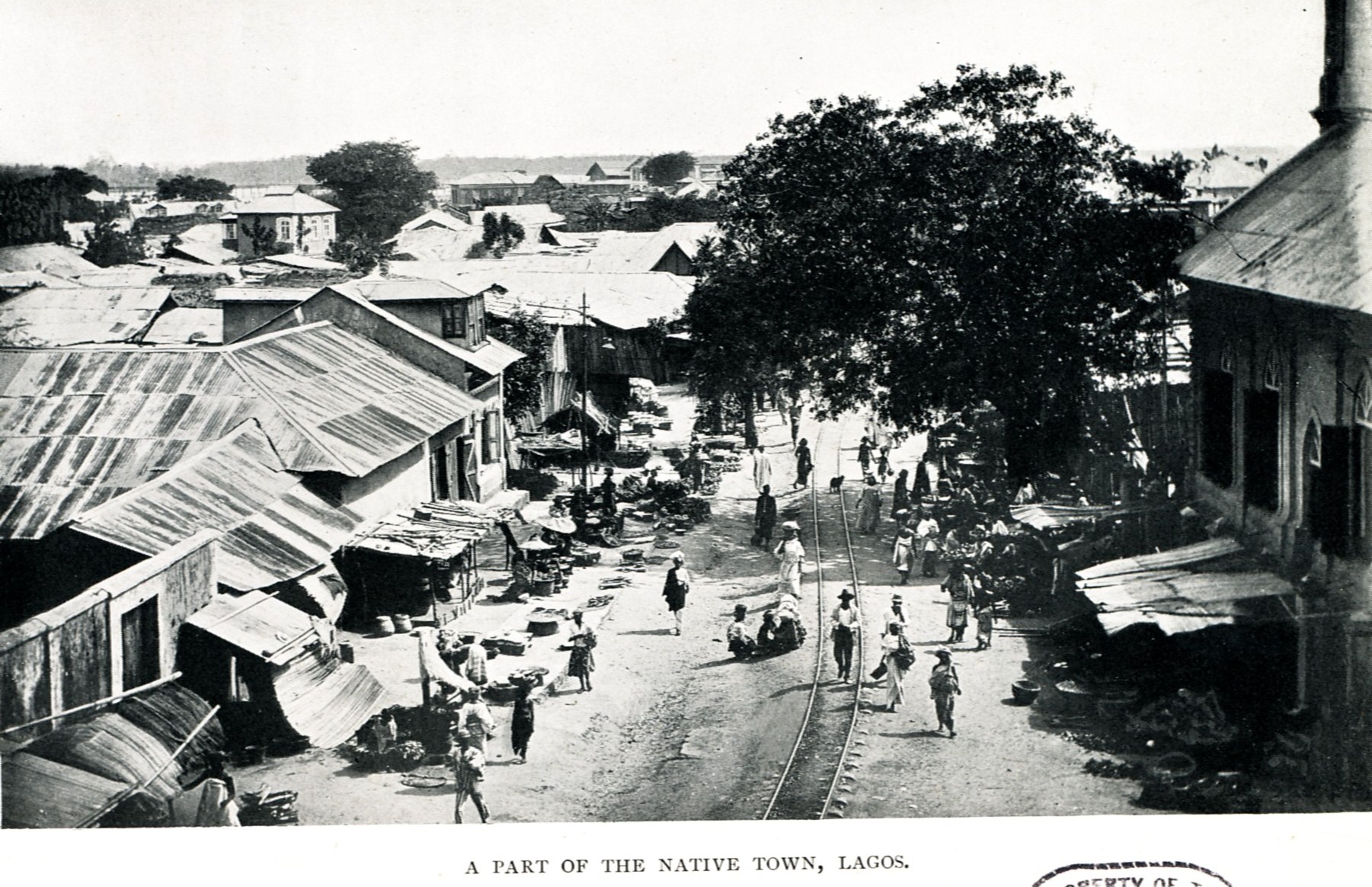
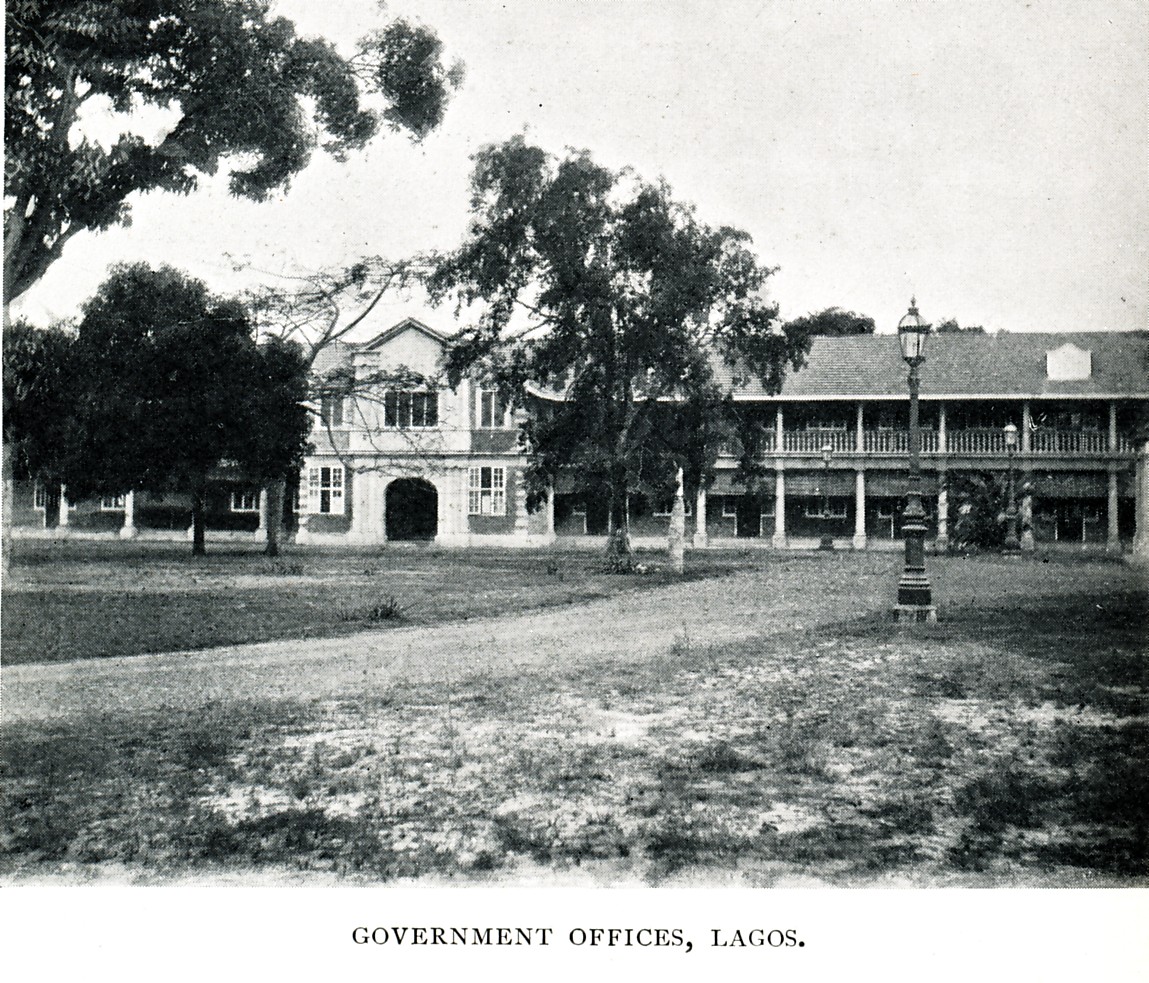
Lagos, Nigeria (Source: A Woman’s Winter in Africa, 1913)
Her middle-aged granddaughter’s comments 100 years later:
This is the third of five days that Grandma combined into one diary entry. Sometimes her world seems so small. In the nearly three years that I’ve been posting the diary, she seldom traveled more than five miles from her home—and the longest trip she took was a train trip which took her about 15 miles so that she could visit relatives who lived in the next county.
The world was a much bigger place a hundred years ago for a few fortunate women. For example, Charlotte Cameron was a wealthy, English woman who traveled to interesting places and wrote books about her adventures In 1913 she published A Woman’s Winter in Africa: A 26,000 Mile Journey.
Mrs. Cameron went around the entire circumference of Africa. She visited many port cities—and from time to time took train trips inland.
In 1913, the colonial era was at its peak in Africa; and Mrs. Cameron visited Europeans who worked at many of the colonial outposts. She also sought to understand African culture—and sometimes framed things differently than we would today.
I was surprised how modern some of the areas were. Here’s a few excerpts from the chapter on her visit to Lagos, Nigeria:
Lagos is extremely modern, and am enjoying all the advantages of an up-to-date town. In 1898 electric light was introduced.
The European population consists of some 572 males and 36 females, while the natives number from 70,000 to 80,000. As the town is situated only five degrees north of the Equator, the heat may be imagined. Climatically it is very moist, with much fever, and English ladies as a rule do not remain more than six months or a year.
The town of Lagos covers over two square miles, and there are innumerable streets, especially in the crowed native town. Never shall I forget visiting the bazaars. Medleys of colour greet the eye on every side. Old and young, rich and poor, are struggling for existence—a colony of tribes, speaking a multitude of languages and dialects.
Through the labyrinthine windings I strolled. Most of the buildings are in corrugated iron, but some of bamboo, with palm-thatched roofs, while reed curtains and matting exclude the inquisitive sun and prevent it damaging the wards. Yams find constant purchases, and calabashes are popular. Bananas, oranges, mangos, avocado pears, coconuts, sweet potatoes, cassavas, and plantains disappear like magic.
We feel like we have viewed this kaleidoscope sufficiently for one morning, and take our places in the motor-car which has had a long wait. On arrival at Government House, luncheon is served. In the cool and shady dining-room with the punkah’s soft and silent breeze and our English comforts, we feel the contrast with the mobs we have just left behind.
18-year-old Helena Muffly wrote exactly 100 years ago today:
Tuesday, October 21, 1913: It’s been so rainy and dreary this week that I begin to feel awful grouchy. I certainly am under the weather these days. Any way October never was a favorite month of mine. I don’t have much to write about for her.
Source: Ladies Home Journal (October, 1013)
Her middle-aged granddaughter’s comments 100 years later:
Did Grandma read Ladies Home Journal to while away the time on cold, rainy days?
And, now that the corn harvest was finished—and Grandma had been paid for helping husk corn—did she dream of using her money to improve her looks? . . . Maybe she wanted some of the hair switches advertised in the October, 1913 issue of Ladies Home Journal.
18-year-old Helena Muffly wrote exactly 100 years ago today:
Monday, October 20, 1913:
10/20 – 10/24: It’s been so rainy and dreary this week that I begin to feel awful grouchy. I certainly am under the weather these days. Any way October never was a favorite month of mine. I don’t have much to write about for her.
Her middle-aged granddaughter’s comments 100 years later:
Hmm. . . it’s interesting that Grandma thought of October as a “her”
Do months have genders? . . . and if so is October, a feminine month?
I don’t think of months as a him or a her, but if I assigned genders to months, I’d make the pleasant warm months feminine ones, and the cold, wet ones masculine ones.
This brings back vague memories of my high school Spanish class. I think that in Spanish the names of all months were masculine words.
18-year-old Helena Muffly wrote exactly 100 years ago today:
Sunday, October 19, 1913: Went to Sunday School this afternoon. Then it commenced to rain, but got home alright after all.
Her middle-aged granddaughter’s comments 100 years later:
Hmm—I don’t quite get this diary entry.
What was Grandma trying to say?. . . that it quit raining before Sunday School ended? . . . that someone gave her a ride home in a buggy? . . . that she walked home in the rain, but didn’t catch a cold? . . . that someone loaned her an umbrella?
Perhaps, I shouldn’t worry about not quite understanding diary entries like this one. It doesn’t sound like Grandma was recording anything very interesting or important. . . but somehow I find it annoying when I can’t figure out what she was trying to say.