17-year-old Helena Muffly wrote exactly 100 years ago today:
Saturday, May 11, 1912:I had to do all the milking this morning. Made me so mad at Ma. She had to come out and pester me some. Did some sewing this afternoon.
The inside of a dairy barn a hundred years ago. The Muffly’s probably had fewer cows than the farm in the photo. (Photo Source: Kimball’s Dairy Farmer Magazine, February 15, 1912)
Her middle-aged granddaughter’s comments 100 years later:
What could Grandma have possibly been doing incorrectly when she was milking the cows? . . . .Or maybe her mother came out to the barn because she was upset that Grandma had forgotten to do some housework (or had done it poorly).
Summer vacation was getting off to a poor start. Grandma had written the previous day that she was lonely and wanted to go somewhere. She’d also written that her sister Ruth had gone to the nearby town of Turbotville to attend a commencement ceremony. Ruth probably stayed overnight in Turbotville with friends—and left all of the milking for Grandma.
Sometimes you just can’t win. One thing doesn’t go right . . . and then another . . . and then. . .
17-year-old Helena Muffly wrote exactly 100 years ago today:
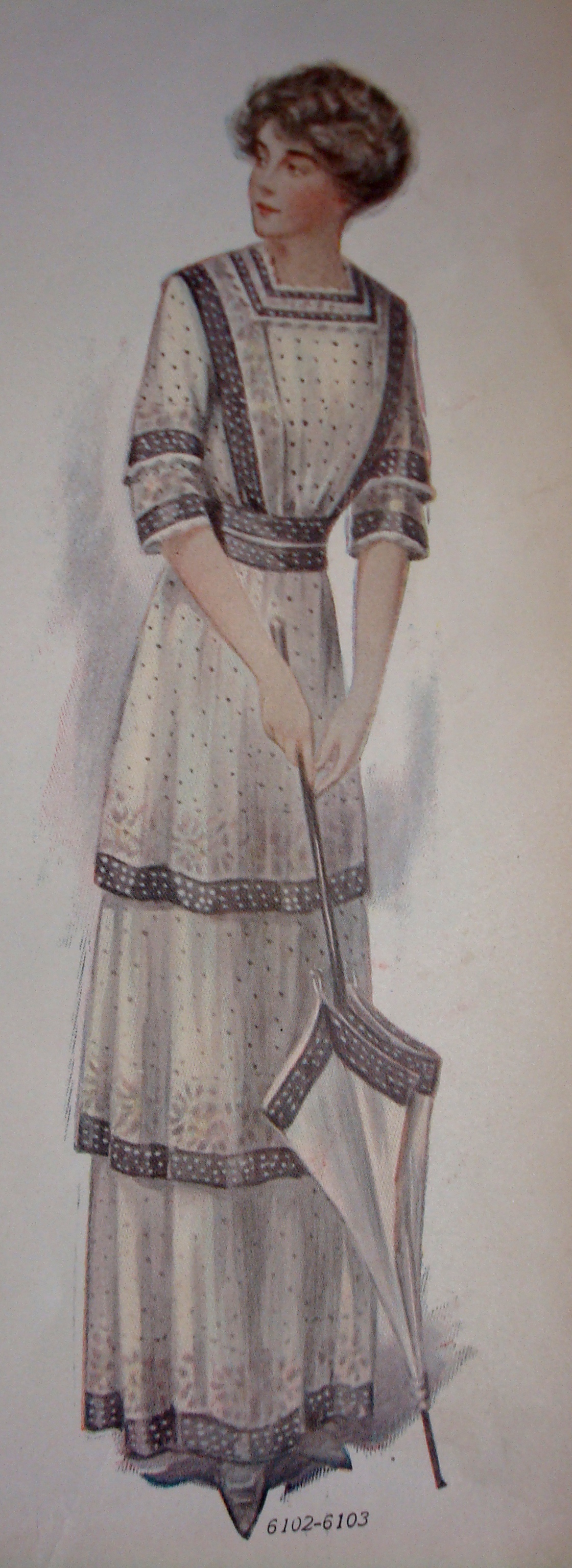
Thursday, May 9, 1912: I brought my dress home today. It is an Indian linen trimmed with wide embroidery, edged on both sides. I think it is very nice. Of course, I intend to get a far grander one next spring.
Photo Source: Ladies Home Journal (June, 1911)
Her middle-aged granddaughter’s comments 100 years later:
This dress must have been really special. Grandma mentioned buying it (or maybe buying cloth and a pattern to make it) in nearby Milton on April 27. On April 30, she went “uptown” to get it made (or maybe altered)—and on May 7 she went back to get it fitted.
Did the linen really come from India? In the days before modern transportation, it seems like it would have been expensive (and unusual) to import cloth from Asia.
(It’s also interesting that Grandma wrote about wanting to make a dress in the previous day’s entry. She was going to have lots of new clothes very soon. )
17-year-old Helena Muffly wrote exactly 100 years ago today:
Wednesday, May 8, 1912:Did some sewing this afternoon. I have so many things to fix over and a dress I want to get made, but it is slow about getting there.
Her middle-aged granddaughter’s comments 100 years later:
A hundred years ago, Ladies Home Journal featured patterns that could be used to make dresses and other clothes. Did Grandma sometimes browse through the magazine and dream of gorgeous outfits that she might make?
17-year-old Helena Muffly wrote exactly 100 years ago today:
Tuesday, May 7, 1912: Went uptown to have my dress fitted this afternoon. The future teacher of the M.H.S. was elected last evening. He was up in the high school yesterday at noon. He is rather stubby, inclined to be stout and has yellow hair. Such I took in at a glance. I wonder what he will be like. Ahem.
Her middle-aged granddaughter’s comments 100 years later:
Whew, McEwensville High School sure went through the teachers. In February, 1912 a teacher resigned and was replaced by another teacher, Forest Dunkle. In the previous day’s diary entry about the last day of school, Grandma mentioned Mr. Dunkle; but hadn’t indicated that he was quitting.According to The History of the McEwensville Schools by Thomas Kramm:
The high teacher turnover rate, especially at the High School prior to 1916 resulted in a new teacher almost every year. At least one teacher, and perhaps more, would not return to teach the following year because the school board refused to increase the teacher’s salary.
The book also indicated that the new teacher’s name was Bruce Bloom—and that he taught at McEwensville High School for just one year, 1912-1913. Hopefully Grandma will like Mr. Bloom and have a good senior year.
17-year-old Helena Muffly wrote exactly 100 years ago today:
Monday, May 6, 1912: It is hard to realize that today was the last day. We had our annual banquet, and I guess we all enjoyed it. At least I did. Mr. Dunkle, our teacher, acted the part of toastmaster. We drank water flavored with lemon to each other’s health, but that was soon over and we vacated our places at the table.
I recited my oration without omitting a single word, but I believe that it wasn’t said none too well. Swiftly today drew to a close. Nor can I say that as school is done, I am glad. My heart is filled with sadness. What I will do next year, when school closes I do not know. As I graduate I will not be able to look forward to the next year. For awhile I bid adieu to my school days.
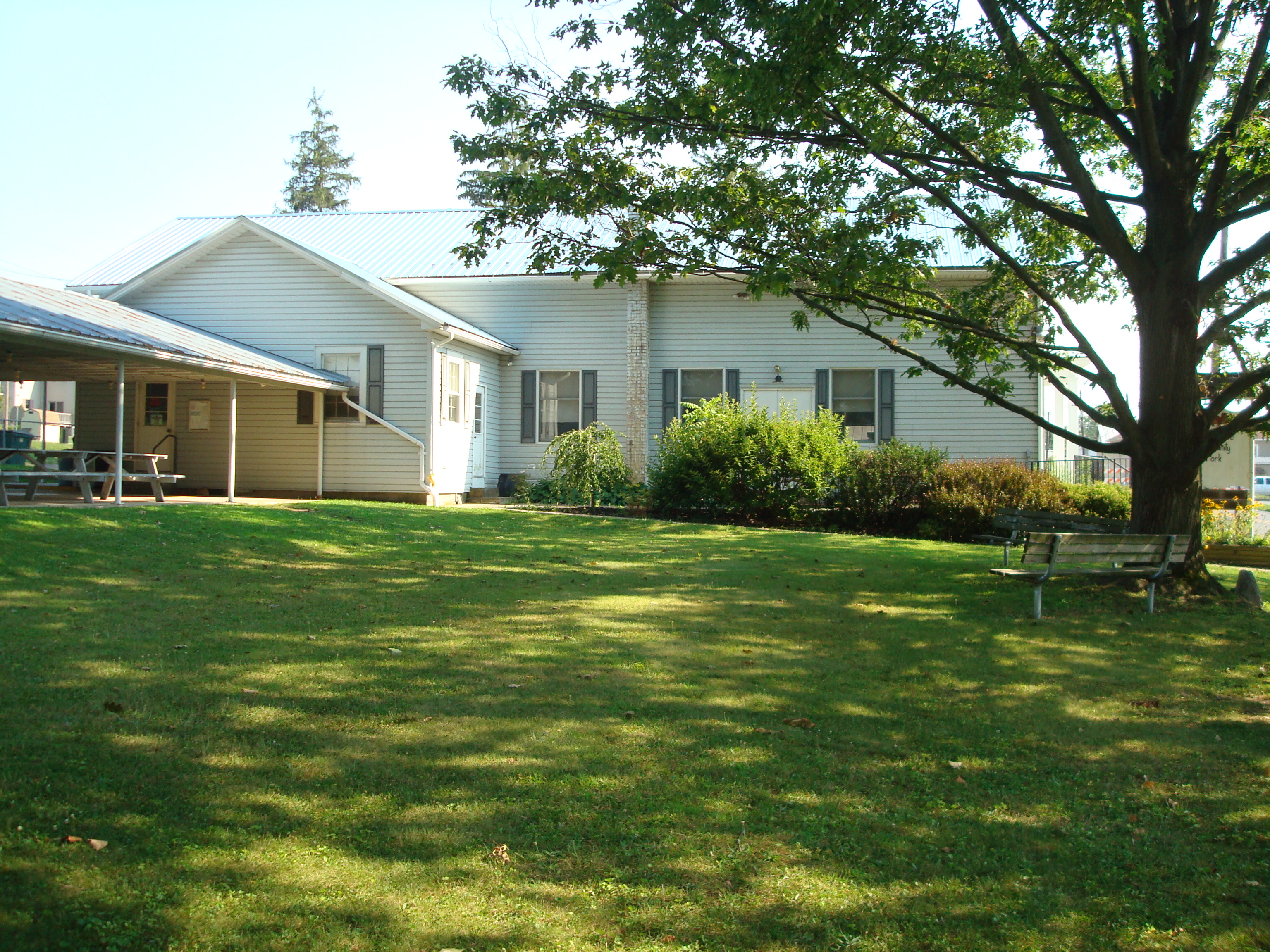
The banquet probably took place at the McEwensville Community Hall and Picnic Shelter. It has been there for more than a hundred years and hasn’t changed much over the years. It has a long history of being used for community events. There is an auditorium with a stage inside.
Her middle-aged granddaughter’s comments 100 years later:
The last day of the school year—with the excitement of the banquet tinged with the realization that school was over for the summer–sounds like it was bittersweet for Grandma. Probably parents and other family members attended the program.
The “trial” that Grandma worried about in yesterday’s diary entry apparently was her oration. She wrote the speech on April 16, 17 and 18; and finalized and memorized it on April 22 and 23. I suppose that she practiced it in class a few times after those entries in preparation for the banquet, but never mentioned it again in the diary until this entry.
I don’t think that it’s very clear from the diary entry, but Grandma had one more year of school to complete before she graduated. She attended an old-fashioned three-year high school, and in 1912 she completed the second year. She was just worrying about her future after graduation, which won’t occur for another year. She always seemed to need to worry about something . . . sigh. . . but I guess that’s just human nature.
17-year-old Helena Muffly wrote exactly 100 years ago today:
Sunday, May 5, 1912: Went to Sunday School this afternoon. Two classes had completed a course they had taken up. They held the commencement before church. It was real interesting. I expect my trial to come off tomorrow.
Her middle-aged granddaughter’s comments 100 years later:
A hundred years ago there was interest in “modernizing” the way instruction was provided in Sunday Schools—though it was controversial.
According to a 1911 book called Practical Pedagogy in the Sunday School:
The function of the Sunday-school is to impart instruction for the purpose of leading to definite results. Since, then, the prime object of the Sunday-school is to impart instruction, pedagogy should have a very important place in the thought of the leaders therein, for, to put it concisely, it is the science and art of teaching.
While this is true, some fears that have been expressed by consecrated Sunday-school teachers must be labeled as groundless. “The introduction of pedagogy into our Sunday-school work will interfere with the position that the Bible now holds.” This is the thought of many. It is, however, entirely erroneous, for the true teaching of the Bible must be in harmony with the principles of pedagogy.
Further, than this, the Bible itself abounds with illustrations of pedagogical principles. It is acknowledged by all thoughtful persons that Jesus of Nazareth was the greatest teacher that ever lived. He was the master of pedagogy, and that He put into operation many of the pedagogical principles which have, in recent years, been advocated by advanced teachers.
Abridged from Practical Pedagogy in the Sunday School
17-year-old Helena Muffly wrote exactly 100 years ago today:
Saturday, May 4, 1912: They put me at cleaning the pantry. I’m not fond of house cleaning, and therefore did not like my work. Sewed some this afternoon. I intend to do a lot more often after school is out.
Source: National Food Magazine (May, 1912)
In
House Cleaning Time
When
Old
Dutch
Comes in
Dirt Goes
Out—
Try it on
Something
Hard to
Clean.
Many uses and full
directions on
large sifter can 10¢
Her middle-aged granddaughter’s comments 100 years later:
The pantry probably needed to be cleaned in anticipation of the upcoming canning season. The shelves likely were dusty and filled with disorganized mixture of empty canning jars, pots, and pans.