17-year-old Helena Muffly wrote exactly 100 years ago today:
Wednesday, September 25, 1912: Was rather surprised at the mark I made yesterday. Didn’t think I would hardly get that. Twas the kind that dummies get.
What did Grandma consider a bad grade? . . . D? . . . F?
Her middle-aged granddaughter’s comments 100 years later:
Whew, I’m surprised that Grandma did poorly on this geometry test. She never worried about the upcoming test during the days preceding the test, and the previous day she’d merely written, “I had a test in geometry.” and then moved on to other topics.
Usually Grandma had a pretty good sense of how she was doing in classes, and if she needed to study—though sometimes she never actually got around to studying.
17-year-old Helena Muffly wrote exactly 100 years ago today:
Monday, September 23, 1912: Walked the muddy way to school this morning. Don’t have much to write these days.
Recent photo of the road that went between McEwensville and Watsontown in Grandma’s day. . . Once dirt, then brick, and now paved. . .
Her middle-aged granddaughter’s comments 100 years later:
With all the mud, it’s a good thing that Grandma got new rubber overshoes the previous Saturday. September, 1912 must have been a rainy month. On September 18 Grandma also wrote about the muddy walk to school.
1912 was the last year that Grandma had to walk the entire way on dirt roads. She lived between McEwensville and Watsontown, and a brick road was apparently under construction that would replace the old dirt road.
According to George Wesner in History in McEwensville (1976):
The brick road leading from McEwensville to Watsontown was one of the first of its kind to be built in Pennsylvania. Construction was begun at McEwsville in 1912 and completed the following year. . .
It was built by the construction firm Fiss and Christiana of Shamokin, Pennsylvania. In grading, the ground was moved by horse-drawn dump wagons which were loaded by manual labor. While some local people were employed most of the laborers were Italian immigrants. Very few could speak English. They were quartered in a labor camp which was located in a ravine on the farm of Isiah Elliot, now owned by Samuel Raup. All the materials, sand, gravel, brick and cement were hauled by teams and horses. The only mechanical equipment used was a steam roller. . .
On an occasion when a period of bad weather had caused the operation to run behind schedule, the contractors, in an effort to catch up, requested that they work on Sunday. . . .
I wonder if the wet days that Grandma wrote about during September 1912 were when the road-building crews got behind schedule.
Grandma would have walked this road to school every day while it was being transformed from a muddy dirt road to fancy brick one. It sounds like a major activity to me, yet she never thought it worth mentioning in the diary. Sigh. . .
17-year-old Helena Muffly wrote exactly 100 years ago today:
Sunday, September 22, 1912: Went to S.S. this afternoon and attended Catechize.
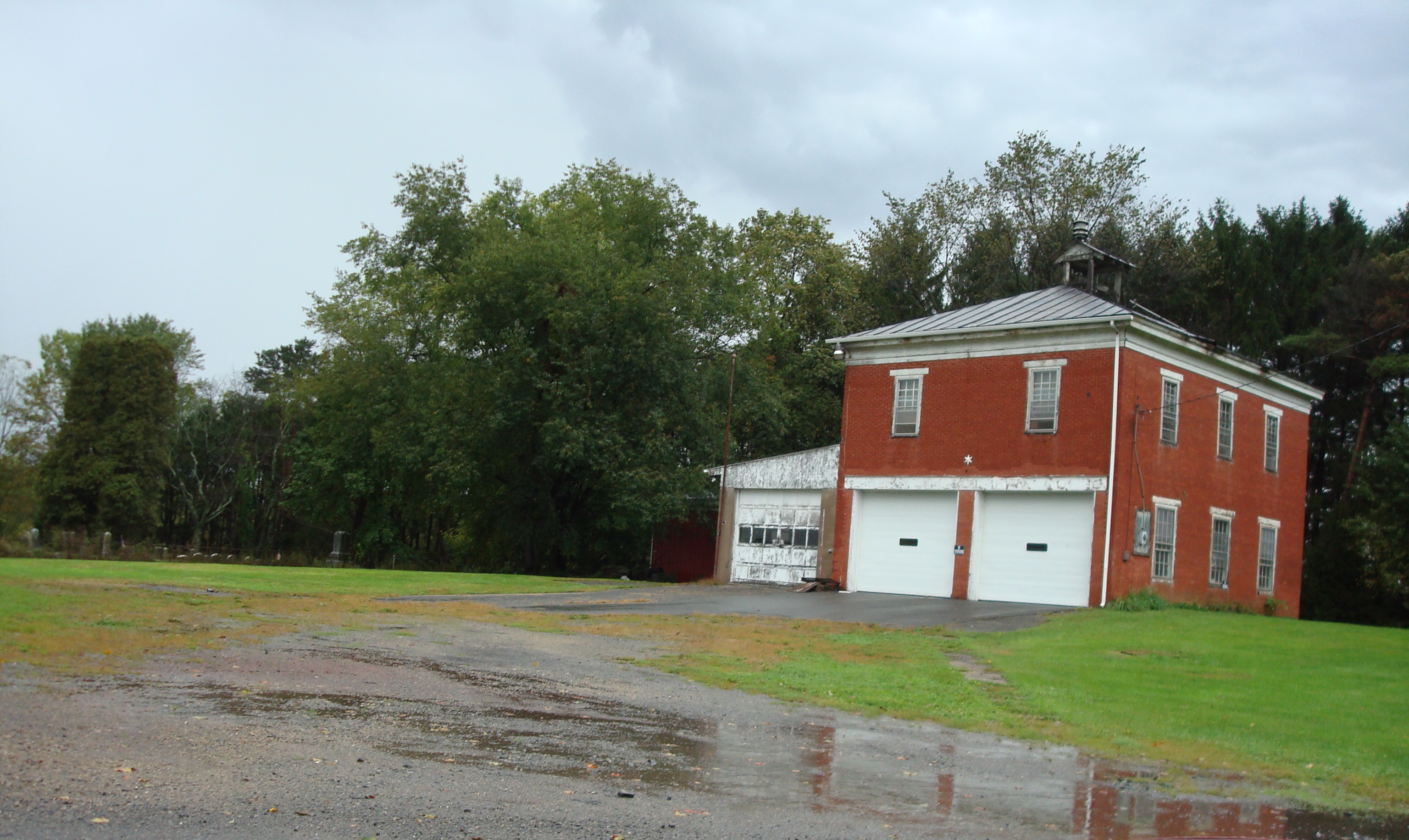
Recent photo of the site where the McEwensville Baptist Church once stood.
Her middle-aged granddaughter’s comments 100 years later:
When I read this diary entry, I got stuck on a simple vocabulary question. I remember going to “catechism” class when I was in middle school. How does “catechize” differ from “catechism”? Is it a different part of speech?
The Free Online Dictionary defines catechize as “to teach the principles of Christian dogma, discipline, and ethics by means of questions and answers.”
While catechism is “a book giving a brief summary of the basic principles of Christianity in question-and-answer form.”
Grandma was 17-years-old when she wrote this entry. I’m surprised that she hadn’t completed catechize and joined the church when she was in her early teens.
17-year-old Helena Muffly wrote exactly 100 years ago today:
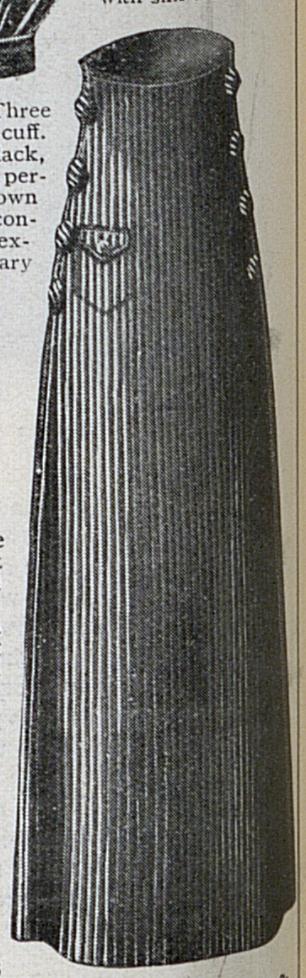
Saturday, September 21, 1912: Ma made over a skirt for me. Got a pair of rubbers today.
From Bedell Company advertisement in November, 1912 issue of Ladies Home Journal.
Her middle-aged granddaughter’s comments 100 years later:
I guess that Grandma’s mother was trying to save about $1.98 by making over the skirt. I can’t remember the last time I remodeled a skirt . . . or dress. (Actually, I don’t think that I’ve ever remodeled one.) Yet, Grandma and her mother did it regularly.
I fixed over a dress for myself this afternoon. It was one of my Aunt Annie’s cast-offs. I had one trying time a getting the waist and skirt together. I have it fixed now and tried it on to see the result. I’m not so much pleased with my sewing. It seems rather short in the back.
Grandma sounded like she wasn’t very satisfied with either of her remodeling efforts, but she didn’t express any similar qualms about the skirt her mother remodeled. Apparently her mother was more proficient at sewing than she was.
—-
On September 18, Grandma mentioned walking to school through the rain and mud—hopefully her new rubber overshoes made the trek slightly less arduous the next time it rained.
17-year-old Helena Muffly wrote exactly 100 years ago today:
Thursday, September 19, 1912: We had a test in General History today. Wasn’t hard at all.
Her middle-aged granddaughter’s comments 100 years later:
I’m glad that the General History test wasn’t difficult for Grandma.
A hundred-year-old book called the Outlines of General History by V. A. Renouf contained information about how to develop good questions:
Different Kinds of Questions
The questions which are most frequently asked in exercises and examinations can be classed somewhat as follows:
Questions of Fact
Personality: Who did a certain thing?
Place: Where did a certain event happen? What places were affected by a certain cause or event?
Time: When did a certain event happen? How long did a certain period last?
Example Questions
Who built Memphis?
Name all of the countries conquered by Alexander the Great.
What year did Nineveh fall?
Questions of Comparison
Comparison with recent or contemporary events or conditions in one’s own country.
Comparison with events or periods in the history previously learned.
Comparison of historical personalities.
Example Questions
Does a man’s education stop when he has left school? What opportunities did the Athenians have for continuing their education through manhood?
Compare the condition of debtors in early Rome with that of early Athens?
Compare the government of Shih Hwang-ti with that of Darius?
Questions of Cause or Effect
Geographical causes
Causes lying in certain institutions
Effects of certain events
Example Questions
In what way did the natural formation of Greece encourage commerce?
What were the causes of the Peloponnesian war?
Why is the battle of Marathon counted among the decisive battles of the world?
Which types of questions did Grandma’s teacher include in the exam?
It’s been awhile–Where have the years gone?– since I’ve taken a history exam, but I think that many of the types of questions asked on a history test today would still fit into this categorization schema.
But, I bet that there are fewer questions today that ask about dates. It seems like students were asked to memorize more things back then than they are now.
17-year-old Helena Muffly wrote exactly 100 years ago today:
Wednesday, September 17, 1912: Had to walk to school through the rain. Also through the mud. Our class is deciding upon a class pin, but we’re making such slow progress in making up our minds as to which pin to take, that I doubt we’ll ever get them at all.
Recent photo of the building that once housed McEwensville High School.
Her middle-aged granddaughter’s comments 100 years later:
Yuck—a mile and a half walk to school in the rain on muddy dirt roads. It sure doesn’t sound like fun. Did Grandma wear galoshes to school?
Did Grandma and her classmates have a catalog that they were going to order the class pin out of? . . . or were they planning to order it from a sales representative or at a nearby jewelry shop?
Grandma’s class was small. Only six students graduated in Spring 1913 from McEwensville High School. It’s amazing how much effort they put into creating a class identity. A few days previous to this diary entry, Grandma wrote about the differences in opinion about class colors and now they can’t seem to agree on a class pin.
17-year-old Helena Muffly wrote exactly 100 years ago today:
Monday, September 16, 1912: I don’t feel very good these last few days. I don’t know but I really think that it is likening to be near a grape vine. Alas all mortals have to suffer for their errors.
Concord Grapes (Source: Wikipedia)
Her middle-aged granddaughter’s comments 100 years later:
If I could have a conversation with Grandma, this is what I’d say:
Grandma, what were you thinking!
Of course, you couldn’t have known we’d be reading it a hundred years later; but what kind of role model is that for your children, grandchildren, and great-grandchildren?
. . . Actually, given your later strong stance against alcohol, my sense is that some are smiling.