16-year-old Helena Muffly wrote exactly 100 years ago today:
Sunday, March 17, 1912: Today is St. Patrick’s Day. I had some green on this morning. It was so nice out today. Just like spring. I was going away this afternoon, but didn’t go after all.
Her middle-aged granddaughter’s comments 100 years later:
Sometimes I’m surprised how similar some things are across the years.
The weather was beautiful a hundred years ago–just like it is today.
Grandma wore green a hundred years ago– just like I’m wearing green today.
16-year-old Helena Muffly wrote exactly 100 years ago today:
Saturday, March 16, 1912: Ruth went to Milton this morning. I made an apron today. Started to read a book this evening. The sequel of which I read about three years ago.
Source: Wikipedia
Her middle-aged granddaughter’s comments 100 years later:
Hmm. . . what was Grandma reading? She probably was reading adult books—but since she said that she’d read the other book in the series three years previously maybe they were children’s stories.
I don’t know which adult series were popular a hundred years ago—but I can think of several children’s series.
The Bobbsey Twin series of adventure stories by Laura Lee Hope were published between 1904 and 1979. Laura Lee Hope is a pseudonym used by several different authors over the years.
The Elsie Dinsmore series by Martha Finley were published between 1967 and 1905. Elsie’s mother was dead, and Elsie faced many moral conflicts (and seemed to constantly feel guilty for one minor offense or another) as she grew up in her grandparent’s home.
An aside–Grandma WAS NOT reading the Nancy Drew series (first book published in 1930) , the Hardy Boys (first book published in 1927), or the Betsy and Tacy series (first book published in 1940).
16-year-old Helena Muffly wrote exactly 100 years ago today:
Friday, March 15, 1912: It was out of the ordinary walking to school this morning. It rained so last night that my morning, water was plainly visible everywhere. It was about the same height tonight. I thought this morning I might not get to school after all.
Recent photo of Warrior Run Creek.
Her middle-aged granddaughter’s comments 100 years later:
Grandma needed to cross Warrior Run Creek to get to school.
It sounds like the creek had flooded and was out of its banks. However, the water apparently had not covered the road and the bridge so Grandma could get to school.
Though not visible, the creek is in the valley in the center of this photo. Probably the field next to the railroad tracks and low lands were flooded a hundred years ago today.
16-year-old Helena Muffly wrote exactly 100 years ago today:
Thursday, March 14, 1912: I wrote out the meaning of that wonderful poem today. I hope I have it as it should be. Am coming to some terrible hard propositions in geometry. The one we have for tomorrow seems so hard for me.
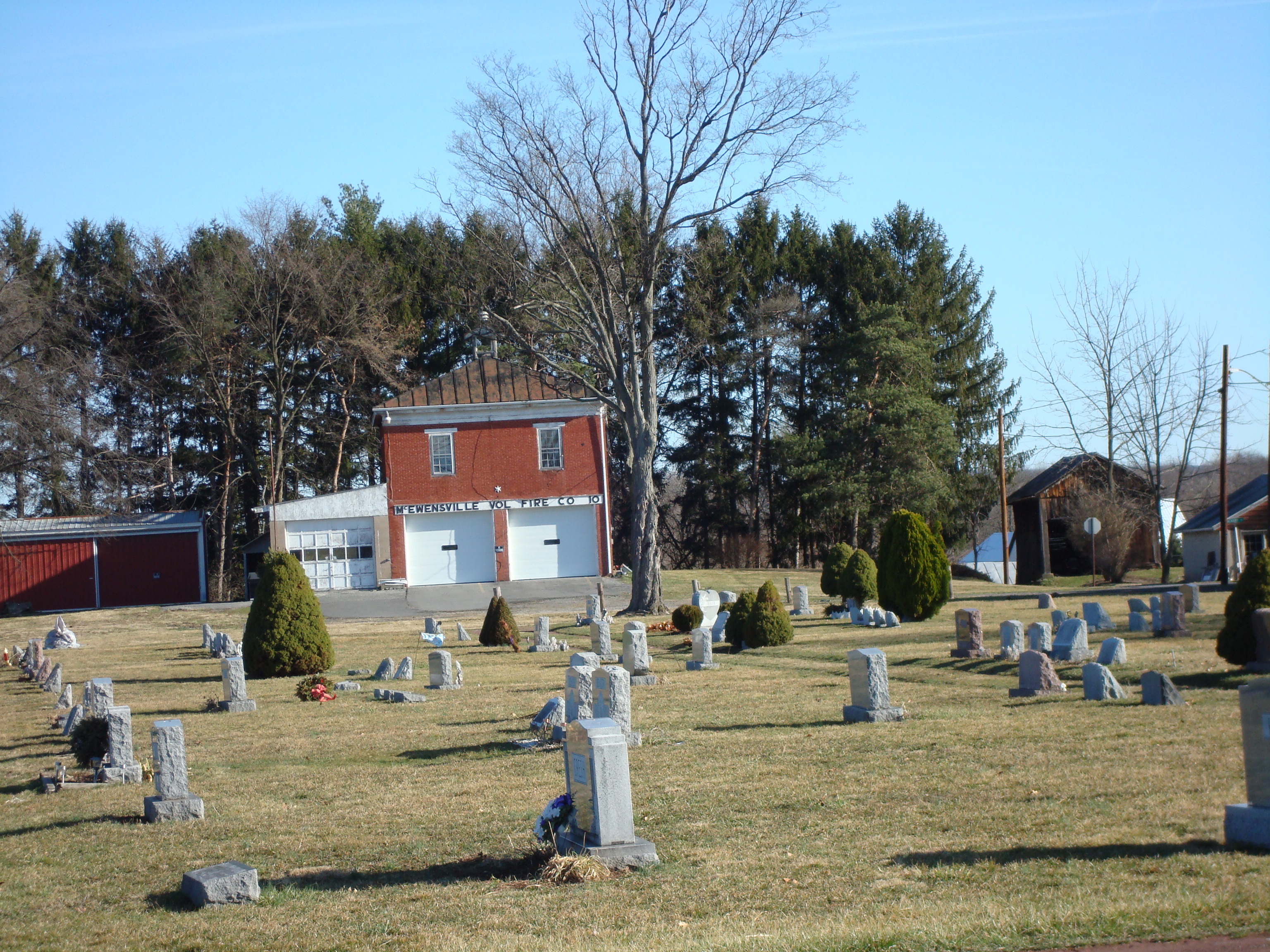
Recent photo of building that once housed McEwensville High School.
Her middle-aged granddaughter’s comments 100 years later:
Did Grandma’s high school courses prepare her for the life she lived?
Grandma attended McEwensville High School—a small classical 3- year high school. She studied geometry (and Latin)—and literature. Grandma did not go to college—and never had a career.
In the early 1900’s there was a lot of discussion about whether a classical high school education met the needs of some students.
About five miles from McEwensville a modern high school was being built in Milton. There was a movement towards larger 4-year general high schools that offered a wider range of courses and different tracks (commercial, home economics, etc.).
Over the next few years, more students from McEwensville attended the more modern high school in Milton (as well as the high school in Watsontown). And, in 1921, McEwensville high school closed because of lack of students.
(The building continued to house an elementary school until 1958.)
16-year-old Helena Muffly wrote exactly 100 years ago today:
Monday, March 11, 1912: I heave a sigh of relief when I think examinations are past for this month. I have my doubts about what I will get in geometry.
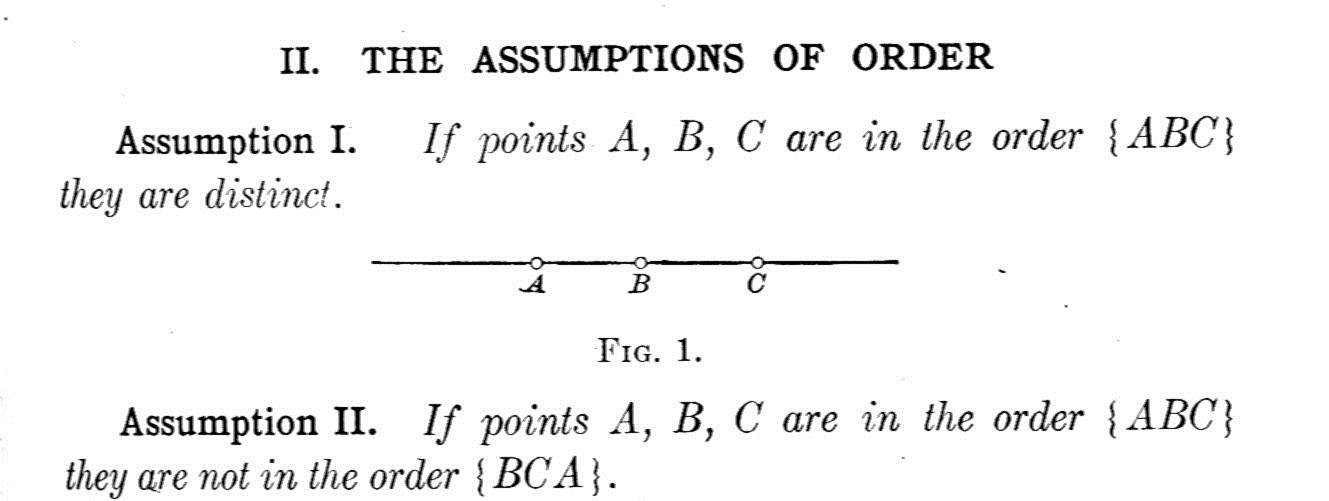
II. THE ASSUMPTIONS OF ORDER
Assumption I. If point A, B, C are in the order {ABD} they are distinct.
Assumption II. If points A, B, C are in the order {ABC} they are not in order {BCA}.
Modern Mathematics (1911), Edited by J.W.A. Young
Her middle-aged granddaughter’s comments 100 years later:
I suppose that Grandma had to do some proofs in geometry. Do students do proofs any more in high school? I get a head-ache just thinking about them.
Here’s the definition of a point in a hundred –year-old mathematics book. It was the first term defined in the book. (I assume that Grandma’s examination was on something more complicated—but I enjoyed reading this definition.)
In geometry a great many technical terms are defined, and each is defined in terms of others. Hence at the beginning of a book on geometry at least one term must be undefined; otherwise the book would have no beginning. We have to leave the undefined term point.
This implies that the reader is free to carry in his mind any image of a point which he can reconcile with what is said about it. We may try to import a notion of our image of a point by saying it has no length, breadth, or thickness, or by like phrases, but these are no part of our book on geometry; they have nothing to do with the logical steps by which the theorems are derived.
16-year-old Helena Muffly wrote exactly 100 years ago today:
Sunday, March 9, 1912: Blanche slept with Ruth and me. I slept on the rail part of the time. Made me kind of stiff. Went to Sunday School this afternoon. B. was there. Hat blew off coming home, but by luck didn’t land in the mud.
Her middle-aged granddaughter’s comments 100 years later:
Grandma had a crush on B. in the diary but doesn’t use the complete name. I think that B. refers to Bill Gauger. Grandma’s sister Ruth married Bill several years after the diary ended.
Blanche Bryson was a friend of Grandma and Ruth. The previous day’s entry indicated that their friend had arrived by train.
I assume that rail refers to the edge of a wooden bed frame. A hundred years ago, people didn’t have nearly the amount of privacy or space that they do today. Grandma and her sister Ruth shared a double bed—and it sounds like when they had an overnight guest they managed to squeeze a third person in.
I wonder how late they stayed awake talking. What did they talk about? Did their parents tire of the noise and tell them to go to sleep?