17-year-old Helena Muffly wrote exactly 100 years ago today:
Friday, April 19, 1912:Dear me, I haven’t anything worth writing. I’m trying to get my sister to moved back to her own room.
Picture of a bedroom in April, 1912 issue of Ladies Home Journal.
Her middle-aged granddaughter’s comments 100 years later:
Grandma and her sister Ruth sometimes shared a bedroom—and other times didn’t.
Based on previous entries, I think that there probably was a double bed in Grandma’s room—and that they shared it during the winter months because there was no heat on the second floor of the house and it was very cold. But now it was spring, and Grandma wanted her sister to move back to her own room.
The previous year Grandma had similar problems getting her sister out of the room. For example, on June 29, 1911 she wrote:
I moved Ruthie’s belongings into another apartment and she herself is going to occupy that room for a time. Don’t know how long it will be though. I’m so tired now, I can hardly stand upright.
17-year-old Helena Muffly wrote exactly 100 years ago today:
Tuesday, April 16, 1912: Am fishing around for a subject to write a theme on. We are to commit these to memory and rattle them off on the last day of school.
Her middle-aged granddaughter’s comments 100 years later:
There are some interesting things directly related to what Grandma wrote that I could write about today– but I feel like I must share a newspaper article from a hundred years ago today.
I’ve seen so much about the 100th anniversary of the Titanic sinking on April 15, 1912 in the national news, so I’d like to tell you how Grandma probably learned about the sinking.
An article in the local paper, the Milton Evening Standard, on April 16, 1912 reported the sinking and included a local connection:
1525 DROWN AS TITANIC SINKS
625 WOMEN AND CHILDREN SAVED
MANY NOTABLES WERE ABOARD
Giant Ship Rams Iceberg on
Her Maiden Trip From Liverpool to New York
Special to the Standard
New York, April 15—Early reports of the loss of life aboard the White Star liner Titanic are not exaggerated.
Only 675 out of 2,200 comprising passengers and crew escaped.
1,525 persons, among them many notables, went down with the ship. How they met death will never be known, but it is believed the upmost order prevailed and the men aboard met their fate calmly as the Titanic sank after a four-hour struggle to keep afloat. . . .
And, now here’s the local angle–
MRS. BALDWIN SAFE; WAS NOT ON BOARD THE TITANIC
Mother Here Gets Message That
Returning Tourist and Daughter
Came on Another Ship
Anxiety over the fate of Mrs. Hasel Baldwin, daughter of Mrs. John McCleery, of 20 N. Front Street, and Mrs. Baldwin’s daughter, Mary Shaw, who it was feared might have been aboard the Titanic, was set at rest this morning by the receipt of a telegram from Mrs. Baldwin who stated that she and her daughter had reached New York safely this morning on board the S.S. President Lincoln. Mrs. McCleery upon learning of the Titanic fatality anxiously scanned the newspapers for the passenger lists, but Mrs. Baldwin’s name was not among them. The uncertainty which was cleared by the receipt of the telegram was added to by the fact that it was known that Mrs. Baldwin had had some difficulty in securing passage at Liverpool, owing to the crowds of tourists coming back for the summer season in America, and it was feared that passage may have been booked at a late hour aboard the Titanic.
Mrs. Baldwin and her daughter will reach here tomorrow. They have been touring France for a year and a half.
To add a bit of context–
According to the Milton History website, Mrs. Baldwin’s Father, John McCleery had been a prominent attorney in Milton and involved with the Milton Car Works which manufactured railroad cars. (It was later called ACF). He also was the founder of the Milton Trust and Safe Deposit Company.
A hundred years ago more prominent people probably lived in Milton than do today. Back then there were several large factories—and the businessmen and managers who ran those firms lived in the town.
I’m amazed how quickly news traveled a hundred years ago. Obviously people in Milton knew about the sinking of the Titanic the day after it happened. And, the article about Mrs. Baldwin suggests that people knew about it prior to this newspaper article. For example, the article says, “Mrs. McCleery upon learning of the Titanic fatality anxiously scanned the newspapers for the passenger lists . . . “ Maybe there were “Extras” of the paper that have not survived over time.
17-year-old Helena Muffly wrote exactly 100 years ago today:
Monday, April 15, 1912: I didn’t study hardly any at all this evening. I did have a very bad streak of laziness.
Her middle-aged granddaughter’s comments 100 years later:
Since Grandma didn’t have much to say a hundred years ago today, I’m going to go off on a tangent.
Many families were larger in 1912 than they are today. I came across the following Letter to the Editor in the April 1912 issue of Good Housekeeping that is very illuminating regarding the discussion about family size and family planning a hundred years ago:
How Many Children?
Mr. Editor—While I have never suffered from ill-health, particularly, nor was it impossible financially to have children when we were first married, yet I think parents should be in such circumstances they can bring up children without feeling that they are a burden. Plenty there are who try to take care of three or four children, sometimes more, and do their own housekeeping, and I say, it’s an injustice to the children. One or the other suffers, usually the children.
It was several years before we were able to have a child, and three years later, when I had fully regained my strength, I had another. That is all we feel we can properly educate and support. Those who preach that each family should have four children are, to my mind, very wrong. Have a dozen if you can bring them up respectably—and if as poor as church mice, none.
17-year-old Helena Muffly wrote exactly 100 years ago today:
Sunday, April 14, 1912: Went to Sunday School this morning. Miss Carrie came over this afternoon. We went for a walk which was not so very long nor yet so very short. We had quite a time getting home, as we stopped to talk much of the way.
Her middle-aged granddaughter’s comments 100 years later:
Carrie refers to Grandma’s friend Carrie Stout. She lived on a nearby farm. Who knows what the teens talked about—but I can picture earnest discussion interspersed with giggling.
They probably weren’t worried about food prices—but the local paper, The Milton Evening Standard, had an article about inflation in April 1912.
Milton Evening Standard (April 8, 1912)
FOOD PRICES SHOW
STEADY INCREASE
For 1911 They Were Two Per Cent.
Higher Then Previous Years
Wholesale prices of food products increased two per cent during 1911 over the previous year, although wholesale prices generally of 257 articles, declined 1.7 per cent. An investigation of the Bureau of Labor into wholesale prices, results of which were announced Thursday, disclosed these facts. . .
Some things never change. According to the Bureau of Labor Statistics the wholesale (producer) food price increased 2.3% from March 2011 to March 2012.
17-year-old Helena Muffly wrote exactly 100 years ago today:
Saturday, April 13, 1912: I was so busy mending my numerous rips and tears and getting to something like they ought to be.
Her middle-aged granddaughter’s comments 100 years later:
Grandma probably was mending the hole in her waist (shirt) that she got on April 10 when she fell and hurt her shoulder.
Since the diary entry that Grandma wrote a hundred years ago today is self-explanatory, I’m going to share an article in the local paper from a hundred years ago today.
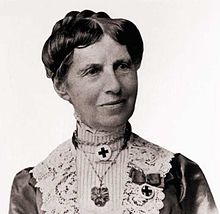
The Civil War ended 147 years ago. The surviving veterans, and other heros and heroines, were very elderly. On April 13, 1912 the Milton Evening Standard reported Clara Barton’s death. She’d died the previous day.
CLARA BARON,
RED CROSS FOUNDER,
DIES AT AGE OF 90
Washington, April 13—Miss Clara Barton, founder of the American Red Cross Society, died at her home in Glen Echo, Md.
The cause of her death was chronic pneumonia, with which she was stricken about a year ago. Her brother, Stephen Barton of Boston, was with her when she died.
Few names in all of the history of American philanthropy are better known than that of Clara Barton. Her life of ninety years, beginning with the happy significance on Christmas Day, in 1821, was given almost entirely to the cause of alleviating human suffering. Even in her old age she experienced no decline of faculties or activity, and almost to the very end declared that it was work which kept her young. . .
It was in the Civil War that Clara Barton first became a national figure. She faced all of the horrors of the campaigns in the south and was a pioneer in lending the healing touch of women’s hand to the wounded and sick of the battlefield. She was also of great service in the work of searching for the missing. In 1865, she laid out the ground of the National Cemetery at Andersonville. . .
17-year-old Helena Muffly wrote exactly 100 years ago today:
Friday, April 12, 1912: It rained this afternoon. I got rather wet coming home from school this evening. I’ve started to digest a dry book about the doings of the Greeks.
Her middle-aged granddaughter’s comments 100 years later:
What book was Grandma reading? This diary entry sent me searching for an old book on the Greeks.
I found a dry –I want to call it mind-numbing–book called Greek and Roman Civilization by Fred Morrow Fling, Ph.D. that was published in 1902.
Amazingly on the inside cover there was a stamp which indicated that it once had been in a public school library (though the library was in the wrong state). But it provides an indication of the types of books that were in high school libraries years ago.
No. 1800 Price _____
Public School Library
Dawson, Minn.
Library Rules— No person shall have more than one book at a time, nor keep that more than two week, and if kept longer a fine of five cents shall be imposed.
If a book is lost or injured, the price of the book or set shall be charged.
Here’s how Chapter 1 begins:
THE HOMERIC AGE
Homer probably never lived, and the Iliad is evidently a national product, not composed by one man at one time, but by many men at different times. As a record of the Trojan War, the poem has practically no value. Its real value to the student of history is due to the fact that it unconsciously reveals to us the manners and customs of the age in which it was composed. While the imagination may construct wholes that are not really, the real elements with which the poet or novelist works are drawn from experience. It is possible, then, for the historian to sift out these elements and make use of them. . .
17-year-old Helena Muffly wrote exactly 100 years ago today:
Wednesday, April 10, 1912:Nothing to write about.
Her middle-aged granddaughter’s comments 100 years later:
Usually I’m disappointed when Grandma doesn’t write much—but this time I’m relieved. It probably means that Grandma’s life was settling back into normal routines. She’s had a rough week with two deaths—a friend died after a long illness and her sister Besse’s son died shortly after his birth.
I feel like I’ve been mourning the death of Besse’s baby all week—so I’ll tell you a little more about Besse.
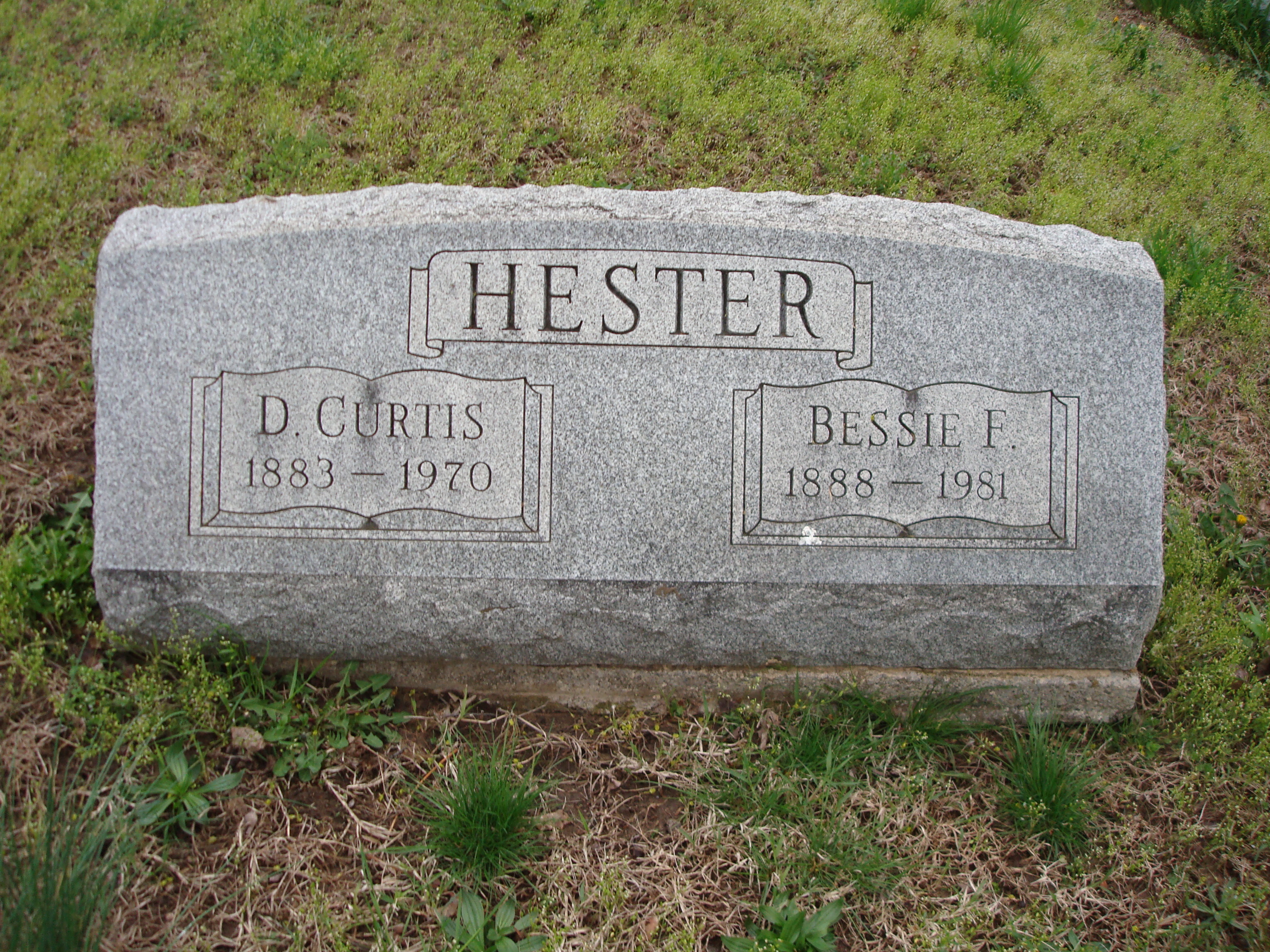
Besse and her husband Curt Hester ran a butcher shop in nearby Watsontown for many years. They had one child who survived beyond infancy. Curt, Jr. was born in 1915.
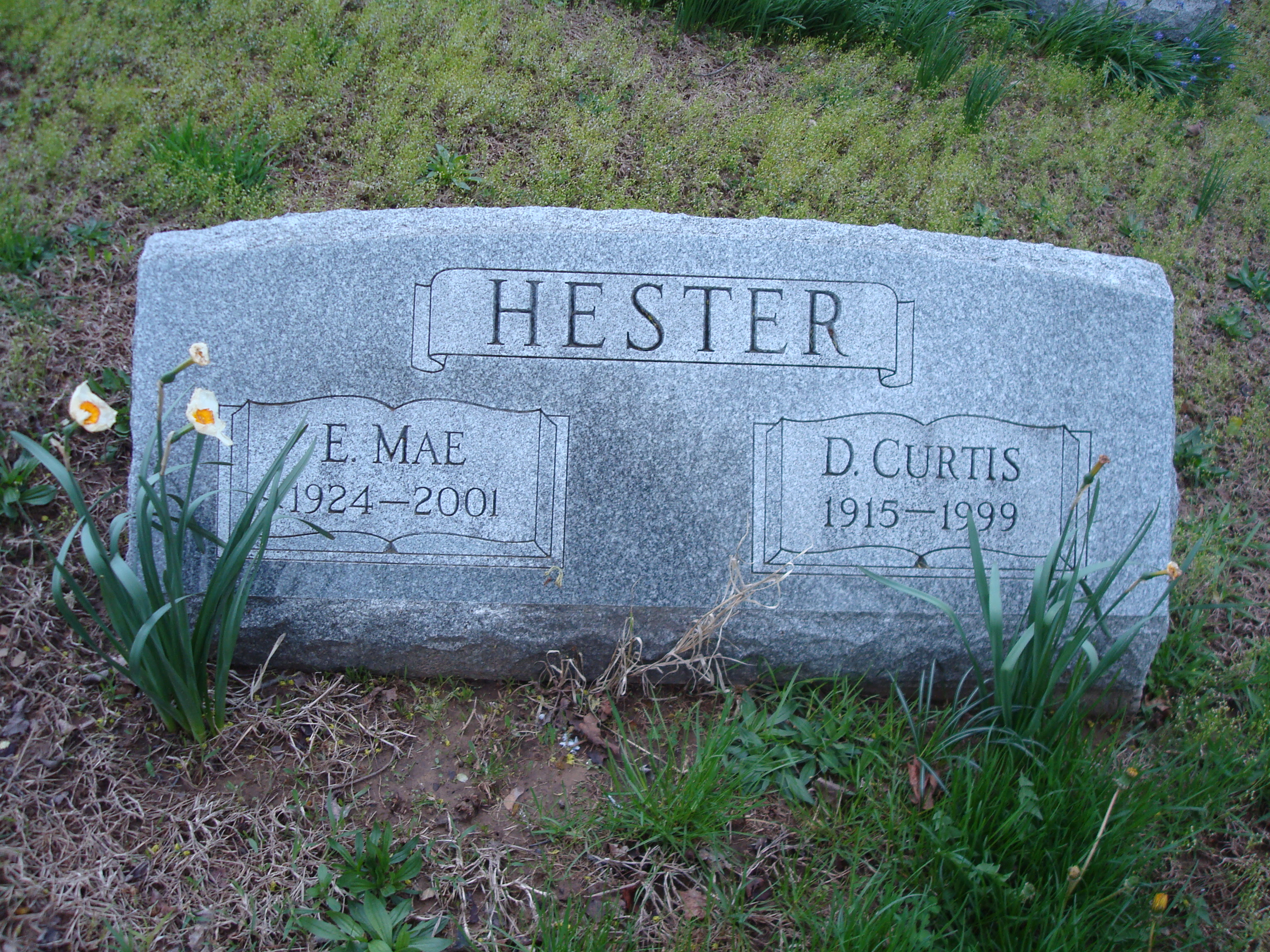
Curt Jr. and his wife Mae never had any children.
Besse, Curt, Mae, and Curt, Jr. are buried next to each other in the Watsontown cemetery.
An aside– When I was young Curt, Jr. and Mae lived on the farm that Grandma lived on when she wrote this diary. I remember that Mae had a beautiful yard which included a small pond with lily pads and large golden fish. (I’ve never known anyone else with a fish pond in their yard and was awed by it.)