How Old Cake Recipes Differ from Modern Ones

17-year-old Helena Muffly wrote exactly 100 years ago today: 

Saturday, September 14, 1912: I made a cake this afternoon with mater’s assistance. She did the baking and put him together. It got real nice.

black walnut cake
Black Walnut Cake

Her middle-aged granddaughter’s comments 100 years later:

If Grandma’s mother put “him” together and baked him, it sounds like she did most of the work. What did Grandma do?  Maybe she found the recipe . . .

It’s interesting that Grandma gave the cake a gender—I would have referred to the cake as “it”.

When I try to replicate one-hundred-year-old cake recipes, I find that I need to make a lot of adaptations—as compared to candy recipes which haven’t changed much.

A hundred years ago cakes were made in wood or coal stoves with ovens that had difficult to regulate temperatures. Baking powder was a “new-fangled” product and had not yet standardized across brands. And, recipes had not yet been standardized for 9” X 13” cake pans.

You might enjoy some of previous posts about cakes:

Chocolate Cake Recipes a Hundred Years Ago

Comparison of Hundred-Year-Old and Modern Recipes for Devil’s Food Cake

Angel Food Cake with Black Raspberries

Black Walnut Cake Recipe

Class Colors

17-year-old Helena Muffly wrote exactly 100 years ago today: 

Friday, September 13, 1912:  Found a pocket knife on the way to school this morning. Wonder who lost it?

We chose our class colors this week. Think it was last Wed. They are maroon and gold. They don’t suit me very well. I preferred to have green and white, but didn’t get them.

Her middle-aged granddaughter’s comments 100 years later:

It’s too bad that Grandma wasn’t able to convince her classmates that green and white would be better class colors. . .though two schools that I attended had maroon and gold (or orange) as their school colors so I have somewhat of a personal affinity for the maroon and gold.

Now that I think about it, I don’t think that we had class colors—just school colors. Does anyplace still have class colors?

Fashion A Hundred Years Ago

17-year-old Helena Muffly wrote exactly 100 years ago today

Wednesday, September 11, 1912:  So say we call it a day again.

Fashion a Hundred Years Ago

Her middle-aged granddaughter’s comments 100 years later:

Since it was another slow day for Grandma, I’d like to tell you about my latest blogging adventure.

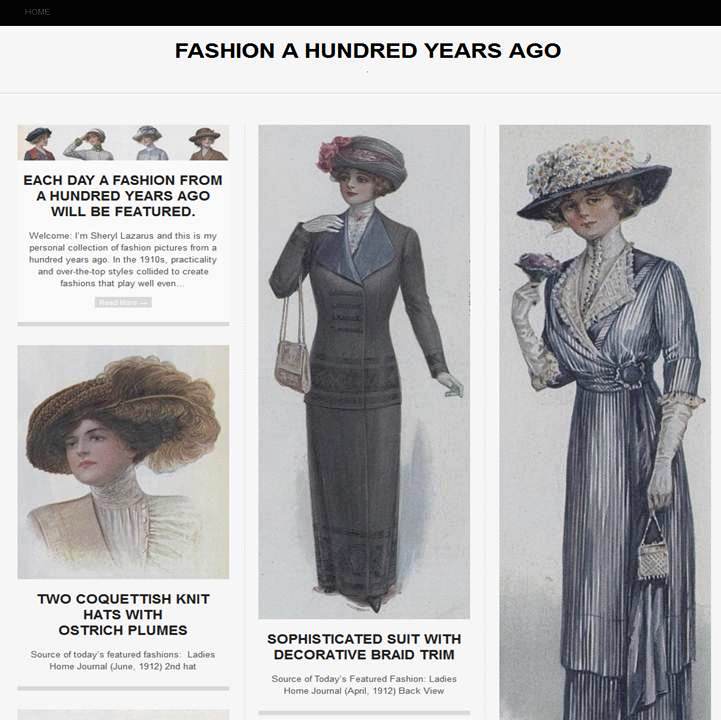
I’ve enjoyed occasionally sharing hundred-year-old fashion pictures with you. I’ve found lots of pictures in old magazines—and can’t possibly use all of them on this site since Grandma only occasionally mentioned clothes or shopping.

I decided that it would be fun to feature a one-hundred-old fashion each day, so I started a new blog called Fashion A Hundred Years Ago.

You might want to check it out if you enjoy looking at the old fashions.

Important to Memorize Latin Vocabulary–Though Difficult to Dig Into Studies

17-year-old Helena Muffly wrote exactly 100 years ago today: 

Tuesday, September 10, 1912:  Such a time as I have been having a digging at my studies.

Roman temple
Picture of Roman Temple in An Elementary Latin Course (1909)

Her middle-aged granddaughter’s comments 100 years later:

Which subjects was Grandma having difficulty digging into?  Latin is the only subject that she’s mentioned since school began in late August.

Maybe she needed to memorize some Latin vocabulary words.

A Latin textbook from the early 20th century gave teachers the following pedagogical advice:

Have the material in each lesson taken up and learned in the order in which it comes. The vocabularies are so short that the pupil can be required to learn them before attempting to translate the sentences.

In assigning the lesson, pronounce the new words to the class before they have seen them, having each word pronounced in turn by some pupil; give the meaning and call for English cognates if there are any. Then have the pupils read the words and commit them to memory. They will have a better command of words learned in this way than when they are learned merely as they are met in the sentences. Drill the class constantly on vocabularies past and present.

An Elementary Latin Course (1909) by Franklin Hazen Potter

(An aside—I don’t think any textbooks today would direct teachers to “drill” the students. I guess that pedagogical methods have changed over the years.)

Cause of Sleepiness

17-year-old Helena Muffly wrote exactly 100 years ago today: 

Monday, September 9, 1912:  July, I mean Sept. 9. Don’t know what to write for today. So good night and sweet dreams.

moonlight
Source: Wikipedia

Her middle-aged granddaughter’s comments 100 years later:

Seems odd that Grandma first wrote July—she must have already been half asleep when she wrote this.

Maybe Grandma’s mind was “benumbed” by all of her schoolwork.

According to a hundred-year-old book called Personal Hygiene and Physical Training for Women:

The sleepy feeling is caused by fatigue due to the circulation in the blood of toxins resulting from tissue waste, which benumb the brain-cells; while the feeling of freshness and bien-etre with which one awakens in the morning is due to the elimination of the fatigue products from the blood.

The medical authorities of today are pretty well agreed that eight hours of sleep is the minimum required for the maintenance of health, and all concede that the brainworker requires more sleep than the manual laborer.

Page from Latin Textbook Used a Hundred Years Ago

17-year-old Helena Muffly wrote exactly 100 years ago today: 

Friday, September 6, 1912:  We had a test in three of our studies today. Didn’t make a very good mark in Caesar, but because I omitted to look up some rules, so you see whence I got to today, I was at a loss what to write.

page from Latin text book
Source: An Elementary Latin Course (1909). Click on page to enlarge.

Her middle-aged granddaughter’s comments 100 years later:

Latin sounds hard. Apparently the class was reading Caesar–probably Caesar’s Gallic War.

The introduction to a Latin text published in 1909 describes how the students first study grammar to prepare to read Caesar.

The lessons have been made fairly comprehensive, in order to afford an adequate preparation for reading Caesar.

The vocabulary of the seventy-eight lessons includes about six hundred words exclusive of proper names. Caesar uses about ninety-four percent of these words of these words and Cicero ninety-six percent.

An Elementary Latin Course by Franklin Hazen Potter

Sweaters a Hundred Years Ago

17-year-old Helena Muffly wrote exactly 100 years ago today: 

Sunday, September 1, 1912:

What can be said of September,

Is very much I think,

But the thinking part is not with me now

Because my efforts so readily sink.

Went to Sunday School this morning. Took a slide on a bank coming out. Fortunately didn’t get myself very muddy. It’s raining now.

I have one cracker jack of a cold. Got the worst part of it yesterday going to the picnic without a coat. Hope it doesn’t last long.

Her middle-aged granddaughter’s comments 100 years later:

Sounds like a miserable day with miserable weather—and a miserable cold.

Instead of wearing a coat during the cool fall season, I wonder if Grandma ever thought about getting one of the stylish sweaters shown in the September, 1912 issue of Ladies Home Journal:

The Autumn Sweaters

With the approach of autumn the new sweaters play a prominent part in the array of apparel for outdoor wear.

A very new idea for a coat sweater is the tailored model in ivory white (Number One), with cloth collar and cuffs embroidered in worsteds. This is very modish and is not intended for a general knockabout. The cap is of white cloth also, finished with an embroidered band.

The white sweater with the striped collar and cuffs (Number Two) suggests an appropriate style for outdoor sports.