17-year-old Helena Muffly wrote exactly 100 years ago today:
Wednesday, September 25, 1912: Was rather surprised at the mark I made yesterday. Didn’t think I would hardly get that. Twas the kind that dummies get.
What did Grandma consider a bad grade? . . . D? . . . F?
Her middle-aged granddaughter’s comments 100 years later:
Whew, I’m surprised that Grandma did poorly on this geometry test. She never worried about the upcoming test during the days preceding the test, and the previous day she’d merely written, “I had a test in geometry.” and then moved on to other topics.
Usually Grandma had a pretty good sense of how she was doing in classes, and if she needed to study—though sometimes she never actually got around to studying.
17-year-old Helena Muffly wrote exactly 100 years ago today:
Tuesday, September 24, 1912: It is raining now. I guess or was. Had an exam in Geometry. Took up Arithmetic today. Didn’t have to but I chose to do so.
Her middle-aged granddaughter’s comments 100 years later:
High school courses apparently were only a month of so long a hundred years ago.
I wonder why Grandma decided to take Arithmetic if it wasn’t required. Maybe she enjoyed doing mental math.
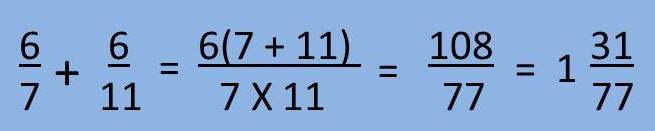
Here are two mental math tricks for adding fractions that I found in a hundred year old textbook:
Example 1: Add two fractions whose numerators are 1.
Solution: Add the denominators, and place the sum over the product of the denominators.
Example 2: Add two fractions whose numerators are alike and greater than 1.
Solution: Add the denominators and multiply the sum by the numerator of either of the fractions, and write the product over the product of the denominators.
Source: Kimball’s Commercial Arithmetic (1911)
If you like math, you might also enjoy these previous posts:
17-year-old Helena Muffly wrote exactly 100 years ago today:
Sunday, September 22, 1912: Went to S.S. this afternoon and attended Catechize.
Recent photo of the site where the McEwensville Baptist Church once stood.
Her middle-aged granddaughter’s comments 100 years later:
When I read this diary entry, I got stuck on a simple vocabulary question. I remember going to “catechism” class when I was in middle school. How does “catechize” differ from “catechism”? Is it a different part of speech?
The Free Online Dictionary defines catechize as “to teach the principles of Christian dogma, discipline, and ethics by means of questions and answers.”
While catechism is “a book giving a brief summary of the basic principles of Christianity in question-and-answer form.”
Grandma was 17-years-old when she wrote this entry. I’m surprised that she hadn’t completed catechize and joined the church when she was in her early teens.
17-year-old Helena Muffly wrote exactly 100 years ago today:
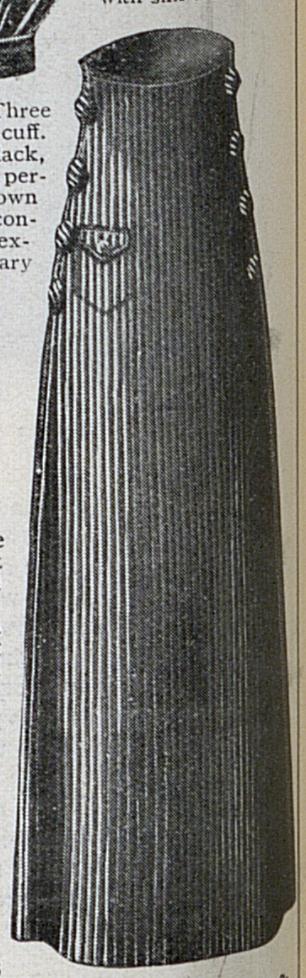
Saturday, September 21, 1912: Ma made over a skirt for me. Got a pair of rubbers today.
From Bedell Company advertisement in November, 1912 issue of Ladies Home Journal.
Her middle-aged granddaughter’s comments 100 years later:
I guess that Grandma’s mother was trying to save about $1.98 by making over the skirt. I can’t remember the last time I remodeled a skirt . . . or dress. (Actually, I don’t think that I’ve ever remodeled one.) Yet, Grandma and her mother did it regularly.
I fixed over a dress for myself this afternoon. It was one of my Aunt Annie’s cast-offs. I had one trying time a getting the waist and skirt together. I have it fixed now and tried it on to see the result. I’m not so much pleased with my sewing. It seems rather short in the back.
Grandma sounded like she wasn’t very satisfied with either of her remodeling efforts, but she didn’t express any similar qualms about the skirt her mother remodeled. Apparently her mother was more proficient at sewing than she was.
—-
On September 18, Grandma mentioned walking to school through the rain and mud—hopefully her new rubber overshoes made the trek slightly less arduous the next time it rained.
17-year-old Helena Muffly wrote exactly 100 years ago today:
Thursday, September 19, 1912: We had a test in General History today. Wasn’t hard at all.
Her middle-aged granddaughter’s comments 100 years later:
I’m glad that the General History test wasn’t difficult for Grandma.
A hundred-year-old book called the Outlines of General History by V. A. Renouf contained information about how to develop good questions:
Different Kinds of Questions
The questions which are most frequently asked in exercises and examinations can be classed somewhat as follows:
Questions of Fact
Personality: Who did a certain thing?
Place: Where did a certain event happen? What places were affected by a certain cause or event?
Time: When did a certain event happen? How long did a certain period last?
Example Questions
Who built Memphis?
Name all of the countries conquered by Alexander the Great.
What year did Nineveh fall?
Questions of Comparison
Comparison with recent or contemporary events or conditions in one’s own country.
Comparison with events or periods in the history previously learned.
Comparison of historical personalities.
Example Questions
Does a man’s education stop when he has left school? What opportunities did the Athenians have for continuing their education through manhood?
Compare the condition of debtors in early Rome with that of early Athens?
Compare the government of Shih Hwang-ti with that of Darius?
Questions of Cause or Effect
Geographical causes
Causes lying in certain institutions
Effects of certain events
Example Questions
In what way did the natural formation of Greece encourage commerce?
What were the causes of the Peloponnesian war?
Why is the battle of Marathon counted among the decisive battles of the world?
Which types of questions did Grandma’s teacher include in the exam?
It’s been awhile–Where have the years gone?– since I’ve taken a history exam, but I think that many of the types of questions asked on a history test today would still fit into this categorization schema.
But, I bet that there are fewer questions today that ask about dates. It seems like students were asked to memorize more things back then than they are now.
17-year-old Helena Muffly wrote exactly 100 years ago today:
Tuesday, September 16, 1912: Just about the same things done over every day with just a little change here and a little more there.
Her middle-aged granddaughter’s comments 100 years later:
Both then and now– some days are just the same old, same old.
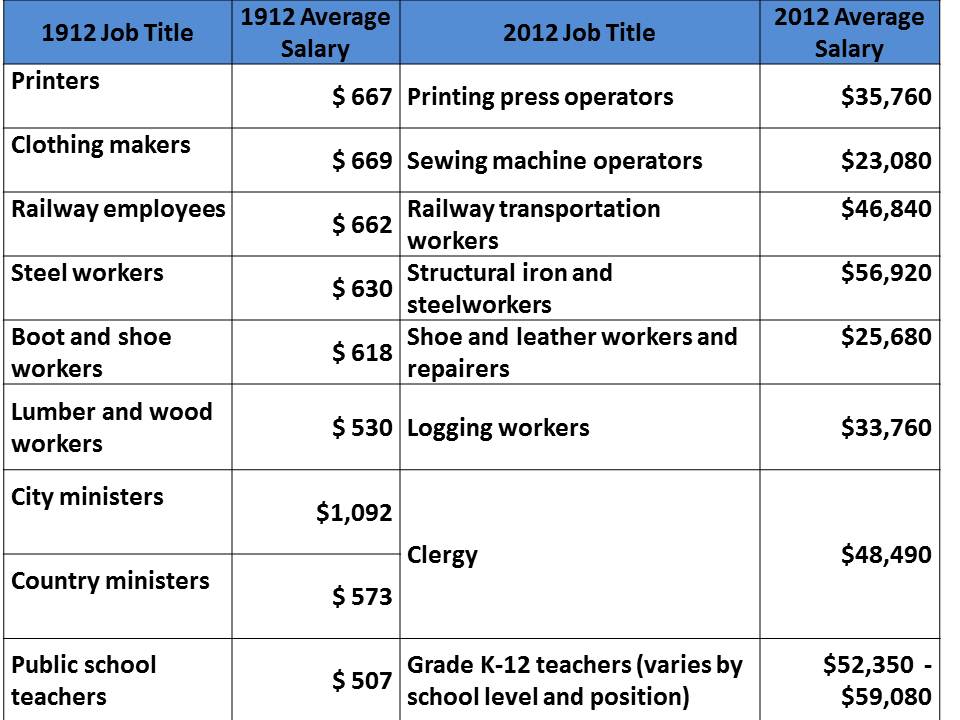
Since Grandma didn’t have much to say a hundred years ago today, I’m going to share some interesting data that I found about the average salaries for selected occupations a hundred years ago and now.
The 1912 data are from an article in the September, 1912 issue of Ladies Home Journal titled “How Other People Live.” The current data was from the Bureau of Labor Statistics.
Average Salaries, 1912 and 2012
Click on table to enlarge
Of course all the salaries are much higher now than they were back then because of inflation. But it’s interesting to compare which salaries were relatively high and which were relatively low across the two years.
Data Sources
This is what the 1912 Ladies Home Journal article said about the data sources for 1912: “The industrial incomes were obtained from the Government’s’ investigation of the incomes of over 3,000,000 adult males. The income for public school teachers is taken from a report of the United States Commissioner of Education for 1911. The salaries of city and country ministers are from the United States Census reports.”
I used the most recent data available from the Bureau of Labor Statistics for the 2012 data. It actually was 2011 data, but I assumed that salaries haven’t changed much over the past year.
17-year-old Helena Muffly wrote exactly 100 years ago today:
Monday, September 16, 1912: I don’t feel very good these last few days. I don’t know but I really think that it is likening to be near a grape vine. Alas all mortals have to suffer for their errors.
Concord Grapes (Source: Wikipedia)
Her middle-aged granddaughter’s comments 100 years later:
If I could have a conversation with Grandma, this is what I’d say:
Grandma, what were you thinking!
Of course, you couldn’t have known we’d be reading it a hundred years later; but what kind of role model is that for your children, grandchildren, and great-grandchildren?
. . . Actually, given your later strong stance against alcohol, my sense is that some are smiling.