16-year-old Helena Muffly wrote exactly 100 years ago today:
Tuesday, June 20, 1911: Had a task I didn’t like very well for this morning. Was going to make an apron this afternoon for myself, but Bisser took pity on me and did it herself, so you see I was saved all the bother.
Photo of a young woman wearing an apron in April, 1911 issue of Good Housekeeping Magazine. (Photo caption: "I don't mind doing the dishes--it's fun.") Was Grandma trying to make an apron that looked similar to the one in the photo?
Her middle-aged granddaughter’s comments 100 years later:
I’m not sure who Bisser referred to—but it may have been Grandma’s oldest sister Besse. Besse was married, but lived nearby.
16-year-old Helena Muffly wrote exactly 100 years ago today:
Monday, June 19, 1911: I worked so very hard this forenoon, but made up for it by retiring early. Ruth is having Mr. J. Oakes down on the front porch this evening.
Her middle-aged granddaughter’s comments 100 years later:
I bet the real reason Grandma retired early was because she was jealous that a beau was visiting her sister. Ruth has been seeing Jim Oakes for almost three months. In the March 26 diary entry it sounded as if he was a new boyfriend. He was also mentioned in the May 25 entry.
16-year-old Helena Muffly wrote exactly 100 years ago today:
Sunday, June 18, 1911: Went to Sunday school this morning. Was over Stout’s this afternoon, and went up to the Lutheran church to witness their children’s day services this evening. Ma was my chaperone.
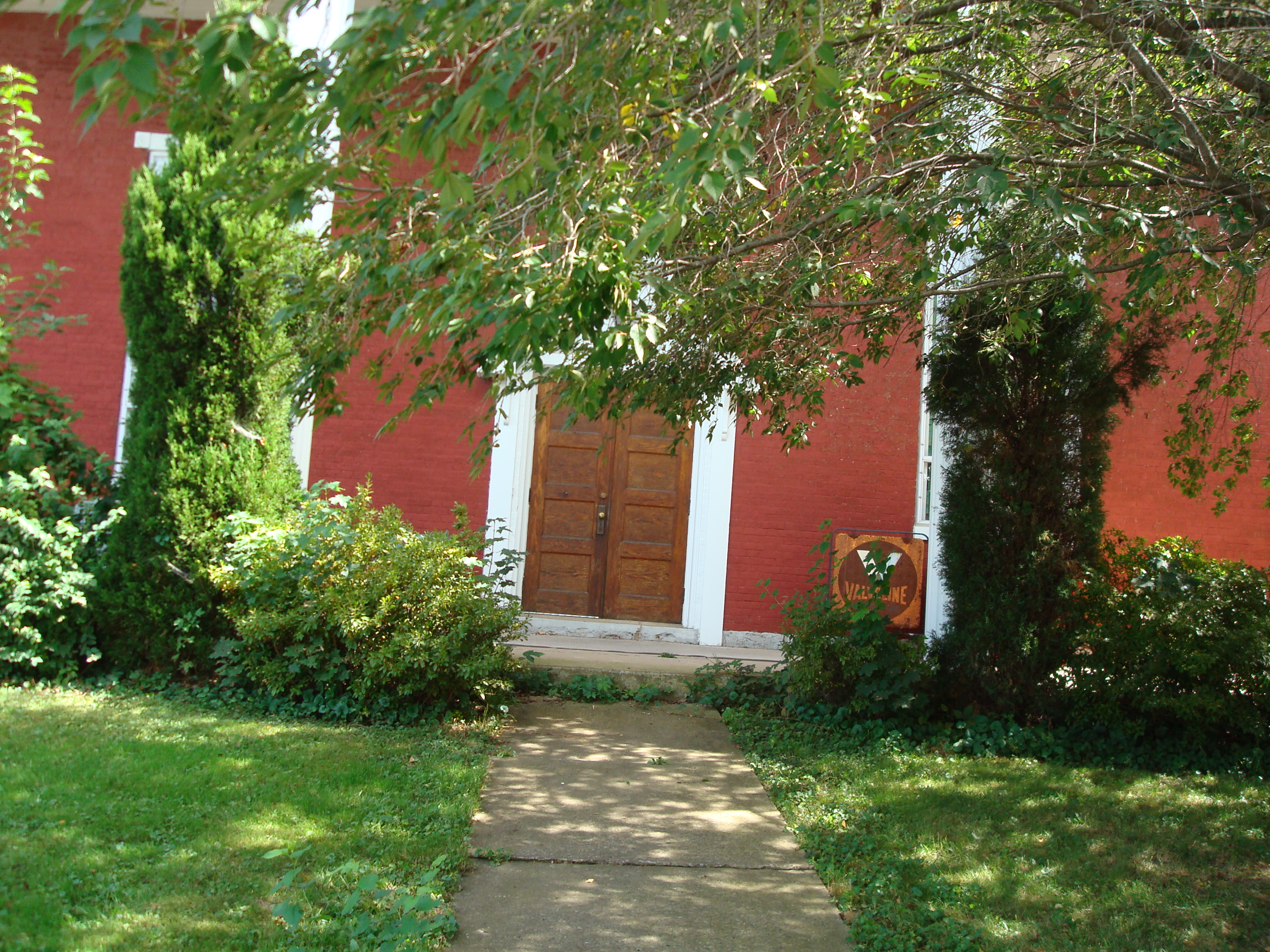
This used to be the Lutheran Church in McEwensville.
Her middle-aged granddaughter’s comments 100 years later:
There is no longer a Lutheran church in McEwensville. Messiah Lutheran merged with the other church in the parish—St. James Lutheran (Turbotivlle) a few years ago. The combined congregation is now called Holy Spirit Lutheran. Holy Spirit built a building in out in the county half way between McEwensville and Turbotville.
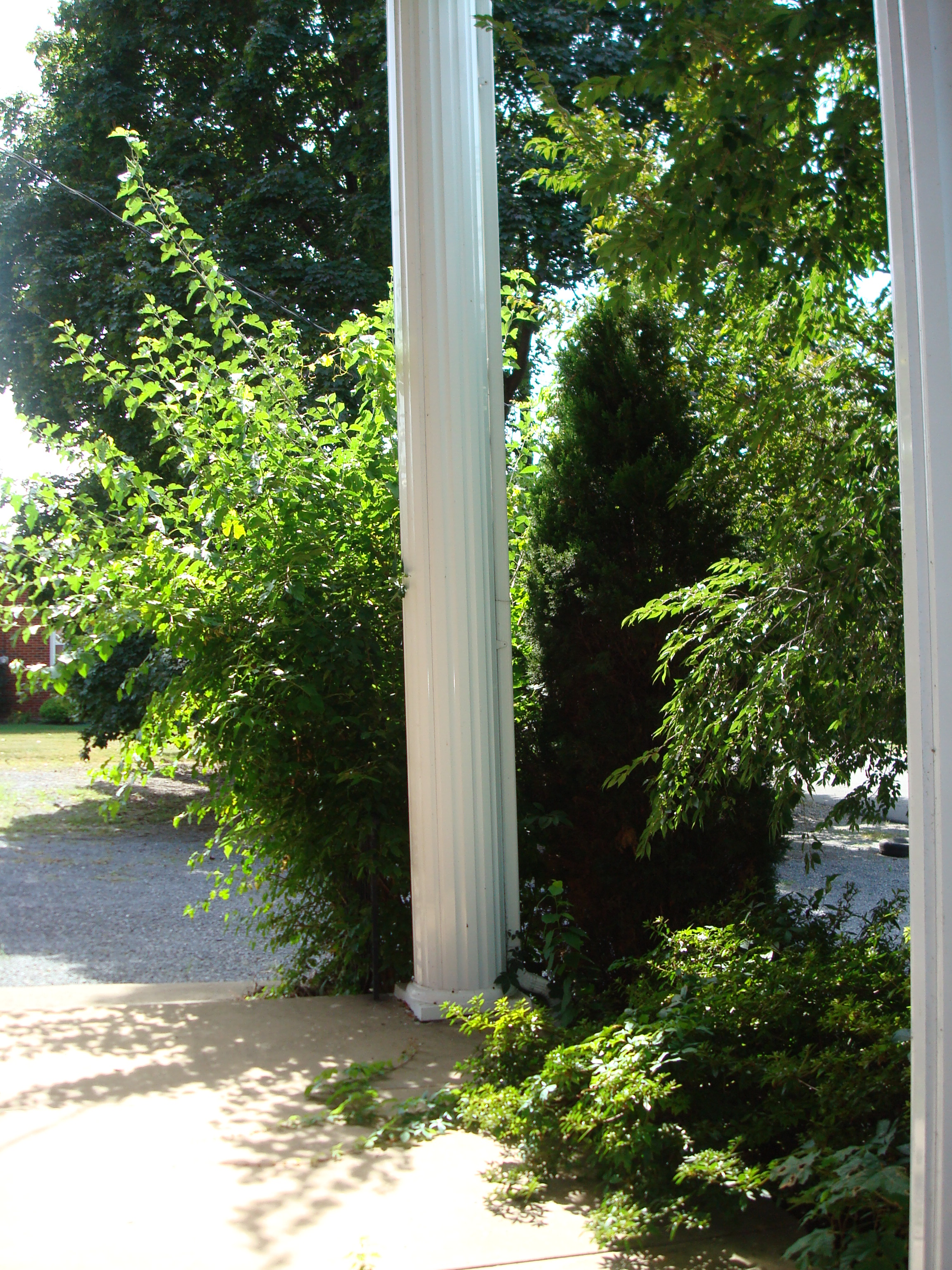
The building is now used for antique storage.An aside: I can remember eating snacks on this porch when I attended Vacation Bible School there as a child. (I wonder why minor random events sometimes pop into my memory.)
16-year-old Helena Muffly wrote exactly 100 years ago today:
Saturday, June 17, 1911: There is a festival up town tonight. Didn’t go because I was too stingy, and I didn’t think it probable that one of my many beaus would be there. Rufus went though.
Recent photo of Watsontown Park. Can't tell from diary entry if festival was at McEwensville or Watsontown. If in Watsontown it probably was held here.
Her middle-aged granddaughter’s comments 100 years later:
Many beaus?? Sounds like a bit of sarcasm in today’s entry. . .
Though I bet that Grandma’s sister Ruth—who is referred to as Rufus in the diary entry— saw a beau at the festival (or at least Grandma thought that she would).
16-year-old Helena Muffly wrote exactly 100 years ago today:
Friday, June 16, 1911: Please excuse me for I have forgotten what I did today. It’s hardly worthwhile to keep a diary, when you can’t remember anything.
Her middle-aged granddaughter’s comments 100 years later:
I’m still enjoying reading a 1911 book by Dr. Mary Galbraith called Personal Hygiene and Physical Training for Women. Last week I told you how about how obesity was defined in 1911. Today, I’ll give you an old-time suggestion for reducing weight and maintaining good health: thoroughly chew (or masticate) each bite of food before swallowing:
Obese patients grow fat because they overeat, but with a thorough mastication of the food their appetites would be satisfied with far less food than they have been accustomed to eat and the superfluous fat would drop off.
Personal Hygiene and Physical Training for Women (1911)
A hundred years ago, many people followed the beliefs of a food faddist named Horace Fletcher. He argued that for good health, it was very important for everyone to completely chew each bite of food before swallowing.
In 1911 people often talked about Fletcherizing (thoroughly chewing) their food. Depending upon the food, Fletcher argued that it should be chewed 32 times, 45 times, or even more before swallowing.
Also, it wasn’t considered healthy to eat too many soft easy-to-eat foods because that encouraged bolting of food, over-eating, and indigestion.
16-year-old Helena Muffly wrote exactly 100 years ago today:
Thursday, June 15, 1911: Wanted to go to Milton today and get some things to wear but mommie wouldn’t go.
Old real picture post card of Milton--Grandma wanted to shop here a hundred years ago today, but she didn't make it. (Postcard source: Milton Historical Society)
Her middle-aged granddaughter’s comments 100 years later:
Since Grandma mentioned several times in previous diary entries that she went to Milton by herself, I’m surprised that she didn’t just go alone when her mother won’t go. I suppose that her mother would only pay for whatever Grandma wanted to buy (clothes?) if she went along.
16-year-old Helena Muffly wrote exactly 100 years ago today:
Wednesday, June 14, 1911: There is nothing to write about for today.
McEwensville
Her middle-aged granddaughter’s comments 100 years later:
Since Grandma had “nothing to write about” a hundred years ago today, I’m going to get on my soapbox.
A hundred years ago this building was the Reader Hotel.The building with the porch once housed a restaurant. When Grandma was writing these diary entries the other building was Armstrong’s General Store.
Sometimes I read other genealogy blogs. Jennifer in Climbing My Family Tree visited some small towns in Iowa where her ancestors had lived. She wrote about towns “that reached their peak a hundred years ago,” and then wondered what caused some towns to struggle or disappear while others thrived. I’ve often pondered similar issues regarding the towns in central Pennsylvania–
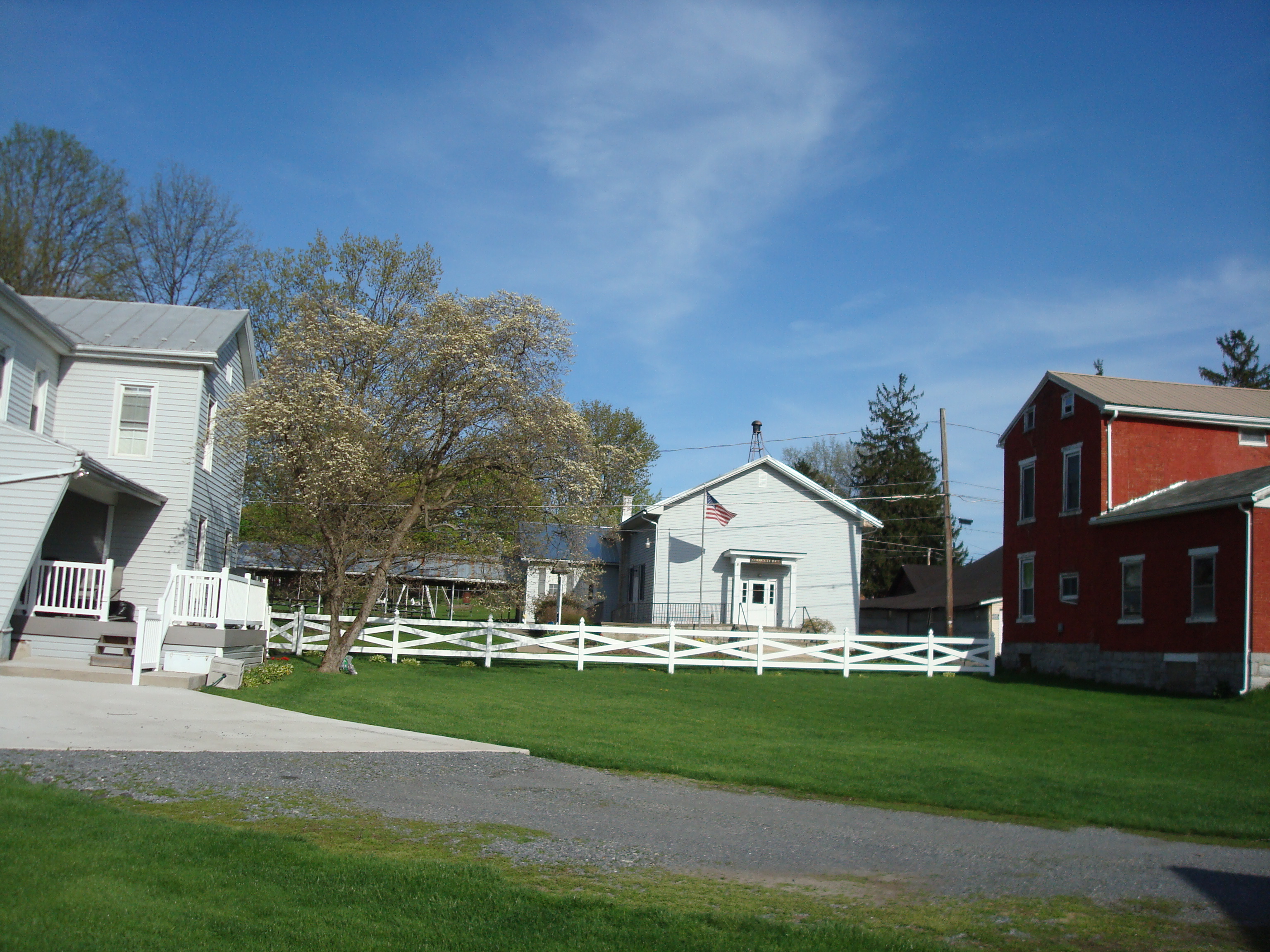
McEwensville Community Hall is the white building in the center of the photo. It would have been the center of community activities a hundred years ago.
I find the world within a 10 mile radius of the farm where Grandma grew up to be fascinating.
One hundred years ago the nearby towns were filled with shops and restaurants. Neighbors helped each other. A good Saturday night would involve doing things with friends and family—visiting the neighbors for ice cream, maybe playing a few cards—or on a big week-end there might be a box social or the high school students might put on a play that the entire community would attend. The local newspaper would report whose grandmother had come to visit-and who’d attended a picnic.
One hundred years ago the villages, towns, and small cities were thriving. Some regional economists today assert that many small towns no longer serve a purpose. When transportation and communication are poor that there is a need for more local and regional centers. But according to these economists when people can easily travel further to work and shop the need for many small communities begins to vanish.
Fred’s–the one and only restaurant in McEwensville today.
Yet I somehow don’t want to give up on the small towns—and want to believe that they still have an important role in the 21st century. Personally I find the small towns in central Pennsylvania to be wonderful, friendly, relaxing places and believe that they are in the process of re-inventing themselves for the 21st century.
Many of our youth today participate in study abroad programs and know all about remote villages half way around the world. Our kids can tell us about the foods, agricultural practices, and cultural norms of tiny villages in Asia, Latin American and Africa (which I totally support and think is incredibly cool)—yet they are clueless about the awesome history and culture of the small towns outside their backdoor.
One young man I know recently told me that when he was growing up his parents regularly took him on trips to Europe—but they never bothered to show him America.
Last year he and some of his friends went on what they called a Rust Belt Tour—and explored and photographed towns in Michigan, Ohio, and Pennsylvania that once had been thriving but now are really struggling. He talked with the people—and learned about the unique history, culture, and foods of each locale. And he discovered some wonderful places and people.
His perspectives and interests are unique in many ways, yet I’m thrilled that there might be a resurging interest (however small) in rediscovering some really cool places.