Fireworks Dangerous! Regulations Needed

16-year-old Helena Muffly wrote exactly 100 years ago today: 

Tuesday, July 4, 1911: The fourth of July is almost over and I have barely given it a thought. That shows that I am not given to celebration on this day having nothing to shoot up in the air. A good reason.

Her middle-aged granddaughter’s comments 100 years later:

A hundred years ago the national media was highlighting the dangers of fireworks. The following is an excerpt of an article in the Ladies Home Journal.

The Killing of Children: 131 More Little Ones Added to the Fearful List

A FOREWORD: The figures given here can be accepted as authoritative. They are figures collated by “The Journal of the American Medical Association” of Chicago from returns sent to it by health officers, hospital superintendents, physicians, and other reliable sources in every part of the country.

The Editor of The Ladies Home Journal

One hundred and thirty-one children were killed either by fireworks or as the result of fireworks in the celebration of the last Fourth of July. This is a lower total than we have had since 1903, due to the rapidly growing feeling among the sensible part of the American people for a radical change of celebrating the day.

Wherever common-sense has ruled and fireworks have been actually and entirely forbidden the results were certainly splendid.

Trenton, New Jersey, for instance, prohibited all fireworks for the first time last year. Not a child was killed nor an injury reported. The year before 58 injuries were reported and 1 killed.

Cleveland, Ohio, where fireworks have been prohibited for two years, had only 1 injury last year, 4 the year before, while 93 were injured and 12 were killed the previous year when fireworks were permitted. . . .

The third city in America, Philadelphia, leads all the cities of the country with the blackest record for 1910: 409 children were killed or maimed in Philadelphia last Fourth of July. A creditable record the the city that is supposed to be the cradle of American liberty and patriotism! A conscientious effort made by a score of the leading citizens of Philadelphia last year to enact a prohibitive fireworks ordinance was met by the comment from the Mayor that he could see no reason why children should not be allowed their fireworks and their fun. “Their fun”! And this in the face of the fact that , during the short period of only four Fourths of July, THERE HAVE BEEN KILLED AND MAIMED IN PHILADELPHIA ALONE ONE THOUSNAD SIX HUNDRED AND THIRTEEN CHILDREN

A humane record in order that children may have “their fun”! Just how long the people of Philadelphia will permit their city to show the blackest Fourth of July record of any city it is difficult to say.

There are other cities too, whose people sadly need an awakening on this barbarous Fourth of July  method of celebration. Pittsburg, Pennsylvania, for example, is co-equal with New York in presenting the largest number of children killed. . . .

There is but one way for a city to stop this fearful increasing roll of little ones killed and maimed each year. The responsibility clearly rests with city governments, since the employment of death-dealing methods of celebration is subject to their regulation. It is, therefore, up to the city governments to decide whether or not the maiming of thousands, the agonizing deaths from lockjaw, and the burning to death of little children by fire from fireworks are to be continued. And that a prohibitory ordinance is the only effective and permanent method is shown by the results in Baltimore, Washington, Cleveland, and Trenton.

But the people of every community must ask for such an ordinance and insist that it shall be passed. And now, before we get too close to another Fourth of July, is the time to act.

Ladies Home Journal (March 1, 1911)

July 3, 1911: High Temperature in 25 Cities Across US

16-year-old Helena Muffly wrote exactly 100 years ago today: 

Monday, July 3, 1911: My, but I’m so roasted, worse than yesterday, I guess. Made an errand up to McEwensville this evening in behalf of my popper.

This is a recent view of the buildings Grandma would have seen as she walked into McEwensville. A hundred years ago the road would have been dirt.

Her middle-aged granddaughter’s comments 100 years later:

A hundred years ago today the horrible heat wave continued across most of the country. The effects were devastating in this era before electric fans or air conditioning. This is the second day in a row that Grandma said she was roasted.

The Minneapolis Morning Tribune reported the July 3, 1911 temperatures for 25 cities across the nation

HOT WAVE CONTINUES TO EXACT HEAVY TOLL

Scores Throughout Country Succumb and Hundreds Are Overcome

Mercury Officially Climbs to 104 in Four Places Far Apart.

People Seeking Relief in Big Cities Sleep in Parks and Roofs.

High Temperatures in Many Cities on Monday

Louisville, Ky . . . 104

St. Joseph, Mo . . . 104

Davenport, IA . . . 104

Yuma, Ariz. . . . 104

Boston . . . 102

Albany. . .102

Kansas City. . .102

Columbus, O. . . .102

Dubuque, Ia. . . . 102

Fresno, Cal. . . 102

Chicago. .  .100

Harrisburg . . . 100

Fort Wayne . . . 100

Cincinnati. . . 100

Springfield . . . 100

St. Louis . . . 100

Indianapolis . . .100

Wash’ton, D.C. . .  99

New York City . . . 98

Philadelphia. . . 98

Northfield, Vt. . . 98

Pittsburg. . . 98

Lynchburg, Va. . . 98

Wichita, Kan.  . . 98

Minneapolis Morning Tribune (July 4, 1911)

An aside: It’s interesting to see which cities were included in the list, as well  which cities were considered to be so major that they didn’t need state names after them. It’s also interesting to see how some state names were abbreviated in 1911. For example, Ohio was abbreviated with an O.  (I wonder what the abbreviation was for Oklahoma in 1911.)

Hot Weather: Almost Roasted

16-year-old Helena Muffly wrote exactly 100 years ago today: 

Sunday, July 2, 1911: Almost roasted today. Went to Sunday school this afternoon. We had company this evening. One of Ruthie’s future pupil’s and parents.

Her middle-aged granddaughter’s comments 100 years later:

July 2, 1911 was an extremely hot day across the Eastern and Midwestern US. The New York Times reported that on July 2 in  New York City it was:

 . . . the hottest day here in twelve years. Mercury up to 94.5, with 72 per cent. humidity, and next to no breeze.

The paper also reported that:

HARRISBURG, Penn, July 2—The temperature today reached 98.2, the hottest recorded since July 1, 1901, when 100 was the maximum. The intense heat caused much sickness.

New York Times (July 3, 1911)

A Whole Half Year Has Just Leaped By

16-year-old Helena Muffly wrote exactly 100 years ago today: 

Friday, July 1, 1911:

A whole half year has just leaped by,

And all can now witness the approach of July.

With all its plenty of frolic and fuss,

But beware and be cautious of the sun.

I worked so hard today out in the hay field a heaping hay. Oh happy day. Mother hasn’t finished my dress yet. I really need it.

Her middle-aged granddaughter’s comments 100 years later:

Whew, it’s hard to believe ‘a whole half year has just leaped by’ since I began posting the diary entries. Today, it seems appropriate to ponder the past 180 days and reflect a bit.

I’ve really enjoyed reconnecting with family and old friends as a result of the diary. I’ve also had the opportunity to meet some wonderful new people.

To all of you have very generously shared family history, memories of Grandma, and information and materials about the history of central Pennsylvania— Thank you!!   I couldn’t do this blog without you!

I’ve been very surprised how many people enjoy reading about Grandma and her times. Over the past several months two newspapers contacted me about this blog and then wrote wonderful stories. Also the blog was featured on a genealogy website. If you haven’t seen the stories you can click on the links below:

Geneabloggers (June 6, 2011): May I Introduce . . . Sheryl Lazarus

Milton Standard Journal (May 21 2011) Blog Connects Former Resident to Central PA  (.pdf. Reprinted with permission)

Williamsport Sun Gazette (May 15, 2011): 100 Years Ago. .. Woman Creates McEwensville Blog to Honor Her Grandmother

I constantly see connections between what happened a hundred years ago and now. My husband and kids might occasionally roll their eyes when I begin a sentence with, “Well, a hundred years ago. . . “ but I think they enjoy learning about Grandma and her times almost as much as I do.

Some things haven’t changed—for example one hundred years ago Grandma worried about final exams; last spring my daughter also worried about finals.

Other things are incredibly different—a hundred years ago horses were used for farming, and the Muffly’s had neither electricity nor a telephone. (Grandma used a phone for the first time in her life during May 1911.)

When I started this blog last January I wasn’t sure if I’d still be doing it in July, but I still am and having a lot of fun researching the entries—and I now anticipate that I’ll still be posting entries on the day the diary ends: December 31, 1914 (or in current terms December 31, 2014).

Have a wonderful July!

Ruth’s Going to be a Teacher

16-year-old Helena Muffly wrote exactly 100 years ago today: 

Friday, June 30, 1911: Rufus is going to teach school next winter, as she has just been elected to that office. Am glad.

Her middle-aged granddaughter’s comments 100 years later:

I haven’t been able to figure out where Grandma’s sister Ruth taught school during the 1911-12 school year, but it apparently was at a nearby one-room school house.

Ruth had just graduated from high school in May 191. A hundred years ago teachers were only required to have a high school diploma—though there was a movement toward encouraging teachers to complete a program of study at a normal school. At that time teacher preparatory schools were called normal schools, and the program of study was typically 2 years.

Since Ruth did not go to normal school she must have passed a examination that qualified here to become a teacher. She would have been a “provisional” teacher and paid at the lowest level.

In 1911 schools were primarily controlled by school boards and other local governments. There was a lot of tension over how much control the state should have over schools—though the state was beginning to regulate teacher licensure.

The state of Pennsylvania adopted teacher certification requirements on May 18, 1911:

Provisional—passed exam in spelling, reading physiology and hygiene, English grammar, arithmetic, elementary algebra, history of the US and PA, civil government including state and local government, school management, and methods of teaching.  One year duration—could be renewed 4 times.

Professional—Two years successful teaching. Passed two additional exam from the list of: vocal music, drawing, English literature, plane geometry, general history, physical geography, elementary botany, elementary zoology, or elementary physics. Must have “carefully and intelligently read” two books on pedagogy on approved list from state Superintendent of Public Instruction.

State normal school certificate: Issued to graduation of state normal schools. After 2 years teaching teacher receives permanent state certificate.

Permanent state certificate: Hold professional certificate, 2 years experience, passed all exams, read 4 books on pedagogy,  Passed exam in all subject areas listed for provisional and professional certificates—Exams held once a year by Examining Board appointed by state superintendent.

Jack Williams in A Historical Study of Education in Milton Pennsylvania

Private Room: Moved Sister’s Belongings to Another Room

16-year-old Helena Muffly wrote exactly 100 years ago today: 

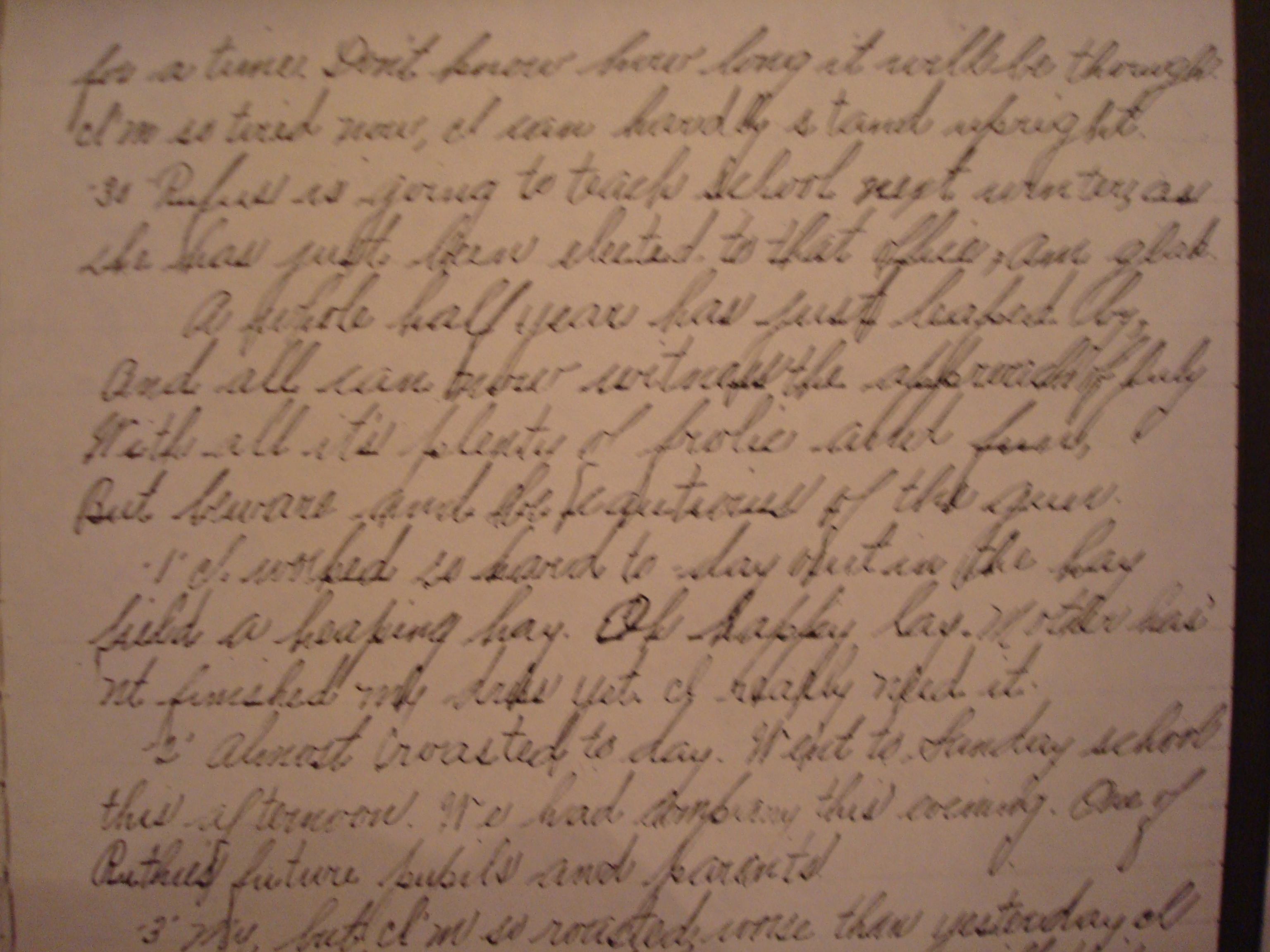
Thursday, June 29, 1911:  I moved Ruthie’s belongings into another apartment and she herself is going to occupy that room for a time. Don’t know how long it will be though. I’m so tired now, I can hardly stand upright.

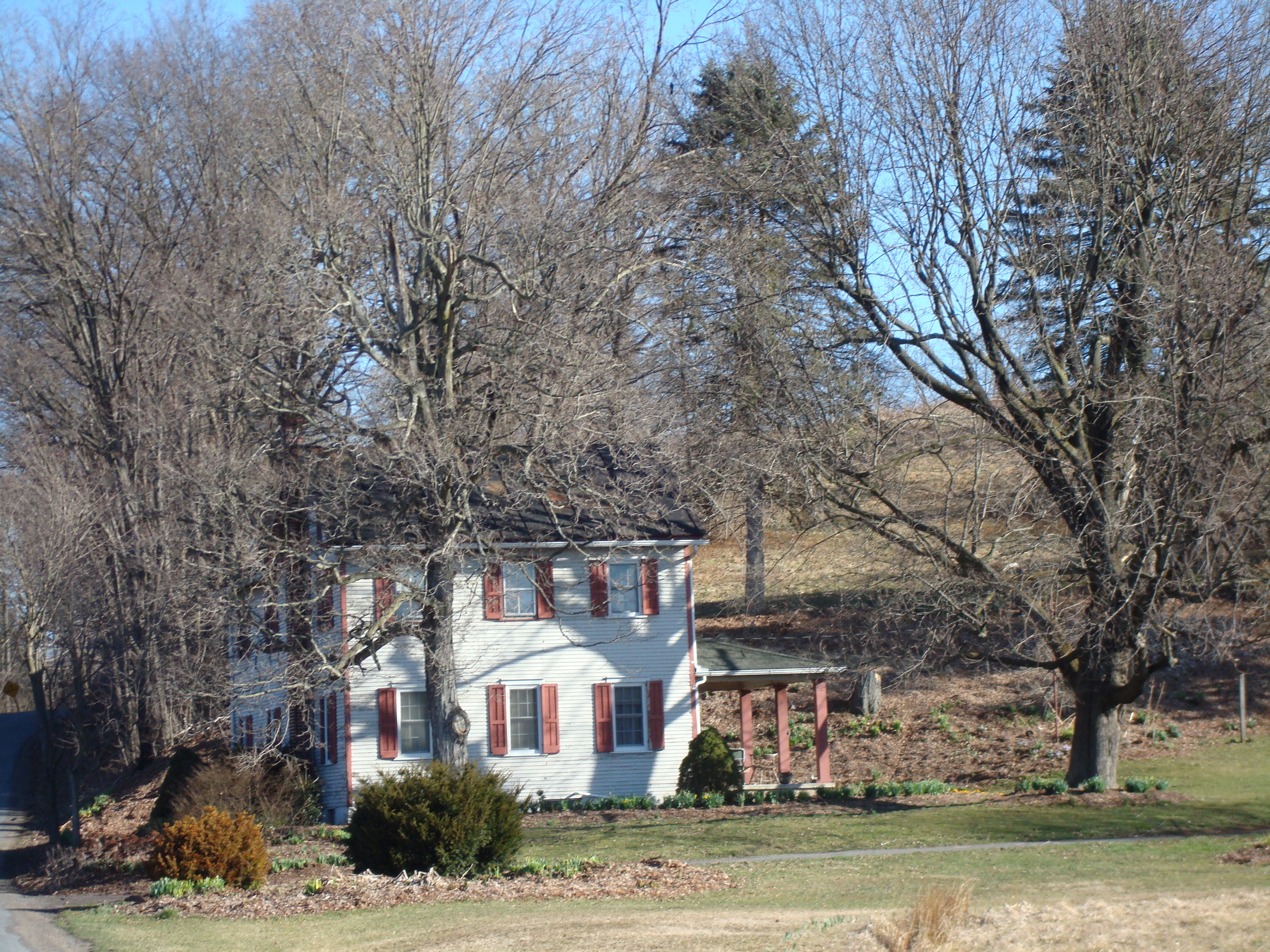
Recent photo of the house Grandma lived in when she was a teen writing the diary.

Her middle-aged granddaughter’s comments 100 years later:

The meaning of this entry isn’t real clear, but my best guess is that Grandma and her sister Ruth normally shared a bedroom—but that for some reason (maybe a disagreement between the two) her sister moved to another room.  Old farmhouses often had lots of bedrooms so there probably was a spare (or guest) room available.

I’m surprised that this entry uses the pronoun “I”. I would have thought that carrying things to the other room would have been a joint effort (or that maybe Ruth would have moved herself). Instead it sounds as if Grandma was upset, so she moved her sister’s possessions when Ruth wasn’t there. It’s amazing that Ruth accepted the situation and didn’t immediately start moving things back.

Reading between the lines, I think that Grandma was pleased with the outcome and how she’d handled the situation.

How to Live 100 Years

16-year-old Helena Muffly wrote exactly 100 years ago today: 

Wednesday, June 28, 1911: Nothing much to write about unless it would be that I was an exceedingly industrious girl today.

Her middle-aged granddaughter’s comments 100 years later:

Since Grandma didn’t write  much today, I’m going to post some century-old advice by Eugene V. Brewster, the author of What’s What in America, about how to live to be a hundred years old:

How to Live 100 Years

I expect to live one hundred years. It is very simple when you know how.

Here’s how:

1. Keep clean. All disease is caused by uncleanliness—principally internal.

2. Drink nearly a gallon of fluid a day—pure water and milk are best.

3. Eat not more than two meals a day of wholesome food. Overeating kills more people than tuberculosis and pneumonia combined.

4. Let all food remain in the mouth twice as long as most people do. It you don’t it will be worse than wasted.

5. Sleep winter and summer with the head of your bed under an open window. Colds are impossible if Rule 1 is followed.

6. Get busy—not merely exercise, but useful work. Walking will do though.

7. Eat sparingly of meat. Three or four times a week is enough.

8. Be extremely moderate with such poison as tobacco, liquor, tea and coffee.

9. Make better friends of nuts, fruits and grains, and cut down your supply of cooked foods. Fire destroys life and many of the nutritive qualities of food.

10. Breath and speak low. Subdue your emotions and keep an even poise.

If I die before 1969 you will know that I fell down on one of these rules.

Eugene V. Brewster, Pure Foods Magazine (June, 1910)

Note: Mr. Brewster died in 1939, so I guess that he fell down on one of these rules.